
The park that only exists in summer
Spruce Street Harbor Park sits on the Delaware River at Penn's Landing, at 301 S. Christopher Columbus Boulevard, where Spruce Street meets the waterfront. It is an urban park with a boardwalk, an urban beach, a hammock grove, food vendors, floating barges, fountains, and misting stations — and it is open during the summer months only, generally from mid-to-late May through late September. The 2026 season, for example, opened on May 22 for Memorial Day weekend. Outside those months the site goes quiet again, the hammocks come down, and the waterfront returns to the marina and the museum ships. That impermanence is the point. The park is a season, not a place you can visit year-round, and Philadelphians treat its opening the way other cities treat the first warm weekend: as the official start of summer.
Entry to the park itself is free. The hammocks in the Grove are free too, first-come, first-served — you claim one by sitting in it. Private hammock lounges on the barges can be reserved, and the bars and food vendors charge for what they serve, but the park charges nothing to walk in, and that openness is a large part of why it works. On a summer evening the boardwalk fills with a mix that few Philadelphia places manage: families with children, old friends meeting after work, couples on dates, tourists who wandered down from Independence Hall, and regulars who have claimed the same hammock every Friday for years.
The park's official name is often shortened to SSHP, and it is run by the Delaware River Waterfront Corporation (DRWC), the nonprofit created in 2009 to manage the publicly owned land on the city's central waterfront on behalf of the City of Philadelphia and the Commonwealth of Pennsylvania. Everything about the park — its design, its programming, its food — is DRWC's work, and the park is the corporation's most visible success: a piece of the waterfront that spent decades as parking lots and empty marina slips, turned into the place the city goes to relax.
From working waterfront to postcard
The ground the park stands on has been Philadelphia's front door to the river for more than three centuries. Penn's Landing takes its name from William Penn's arrival in the Philadelphia area in October 1682 — though Penn's ship actually landed downriver at Chester, and the city later purchased the right to use the name for this stretch of waterfront. Through the eighteenth and nineteenth centuries, this was the center of Philadelphia's working waterfront: ferries carried passengers across the Delaware to the growing towns of southern New Jersey, dockworkers unloaded boats laden with cotton, liquor, and sugar, and produce streamed up from the river along city streets to the nearby Dock Street Market.
The twentieth century took the work away. Ferry service ended after the Delaware River Bridge — today's Benjamin Franklin Bridge — opened in 1926. The piers emptied one by one; by 1956, only six of the central Delaware River's twenty-three piers were still operational. Interstate 95, built along the waterfront, cut the river off from the old city behind a wall of highway. Penn's Landing survived as a name and a place for summer festivals, anchored by the Great Plaza, a mostly concrete open space at Christopher Columbus Boulevard and Chestnut Street, and by the historic ships moored in the harbor. But for decades the waterfront felt like somewhere you drove past, not somewhere you went.
The Delaware River Waterfront Corporation was created to change that, and Spruce Street Harbor Park was its boldest early experiment: take the Penn's Landing Marina, a working marina of slips and concrete, and prove — temporarily — that the waterfront could be a place people loved. The park was built with a substantial grant from ArtPlace America, and it was designed by a team of Groundswell Design Group, Interface Studio Architects, and Digsau, working with the DRWC. The idea was placemaking in its purest form: hammocks, barges, lights, food, and shade, installed for a season, to show the city what the waterfront could feel like.
A two-month experiment that never left
Spruce Street Harbor Park opened on Friday, June 27, 2014, planned to run for just two months, through August 31. The opening was part of a first Harbor Park festival, planned with beer gardens to start a new tradition the organizers called "Summer in the city." It worked immediately. The park drew thousands in its first weeks, and before the season was over, the DRWC announced it would extend the run through Sunday, September 28, 2014, because of what its press release called "tremendous public demand."
It has come back every summer since. The park drew about 175,000 visitors in 2015, and a decade later it was drawing far more: the DRWC reported that the park welcomed 400,000 visitors in the summer of 2024. What began as a pop-up beer garden is now routinely named one of the best urban beaches in the United States, and it has become the anchor of the summer waterfront, alongside the neighboring Independence Blue Cross RiverRink Summerfest. The experiment became the institution — and the design that made it work has barely changed, because it never needed to.
The lesson of the park is that a great public space does not need a grand gesture. It needs a reason to linger, and the park is built entirely out of reasons to linger: a hammock in the shade, a drink on a barge, a misting station on a hot afternoon, a band on a Thursday night. Nothing about it is monumental. Everything about it is comfortable.
The Grove: a hundred hammocks under the lights
The park's signature is the Grove, a stand of trees hung with about a hundred colorful handmade hammocks, clustered around the Columbus Monument at the park's landward end. The hammocks are the first thing most visitors look for, and they are free, available on a first-come, first-served basis. On a busy evening the good ones — the ones in deep shade, the ones with the river view — go early, and part of the park's culture is the unhurried negotiation of who gets which hammock and for how long. Nobody is in a rush. That is the whole idea.
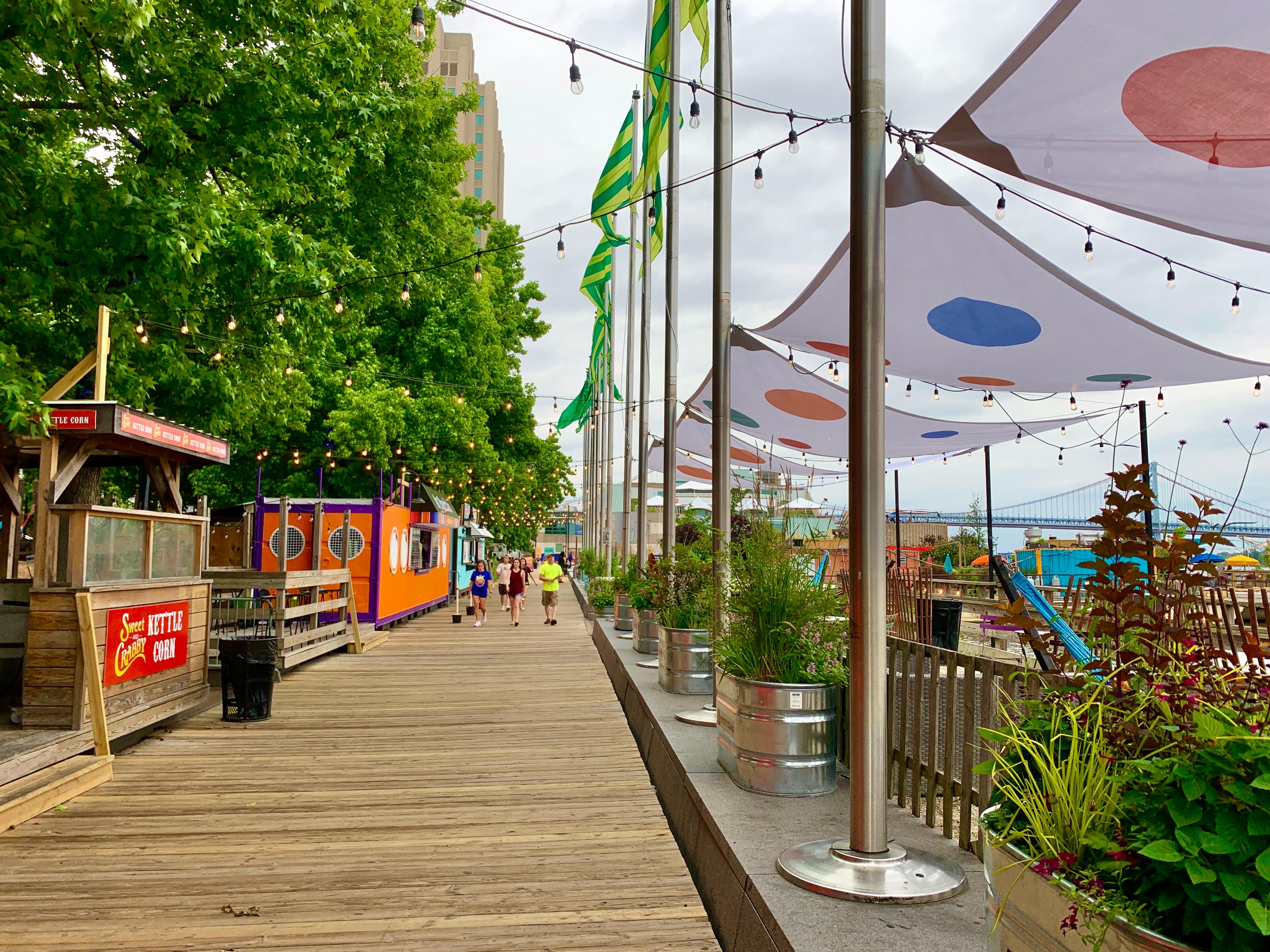
Above the hammocks, thousands of LED lights are strung through the trees, and after dark the Grove turns into the park's most photographed scene: the hammocks swaying under a canopy of light, the river dark beyond the boardwalk, the bridge lit up the river. The lights are on strings, not floodlights, so the glow stays low and warm, and the park at night feels less like a civic space and more like a backyard party the whole city was invited to. The DRWC also rents private hammock lounges closer to the water, on the Barge Oasis, for groups and parties — the one part of the hammock experience that is reserved rather than claimed.
The Grove is also where the park's summer programming gathers. The 2026 season brought free salsa lessons and DJ sets on select Friday nights, tai chi on the double-decker barge on Saturday mornings, a Friday Night Jazz series every other week, a Live & Local concert series on select evenings, and Family Fun Days on Sunday afternoons — all free and open to the public. Saturdays have long belonged to the markets: the Art Star Pop Up Market, where local artists sell candles, soaps, ceramics, art, home goods, and jewelry, and the Liberty Flea market. The programming changes year to year, and the details belong to the current season, but the shape is constant: something free, something local, something outside, every week of the summer.
The barges: a beer garden that floats
The park's strangest and best feature is that part of it floats. Two barges, moored in the marina basin, carry a restaurant and bar, a floating garden, and seating that puts you on the water itself, with the river moving under your feet and the ships of Penn's Landing on either side. The barges were part of the original 2014 design — landscaped barges featuring a restaurant and bar, a floating garden, fountains, an urban beach and boardwalk — and they remain the park's center of gravity in the evening, when the light goes gold on the river and the bar fills.
The Blue Anchor Bar serves from the barges, and in 2024 the park added The Lazy Hammock, a second venue with a covered bar, a 20-foot stage, and a 16-foot video wall, built for live music, movie nights, and watch parties. The Lazy Hammock's Thursday-night concert series, featuring local musicians from across Greater Philadelphia, has become a fixture of the season, and the video wall turns the venue into an outdoor cinema and a gathering place for big games. The bar menus emphasize local beers and handcrafted cocktails, and the food vendors around the park serve Philly-flavored festival food — tacos, funnel cake, crab fries, and the like among the recurring favorites. No fixed prices for food or drink are stated in this article, since none was verified against an official source in this run.
The floating garden is easy to miss and worth noticing: planted barges, greenery on the water, part of the park's argument that a marina basin can be a garden as well as a parking lot for boats. It is a small thing, but it captures the design intelligence of the place — the park was never just a beer garden with a view. It was a demonstration that the waterfront could be soft, green, and public.
The boardwalk, the beach, and the mist
Between the Grove and the barges runs the boardwalk, the park's main street: a wooden walk along the Delaware with food stands, shade sails, string lights, and planters, and the river on one side and the trees on the other. On the landward side sits the urban beach — sand, umbrellas, and seating that gives the park its beach-town feeling a long way from the ocean — and the fountains and misting stations that make a Philadelphia heat wave survivable. Fire pits near the Columbus Monument draw a crowd as the evening cools, and the boardwalk games, the arcade, and the festival atmosphere fill in the rest.
The marina itself is part of the show. The park occupies the Penn's Landing Marina, and the slips around it still hold boats, while Wheel Fun Rentals operates swan boats — and, by some accounts, chiliboats — from the marina, so you can pedal out onto the basin in a giant swan and look back at the park from the water. It is a silly, delightful way to see the place, and it is very much in the spirit of the park: the waterfront is for playing on, not just looking at.
The park is also a good base for the wider waterfront. The RiverLink Ferry links Penn's Landing with the Camden Waterfront across the river in New Jersey, and the walk north along Columbus Boulevard reaches the Great Plaza and the rest of Penn's Landing's festival grounds. Meanwhile, just to the north, the DRWC's larger, permanent Park at Penn's Landing project has been reshaping the Great Plaza area — the next chapter of the same waterfront story the Harbor Park started.
The ships next door
What makes Spruce Street Harbor Park unlike any other beer garden in America is what is moored beside it. The park sits in Spruce Street Harbor, and the harbor's permanent residents are three of the most storied vessels on the East Coast.
The USS Olympia (C-6) is the star: a nineteenth-century protected cruiser, launched in 1892 and placed into service in February 1895, famous as Commodore George Dewey's flagship at the Battle of Manila Bay on May 1, 1898, in the Spanish-American War. It was from Olympia's deck that Dewey gave the order, "You may fire when ready, Gridley," that opened the battle. Olympia is the oldest steel warship still afloat in the world, a National Historic Landmark since 1966, and a museum ship at Penn's Landing since 1957, part of the Independence Seaport Museum — which merged with the ship's stewards in 1996 — and docked alongside the submarine Becuna since 1976. She is moored in the harbor immediately beside the park, her white hull and buff superstructure visible from the boardwalk, and she is open for walk-through tours through the museum.
Beside her sits the USS Becuna (SS-319), a World War II-era submarine, also part of the Independence Seaport Museum, and the third ship in the harbor is the Moshulu, a four-masted steel barque built as the Kurt by William Hamilton and Company on the River Clyde in Scotland, launched on April 18, 1904. The Moshulu is the largest remaining original windjammer in the world: built for the nitrate trade, seized by the Germans in 1940, capsized in a storm off Norway in 1947, bought by an American restaurant company in 1970, and a floating restaurant at Penn's Landing since 1975, moored adjacent to Olympia and Becuna. She has also had a film career, appearing in Rocky and The Godfather Part II.
The Independence Seaport Museum itself stands at Penn's Landing, steps from the park, with exhibits on the Delaware River's maritime history. A visit pairs naturally with the park: tour the ships in the afternoon, then claim a hammock as the sun goes down.
The bridge and the river
The view from the park is the Delaware itself, and the structure that defines it is the Benjamin Franklin Bridge, opened in 1926 as the Delaware River Bridge, its steel towers and suspension cables framing the view upriver. From the boardwalk you look north along the river toward the bridge and across to Camden, New Jersey, whose waterfront towers rise on the far bank — the same view the park's first visitors saw in 2014, and the same view the dockworkers and ferrymen saw a century before. At night the bridge is lit, and the park's string lights answer it from below.
The river is a working river still — tugboats, tour boats, and the occasional tall ship pass the park — and that is part of the pleasure. Spruce Street Harbor Park does not pretend the Delaware is a lake. It is a city park on a real river, with real ships, a real bridge, and a real skyline behind it, and the park's charm is that it lets you sit in the middle of all of that, in a hammock, doing nothing.
How to visit
Spruce Street Harbor Park is at 301 S. Christopher Columbus Boulevard, Philadelphia, at Spruce Street on the Delaware River waterfront at Penn's Landing. The easiest way there is the SEPTA Market-Frankford Line to 2nd Street station, then a short walk east down Market Street to the river; several bus routes run along Columbus Boulevard, and the park is an easy walk from Independence Hall, the Liberty Bell, and Old City. The RiverLink Ferry connects Penn's Landing with the Camden Waterfront across the river.
Remember the one rule that matters: the park is seasonal. It is generally open from mid-to-late May through late September, and it is closed outside the summer season — the hammocks come down and the barges go quiet. Hours vary by day of the week and by season, and they have changed from year to year, so no fixed hours are stated in this article: check the official site at sprucestreetharborpark.com or delawareriverwaterfront.com before visiting for the current season's dates and hours. Entry to the park itself is free. Allow an hour or two for a wander, longer if you want a hammock, a drink on the barges, or a tour of the Olympia next door. Come at dusk, when the LED lights come on in the Grove, the barges glow on the water, and the bridge lights up the river — that is when the park is most itself, and when you will understand why a two-month experiment never left.
A practical note: construction on the waterfront has changed how you reach the river in recent seasons — access via Chestnut and Walnut Streets was closed due to construction, with I-95 CAP construction ongoing — so check the DRWC's Know Before You Go guide before your visit for the current walking routes.
Location Photography


Key Facts
- Spruce Street Harbor Park is a seasonal urban park at Penn's Landing in Philadelphia, at 301 S. Christopher Columbus Boulevard on the Delaware River. It is open during the summer months only, generally from mid-to-late May through late September. The 2026 season opened May 22. Coordinates: 39.9465, -75.1412.
- The park opened on Friday, June 27, 2014, planned as a two-month pop-up through August 31, 2014, as part of a first Harbor Park festival with beer gardens, under the banner "Summer in the city." Because of tremendous public demand, the Delaware River Waterfront Corporation extended the first season through Sunday, September 28, 2014. It has returned every summer since.
- The park was built using a substantial grant from ArtPlace America to transform the Penn's Landing Marina, and was designed by the Delaware River Waterfront Corporation with Interface Studio Architects, Digsau, and Groundswell Design Group. Its original features included hammocks on land and over the water, landscaped barges with a restaurant and bar, a floating garden, fountains, an urban beach and boardwalk, and seating areas designed to create private "moments."
- The park's features include a boardwalk along the Delaware River, an urban beach, about 100 colorful hammocks in the Grove (free, first-come, first-served), thousands of LED lights hung in the trees, two barges available for reservation, fountains and misting stations, fire pits, food vendors, and the Blue Anchor Bar on the barges. The Lazy Hammock, added in 2024, is a performance venue with a covered bar, a 20-foot stage, and a 16-foot video wall for live music, movie nights, and watch parties.
- The park drew about 175,000 visitors in 2015, and the Delaware River Waterfront Corporation reported 400,000 visitors in the summer of 2024.
- The park is run by the Delaware River Waterfront Corporation (DRWC), the nonprofit established in 2009 to manage the publicly owned land on Philadelphia's central waterfront on behalf of the City of Philadelphia and the Commonwealth of Pennsylvania.
- Penn's Landing takes its name from William Penn's arrival in the Philadelphia area in October 1682, though his ship actually landed downriver at Chester, and the city later purchased the right to use the name. The waterfront was the center of Philadelphia's port through the eighteenth and nineteenth centuries — ferries to New Jersey, dockworkers unloading cotton, liquor, and sugar, produce bound for Dock Street Market. Ferry service ended after the Delaware River Bridge (today's Benjamin Franklin Bridge) opened in 1926, and by 1956 only six of the central Delaware River's twenty-three piers were still operational. Penn's Landing is a 35-acre redevelopment site between Columbus Boulevard and the river.
- The USS Olympia (C-6), moored in Spruce Street Harbor beside the park, was launched in 1892, placed into service in February 1895, and served as Commodore George Dewey's flagship at the Battle of Manila Bay on May 1, 1898, in the Spanish-American War — the battle opened by Dewey's order, "You may fire when ready, Gridley." Olympia is the oldest steel warship still afloat in the world, a National Historic Landmark since 1966, a museum ship at Penn's Landing since 1957, and part of the Independence Seaport Museum since 1996. She has been docked alongside the World War II-era submarine USS Becuna since 1976.
- The Moshulu, moored at Penn's Landing adjacent to Olympia and Becuna, is a four-masted steel barque built as the Kurt by William Hamilton and Company on the River Clyde in Scotland, launched April 18, 1904 — the largest remaining original windjammer in the world. Seized by the Germans in 1940, capsized in a storm off Norway in 1947, bought by an American restaurant company in 1970, she has been a floating restaurant at Penn's Landing since 1975, and appeared in the films Rocky and The Godfather Part II.
- The Benjamin Franklin Bridge, which frames the view upriver from the park, opened in 1926 as the Delaware River Bridge. The RiverLink Ferry links Penn's Landing with the Camden Waterfront across the Delaware in New Jersey.
- Weekly summer programming has included the Art Star Pop Up Market on Saturdays, the Liberty Flea market, free live music and concert series (including Thursday nights at The Lazy Hammock), Friday Night Jazz, salsa lessons and DJ sets, Saturday tai chi on the double-decker barge, and Sunday Family Fun Days. Details change each season; check the official site for the current schedule.
Visitor Details
Address: Spruce Street Harbor Park, 301 S. Christopher Columbus Boulevard, Philadelphia, PA 19106 (Penn's Landing, at Spruce Street on the Delaware River waterfront).
Transit: SEPTA Market-Frankford Line to 2nd Street station, then walk east down Market Street to the river; buses run along Columbus Boulevard. An easy walk from Independence Hall, the Liberty Bell, and Old City. The RiverLink Ferry connects Penn's Landing with the Camden Waterfront.
Hours/Admission: The park is SEASONAL — open during the summer months only, generally mid-to-late May through late September (the 2026 season opened May 22). Entry to the park itself is free, and the hammocks in the Grove are free on a first-come, first-served basis. No fixed hours, food or drink prices, or rental prices are stated in this article, since none was verified against an official source in this run. Check sprucestreetharborpark.com or delawareriverwaterfront.com before visiting for the current season's dates, hours, and event schedule. Waterfront construction has changed walking routes in recent seasons — check the DRWC's Know Before You Go guide before your visit.
Best timing: Allow an hour or two for a wander, longer for a hammock, a drink on the barges, or a tour of the USS Olympia next door. Come at dusk, when the LED lights come on in the Grove and the bridge lights up the river. The park is closed outside the summer season — do not plan a winter visit.