
A park born from the city's drinking water
Every great American park has an origin story, and Fairmount Park's is stranger and more practical than most: it began as a public-health project. In 1793, yellow fever swept through Philadelphia — then the capital of the young United States — killing thousands and scattering the federal government. The epidemic convinced the city of something no American city had yet accepted as a municipal duty: that delivering clean water to its citizens was the government's job. Philadelphia became the first American city to treat fresh water as a public responsibility, and the answer it built stood on a hill above the Schuylkill River.
In June 1812, the city purchased five acres of land on the east bank of the Schuylkill, including the hill marked "Faire Mount" on Thomas Holme's 1682 plan of the city — the same hill where the Philadelphia Museum of Art stands today. On that rocky ledge the city built the Fairmount Water Works, designed by Frederick Graff and constructed between 1812 and 1815, with steam engines lifting river water into reservoirs on top of the hill. Additions followed in 1822, including a mill house for eight water wheels and a dam across the river, and the works kept pumping until 1909. The classical pavilions Graff designed — a dam, a Greek Revival pavilion, mill houses, and an engine house — turned an industrial pumping station into one of the most admired pieces of architecture in America, and the landscaped grounds around it, the South Garden of 1835, became one of the country's earliest formal public gardens and the seed of everything that followed.
The park grew the way the waterworks had begun: by buying land to protect the water. In 1844 the city bought Lemon Hill, a 45-acre estate just north of the waterworks, to keep industry off the riverbank, and in 1855 the estate was dedicated to public use and officially renamed Fairmount Park — the nucleus of the park that exists today. More estates followed, including Sedgeley, and the Fairmount Park Commission was established by an act of the Pennsylvania Assembly on March 26, 1867, which declared the park "an open public place and a park for the health and enjoyment of the people of said city, and the preservation of the purity of the city's water supply." A second act, on April 14, 1868, extended the park's borders further, and by 1868 the parklands already encompassed some 2,800 acres on both banks of the river. The threat that had driven the whole project — factories and mills fouling the river the city drank from — was answered by buying the riverbanks themselves and holding them open forever.
Today the park the Commission built is divided, since 2010, into East and West Fairmount Park, split by the Schuylkill River, and together the two sections total 2,052 acres. But "Fairmount Park" is also the historic name for the whole system the Commission came to administer: 63 parks totaling 9,200 acres — about a tenth of all the land in Philadelphia — including Wissahickon Valley Park's 2,042 acres to the northwest, the Benjamin Franklin Parkway, and the watershed parks along the city's creeks. The Fairmount Park system is one of the largest municipal park systems in the United States, and it all traces back to those five acres bought in 1812 to keep the drinking water clean.
The Water Works and the gardens that started it all
Stand at the foot of the Art Museum steps today and look down toward the river, and the Fairmount Water Works is still there — the low classical buildings along the east bank, the dam, the mill houses — now restored as an interpretive center and restaurant, with its own article on this site. In its working years it was both infrastructure and spectacle: Philadelphians came to stroll its gardens and watch the great water wheels turn, and artists painted it the way they painted the city's churches and squares. The South Garden, laid out in 1835, was one of the earliest formalized public gardens in the country, and it established the pattern the park would follow for the next century: public land, designed for pleasure, paid for by the practical business of keeping a city alive.
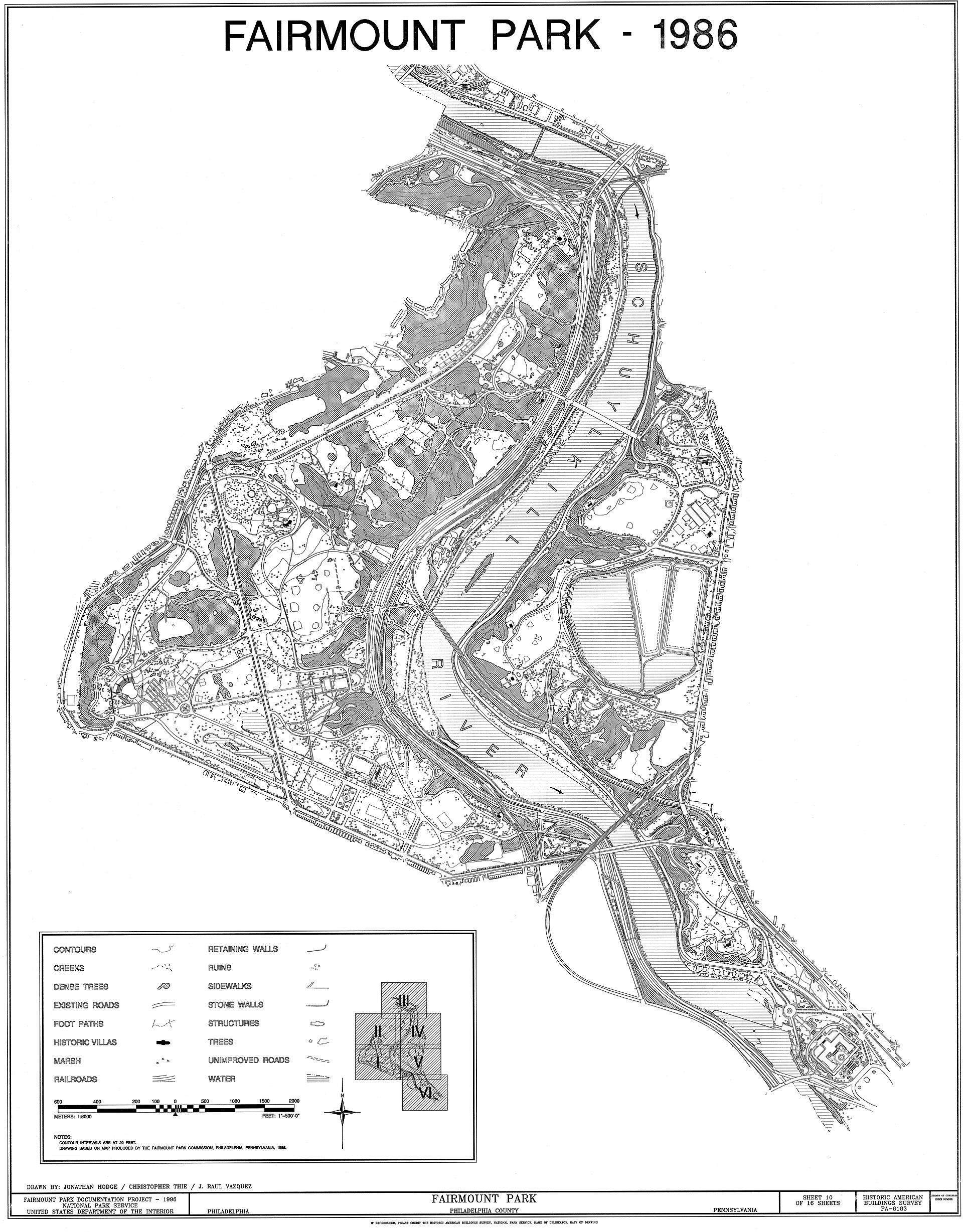
The Water Works also explains the park's geography. Because the city was buying land to protect the river, the park follows the water — five miles along the Schuylkill from Spring Garden Street north to the mouth of the Wissahickon, then up the Wissahickon Creek to Northwestern Avenue in Chestnut Hill, and along its tributaries. The park is not a square on a map; it is a river corridor, a green seam running through the city, which is why it feels so different from a designed square like Rittenhouse or a single great lawn like Central Park. It is a landscape that was assembled piece by piece, estate by estate, for a practical reason, and the result is a park with more variety in a single afternoon's walk than most cities manage in a lifetime: formal gardens and wild gorge, carriage drives and dirt trails, a zoo and a Japanese garden, a world's fair ground and a children's playground.
The 1876 Centennial Exposition
The park's great coming-out party was the Centennial International Exhibition of 1876 — the first official world's fair held in the United States, staged to mark one hundred years since the Declaration of Independence was adopted in Philadelphia on July 4, 1776. From May 10 to November 10, 1876, the fairgrounds in West Fairmount Park drew nearly ten million visitors — roughly a quarter of the entire population of the United States at the time — from 37 participating countries, to see the art, manufactures, and products of the soil and mine of the industrial age. The fairgrounds were designed by Hermann J. Schwarzmann, chief engineer of the Fairmount Park Commission, who laid out a temporary city of exhibition halls along the river and the park's drives.
The fair was where America showed the world what it had become since 1776, and it was where the world showed America the same. Visitors saw the telephone and the typewriter demonstrated for the first time, tasted root beer, watched the arm and torch of the Statue of Liberty — then under construction in France — displayed on the fairgrounds, and walked through exhibition buildings from dozens of nations. The main exhibition hall and the Machinery Hall were among the largest buildings ever constructed at the time, built of wood and glass and meant to last only the six months of the fair. When the gates closed in November, most of the fair was dismantled and shipped away — crates of exhibits from 34 countries went by rail to the Smithsonian Institution in Washington — and the park quietly absorbed the fairgrounds back into lawns and drives. Almost nothing of the fair survives on the ground today except the two buildings that were meant to be permanent, and one of them, Memorial Hall, is still the park's great landmark.
Memorial Hall and the Centennial District
Memorial Hall is the only major structure from the 1876 Centennial Exposition still standing, and it is one of the finest buildings in Philadelphia. Schwarzmann designed it as the fair's art gallery, in a monumental Beaux-Arts style modeled on a French Prix de Rome design, and construction began on July 6, 1874. It was completed in time for the opening ceremonies on May 10, 1876, when President Ulysses S. Grant dedicated it with a ribbon-cutting ceremony, at a cost of about $1.5 million. Its great iron-and-glass dome rises 150 feet over the park, topped by a 23-foot statue of Columbia holding a laurel branch, with four figures at the dome's base representing industry, commerce, agriculture, and navigation. Nearly ten million visitors passed through its galleries during the six months of the fair.
After the fair, Memorial Hall reopened in 1877 as the first home of the Pennsylvania Museum and School of Industrial Art — the institution that became the Philadelphia Museum of Art — and it remained the museum's home until the new art museum building on the old reservoir site at the head of the Benjamin Franklin Parkway opened in 1928. The hall then served as a recreation center and headquarters for the Fairmount Park Commission, and by the end of the twentieth century it had fallen into serious disrepair. In 2005 the Please Touch Museum — the nation's first children's museum, founded in 1976 — signed an eighty-year lease on the building and undertook an $85-million renovation; the museum opened in Memorial Hall on October 18, 2008, and the great hall that once held the art of the Centennial now holds a 40-foot replica of the Statue of Liberty's arm and torch, a carousel, and a scale model of the 1876 fairgrounds. The building was added to the National Register of Historic Places in 1976 and designated a National Historic Landmark the same year.
The Centennial District around Memorial Hall still reads as fairground. The Smith Memorial Arch, a Civil War monument at South Concourse and Lansdowne Drive, stands as a gateway to West Fairmount Park on the former exposition grounds. Ohio House, one of the state buildings from the fair, survives as a restaurant. The Horticulture Center, built on the site of the fair's Horticultural Hall — a Moorish-style building demolished in 1955 after hurricane damage and decades of neglect — carries on the fair's gardening tradition, and the azalea garden beside it is one of the park's spring spectacles. Walk the wide, straight drives of the Centennial District on a quiet morning and you can still feel the scale of the fair: the roads were built for crowds of ten million, and they have never quite forgotten it.
Belmont Plateau — the best view in the city
If Memorial Hall is the park's great building, Belmont Plateau is its great view. The plateau is a broad, high meadow in West Fairmount Park, and from its edge the Philadelphia skyline opens up across the river — Center City's towers rising over the trees, the Art Museum below, the whole city laid out in a single panorama. It is the view Philadelphians bring visitors to, the place for picnics, festivals, and summer evenings, and on a clear day at golden hour it is arguably the finest free view in the city. The plateau's elevation is no accident: this is the high ground of the park's western half, and the same rise that gives the view also gave the plateau its name from the estate that once stood here.
Belmont Mansion, at 2000 Belmont Mansion Drive, is one of the oldest houses in the park — built in 1742–45 by William Peters, an English lawyer and land agent for William Penn's family, and one of the finest examples of Palladian architecture in the United States. It is also one of only three surviving Fairmount Park mansions that belonged to men associated with William Penn himself. The mansion's grounds, its terraces, and the plateau beyond them were part of the working estate that the park eventually absorbed, and the house is now maintained as a museum and Underground Railroad site. From Belmont, the park's logic is visible in one look: the river below, the skyline beyond, and the green in between that the city bought, acre by acre, to keep.
The historic houses
The park holds nineteen extant historic houses, built between 1742 and 1810 as the summer country estates of Philadelphia's wealthy families, and they are the park's quietest treasure. Most were built along the elevated banks of the Schuylkill for the view and the breeze, and the city acquired them along with their grounds in the nineteenth century, preserving the houses as the park grew around them. Three of the nineteen were moved into the park from elsewhere in the city — Cedar Grove from Frankford, Hatfield House from Nicetown, and the Letitia Street House from Old City — but the rest stand where their owners built them.
Cedar Grove, in West Fairmount Park, was built in 1748–50 by Elizabeth Coates Paschall, a widow who raised three children there; five generations of the Paschall-Morris family lived in it before Lydia Thompson Morris gave the house, with its original furnishings, to the city in 1926, and it was moved brick by brick from Frankford to the park in 1926–28. Mount Pleasant, in East Fairmount Park, was built in 1761–65 by Scottish sea captain John Macpherson and his wife Margaret, and John Adams called it "the most elegant seat in Pennsylvania" — a grand Georgian house on a rise above the river, designed by Thomas Nevell. Laurel Hill Mansion, built in 1767 by Rebecca Rawle after the death of her first husband, stands on Edgeley Drive in the park's northern reaches; her son sold it in 1820 to Dr. Philip Syng Physick, the "Father of American Surgery," whose family added an octagonal music room. Lemon Hill Mansion, built in 1800 by merchant Henry Pratt on land once owned by Robert Morris, was the first property the city purchased in creating the park — bought in 1844 — and is often called the birthplace of Fairmount Park. Strawberry Mansion, the largest of the park's houses, dates to about 1790 and was built for Judge William Lewis, who drafted the first American law abolishing slavery. Woodford Mansion, from 1758, completes the East Park cluster along Boxer's Trail, the 4.3-mile path that links Strawberry, Woodford, Laurel Hill, and Mount Pleasant in a single walk.
The houses are not museums in the ordinary sense — several are open for tours only seasonally, and hours and admission vary by house and by year — but they are worth seeking out for what they are: the country seats of a city that once ended at the river's edge, preserved inside the park that swallowed their estates. Check the Fairmount Park Conservancy or the individual house before visiting for current tour times.
Smith Memorial Playground and Playhouse
Deep in East Fairmount Park, near 33rd and Oxford Streets, stands one of the most unusual buildings in Philadelphia: a three-story Beaux-Arts mansion built entirely for children. Smith Memorial Playground and Playhouse was established in 1899 by the wills of Richard and Sarah Smith — he a wealthy electroplate and type founder — in memory of their son Stanfield, and it opened to the public on July 23, 1899. The architect was James H. Windrim, designer of the Masonic Temple and the Academy of Natural Sciences, and the Playhouse he built is a 16,000-square-foot mansion of playrooms, an elegant staircase, and wraparound porches, set on six and a half wooded acres inside the park.
Outside, the playground holds its most beloved treasure: the Ann Newman Giant Wooden Slide, a 40-foot-long, 12-foot-wide covered maple slide installed in 1905 that fits a dozen children abreast and has delighted generations of Philadelphia children. The playground closed from 2003 to 2005 while a citizens' nonprofit rebuilt its equipment and landscape and renovated the Playhouse, and it has been open ever since — free, as the Smiths intended, a country play haven for city children, visited by more than a thousand children a day. It is the oldest purpose-built children's playground in the country, and it is still doing exactly what its founders asked of it: giving children fresh air, green hills, and the simple joys of play, a ten-minute drive from Center City.
The Wissahickon gorge
North of the park's formal half, Fairmount Park turns wild. Wissahickon Valley Park — 2,042 acres of forested gorge along the Wissahickon Creek, from the Schuylkill's mouth at the Falls up to Chestnut Hill — is the park system's great wilderness, and it is where Philadelphians go when they want to forget they are in a city at all. The creek runs through a steep, wooded valley of schist cliffs and hemlock, crossed by stone bridges and threaded by more than fifty miles of trails, including Forbidden Drive, the car-free gravel path that follows the creek for its full length past the Valley Green Inn, a roadhouse that has served travelers since the nineteenth century.
The Wissahickon is also where the park's oldest surviving structure stands: the Thomas Mill Covered Bridge, built in 1855, an 86-foot Howe truss bridge that is the only covered bridge left in a major American city. It spans the creek in the valley's upper reaches, and it is one of the park's most photographed places — a red wooden bridge in a green gorge, looking like something from a century before the city grew around it. The valley's trails are the park's busiest on weekends, and its slopes hold the park's best birding, its best fall color, and its deepest quiet. The Wissahickon is administered as part of the Fairmount Park system, and it is the reason the system's acreage is so large — but it feels like a different park entirely, and that is the point: Fairmount Park contains multitudes, and the gorge is its wildest one.
Shofuso and the Japanese garden
West Fairmount Park holds one of the city's most unexpected places: Shofuso, the Japanese House and Garden, a 17th-century-style shoin house and garden on a one-acre site near the Horticulture Center, covered in its own article on this site. The ground has held a Japanese garden almost continuously since the 1876 Centennial Exposition, when a Japanese bazaar and garden stood on the site; a 17th-century temple gate, the Niomon, imported from Japan and first shown at the 1904 St. Louis World's Fair, stood here from 1905 until it burned in 1955. Shofuso itself — "Pine Breeze Villa" — was built in Nagoya in 1953 by architect Junzo Yoshimura, using traditional techniques and almost no nails, as a gift from the Japanese people to the American people. It was exhibited in the sculpture garden of the Museum of Modern Art in New York in 1954–55, then dismantled, shipped to Philadelphia, and reassembled on this site, opening to the public on October 19, 1958. The garden, designed by Tansai Sano, holds a koi pond, a tiered waterfall, a tea garden with a ceremonial teahouse, and a courtyard garden; it was restored for the American Bicentennial in 1976, and in 2007 the artist Hiroshi Senju donated twenty waterfall murals that hang inside the house. Shofuso is open seasonally — check before visiting for current hours and admission.
The zoo, Boathouse Row, and the river
The park's edges hold two more Philadelphia institutions. The Philadelphia Zoo, on the west bank of the Schuylkill in the Centennial District, was chartered by the Commonwealth of Pennsylvania on March 21, 1859, and opened its gates on July 1, 1874 — delayed fifteen years by the Civil War — as America's first zoo. It opened with a thousand animals, and more than three thousand visitors passed through its Victorian gates on the first day; in 1876, the Centennial year, attendance topped 677,000, a record that stood until 1951. The zoo's 42 acres sit inside the park system, and its historic Solitude mansion, built by John Penn in 1785, predates the zoo by nearly a century.
Downriver, along the east bank, Boathouse Row — the classic Tudor boathouses of the Schuylkill Navy, lit up at night — lines Kelly Drive, and the Fairmount Water Works anchors the row's southern end, each covered in its own article on this site. The Schuylkill itself is the park's spine: the river the city drank from, the river the park was bought to protect, and the river that still draws rowers, runners, cyclists, and anglers to its banks every day. The Schuylkill River Trail runs along the water through the park, and Kelly Drive and Martin Luther King Jr. Drive carry the park's great loop — the drive Philadelphians run, ride, and walk the way other cities use a promenade.
How to visit
Fairmount Park is not a single attraction with a gate; it is a river corridor with a hundred entrances, and the best way to visit is to pick a corner and walk it. Start at the Water Works and the Art Museum steps at the park's southern end, reachable from Center City on foot or by bus, and walk north along Kelly Drive past Boathouse Row. Or start at Memorial Hall and the Please Touch Museum in West Fairmount Park, at 4231 Avenue of the Republic, and walk the Centennial District's wide drives to Belmont Plateau for the skyline view. Or start at the Wissahickon — park at Valley Green or Forbidden Drive's trailheads and walk the gorge. Allow a half day for any one corner, and a full day if you want the park's whole story, from the Water Works to the Wissahickon.
The park itself is free to enter, and its trails, drives, playgrounds, and picnic areas cost nothing. The attractions inside it — the Please Touch Museum, the Philadelphia Zoo, Shofuso, and the historic houses — charge admission and keep their own hours, and none of those prices or hours is stated in this article, since none was verified against an official source in this run: check each attraction's own site before visiting for current admission, hours, and any booking requirements. Come in spring for the azaleas and the cherry blossoms at Shofuso, in fall for the Wissahickon's color, and at golden hour for the Belmont Plateau skyline — and remember, as you walk it, that you are walking on land the city bought to keep its water clean, and kept open ever since.
Location Photography


Key Facts
- Fairmount Park (East and West Fairmount Park, divided by the Schuylkill River) totals 2,052 acres; the historic Fairmount Park system encompasses 63 parks and 9,200 acres, about a tenth of Philadelphia's land. Wissahickon Valley Park accounts for 2,042 of those acres. Coordinates: 39.9842, -75.2028.
- In June 1812 the city purchased five acres including the "Faire Mount" hill (named on Thomas Holme's 1682 plan) and built the Fairmount Water Works, designed by Frederick Graff and completed in 1815, pumping Schuylkill water to reservoirs on the hill where the Philadelphia Museum of Art now stands. The works operated until 1909. The city built it in response to the yellow fever epidemic of 1793.
- Lemon Hill was purchased by the city in 1844 and dedicated to public use in 1855, when it was officially renamed Fairmount Park. The Fairmount Park Commission was established by act of the Pennsylvania Assembly on March 26, 1867, declaring the park open public space in perpetuity; the borders were extended by a second act on April 14, 1868, and by 1868 the parklands encompassed some 2,800 acres.
- The Centennial International Exhibition, the first official world's fair in the United States, ran in West Fairmount Park from May 10 to November 10, 1876, drew nearly ten million visitors from 37 countries, and was designed by Hermann J. Schwarzmann.
- Memorial Hall, the fair's art gallery, was built 1874–76, dedicated by President Ulysses S. Grant on May 10, 1876, at a cost of about $1.5 million; its dome rises 150 feet and is topped by a 23-foot statue of Columbia. It is the only major Centennial structure still standing, was the first home of the Philadelphia Museum of Art (1877–1928), and has housed the Please Touch Museum since October 18, 2008. It was added to the National Register of Historic Places on December 8, 1976.
- Fairmount Park was added to the National Register of Historic Places on February 7, 1972.
- Belmont Mansion was built in 1742–45 by William Peters, land agent for William Penn's family, and is one of the finest examples of Palladian architecture in the United States. Belmont Plateau, beside it, offers the park's best skyline view.
- The park holds 19 extant historic houses built between 1742 (Belmont Mansion) and 1810 (Rockland). Cedar Grove (1748–50) was moved from Frankford to the park in 1926–28; Mount Pleasant (1761–65) was called "the most elegant seat in Pennsylvania" by John Adams; Laurel Hill Mansion was built in 1767 by Rebecca Rawle; Lemon Hill Mansion (1800) was built by Henry Pratt and was the first property the city bought in creating the park; Strawberry Mansion (about 1790) is the largest of the houses.
- Smith Memorial Playground and Playhouse was established in 1899 by the wills of Richard and Sarah Smith in memory of their son Stanfield, opened July 23, 1899, and was designed by James H. Windrim on six and a half acres in East Fairmount Park. Its Ann Newman Giant Wooden Slide, installed in 1905, is 40 feet long and fits a dozen children abreast. The playground closed 2003–2005 for renovation and is free.
- The Thomas Mill Covered Bridge, built in 1855, is an 86-foot Howe truss bridge and the only covered bridge in a major American city.
- Shofuso ("Pine Breeze Villa") was built in Nagoya in 1953 by architect Junzo Yoshimura, exhibited at the Museum of Modern Art in New York in 1954–55, and reassembled in West Fairmount Park, opening to the public on October 19, 1958. The site has held a Japanese garden since the 1876 Centennial; a 17th-century temple gate stood there from 1905 until it burned in 1955. The garden was restored in 1976 and Hiroshi Senju donated twenty waterfall murals in 2007.
- The Philadelphia Zoo was chartered March 21, 1859, and opened July 1, 1874, as America's first zoo, on 42 acres in the park; it opened with 1,000 animals and more than 3,000 visitors on its first day.
- The Fairmount Water Works, Boathouse Row, and Shofuso Japanese House and Garden each have their own articles on this site; they are mentioned here as places within the park system.
- Coordinates: 39.9842, -75.2028 (central Fairmount Park).
Visitor Details
Address: Fairmount Park, Philadelphia, PA — entrances along the Schuylkill River from Spring Garden Street north to Northwestern Avenue, and along Wissahickon Creek. Key anchors: Fairmount Water Works at the foot of the Philadelphia Museum of Art (2600 Benjamin Franklin Parkway); Memorial Hall / Please Touch Museum, 4231 Avenue of the Republic, West Fairmount Park; Smith Memorial Playground, 3500 Reservoir Drive, East Fairmount Park; Shofuso Japanese House and Garden, Lansdowne and Horticultural Drives, West Fairmount Park.
Transit: SEPTA bus routes serve the Art Museum, Memorial Hall, and the zoo; the park's river drives (Kelly Drive, Martin Luther King Jr. Drive) are popular cycling and running routes. The Wissahickon trailheads at Valley Green and Forbidden Drive are reached by car or by regional rail to nearby stations.
Hours/Admission: The park itself is free to enter. No fixed admission price or opening hours for the Please Touch Museum, Philadelphia Zoo, Shofuso, or the historic houses is stated in this article, since none was verified against an official source in this run. Check each attraction's own site before visiting for current admission, hours, and booking requirements; several historic houses are open for tours only seasonally.
Best timing: Allow a half day for one corner of the park (Water Works and Boathouse Row, the Centennial District, or the Wissahickon) and a full day for the park's whole story. Spring for azaleas and cherry blossoms, fall for the Wissahickon's color, golden hour for the Belmont Plateau skyline.