
Miami's front porch
Bayfront Park is a 32-acre public park in the Central Business District of Downtown Miami, on the eastern edge of Biscayne Boulevard where the city meets Biscayne Bay. To the north sits Bayside Marketplace and the Kaseya Center arena; to the south, Chopin Plaza and the InterContinental hotel; to the west, Biscayne Boulevard, downtown's main street; and to the east, the water itself. It is the green room between the towers and the bay, and for a century it has been the place where Miami gathers in public — for concerts and protests, for New Year's Eve and the Fourth of July, and on ordinary days for a walk under the palms with the skyline at your back and the bay in front of you.
The park's story starts earlier than its 1925 opening. The site began as Royal Palm Park, established in 1896 as the oldest public gathering space in the greater Miami community — a pavilion and green space used for sports and public events in the young city, which had itself only been incorporated that same year. The modern park, though, was a product of the Florida land boom of the 1920s. Construction began in 1924 under the design plans of the landscape architect Warren Henry Manning, on land reclaimed from the shallow edge of Biscayne Bay. In April 1925, piers for a city yacht basin were driven into the bay bottom immediately north of the park, and the new bayfront park opened in March 1925, with a promenade, a small bandstand, and lawns running down toward the water. Miami and all of South Florida were immersed in a real estate boom, and the park was built to give the booming city a proper front door on the bay.
By the 1930s it had become what the park's own historians call Miami's "front porch" — a popular venue for musical presentations, political gatherings, holiday happenings, civic celebrations, and religious services, as well as a restful place for Miamians and visitors of all ages. A historic waterfall dating to 1926 still stands in the park's tropical rock garden, a reminder of that first, optimistic version of the place. The bandleader Caesar LaMonaca and his City of Miami band gave performances in the park from 1928 to 1978, a fifty-year run that made the park's bandstand a fixture of downtown life.
A park with a front-row seat to history
Bayfront Park has been present at some of the darkest and most consequential moments in American history. On February 15, 1933, President-elect Franklin D. Roosevelt was speaking from an open car in front of the park when the assassin Giuseppe Zangara opened fire. Roosevelt was unhurt, but Chicago Mayor Anton Cermak, who was shaking hands with the President-elect beside the car, was struck three times in the chest and mortally wounded. Cermak died a few weeks later, and the attempt — in the middle of a Miami park on a winter evening — remains one of the most famous episodes in the park's history.
During the Second World War, work began on a social hall for the entertainment of military officers. The complex, built incrementally from about 1942 until 1950, became known as the Bayfront Park Auditorium. In April 1945, the unfinished complex hosted a memorial service for President Franklin Roosevelt, who had died that month. Twelve years after the shooting in front of the park, the park was the place where Miami mourned the man who had survived it.
The Torch of Friendship
The park's most recognizable monument stands at its northwest corner, on Biscayne Boulevard. The Torch of Friendship was built in 1960 to signify the passageway for immigrants coming from Latin America and the Caribbean. Its gas-fed flame was meant to act as a welcoming beacon for all new and old immigrants to the nation — a fitting symbol for a city that was becoming the gateway between the United States and the Caribbean and Latin America. The wall beneath the torch carries the seals of Latin American and Caribbean nations, a reminder that the monument was built as a gesture of friendship across the hemisphere.
In 1964 the Torch was re-dedicated to the memory of President John F. Kennedy, who had been assassinated a few months earlier and who had appeared at a presidential campaign rally in Bayfront Park in the fall of 1960. The dedication is carved into the wall on the left side of the monument, so the Torch now carries two meanings at once: a welcome to newcomers, and a memorial to a president who had stood in this park weeks before winning the White House.
Noguchi's reinvention
By the late 1970s, the park that had been Miami's front porch had fallen into disrepair. In 1980 it underwent a major redesign by the Japanese-American modernist artist and landscape architect Isamu Noguchi, one of the twentieth century's foremost sculptors. Noguchi conceived of the project as a village green — a place where the community would gather with purpose, rather than just a manicured lawn. His first move was to persuade the city to remove a library building that was obstructing views of the bay; the visual connection between land and water would be the driving principle of his design.
Noguchi's plan incorporated sculptural elements that functioned as sites of play, an open-air amphitheater, and a fountain capping off a large promenade. The Mildred and Claude Pepper Fountain, a musical fountain on the eastern side of the park, opened in 1990 as an integral component of his concept, giving the promenade a tranquil focal point. The Challenger Memorial, a 100-foot steel sculpture shaped as a double helix, was dedicated on January 28, 1988, the second anniversary of the Space Shuttle Challenger disaster, in the park's southwest corner. The Slide Mantra, a ten-foot-high white Carrara marble slide weighing 29 tons — Noguchi's long-held belief that play could lead to a new appreciation of sculpture, brought to Miami from the 1986 Venice Biennale — sits in the park as both artwork and playground. And the Light Tower, a forty-foot aubergine tower referencing Japanese lanterns and the full moon over Miami, anchors the park's sculptural landscape.
Noguchi died in 1988, before he could finish the park. His longtime collaborator Shoji Sadao saw the project through to completion in 1996. Today the park is maintained by the Bayfront Park Management Trust, a limited agency of the City of Miami created in 1987, which also manages Museum Park to the north. Walk the park today and you are walking through a Noguchi sculpture garden that happens to be the size of a city block — a place designed to be experienced rather than observed, full of movement, openness, and quiet reflection.
The amphitheater and the city's stage
The FPL Solar Amphitheater — the Bayfront Park Amphitheater, known for years as the Klipsch Amphitheatre — is the park's great gathering machine. It has a seating capacity of 10,000 people: 2,672 fixed benches and 7,328 on the lawn, with the stage set so that the bay glitters behind the performers. The Tina Hills Pavilion, a smaller open-air pavilion nearby, seats 1,000 people, with 200 fixed seats and 800 on the lawn, for smaller concerts, receptions, and press conferences.
The amphitheater's most famous nights are part of pop-culture history. In early 1999, country-pop singer Shania Twain played two shows there during her Come On Over Tour, with guests including the Backstreet Boys, Elton John, and the Canadian dance group Leahy. The park has also hosted the Ultra Music Festival, whose stages and crowds transformed the lawns into one of the world's most famous electronic-music gatherings. The amphitheater is managed and operated by Live Nation, and it reopened in August 2009 after a multi-million-dollar renovation that added permanent reserved seats, new sightlines to the bay, a new roof structure, state-of-the-art production capabilities, VIP boxes, permanent restrooms, and expanded concessions.
But the park's stage is not only for touring acts. Bayfront Park holds the city's annual New Year's Eve celebration, with the ball drop at the neighboring InterContinental Miami, and its America's Birthday Bash on the Fourth of July, along with Christmas celebrations, holiday tree and menorah lightings, ethnic festivals, charitable walks and runs, and free exercise classes such as yoga and capoeira. It is, in the truest sense, the city's outdoor living room — the place Miami goes when it wants to be together.
The views across Biscayne Bay
What makes Bayfront Park different from any other downtown park in America is the view. The baywalk runs along the edge of Biscayne Bay throughout the park and continues north to Bayside Marketplace, the open-air festival marketplace that draws millions of visitors a year. Stand at the water's edge and the panorama opens up: the bay itself, the MacArthur Causeway stretching toward Miami Beach, the cruise ships and the working port, the marina at Bayside, and the downtown towers rising behind you. The park's small sand beach area, the tropical rock garden with its 1926 waterfall, and the playground at the southern end give the waterfront a softer edge — a place to sit, not just to pass through.
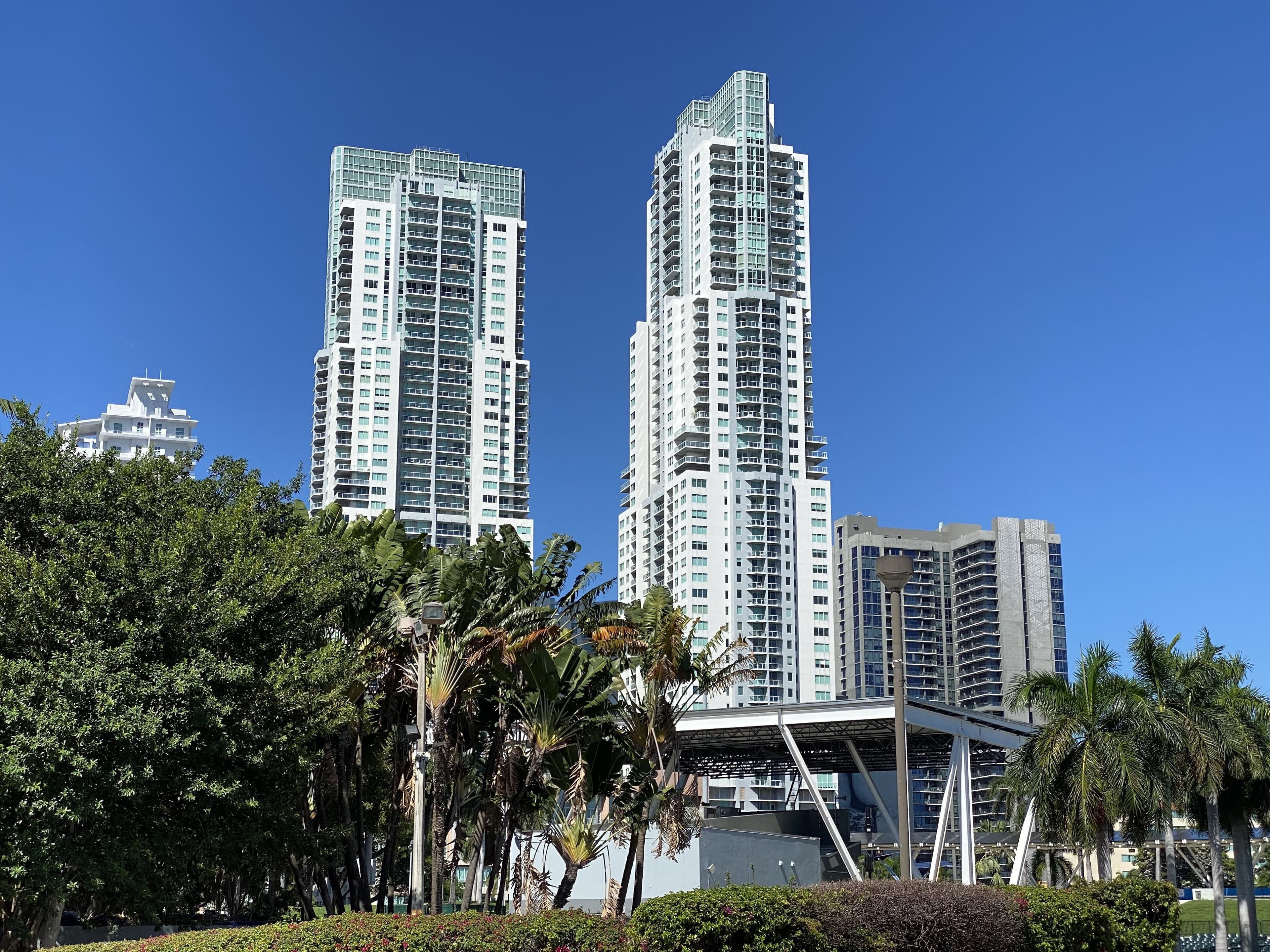
The view works in both directions. From the water, or from a boat tour leaving Bayside, the park reads as a green band at the foot of the towers, the white shell of the amphitheater and the dark spike of the Light Tower marking the spot where the city pauses. From the park, the skyline reads as a backdrop to the bay — the Southeast Financial Center's stepped crown, the glass of the newer towers, and the low white curve of the arena to the north. It is the postcard view of downtown Miami, and it costs nothing to stand in the middle of it.
Visiting today
Bayfront Park sits at 301 Biscayne Boulevard, Miami, FL 33132, in the heart of Downtown Miami. The Bayfront Park Metromover station drops you at the park's edge, and the park is an easy walk from the rest of downtown, from Bayside Marketplace to the north, and from the hotels along Biscayne Boulevard. It is a public park, free to enter, and the best way to see it is on foot: start at the Torch of Friendship at the northwest corner, walk the promenade past the Pepper Fountain, find the Challenger Memorial and the Slide Mantra, and end at the baywalk with the water in front of you.
Give yourself an hour or two, and time it for late afternoon if you can — the light on the bay turns gold, the towers catch the sun, and the park fills with joggers, families, and musicians as the city winds down. If a concert is on at the amphitheater, the park takes on a different life entirely: the lawn fills, the stage lights come up, and 10,000 people share the view that made this patch of reclaimed bayfront into Miami's front porch a century ago. No fixed opening hour is stated in this article, since none was verified against an official source in this run: check the official Bayfront Park site before visiting for current hours and event schedules.
Key Facts
- Bayfront Park is a 32-acre (13 ha) public urban park in the Central Business District of Downtown Miami, Florida, on Biscayne Bay.
- The site began as Royal Palm Park, established in 1896 as the oldest public gathering space in the greater Miami community; the modern park began construction in 1924 under landscape architect Warren Henry Manning and officially opened in March 1925, on land reclaimed from the shallow edge of Biscayne Bay.
- On February 15, 1933, President-elect Franklin D. Roosevelt survived an assassination attempt in front of the park; Chicago Mayor Anton Cermak was mortally wounded by the assassin Giuseppe Zangara.
- The Bayfront Park Auditorium was built incrementally from about 1942 to 1950 and hosted a memorial service for President Franklin Roosevelt in April 1945.
- The Torch of Friendship, at the park's northwest corner on Biscayne Boulevard, was built in 1960 as a welcoming beacon for immigrants from Latin America and the Caribbean, and was re-dedicated in 1964 to the memory of President John F. Kennedy, who had campaigned in the park in the fall of 1960.
- Beginning in 1980, the park underwent a major redesign by Japanese-American modernist artist and landscape architect Isamu Noguchi; Noguchi died in 1988 and his collaborator Shoji Sadao completed the project in 1996.
- Noguchi's works in the park include the Mildred and Claude Pepper Fountain (opened 1990), the Challenger Memorial (a 100-foot steel double helix, dedicated January 28, 1988), the Slide Mantra (a 10-foot white Carrara marble slide weighing 29 tons), and the 40-foot Light Tower.
- The FPL Solar Amphitheater (formerly the Klipsch Amphitheatre) has a seating capacity of 10,000 people: 2,672 fixed benches and 7,328 on the lawn. The Tina Hills Pavilion seats 1,000 people: 200 fixed seats and 800 on the lawn.
- Shania Twain played two shows at the amphitheater in early 1999 during her Come On Over Tour, with guests including the Backstreet Boys, Elton John, and Leahy. The park has also hosted the Ultra Music Festival.
- The park holds the city's annual New Year's Eve celebration and America's Birthday Bash on the Fourth of July, along with Christmas celebrations, holiday tree and menorah lightings, festivals, and free exercise classes.
- The park is bounded on the north by Bayside Marketplace and the Kaseya Center, on the south by Chopin Plaza and the InterContinental hotel, on the west by Biscayne Boulevard, and on the east by Biscayne Bay.
- The park is maintained by the Bayfront Park Management Trust, a limited agency of the City of Miami created in 1987. Bandleader Caesar LaMonaca and his City of Miami band performed in the park from 1928 to 1978.
- The park is at 301 Biscayne Boulevard, Miami, FL 33132, served by the Bayfront Park Metromover station.
- Coordinates: 25.7753, -80.1865.
Visitor Details
Address: 301 Biscayne Boulevard, Miami, FL 33132.
Transit: Bayfront Park Metromover station at the park's edge; an easy walk from the rest of Downtown Miami and from Bayside Marketplace to the north.
Hours/Admission: No fixed opening hour is stated in this article, since none was verified against an official source in this run. The park is a public park, free to enter; check the official Bayfront Park site before visiting for current hours and event schedules.
Best timing: Allow one to two hours. Start at the Torch of Friendship at the northwest corner, walk the promenade past the Pepper Fountain to the Challenger Memorial and the Slide Mantra, and end at the baywalk. Late afternoon is the best light on the bay; concert nights at the amphitheater transform the park.
Location Photography