Brooklyn's backyard, designed like a wilderness
Every great city park has a moment when it swallows the city whole, and in Prospect Park that moment comes fast. Step through the northern entrance at Grand Army Plaza, pass under the Soldiers' and Sailors' Arch, and the roar of Flatbush Avenue falls away behind a screen of trees. Ahead lies the Long Meadow, 90 acres of open grass rolling gently southward — one of the largest unbroken meadows in any American urban park — and beyond it, woods, water, and hills that seem to have been there forever. They have not. Almost nothing in Prospect Park is natural. The meadow was graded, the lake was dug, the ravine was carved, and the forest was planted, all to a plan drawn in the 1860s by Frederick Law Olmsted and Calvert Vaux, the landscape architects who had just finished Central Park in Manhattan.
Olmsted and Vaux considered Prospect Park the better of their two great New York parks, and it is easy to see why. In Manhattan they had to work around two reservoirs and four cross streets; in Brooklyn they had a freer, hillier site of 526 acres, and they used it to build a complete landscape in miniature: a pastoral meadow, a picturesque woodland gorge, and a broad sheet of water, arranged so that a walk through the park feels like a journey through the countryside. The park opened to the public on October 19, 1867, two years after the end of the Civil War, and it has been Brooklyn's common ground ever since — the place where the borough picnics, plays ball, watches birds, hears concerts, and learns to ride a bike. It is the second-largest public park in Brooklyn, behind Marine Park, and it is ringed by the neighborhoods that grew up around it: Park Slope and Prospect Heights to the north and west, Crown Heights and Prospect Lefferts Gardens to the east, Flatbush and Windsor Terrace to the south. The Brooklyn Museum and the Brooklyn Botanic Garden stand just outside its northern edge, and the park is operated by NYC Parks together with the nonprofit Prospect Park Alliance.
What makes Prospect Park feel different from Central Park is its spaciousness and its calm. Central Park is a masterpiece, but it is also a crowded stage; Prospect Park is a landscape you can get lost in. Its designers divided it into three kinds of scenery, following the landscape ideals of their century: the Beautiful, or pastoral, in the Long Meadow; the Picturesque, in the rough, wooded hills of the Ravine; and the Sublime in the broad water of the Lake. A walk that links all three — meadow, forest, lake — is the classic Prospect Park experience, and it is the walk this article follows.
The grand entrance: Grand Army Plaza and the Arch
Begin at the park's front door, because Olmsted and Vaux meant you to. Grand Army Plaza, the 11-acre oval at the park's northern corner, was designed in 1867 as the park's formal entrance and as the start of Eastern Parkway, the world's first parkway, which runs east from here toward Crown Heights. The plaza was originally called Prospect Park Plaza; it was renamed in 1926 for the Grand Army of the Republic, the Union veterans' organization. Its centerpiece is the Soldiers' and Sailors' Arch, Brooklyn's Arc de Triomphe, and it is one of the finest triumphal arches in America.
The arch was built between 1889 and 1892 to commemorate the Union soldiers and sailors of the Civil War, from a design by John H. Duncan, who later designed Grant's Tomb in Manhattan. Duncan won the commission in a blind competition judged from 36 entries; the cornerstone was laid by General William Tecumseh Sherman on October 30, 1889, and President Grover Cleveland presided over the dedication on October 21, 1892. The arch is 80 feet tall and 80 feet wide, of light granite on a base course of dark Quincy granite, enclosing a single opening 50 feet high and 35 feet wide. Its inscription reads "To the Defenders of the Union, 1861–1865." The sculpture came later and is the work of Brooklyn's own Frederick MacMonnies: the great bronze quadriga on top, showing Columbia in her chariot drawn by two horses and flanked by winged Victories, was installed in 1898, and the Spirit of the Army and Spirit of the Navy groups on the south pedestals followed in 1901. Inside the archway, high-relief equestrian portraits of Abraham Lincoln and Ulysses S. Grant face each other across the passage — the men modeled by William Rudolf O'Donovan, the horses by the painter Thomas Eakins, in 1893–94. The arch was designated a New York City landmark in 1973, the whole plaza followed in 1975, and the arch and its sculptures were restored in 1980 and again in 2023–2025.
Walk through the arch and you are in the park. Behind you, across the plaza, stand the Bailey Fountain, the Brooklyn Public Library's Central Library — built in the shape of an open book — and the bustle of Flatbush Avenue. Ahead, the drive curves and the trees close in. The contrast is the whole point: the plaza is the city's formal welcome, and the park is the escape from it.
The Long Meadow: the pastoral heart
The first landscape you meet is the Long Meadow, and it is the park's great open room. Ninety acres of lawn run south from the entrance, bordered by trees and crossed by paths, and on any fair weekend it fills with the life of the borough: picnickers and barbecues, soccer and softball games, kite flyers, dog owners in the off-leash hours, and families spread out on blankets. In the nineteenth century the meadow hosted archery and croquet — on some weekend afternoons, a hundred croquet parties at once — and it remains the park's most democratic space, big enough that a crowd never feels like one.
The meadow is also the park's best vantage point. From its southern end the land rises toward Quaker Hill, Breeze Hill, and Lookout Hill, 186 feet above sea level, the highest point in the park, and the views open out across the lawn to the trees beyond. The Picnic House, a brick-and-glass pavilion built in 1927 near the meadow's middle, anchors the social life of the lawn, and the Tennis House of 1909–10, with its casino air, recalls the era when the meadow's edges were lined with tennis courts. But the meadow's real achievement is simpler: it is a field that feels like countryside, in the middle of a borough of 2.6 million people, and it has felt that way for more than 150 years.
Cross the meadow and you reach the park's second great landscape, the water. Prospect Park's Lake covers about 60 acres at the park's southern end — Brooklyn's only lake — with a winding shoreline, small islands, and a long arm made for boating. In the nineteenth century it was famous for ice skating, with a larger skating area than Central Park's; today it is fished, paddled, and walked around, and its shoreline paths are among the park's quietest. At the lake's southeastern corner, the LeFrak Center at Lakeside, built on the site of the old Wollman Rink, carries on the skating tradition in winter and roller skating in summer, and the lake's Peninsula, a wooded finger of land reaching into the water, is one of the park's best birding spots.
The Ravine: Brooklyn's only forest
If the meadow is the park's open hand, the Ravine is its secret. In the park's center, behind the meadow and the Nethermead, lies a steep, narrow gorge, roughly 100 feet deep in places, threaded by a stream that drops over a series of small waterfalls — Fallkill Falls, Ambergill Falls, Binnen Falls — on its way from the park's northern pools down to the Lullwater and the Lake. The Ravine district covers roughly 146 acres, and it holds Brooklyn's only remaining forest: a dense, upland woodland of oaks and other hardwoods, with ferns and wildflowers in the understory, that the designers deliberately shaped to recall the Adirondacks.
Olmsted and Vaux called the Ravine the heart of the park, and they engineered it with extraordinary care. Two pre-existing woodlots were preserved, and the valley between them was deepened and planted so that the stream could be heard trickling through the trees for the whole length of the gorge — the sound of water was part of the design. Rustic bridges carry the paths over the stream: the Esdale Bridge, the Rock Arch Bridge, the Fallkill Bridge, each one placed for a view. Decades of overuse and erosion wore the Ravine down, and since the 1990s it has been the focus of sustained restoration by the Prospect Park Alliance, replanting the slopes and rebuilding the paths. Walk it on a weekday morning and you will understand why Brooklynites speak of it almost reverently: the city noise fades, the canopy closes overhead, and for a stretch of trail you could be fifty miles from New York.
The watercourse that runs through the Ravine is the thread that ties the park together. It begins in the pools at the meadow's northern edge — the Vale of Cashmere, the Upper and Lower Pools — winds through the Ravine's falls, opens into the Nethermead's Binnen Water, and then, as the Lullwater, glides past the Boathouse and into the Lake. Follow it downstream and you walk the park's whole story, from pastoral lawn to wild gorge to open water.
The Boathouse on the Lullwater
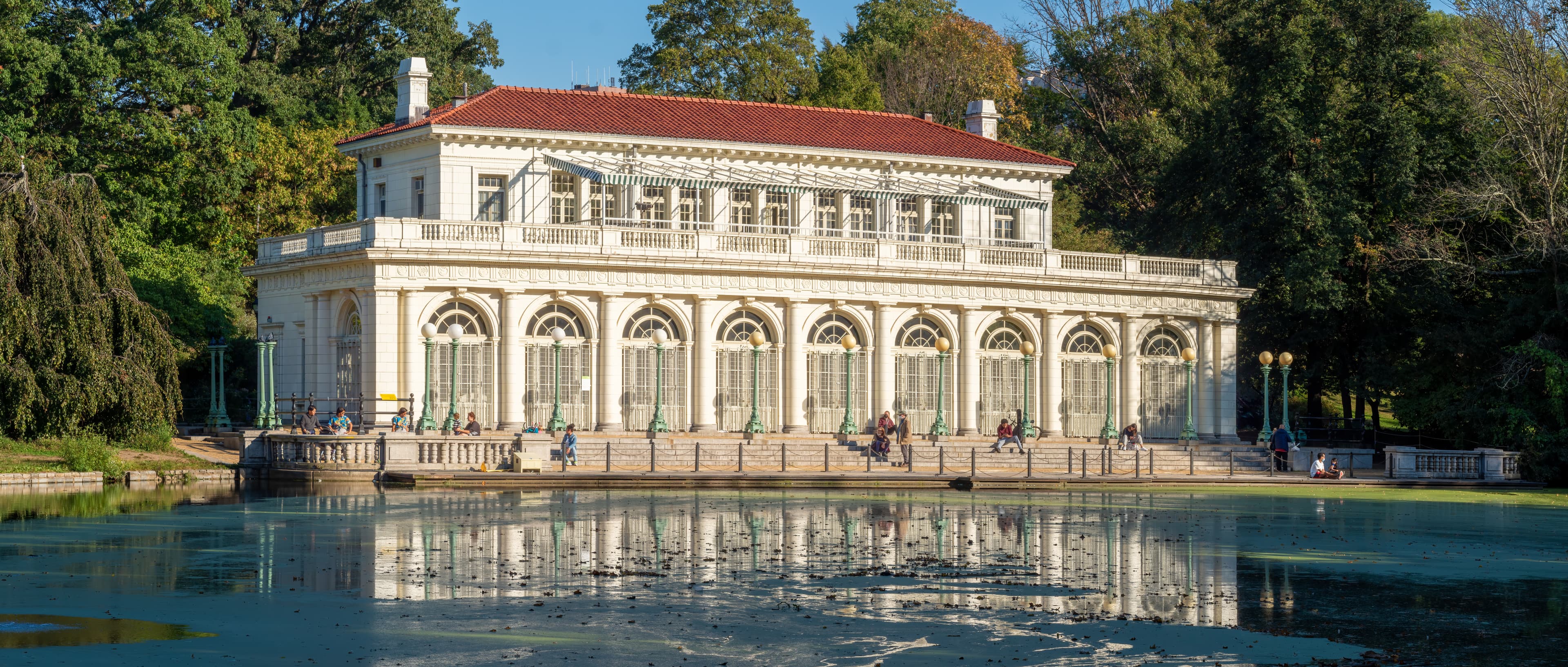
Where the Lullwater meets the Lake stands the park's most beautiful building. The Prospect Park Boathouse, on the northeast shore of the Lullwater, is a gleaming white terra-cotta pavilion in the Italian Renaissance manner, its arcade of arches and Tuscan columns facing the water, its terrace catching the sunset over the Lake. It was built in 1905–07 to designs by Helmle, Hudswell and Huberty, protégés of McKim, Mead and White, replacing an older wooden boathouse of 1876, and its model was the Library of St. Mark in Venice — the first floor of Sansovino's great building, translated to a Brooklyn lakeshore. Inside, a double staircase rose to a dining room opening onto the terrace, and the ceilings were vaulted in Guastavino tile.
The Boathouse nearly did not survive. By the 1960s it was underused and unmaintained, and in September 1964 the Parks Department, under Robert Moses, came within 48 hours of demolishing it. The outcry that followed became one of New York's early preservation fights: the building was designated a New York City landmark in 1965 — among the first landmarks ever designated — and listed on the National Register of Historic Places in 1972. It reopened in 1974, was restored again in the late 1990s, and now houses the Prospect Park Audubon Center, the Audubon Society's first urban nature center, with exhibits on the park's birds and ecology, plus a café on the terrace that opened in 2024. Stand on the terrace at dusk, when the white terra-cotta glows and the Lullwater darkens, and you will understand why Brooklyn fought to keep it.
The east side: Lefferts, the Carousel, and the Zoo
The park's eastern edge holds its oldest stories. Near the intersection of Ocean Avenue, Flatbush Avenue, and Empire Boulevard stands the Lefferts Historic House, the oldest structure in the park. It is an eighteenth-century Dutch Colonial farmhouse, built between 1777 and 1783 by Lieutenant Peter Lefferts, replacing an earlier family homestead burned by the Americans during the Battle of Flatbush in 1776. The house was given to the city by Lefferts descendants in 1918 and moved into the park from its original site at 563 Flatbush Avenue, relocating again in 1920 to make way for the Willink entrance. Today it operates as a children's museum of nineteenth-century Brooklyn family life, with a working garden and farmyard that recall the borough's rural past.
Immediately west of the house is the Prospect Park Carousel, one of the park's great delights. Its 53 horses were carved in 1912 by Charles Carmel, a master of the Coney Island carousel tradition, along with three animal carvings and two chariots; the carousel itself opened in October 1952, replacing an earlier carousel that had burned, and it was restored in 1971–74 and again in 1987–89. A ride on it is a direct line to the Brooklyn of a century ago, when carousel carvers were among the borough's finest folk artists.
Just north, across Flatbush Avenue from the Brooklyn Botanic Garden, lies the Prospect Park Zoo, a 12-acre zoo managed by the Wildlife Conservation Society, and nearby the Bandshell, the park's outdoor concert stage, which hosts free performances through the summer — the modern echo of the nineteenth-century concerts once given on the Lake's Music Island, where musicians rowed out to play for crowds on the shore. Together with the Rose Garden and the Vale of Cashmere, the east side is the park's family quarter, and on summer weekends it hums.
A walk through the park
The best way to see Prospect Park is on foot, in one long loop, and the park rewards the walker who takes its designers' route. Enter at Grand Army Plaza and walk through the arch; cross the Long Meadow diagonally to the southwest, toward the Picnic House; then turn into the woods and follow the watercourse upstream through the Ravine, over its bridges and past its falls, until you reach the Nethermead; continue down the Lullwater to the Boathouse, where the terrace is the place to stop; then circle the Lake's shoreline to the Peninsula and back up the east side, past the Carousel and the Lefferts House, to the Rose Garden and out at Grand Army Plaza. The loop is roughly three miles, it touches all three of the park's landscapes, and it leaves the city's noise behind for most of its length.
Come in different seasons and the park changes its character completely. Spring brings the cherry blossoms and the return of the warblers that make the park one of the great urban birding sites in America; summer brings the concerts and the crowds on the meadow; autumn turns the Ravine's canopy amber and gold, and the Long Meadow's edges flame with color; winter strips the trees and opens long views across the Lake, and the skating rink takes over the lake's corner. Prospect Park is a park for all four seasons, and Brooklynites use it in all four — which is, after a century and a half, the truest measure of Olmsted and Vaux's success. They set out to build a place where a crowded city could breathe, and they built it so well that the city still breathes there.
Key Facts
- Prospect Park is a 526-acre urban park in Brooklyn, designed by Frederick Law Olmsted and Calvert Vaux, opened October 19, 1867, and is the second-largest public park in Brooklyn behind Marine Park.
- Designated a New York City scenic landmark November 25, 1975, and listed on the National Register September 17, 1980; operated by NYC Parks together with the Prospect Park Alliance.
- 90-acre Long Meadow; 60-acre Lake, Brooklyn's only lake.
- Ravine district roughly 146 acres holding Brooklyn's only remaining forest, with Fallkill, Ambergill, and Binnen Falls.
- Soldiers' and Sailors' Arch built 1889–1892, designed by John H. Duncan, dedicated October 21, 1892, 80 feet tall and wide, archway 50 by 35 feet, inscribed "To the Defenders of the Union, 1861–1865," sculptures by Frederick MacMonnies, Lincoln/Grant reliefs by O'Donovan and Eakins.
- Boathouse built 1905–07 by Helmle, Hudswell and Huberty, nearly demolished September 1964, landmarked 1965, National Register 1972, now houses the Prospect Park Audubon Center.
- Lefferts Historic House built 1777–1783 by Peter Lefferts, moved into the park from 563 Flatbush Avenue; Carousel: 53 horses carved 1912 by Charles Carmel, opened October 1952; Zoo 12 acres, Wildlife Conservation Society; Lookout Hill 186 feet, highest point; Picnic House 1927, Tennis House 1909–10.
Visitor Details
Entrances all around the perimeter, including Grand Army Plaza (north), Bartel-Pritchard Square (northwest), Parkside Avenue (south), and the Willink entrance at Flatbush Avenue and Empire Boulevard (east). Subway stops ringing the park include Grand Army Plaza (2/3), 15 St–Prospect Park (F/G), and Prospect Park (B/Q); buses along Prospect Park West, Flatbush Avenue, and Ocean Avenue. No fixed opening hour, ticket price, or fee is stated, since none was verified — the park itself is free and open daily; individual attractions (Zoo, Carousel, LeFrak Center at Lakeside, Audubon Center) set their own hours and admission — check prospectpark.org and NYC Parks before visiting. Allow at least half a day for the full meadow–ravine–lake loop (roughly three miles); weekday mornings quietest in the Ravine; pair with the Brooklyn Museum and Brooklyn Botanic Garden just outside the northern edge.
Gallery: Prospect Park