
The lawn in the middle of everything
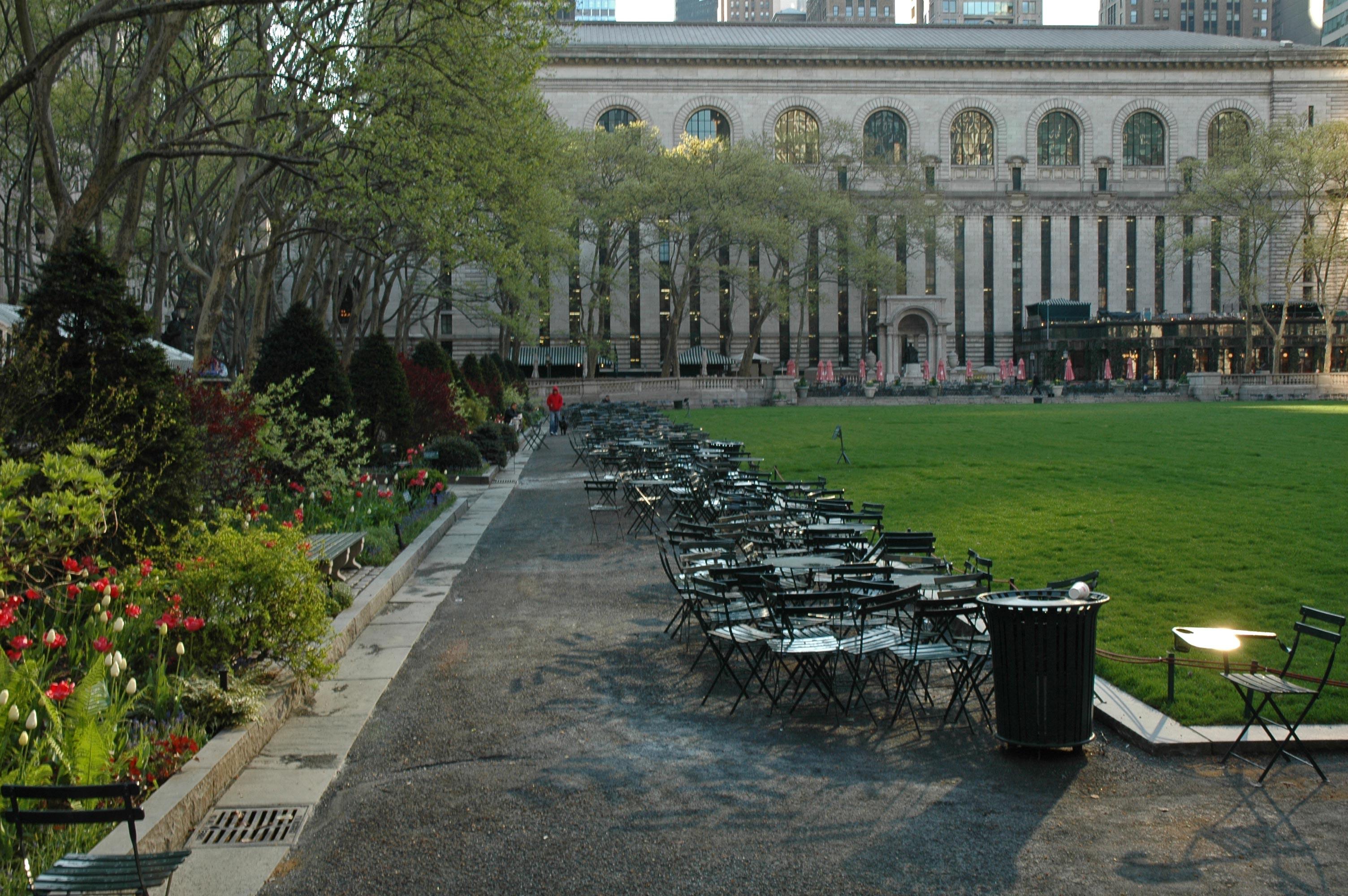
Bryant Park is a 9.6-acre public park in Midtown Manhattan, bounded by Fifth Avenue and the Avenue of the Americas (Sixth Avenue) between 40th and 42nd Streets. Its eastern half is occupied by the main branch of the New York Public Library, the great Beaux-Arts Stephen A. Schwarzman Building, whose rear terrace looks out over the park. Its western half is a formal garden: a great lawn, 300 feet by 215 feet, ringed by promenades planted with London plane trees, gravel paths, flower beds, and hundreds of movable green bistro chairs that have become one of the park's signatures. The whole western half sits on top of the library itself — on an underground structure holding the library's book stacks, two levels deep.
It is often called Manhattan's town square, and the name fits. There is no gate and no admission charge to enter the park itself; it is free and open year-round, and it is used the way a town square is used. On a weekday at noon the lawn and the chairs fill with office workers eating lunch. In the morning, joggers and dog walkers circle the paths. In summer the lawn becomes an outdoor theater and concert ground; in winter it disappears under the Bank of America Winter Village, an ice rink and holiday market. Few parks in America are worked this hard, and fewer still have been through as much to get here.
The first thing to understand about Bryant Park is that almost nothing you see is original — and that is the point. The lawn, the promenades, the fence, the monuments, even the ground under your feet have all been rebuilt, some of them more than once. The park has had three major redesigns since it began as Reservoir Square in the 1840s, and each one was a response to a different New York: the city that needed drinking water, the city that needed a world's fair, the city of the Depression, the city of the 1970s that had given up on its public spaces, and the city of the 1990s that decided to take one back.
From potter's field to reservoir square
The ground was public long before it was a park. In the late 1600s the colonial governor Thomas Dongan designated the land as public property, and in 1823 it became a potter's field — a public cemetery for unknown or indigent people. The city decommissioned the potter's field in 1840 to build the Croton Distributing Reservoir, completed in 1842: a massive, Egyptian-revival walled basin, a four-acre man-made lake holding the city's drinking water, brought down from the Croton River in Westchester County. The reservoir stood on the eastern part of the site, where the library stands now, and the open ground behind it — to the west — was designated Reservoir Square in 1842 and used as a public space. The first park on the site opened in 1847, called Reservoir Square after its neighbor, and it was formally designated a park in 1871.
The square was a working piece of the 19th-century city, not a manicured garden. During the Civil War, Union troops drilled and camped there. In 1853 it hosted the most spectacular thing ever built on the site — and then, five years later, watched it burn.
The Crystal Palace and America's first World's Fair
On July 14, 1853, the Exhibition of the Industry of All Nations opened in Bryant Park — the event now remembered as America's first World's Fair. To house it, the architects Georg J. B. Carstensen and Charles Gildemeister built the New York Crystal Palace, an iron-and-glass structure modeled on London's Crystal Palace of 1851: a Greek cross in plan, surmounted by a soaring 123-foot dome, one of the largest and most sophisticated buildings ever raised in America. It stood on the ground immediately west of the reservoir, between Fifth and Sixth Avenues, and it filled with some 4,000 exhibits — machinery, sculpture, paintings, and new inventions, including Elisha Otis's demonstration of his safety elevator, the device that made the skyscraper possible.
The fair closed on November 1, 1854, more than a million visitors later but $300,000 in debt, and the building was leased out for special events, including the Fair of the American Institute. On October 5, 1858, while it was hosting that fair, the Crystal Palace caught fire. The building had been reputed fireproof; it was not. Nearly 2,000 people were inside when the blaze began, and the dome collapsed within minutes, but remarkably no one was killed. The losses were estimated at about $500,000. Nothing of the palace survives on the site today — only drawings, lithographs, and descriptions — but the fair it housed was the moment this patch of ground first announced itself to the world.
The library rises, and the park gets its name
The square was renamed in 1884 for William Cullen Bryant (1794–1878), the poet and longtime editor of the New-York Evening Post, a leading abolitionist voice, and one of the city's most persistent advocates for the creation of Central Park. The renaming, authorized by the state legislature, honored a man who had spent his public life arguing that New York needed green space — a fitting namesake for a park that would spend the next century proving him right.
The park's next transformation began in 1899, when the reservoir was demolished to make way for the New York Public Library. The library's main branch, designed by Carrère and Hastings, opened in 1911 on the reservoir's site, its great marble bulk forming the park's eastern wall. The architect Thomas Hastings set the park's basic design: a raised terrace behind the library, connected with the front terrace and terminating in two stone park houses. The library's rear terrace, with its classical garlands, urns, and rams' heads, became the park's ceremonial east end — and the site of the memorial to the man the park was named for.
By then the park was already struggling. The Sixth Avenue Elevated railway, built in 1878, cast a literal and metaphorical shadow over it, and by the 1930s Bryant Park was neglected and, in Robert Caro's phrase, "a haven for drunk and idlers." In 1932 the businessman Grover Whalen made it worse: to celebrate the bicentennial of George Washington's inauguration, he stowed away the park's statues, put up walls around the park, and built a flimsy $150,000 model of Federal Hall, planning to charge 25 cents to view it. The episode was a farce, and it left the park in need of rescue.
The 1930s redesign — Moses, Simpson, and the Great Lawn
The rescue came from a competition. The Architects' Emergency Committee, a Depression-era body finding work for idle architects, ran a 1933 competition to redesign the park. The winner was Lusby Simpson, a Queens-based architect, whose plan called for a large central lawn, formal pathways, an oval plaza with a memorial fountain, and promenades of London plane trees. The design was implemented within a year by the Parks Department under its new commissioner, Robert Moses, with Aymar Embury II as department architect and the landscape architect Gilmore D. Clarke laying out the Great Lawn. The rebuilt park opened to the public on September 14, 1934, and a wrought-iron fence enclosure, with cast-iron embellishments fabricated by New York's J. W. Fiske Ironworks, was added in 1936.
The Moses-era design is still the skeleton of the park you walk through today: the sunken lawn, slightly below the level of the surrounding walkways, the allées of plane trees, the raised terrace at the library end, the oval plaza and fountain at the Sixth Avenue end. But the design had a flaw that would nearly kill the park. It turned the lawn inward, hedged it and fenced it off from the streets, so that from the sidewalk you could barely see in — and what you could not see, no one watched. A park that could not be seen from the street became a place to hide.
Decline and "Needle Park"
The decline was slow and then total. The Sixth Avenue elevated came down in the late 1930s and the IND Sixth Avenue subway went in, tearing up the park's edges. After the war, maintenance slipped, and by the 1970s Bryant Park had a new name in the city's vocabulary: "Needle Park," for the drug users who frequented it. The hedges and the raised lawn that had made it a handsome formal garden now made it a perfect hideout for illegal activity, and ordinary New Yorkers stopped going. By 1974, when the Landmarks Preservation Commission designated the park a New York City Scenic Landmark, it had, in the commission's own history, "again slipped into the shadows."
The turnaround began before the restoration, in small steps. From 1979 to 1983, the Parks Council, a parks advocacy group, ran a coordinated program of amenities — a book market, a flower market, cafes, landscape improvements, and entertainment — that brought new life to the park and proved that people would come back if there was something to come back for. The lesson stuck.
The restoration that saved it
The Bryant Park Restoration Corporation was founded on January 3, 1980, by Daniel A. Biederman — then a 26-year-old systems consultant who also chaired the local community planning board — and Andrew Heiskell, chairman of Time Inc. and of the New York Public Library, with backing from the Rockefeller brothers. Biederman devised a plan for private management and funding of the park, drawing on the theories of the urbanist William H. Whyte Jr., who had studied what makes public spaces work: visibility from the street, movable chairs, food, and reasons to linger. The landscape architects were Hanna/Olin Ltd., and the park houses were redesigned by Hardy Holzman Pfeiffer Associates. The design preserved many elements of Simpson's 1930s plan — the lawn, the allées, the terrace — but opened the park up: new entrances with clear sightlines from the streets, lower hedges, refreshment stands, restored monuments, and the green bistro chairs that let visitors arrange their own seating.
The park closed for the work in 1988 and fully reopened in 1992, after a nearly $10 million restoration — and after a piece of engineering that still defines the place. While the park was rebuilt above, two levels of underground storage were built beneath the lawn for the library's collections: 84 miles of shelving, holding the books that the library's landmark building could no longer contain. The lawn you sit on is a roof.
The reopening was an instant and spectacular success, and it changed how American cities think about parks. Bryant Park became the textbook case for the privately managed public park: owned by the New York City Department of Parks and Recreation, managed by the private not-for-profit Bryant Park Corporation, funded largely by the businesses around it, and programmed year-round. The model has been copied across the country. The park itself has not looked back.
The lawn and its seasons
The Great Lawn is the park's center and its calendar. Its season runs roughly from February to October, when it closes to make way for the Winter Village, and in the months it is open it is the most intensively used lawn in the city. On a summer weekday it is a lunchroom for thousands of Midtown office workers, who spread out on the grass or pull the green chairs into the shade of the plane trees. On summer evenings it becomes an audience: free outdoor film screenings on Monday nights draw crowds that spill across the grass, and the free Picnic Performances series brings music, dance, and theater to the lawn, with the library as a backdrop. At lunchtime, Broadway in Bryant Park brings performers from current shows out to sing on the lawn. On other days there is yoga and tai chi on the grass, juggling and fencing lessons, poetry readings, and Shakespeare — a full program of free events that runs most of the year.
Around the lawn, the park's daily life is quieter and smaller in scale: chess and backgammon at the game tables, the Art Cart handing out free art supplies and classes, children with picture books at the Reading Room, birdwatchers — more than 120 bird species have been recorded in the park — and readers in the chairs with the morning paper. The chairs are the detail visitors remember: there are hundreds of them, they belong to no one, and anyone can move one into the sun or the shade. It was William H. Whyte's central insight, and it is why the park feels less like a monument and more like a living room.
Winter Village
When the lawn closes in late autumn, the park becomes something else entirely. The Bank of America Winter Village takes over the western half: an ice rink, the Pond, ringed by holiday shops in small kiosks selling crafts, gifts, and food, with a towering holiday tree at the rink's edge. The rink opened in 2005 and has become one of the city's best-known winter scenes — skaters circling under the library's terrace and the towers of Sixth Avenue, the shops glowing around them, the park's familiar chairs replaced by the bustle of the market. It is the park's second season, as deliberate as the first: the same ground, the same trees, a different city using it.
Entry to the park itself is free in every season. Skating, the carousel, and the holiday shops have their own arrangements, and none of their prices are stated here — check the park's official site at bryantpark.org before visiting for current details, since they change by season.
The library next door
You cannot write about Bryant Park without the library, because the park is, in a real sense, the library's garden. The Stephen A. Schwarzman Building, the library's main branch, opened in 1911 and fills the park's eastern edge. Its Fifth Avenue front is guarded by the two marble lions sculpted by Edward Clark Potter and carved in pink Tennessee marble by the Piccirilli brothers — nicknamed "Patience" and "Fortitude" by Mayor Fiorello LaGuardia in the 1930s. Walk around to the park side and the building's rear terrace, designed by Thomas Hastings, forms the park's east end, with the Bryant Memorial at its center.
The library's presence explains the park's most distinctive institution: the Reading Room. An open-air library operated in the park during the Depression, when the library set out books and newspapers for the unemployed; the Bryant Park Corporation revived the tradition in 2003, and the Reading Room now offers books, newspapers, and magazines to borrow on the spot, with children's picture books and summertime story times. It is free, it is outdoors, and it is the most literal expression of what this park is: a library's front lawn, open to anyone.
Monuments and statues
The park's monuments repay a slow walk, because they are the park's memory in bronze and stone. At the east end, on the library's rear terrace, stands the William Cullen Bryant Memorial, dedicated in 1911 at the completion of the library. The sculptor Herbert Adams cast Bryant in bronze, seated in an armchair with a stack of papers on his lap and a blanket draped across his knees, under a columned canopy designed by Thomas Hastings; an excerpt from Bryant's poem "Thanatopsis" is inscribed at the base. The memorial was unveiled on October 24, 1911, presented to the city by the Century Association, of which Bryant had been president.
Just west of the memorial sits a small bronze bust of Gertrude Stein — a cast of Jo Davidson's 1923 bust of the American author, poet, and art collector, installed in the park in 1992. Her seated, Buddha-like figure is one of the park's most photographed oddities. On the park's northern border stands the statue of William E. Dodge (1885), by John Quincy Adams Ward: the philanthropist and YMCA founder leaning against a bookstand. At the Sixth Avenue end, the Josephine Shaw Lowell Memorial Fountain honors the social reformer Josephine Shaw Lowell — the first major monument in New York City dedicated to a woman — and its oval plaza is the park's western anchor. Somewhere among the trees, if you look, is also a bust of Johann Wolfgang von Goethe, facing the carousel with what one writer called a dour expression. The monuments were all restored in the 1988–1992 renovation, and they are part of why the park feels layered: every generation that rebuilt this ground left a statue behind.
The carousel and the small pleasures
The Bryant Park Corporation added a custom-built carousel in 2002 — a French-style merry-go-round with painted horses and a blue-green pavilion roof, tucked among the plane trees near the park's center. It is small, it is charming, and it is the park's most reliable delight for children. Around it, the park's smaller pleasures accumulate: the green chairs and tables, the flower beds that change with the seasons, the games tables, the food kiosks and the restaurants in the park houses, the clean public restrooms that Midtown workers treat as a minor miracle. The park is also, quietly, a piece of infrastructure: the lawn is a roof over the library's stacks, the paths drain a 9.6-acre site in the middle of the densest commercial district in the country, and the whole place is cleaned, planted, and programmed by a private corporation on behalf of the city.
What a visit feels like depends on when you come. In the morning, before the lunch crowd, the park is quiet: the chairs in rows, the plane trees filtering the light, the library's marble glowing at the east end, the only sound the sweepers and the birds. At noon it is a cafeteria with no walls. In the evening in summer, it is a theater. In December, it is a market and a rink and a tree, with the towers of Sixth Avenue lit above it. The park never asks for your attention the way a monument does. It just gives you a chair, a patch of grass, and a reason to stay — and that, after a century and a half of reinvention, is the whole trick.
How to visit
Bryant Park sits between Fifth Avenue and Sixth Avenue (Avenue of the Americas), between 40th and 42nd Streets in Midtown Manhattan, directly behind the New York Public Library's main branch — reach it by subway at 42nd Street–Bryant Park (B, D, F, M) or Fifth Avenue (7). Entry to the park itself is free, and the park is open year-round. Allow an hour for a wander and a sit, longer if you want the Reading Room, the carousel, a game of chess, or a lunch on the lawn. Come in the morning for quiet, at noon for the crowd, or at dusk in December, when the rink lights come on and the park turns into the postcard. No fixed prices for skating, the carousel, or the holiday shops are stated in this article, since none was verified against an official source in this run: check bryantpark.org before visiting for current prices, hours, and seasonal schedules.
Location Photography


Key Facts
- Bryant Park is a 9.6-acre public park in Midtown Manhattan, between Fifth Avenue and Sixth Avenue (Avenue of the Americas) and 40th and 42nd Streets. Its eastern half is occupied by the New York Public Library's main branch; its western half — lawn, promenades, and amenities — sits entirely over an underground structure housing the library's book stacks. Coordinates: 40.7536, -73.9832.
- The site was a potter's field from 1823, decommissioned in 1840 for the Croton Distributing Reservoir (completed 1842). The ground behind the reservoir was designated Reservoir Square in 1842; the first park opened in 1847, and it was formally designated a park in 1871. During the Civil War, Union troops drilled and camped in the square.
- The Crystal Palace, built for the Exhibition of the Industry of All Nations (America's first World's Fair), opened July 14, 1853 — an iron-and-glass structure by Georg J. B. Carstensen and Charles Gildemeister with a 123-foot dome, housing some 4,000 exhibits including Elisha Otis's safety elevator demonstration. The fair closed November 1, 1854; the palace burned to the ground on October 5, 1858, with no lives lost.
- The square was renamed Bryant Park in 1884 for William Cullen Bryant (1794–1878), poet, editor of the New-York Evening Post, and a leading advocate for the creation of Central Park.
- The reservoir was demolished to make way for the New York Public Library, whose main branch (Stephen A. Schwarzman Building, designed by Carrère and Hastings) opened in 1911. The library's rear terrace, designed by Thomas Hastings, became the park's east end.
- The park was redesigned in 1933–1934 to a plan by Lusby Simpson, winner of a competition run by the Architects' Emergency Committee, implemented under Parks Commissioner Robert Moses with Aymar Embury II and landscape architect Gilmore D. Clarke. The Great Lawn measures 300 by 215 feet. The rebuilt park opened September 14, 1934; the wrought-iron fence was added in 1936. In 1932, Grover Whalen had stowed the park's statues and built a $150,000 model of Federal Hall in the park, charging 25 cents to view it.
- The park was designated a New York City Scenic Landmark in 1974. By the 1970s it was known as "Needle Park" for the drug use there, its hedged, inward-turning 1930s design having made it a hideout.
- The Bryant Park Restoration Corporation was founded January 3, 1980, by Daniel A. Biederman and Andrew Heiskell, with backing from the Rockefeller brothers. The restoration of 1988–1992, by landscape architects Hanna/Olin Ltd. and architects Hardy Holzman Pfeiffer Associates and guided by the urbanist William H. Whyte Jr.'s theories, rebuilt the park with open sightlines, new entrances, and movable chairs, and built two levels of library stacks beneath the lawn with 84 miles of shelving. The park fully reopened in 1992 after a nearly $10 million restoration.
- The park is owned by the New York City Department of Parks and Recreation and managed by the private not-for-profit Bryant Park Corporation.
- The custom-built carousel was added in 2002; the open-air Reading Room tradition was revived in 2003; the Pond ice rink opened in 2005 as the centerpiece of the Bank of America Winter Village, with holiday shops. The lawn's season runs roughly February to October.
- The William Cullen Bryant Memorial, by sculptor Herbert Adams, was unveiled October 24, 1911, on the library's rear terrace, with an excerpt from Bryant's "Thanatopsis" at its base. The Gertrude Stein bust is a cast of Jo Davidson's 1923 bust, installed in the park in 1992. The William E. Dodge statue (1885) is by John Quincy Adams Ward. The Josephine Shaw Lowell Memorial Fountain, at the Sixth Avenue end, was the first major New York City monument dedicated to a woman.
- The library's lions, Patience and Fortitude, were sculpted by Edward Clark Potter, carved in pink Tennessee marble by the Piccirilli brothers, and nicknamed by Mayor Fiorello LaGuardia. More than 120 bird species have been recorded in the park.
Visitor Details
Address: Bryant Park, between Fifth Avenue and Sixth Avenue (Avenue of the Americas), 40th–42nd Streets, New York, NY 10018 (Midtown Manhattan, directly behind the New York Public Library's main branch).
Transit: Subway to 42nd Street–Bryant Park (B, D, F, M) or Fifth Avenue (7). The park is a short walk from Times Square and Grand Central Terminal.
Hours/Admission: Entry to the park itself is free, and the park is open year-round. No fixed prices for ice skating, the carousel, or the Winter Village holiday shops are stated in this article, since none was verified against an official source in this run. Check bryantpark.org before visiting for current prices, hours, and seasonal schedules.
Best timing: Allow an hour for a wander and a sit, longer for the Reading Room, the carousel, or lunch on the lawn. Mornings are quiet; summer Monday evenings bring free outdoor film screenings on the lawn; December brings the Winter Village rink and holiday market.