The hippest street in town
"Where do the hippies meet? South Street, South Street." When the Orlons, a Philadelphia R&B group, sang that line in January 1963, they were not inventing a slogan. They were reporting a fact that Philadelphians already knew. South Street — the east-west corridor running from Front Street at the Delaware River west to the Schuylkill, forming the southern border of Center City and the northern border of South Philadelphia — had been the city's release valve for nearly three hundred years by then, and it has refused to be anything else since.
Walk it today, from the cobblestones of Headhouse Square at 2nd Street west toward Broad, and the parade is still gloriously mixed up: cheesesteak counters shoulder to shoulder with tattoo parlors, vintage shops, record stores, bars, and galleries, all of it under the glitter of Isaiah Zagar's mosaics. Boyz II Men name-checked the street on "Motownphilly" in 1991 and filmed part of the video there. Green Day made their Philadelphia debut at J.C. Dobbs on the 300 block in January 1993, before they had signed with a major label. The Dead Milkmen opened "Punk Rock Girl" in 1988 with a walk to Zipperhead, the punk clothing store. The street collects these moments the way its sidewalks collect flyers — one on top of another, none of them ever fully peeled away.
South Street is not a single attraction with a gate and a ticket. It is a corridor, and the right way to see it is on foot, slowly, with your head up. The buildings are mostly low, brick, and old; the storefronts change constantly; and the history is written in layers, from a colonial boundary line to a highway that was never built to a mosaic garden that saved a neighborhood by refusing to be demolished.
A line drawn in 1682
South Street began as a boundary, and it has never quite stopped being one. In William Penn's original 1682 plan for Philadelphia, the street was called Cedar Street, and it marked the southern edge of the city. Everything south of it — the district of Southwark — lay outside the city's limits, and that legal fact shaped everything that followed. Quaker Philadelphia banned live theater within the city, so in 1766 the Southwark Theatre, the first permanent playhouse in the American colonies, was built just south of the line, on the south side of the street at Leithgow Street. Philadelphians who wanted a night out simply stepped across the boundary. The tradition of seeking entertainment on South Street started there, and it never left.
The street was officially renamed South Street in 1854, the same year the city consolidated its boundaries outward to 130 square miles. By then the corridor had already become one of the city's great zones of contact. Eastern South Street held Swedish and Dutch settlers first, then Irish immigrants in the early to mid-1800s, then Jewish and Italian immigrant shops and theaters. Western South Street became a cultural and commercial center for South Philadelphia's African American community, anchored by theaters and clubs — including the Standard Theatre — that gave Black performers a stage when much of the city would not. W.E.B. Du Bois's landmark 1899 study, The Philadelphia Negro, took the Seventh Ward, bordered by South Street, as its subject, documenting a community that was already one of the most studied and most vibrant Black neighborhoods in America. William Gardner Smith's 1954 novel South Street took the corridor itself as its subject, a place where many Philadelphias met on the same sidewalk.
That layered history is still legible in the street's eastern end, where Headhouse Square preserves the oldest piece of it. The New Market, established on South 2nd Street in 1745, is one of the oldest surviving market buildings of its kind in the country; the Georgian brick Head House, built in 1804 as a firehouse with a cupola that once held a fire bell, is the oldest extant firehouse in the United States and now serves as a community center. The market sheds once ran all the way to South Street itself. Stand in the square's cobblestone plaza, among the brick market buildings and the farmers market that still runs on Sundays, and you are standing where South Street's commercial life began — a public market at the edge of the city, feeding the neighborhoods on both sides of the line.
Garments, then guitars
Until the 1950s, South Street was known mainly as a garment district. Men's suit shops and fabric stores lined the corridor, and the eastern end formed part of the Jewish and Italian Fabric Row — a stretch of 4th Street, from Bainbridge to Catharine, where fabric shops, drapery workrooms, and trim stores still cluster today. If you wanted a suit cut, a bolt of cloth, or a tailor who knew your name, you came to South Street.
The music came next, and it came in waves. Starting in the early 1960s and running through the 1970s, South Street filled with clubs and bars, and bar-hopping — drifting from one small room to another, catching a set in each — became a local pastime. The rooms were small, the crowds were loyal, and the scene launched careers: Kenn Kweder, called the bard of South Street; George Thorogood, who cut his teeth in the city's bars before "Bad to the Bone"; and Robert Hazard, whose songs came out of the same rooms. The clubs were not showcases for tourists. They were neighborhood rooms where a band could build a following one Friday night at a time, and the following, in turn, could carry a band to a recording contract.
By the mid- to late 1970s and into the 1980s, the same rooms made South Street the center of Philadelphia's punk scene. J.C. Dobbs on the 300 block booked the bands nobody else would; Zipperhead sold the clothes; and the street's cheap rents and tolerant attitude did the rest. Fear's 1982 song "I Don't Care About You" opens with the line "South Street Philadelphia," a name-check that told every punk kid in America where the city's scene lived. The Theatre of Living Arts at 334 South Street, a small and intimate concert venue, carried the tradition forward — Andrew Dice Clay recorded his HBO special The Diceman Cometh there in January 1989, and the room still books a mix of national acts and local bands.
The highway that never was
None of this would have happened without a highway that was never built. In the 1950s and 1960s, city planner Edmund Bacon and others proposed the Crosstown Expressway, a limited-access highway linking the Schuylkill Expressway (I-76) with I-95. It would have required demolishing many buildings on South Street and on Bainbridge Street, one block south. Property values plummeted as the plan hung over the corridor. Businesses and residents moved out. And then something unexpected happened: the suddenly cheap buildings attracted the people who could least afford anywhere else — artists, musicians, and counterculture types, drawn by low rents and big, raw spaces.
The neighborhood fought back, and the fight had a face. Community leader Alice Lipscomb organized her South Street neighbors against the highway, working with successive mayors and pressing the case for years; former mayor Ed Rendell later said no one fought harder for her neighborhood than Lipscomb did. By the mid-1970s the expressway plan was dead — the coalition of long-term residents and newly arrived artists had won — and the street the highway would have erased was left standing, cheap, and full of people with something to prove.
That accident of preservation is the whole story of modern South Street. The Beat subculture of the late 1950s, the hippie movement of the 1960s, the punk scene of the 1970s and 1980s — each wave moved into buildings the highway had emptied, and each wave left its mark on the storefronts. The street's reputation as Philadelphia's counterculture capital was not marketed into existence. It was the byproduct of a demolition that never happened.
The mosaic renaissance
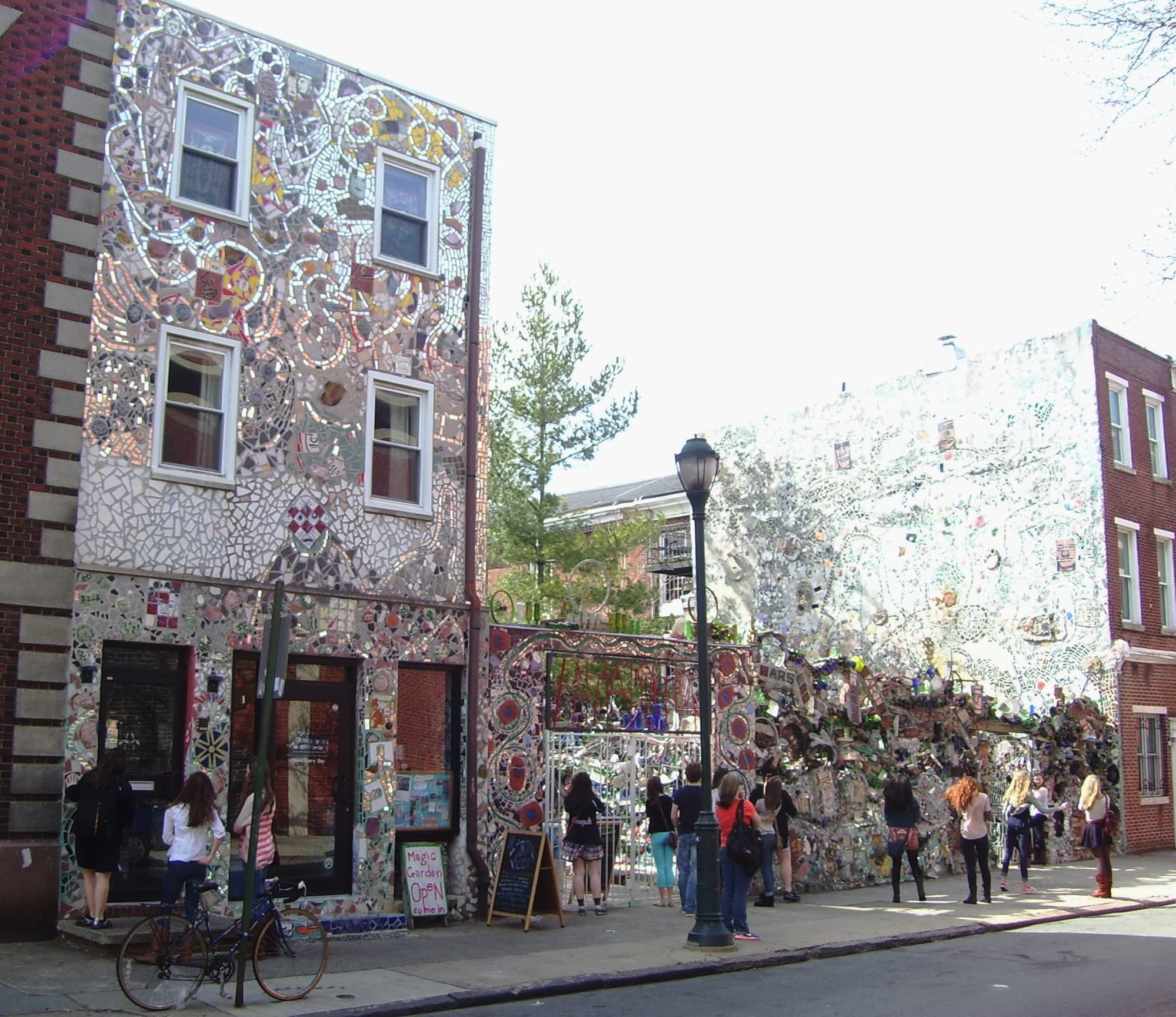
The most visible legacy of that era is also its most beautiful. In 1968, mosaic artist Isaiah Zagar and his wife Julia moved to South Street, fresh from Peace Corps service in Peru, and opened the Eyes Gallery at 402 South Street — the first property Zagar would cover in his signature mosaics. The couple renovated derelict buildings, tiled walls both public and private, and helped lead the neighborhood's revival, a period locals called the South Street Renaissance. Zagar went on to create more than 200 mosaic murals, most of them in Philadelphia, many of them within a few blocks of South Street: walls, gates, and alleyways glittering with handmade tiles, mirror shards, glass bottles, bicycle wheels, china plates, and Latin American folk art.
His largest work stands at 1020 South Street, between 10th and 11th Streets: Philadelphia's Magic Gardens, a half-block folk-art environment of indoor galleries and a bi-level outdoor labyrinth, built over fourteen years beginning in 1994 in vacant lots beside his studio. The Gardens faced their own demolition threat in the early 2000s, when the lots' owner decided to sell — and the neighborhood, again, refused to let the art be destroyed. The community organized, the lots were purchased, and Philadelphia's Magic Gardens was incorporated as a nonprofit. It opened to the public in 2008 and remains the corridor's single most visited artistic landmark. Zagar died in February 2026 at the age of 86, and the Gardens now stand as his monument — a place he built, tile by tile, out of other people's discards, on a street that had itself been discarded.
You do not need a ticket to the Gardens to see Zagar's South Street. Walk the blocks between 8th and 11th Streets and look up: mosaics frame doorways, climb stairwells, and spill down side alleys like Jessup Street, where entire walls shimmer within arm's reach. The street is, in effect, an open-air gallery, and the best pieces are the ones you stumble on.
Cheesesteaks and the storefront parade
South Street's other great tradition is eating while you walk. In 1976, Jim's Steaks of West Philadelphia expanded to 400 South Street, its first franchise location; the shop has since split from the original and now operates separately as Jim's South Street, but the corner remains a rite of passage — a cheesesteak eaten standing up, on the sidewalk, in the middle of the parade. Around it, the storefronts tell the street's story in miniature: the Famous 4th Street Deli, a few steps off the corridor, serving the kind of old-school deli food that has anchored the neighborhood for generations; tattoo parlors and piercing studios that date to the street's punk years; vintage and streetwear shops; record stores; coffee counters; and, increasingly, national chains that arrived with the tourist crowds of the late 1980s and 1990s.
That shift is the honest complication in South Street's story. In the late 1980s, the street became one of the city's main tourist attractions, and many of the clubs that made it famous closed, replaced by shops catering to visitors. The "neighborhood" feeling that the artists and musicians had built thinned out. A 2026 Drexel University thesis on the corridor found that South Street has lost more than half its cultural anchors and that commercial vacancy has climbed to a 30-year high — a sobering measure of how much of the old street has already gone, even as revival efforts under the banner of "Saving South Street" work to stabilize the corridor's remaining independent businesses. The street today is both things at once: a genuine Philadelphia institution and a place fighting to stay one.
The harder chapters belong in the story too. On June 4, 2022, three people were killed and eleven others were injured in a shooting on the 400 block of South Street, on a crowded Saturday night. It was a tragedy for the victims, their families, and a neighborhood that gathers on those sidewalks every weekend — and it is part of why the corridor's future, and who gets to feel safe and welcome on it, is argued over so fiercely today.
Walking South Street
The best walk starts at the eastern end, where the corridor is oldest. Begin at Headhouse Square, at 2nd and Pine, among the brick market buildings and cobblestones, then turn south to South Street itself and walk west. The first blocks — Front to 5th — are the Headhouse District proper: dense, low-rise, and commercial, the stretch the Orlons were singing about. Notice the mix: a cheesesteak counter beside a tattoo studio beside a boutique beside a bar that has been there longer than you have been alive. At 4th Street, dip south to Fabric Row, where the garment district survives in bolts of cloth and shop windows full of trim.
Keep walking west past 8th Street, and the street opens up into its mosaic heart. Between 10th and 11th, stop at Philadelphia's Magic Gardens — check its official site before visiting for current hours and admission, since neither is stated as fact here — and then keep your eyes on the walls for Zagar's smaller murals all the way to Broad Street. If you have time, continue west across the South Street Bridge, rebuilt in 2010 to replace a 1923 double bascule bridge, for the skyline view back over the Schuylkill — the panorama that has become the corridor's signature photograph, and the western bookend of a street that runs, in full, from river to river.
Come in the evening if you can. South Street after dark is when the music rooms, the neon, and the sidewalk crowds make the most sense — and when the street most resembles the place the Orlons sang about, the place Fear name-checked, the place where Philadelphia has always gone to be a little louder, a little stranger, and a little more itself than anywhere else in the city.
Key Facts
- South Street is an east-west corridor in Philadelphia running from Front Street at the Delaware River west to 33rd and Spruce Streets in University City, crossing the Schuylkill on the South Street Bridge; it is the southern border of Center City and the northern border of South Philadelphia.
- In William Penn's 1682 plan it was Cedar Street, the city's southern boundary; it was renamed South Street in 1854, when the Consolidation Act expanded the city to 130 square miles.
- Southwark Theatre, the first permanent playhouse in the American colonies, was built in 1766 on the south side at Leithgow Street because Quaker Philadelphia banned live theater in the city.
- Eastern South Street held Swedish and Dutch settlers first, then Irish immigrants in the early to mid-1800s, then Jewish and Italian immigrant shops and theaters; western South Street became a cultural and commercial center for South Philadelphia's African American community.
- W.E.B. Du Bois's 1899 The Philadelphia Negro took the Seventh Ward, bordered by South Street, as its subject; William Gardner Smith's 1954 novel South Street is set on the corridor.
- Garment district until the 1950s; Fabric Row on 4th Street (Bainbridge to Catharine) preserves that trade.
- Proposed Crosstown Expressway (linking I-76 and I-95) would have demolished many South Street and Bainbridge Street buildings; property values fell, artists and counterculture moved in, and community opposition led by Alice Lipscomb helped kill the plan by the mid-1970s; it was never built.
- Clubs in the 1960s–1970s fostered live music (Kenn Kweder, George Thorogood, Robert Hazard); South Street was the punk center in the mid-late 1970s–1980s with J.C. Dobbs and Zipperhead.
- Isaiah Zagar and Julia moved to South Street in 1968 and opened Eyes Gallery at 402 South Street; Zagar created 200+ mosaic murals. Philadelphia's Magic Gardens at 1020 South Street was built over fourteen years from 1994, saved from sale/demolition by community organizing in the early 2000s, incorporated as a nonprofit, and opened to the public in 2008; Zagar died in February 2026 at age 86.
- Jim's Steaks expanded to 400 South Street in 1976 as its first franchise, now separately owned as Jim's South Street. Theatre of Living Arts at 334 South Street; Andrew Dice Clay recorded The Diceman Cometh there in January 1989.
- Popular culture: Orlons "South Street" January 1963; Fear "I Don't Care About You" May 1982 opens "South Street Philadelphia"; Dead Milkmen "Punk Rock Girl" December 1988 opens at Zipperhead; Boyz II Men "Motownphilly" April 1991 references South Street, partly filmed there; Green Day Philadelphia debut at J.C. Dobbs January 1993; 5th-to-6th block in opening credits of It's Always Sunny in Philadelphia (2005–2012).
- Headhouse Square: New Market on South 2nd Street dates to 1745; Head House built 1804 as a firehouse, the oldest extant firehouse in the U.S., now a community center; market sheds once extended to South Street. South Street Bridge rebuilt 2010, replacing a 1923 double bascule bridge; South Street is one-way eastbound from 27th Street to Front Street. June 4, 2022 shooting on the 400 block: three killed, eleven injured. A 2026 Drexel thesis ("Saving South Street") found the street has lost more than half its cultural anchors, with commercial vacancy at a 30-year high.
South Street in Photographs