Miami's Manhattan, on the bay
Every great city has a district where it does its serious business and shows off at the same time. In Miami, that district is Brickell. Cross the Miami River south from downtown on Brickell Avenue — U.S. Route 1 — and the city changes character in a single bridge span. The low, historic streets of downtown give way to a dense wall of glass condominiums and office towers, packed tightly along the bayfront, their balconies facing Biscayne Bay and the cruise ships sliding toward the Port of Miami. This is the neighborhood locals call Miami's Manhattan, and the nickname is not just about height. Brickell is where Miami's international banks keep their offices, where its condominiums stack residents by the thousands, and where its sidewalks stay busy long after the offices close — because here, unlike in most American financial districts, people actually live above the banks.
Stand on Brickell Avenue at dusk and the neighborhood explains itself. The avenue runs south from the river bridge as a canyon of towers, palm trees lining the sidewalks, the Metromover gliding overhead on its elevated loop, joggers and dog-walkers threading between office workers heading home. Turn east and you reach the bayfront, where Brickell Key sits just offshore behind its own small bridge, and where the water opens up to Biscayne Bay. Turn west and the neighborhood softens into the Brickell Backyard section of the Underline, the linear park beneath the Metrorail, where a farmers market sets up and families gather under the tracks. Brickell is compact — you can walk its spine in well under an hour — but it contains more of modern Miami than any other square mile in the city: its money, its towers, its waterfront, and, underneath it all, its oldest history.
That history is older than Miami itself. Brickell takes its name from William and Mary Brickell, who arrived in the 1870s and ran a trading post on the south bank of the Miami River, trading with the Seminole people and the handful of settlers in the area. The Brickells were among the founders of the city that would grow around them, and the avenue that bears their name was once Millionaire's Row, lined with the great winter mansions of Miami's early elite. Almost all of those mansions are gone now, replaced by towers, but the name stuck, and so did the character: Brickell has always been the address for people who came to Miami to do business and decided to stay.
The avenue: banks, towers, and Millionaire's Row
Brickell Avenue is the neighborhood's spine and its reason for being. As U.S. Route 1, it carries the city's main north-south road across the Miami River on the Brickell Avenue Bridge, a bascule bridge whose 1995 replacement carries a tall bronze sculpture by Cuban-born artist Manuel Carbonell. The bridge is worth a pause in itself: it is the hinge between downtown and Brickell, and when it opens for river traffic, the whole avenue stops to watch boats pass beneath the towers.
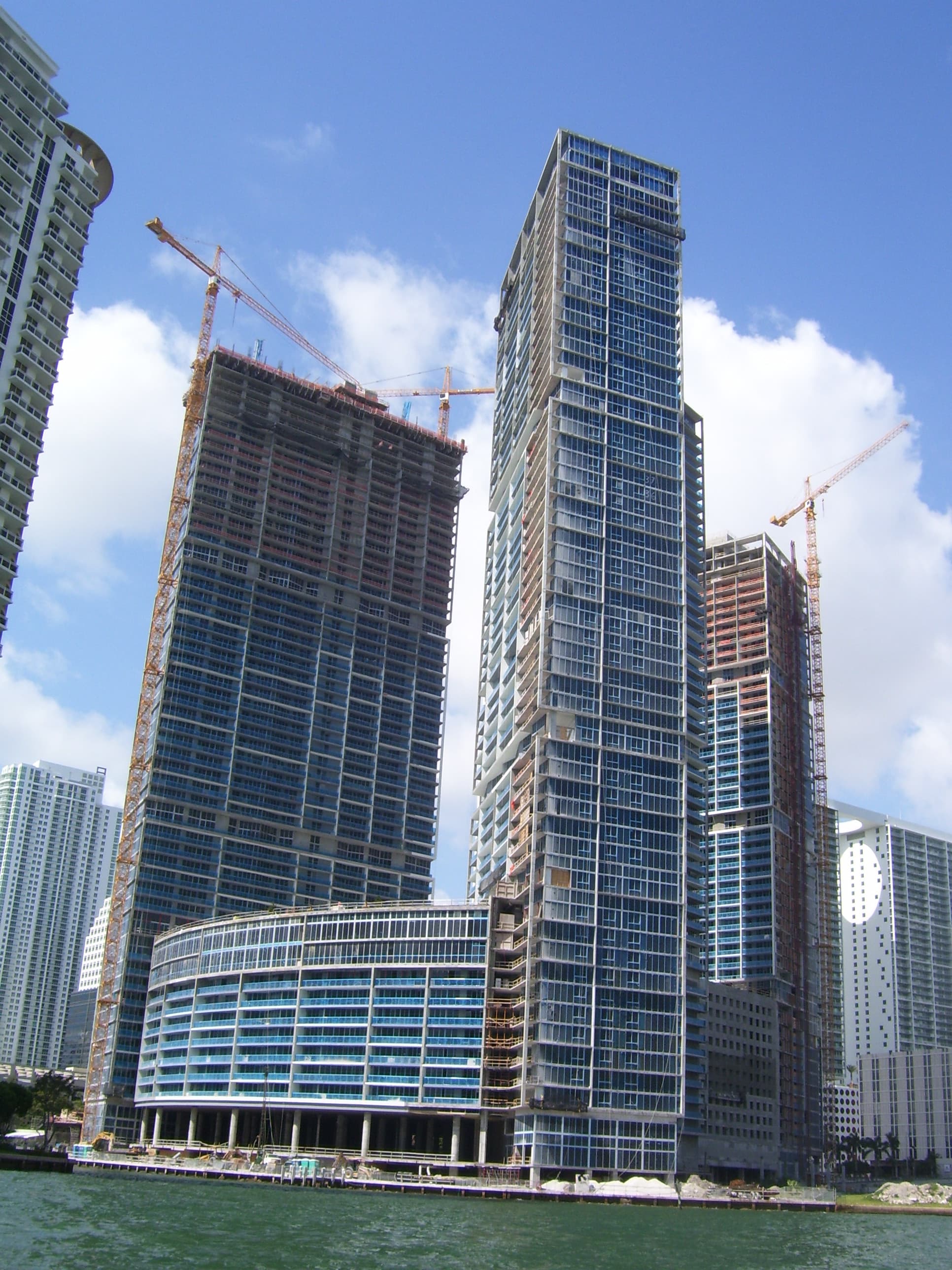
South of the bridge, the avenue is lined with the headquarters and offices of international banks, law firms, and consulates — the reason Brickell is often called the Wall Street of the South. Latin American finance has centered here for decades, and the result is a neighborhood that feels genuinely international: Spanish and Portuguese are as common on the sidewalks as English, and the lunch crowd is as likely to be discussing a deal in São Paulo or Bogotá as in New York. The towers themselves tell the story of Miami's building booms. The Icon Brickell complex, with its twin curved towers on the bayfront, is one of the neighborhood's signature silhouettes. The Four Seasons Hotel Miami and the Panorama Tower rise among the tallest buildings in the city, and newer towers keep joining them — Brickell's skyline is still changing, crane by crane, and a photograph of it from even a few years ago already looks dated.
But Brickell Avenue is not only offices. Its ground floors hold restaurants, cafés, and shops, and its side streets hold the residential life that makes the neighborhood work after dark. Mary Brickell Village, the open-air shopping and dining center a few blocks west of the avenue, is the neighborhood's living room — a place where residents meet for dinner and visitors can get a first taste of Brickell's restaurant scene. The avenue's sidewalks, shaded by palms and lined with storefronts, are among the most walkable in Miami, and walking them is the best way to understand the neighborhood: tower lobbies and valet stands on one side, bay breezes and joggers on the other.
Brickell City Centre and the new downtown
If Brickell Avenue is the neighborhood's history, Brickell City Centre is its present. The massive mixed-use complex, developed by Swire Properties and opened in 2016, spans several city blocks just west of Brickell Avenue, rising over South Miami Avenue. It is part shopping center, part office and residential complex, part public space — and its most distinctive feature is the Climate Ribbon, a sweeping, latticed canopy of steel and glass that arcs over the open-air shopping levels, catching breezes and shading shoppers from the Miami sun while letting the air move through. On a hot afternoon, standing under the Ribbon with the towers rising around you is the most Brickell experience there is: commerce, architecture, and climate, all handled at once.
The Centre anchors the western side of the neighborhood and draws visitors who might otherwise never leave the beach. Its shops and restaurants are upscale and international, its public spaces are genuinely public, and its design — open to the street rather than sealed off like a suburban mall — fits the neighborhood's walkable character. Come here for lunch or for an evening out, and then walk east toward the bay: the contrast between the Centre's polished modernism and the older, grittier streets near the river is Brickell in miniature, a neighborhood that rebuilt itself tower by tower without ever quite erasing what came before.
The river, the bay, and Brickell Key
Brickell's other great asset is water. The neighborhood is bounded by the Miami River to the north and Biscayne Bay to the east, and its waterfront is its playground. The Miami Riverwalk runs along the river's south bank, where you can watch yachts and working boats share the same narrow channel — the river is still a working waterway, and its drawbridges still open for traffic. The Brickell Avenue Bridge is the most famous of them, but the whole riverfront rewards a slow walk, especially at sunset, when the towers catch the light and the water turns gold.
East of the avenue, Brickell Key is a small island neighborhood reached by its own causeway bridge, a quiet loop of luxury condominiums and a hotel around a marina, with a running path that circles the island. It is one of the calmest walks in the neighborhood — a flat, scenic loop with the downtown skyline on one side and the open bay on the other — and it is the best place in Brickell to see the skyline whole, from across the water. The island's calm is a useful corrective to the avenue's bustle: Brickell is not only towers and traffic, but also water, wind, and open sky.
At the mouth of the river, on Brickell Point, sits the neighborhood's deepest story. The Miami Circle, discovered during construction in 1998, is an archaeological site of the Tequesta people, the Native inhabitants of the Miami area, with carved basins in the limestone bedrock dated to more than 2,000 years ago. The site was designated a National Historic Landmark in 2009, and it is a reminder that Brickell's waterfront was a gathering place long before it was a financial district. The Circle's story — a modern construction site revealing an ancient village — is Miami's history in a single episode, and it belongs at the start of any honest account of this neighborhood.
The Underline and the neighborhood's backyard
Brickell's newest public space runs not along the water but underneath the train. The Underline is a linear park and trail being built beneath Miami's elevated Metrorail, and its Brickell Backyard section, at the neighborhood's western edge, is where the project begins. Here, under the tracks, are walking and cycling paths, public art, playgrounds, and gathering spaces — and a farmers market that brings the neighborhood together on market days. The Underline matters because it gives Brickell something its towers cannot: ground-level green space, shade, and a place to simply be outside without an agenda. On a weekend morning, the Backyard fills with runners, cyclists, families, and market shoppers, and the neighborhood's density suddenly feels like an asset rather than a crowd.
For a contrast to all that glass and concrete, seek out Simpson Park Hammock, a small nature preserve tucked into the neighborhood's southwest corner. It protects a rare patch of tropical hardwood hammock — the dense, shady forest that once covered much of South Florida — and walking its short trails feels like stepping out of the city entirely. Between Simpson Park, the Underline, the riverwalk, and the Brickell Key loop, Brickell offers more outdoor variety than most visitors expect from a financial district, and it is this variety that makes the neighborhood worth a full visit rather than a drive-through.
How to visit, and what to see around it
Brickell sits just south of the Miami River in downtown Miami, bounded by the river to the north, Biscayne Bay to the east, and roughly Southwest 15th Road and the Metrorail corridor to the south and west. The neighborhood's center is Brickell Avenue, and the GPS point for this article (25.7655, -80.1935) falls on the Brickell Avenue corridor, matching the location recorded for a March 2026 photograph of the neighborhood used here. The Metromover's Brickell loop and the Metrorail's Brickell station both serve the neighborhood, and the area is best explored on foot — park once, or arrive by transit, and walk.
A good Brickell visit starts on Brickell Avenue itself. Walk south from the river bridge, pausing to watch the bridge and the river traffic, then turn east toward the bay and the Brickell Key loop for the skyline view. Come back along the bayfront and cut west to Brickell City Centre for lunch and a look at the Climate Ribbon, then finish at the Underline's Brickell Backyard for a walk under the tracks. If you have more time, add Simpson Park Hammock for a taste of old Florida forest, and the riverwalk for sunset. Brickell pairs naturally with downtown Miami across the river — the Pérez Art Museum Miami and the Frost Museum of Science are a short trip north — and with Coconut Grove to the south, Miami's oldest neighborhood and a useful contrast to Brickell's towers.
Do not state a restaurant price, a shop's hours, or a tour time as fact from this article alone — venues in Brickell change frequently, and the venues' own sites are the authority. Check the official sources for Brickell City Centre, the Underline, and Miami-Dade transit before visiting for current hours, schedules, and service information.
Brickell is sometimes described as Miami's future, and there is truth in that: it is dense, vertical, international, and still growing. But it is also Miami's past, from the Tequesta circle at Brickell Point to the Brickell family's trading post to the mansions of Millionaire's Row. Walk the avenue, cross the bridge, circle the Key, and rest in the park under the tracks, and you will have seen both — a neighborhood that built its towers on very old ground, and that still leaves room, between the banks and the bay, for a walk, a market, and a sunset.
Location Photography


Architectural & Historical Highlights
- Brickell is Miami's downtown financial district and waterfront neighborhood, just south of the Miami River, bounded by Biscayne Bay to the east; called the Wall Street of the South and Miami's Manhattan.
- Named for William and Mary Brickell, who ran a trading post on the south bank of the Miami River in the 1870s; Brickell Avenue was once Millionaire's Row.
- Brickell Avenue is U.S. Route 1, crossing the Miami River on the Brickell Avenue Bridge, a bascule bridge replaced in 1995 with a bronze sculpture by Manuel Carbonell.
- Icon Brickell twin curved towers are a bayfront signature; Four Seasons Hotel Miami and Panorama Tower are among the tallest buildings in the city.
- Brickell City Centre, developed by Swire Properties, opened in 2016, with the Climate Ribbon, a latticed steel-and-glass canopy.
- Brickell Key is a small island east of the avenue, reached by a causeway bridge, with a marina, condominiums, and a scenic walking loop.
- Miami Circle at Brickell Point, discovered in 1998, Tequesta site with carved limestone basins over 2,000 years old, National Historic Landmark 2009.
- Underline linear park under the Metrorail, Brickell Backyard section with paths, art, playgrounds, and farmers market.
- Simpson Park Hammock in the southwest corner protects a rare patch of tropical hardwood hammock.
- Mary Brickell Village west of the avenue is an open-air shopping and dining center.
- Served by Metrorail Brickell station and the Metromover Brickell loop; best explored on foot.