A Neighborhood Built by Exile
Little Havana began as somewhere else. In the 1930s the blocks west of the Miami River — the old Riverside and Shenandoah districts — were lower-middle-class streets, home to Southern families and a thriving Jewish community, their bungalows and small apartment buildings shaded by palms a short streetcar ride from downtown. What transformed them was a revolution ninety miles offshore. After Fidel Castro took power in Cuba in 1959, exiles arrived in Miami in waves — first the wealthy and professional classes, then, through the 1960s, nearly everyone who could get out — and they settled where rents were cheap and the streetcar-era housing stood waiting. Most expected to stay a year, maybe two, until Castro fell. By 1970 the neighborhood was more than 85 percent Cuban, and the temporary landing place had quietly become a permanent city within the city: the cultural and political capital of Cuban America, and the best-known Cuban exile neighborhood in the world. Later waves renewed it — most dramatically the 1980 Mariel boatlift, which brought some 125,000 more Cubans to South Florida in a single season, many of them settling first in the same Riverside blocks. Each arrival, whatever the decade, followed the same path: a relative's couch in Little Havana, a job found through someone from the neighborhood, a first colada at a ventanita. The place functioned as the exile community's reception hall, employment office, and town square combined.
Calle Ocho: The Main Street of a Havana That Moved
The neighborhood's spine is Southwest 8th Street — Calle Ocho — the old Tamiami Trail running west from the river. Walk it and the street tells the story in storefronts: hand-painted signs in Spanish, bakeries selling guava pastelitos, record shops, botánicas, fruit stands, and restaurants where lunch is ropa vieja and the television argues politics. Set into the sidewalks is the Calle Ocho Walk of Fame, stars honoring the artists who soundtracked the exile century — Celia Cruz, Gloria Estefan, Desi Arnaz, Julio Iglesias, Willy Chirino. At the corners stand the neighborhood's mascots, six-foot fiberglass roosters painted in carnival colors, installed as a public-art flock in the early 2000s. A block north, along Southwest 13th Avenue, Cuban Memorial Boulevard holds the neighborhood's solemn register: monuments to Cuba's independence heroes, a statue of José Martí, and an eternal flame for the exiles who died in the 1961 Bay of Pigs invasion — a reminder that in Little Havana, memory is not decoration. It is infrastructure.
Domino Park: The Beating Heart
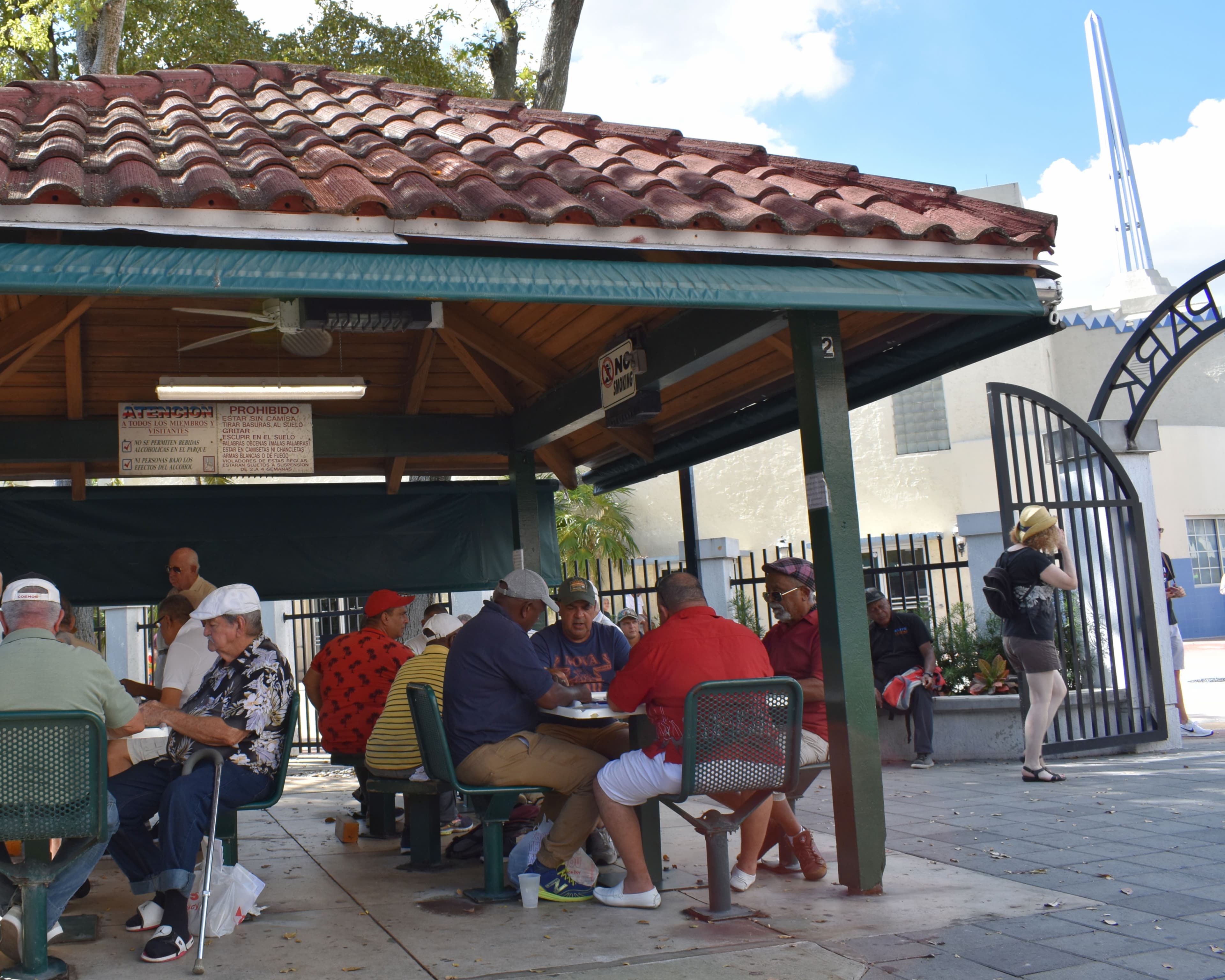
At the corner of Calle Ocho and 15th Avenue sits a small shaded park formally named for Máximo Gómez, the Dominican-born general who fought for Cuban independence — and known to everyone simply as Domino Park. Since the 1970s this has been the neighborhood's front porch and debating society: rows of tables under the trees where the regulars — most of them older exiles, many in crisp guayaberas — play dominoes with theatrical slams of the tiles, drink cafecito, smoke cigars, and conduct the day's political arguments at full volume. The games are not a performance staged for visitors; tourists are welcome to watch from the edges, but the tables belong to the players, and the rhythm of the place — the click of tiles, the bursts of laughter and outrage — is the sound of a community keeping itself intact, one game at a time. The park is small — a single shaded lot with tiled tables, benches, and busts of Cuban heroes — but its scale is the point. In Havana, this social world lived in clubs and cafés that the revolution scattered; here it was rebuilt in the open air, in public, where anyone passing on Calle Ocho can hear it happening. If Little Havana has a single image the world knows, it is this one.
Coffee, Cigars, and the Ventanita
Little Havana runs on coffee, and its distribution system is the ventanita — the walk-up window cut into the side of a café, where you order standing on the sidewalk and the whole transaction takes ninety seconds. The order matters: a cafecito, a thimble of sweet, dark espresso; a cortadito, cut with steamed milk; or a colada, a larger pour served with a stack of small cups meant to be shared with coworkers and strangers — coffee as social contract. A few windows down, the other sacrament is being rolled by hand: cigar makers, torcedores, sit in shopfront windows along Calle Ocho rolling leaves into cigars the way it was done in Havana's factories, a craft that arrived with the exiles and never mechanized. Factories like El Credito, founded here in 1968, anchor a strip where you can watch a cigar go from leaf to finished stick, then smoke it where it was born. At the western end of the classic strip, Versailles restaurant — open since 1971 and billing itself, with cause, as the world's most famous Cuban restaurant — serves as the exile community's unofficial parliament, its mirrored dining room and ventanita the first stop for every politician courting Miami.
The Tower Theater and the Festival Street
Anchoring the strip at 1508 Southwest 8th Street, the Tower Theater opened in 1926 as one of the South's grand movie palaces, its forty-foot tower sign lit over the street. In the 1960s the Tower took on a second job: it showed American films with Spanish subtitles, and a generation of newcomers learned English in its seats. Owned by the City of Miami and operated by Miami Dade College, it screens Spanish-language and independent film and hosts exhibitions today — the rare movie house that is also an immigration document. The street outside throws the parties. Every March, the Kiwanis Club of Little Havana's Calle Ocho Festival — running since 1978 as the climax of Carnaval Miami — closes more than twenty blocks for one of the largest street festivals in the United States. And on the last Friday of each month, Viernes Culturales — Cultural Fridays, held since 2000 — turns four blocks around Domino Park into an evening art fair: galleries open late, stages go up on the sidewalks, and a free walking tour with a local historian leaves from the Tower Theater. On an ordinary weekday, though, the neighborhood needs no festival. Ordinary is the attraction. Music leaks from doorways all day — from record shops, from the salsa bands setting up at Ball & Chain, the 1935 saloon across from Domino Park reborn as a live-music room, from car radios at the light — and the street supplies its own schedule of small events: a domino final, a cigar roller starting a fresh leaf, a cafecito arriving exactly when the conversation needs one.
A Neighborhood Under Pressure
Little Havana is changing, in two directions at once. The exile generation's children largely moved to suburbs like Hialeah and Kendall, and since the late 1990s the neighborhood has filled with newer arrivals — Nicaraguans, Hondurans, and other Central and South Americans — who have made its streets more diverse while keeping its Spanish-first, small-business character; most storefronts remain Cuban-owned, and the dominoes continue. The harder pressure is money: as downtown and Brickell boom a mile east, developers have circled a neighborhood of one- and two-story buildings on suddenly valuable land, and residents fear the fate of other Miami districts remade beyond recognition. The National Trust for Historic Preservation put Little Havana on its 11 Most Endangered Places list in 2015 — then, in 2017, took the rarer step of declaring it a national treasure, an official acknowledgment that what stands here is not just real estate. The argument over Little Havana's future is really an argument about whether a neighborhood created by displacement gets to stay. For now, the tiles still slam at Domino Park, the ventanitas still pour, and Calle Ocho remains what the exiles made it: Havana, rebuilt at walking scale.
Key Facts
- Little Havana (Pequeña Habana) stretches west from the Miami River across roughly two and a half miles; before the Cuban influx of the 1960s it was the lower-middle-class Riverside and Shenandoah districts, and by 1970 it was more than 85% Cuban.
- Calle Ocho (SW 8th Street, the Tamiami Trail) is the main street, lined with the Walk of Fame honoring Celia Cruz, Gloria Estefan, Desi Arnaz, and other Latin stars, plus painted fiberglass roosters at its corners.
- Máximo Gómez Park — Domino Park — at SW 8th Street and 15th Avenue has hosted daily domino games since the 1970s and is the neighborhood's social heart.
- The Tower Theater (1926) at 1508 SW 8th Street helped 1960s exiles learn English via subtitled films; today Miami Dade College operates it as a cultural center.
- Signature rituals: cafecito and colada shared at sidewalk ventanitas, and cigars hand-rolled by torcedores in Calle Ocho shop windows (El Credito has rolled here since 1968).
- The Calle Ocho Festival (since 1978, each March) and monthly Viernes Culturales (since 2000) headline the calendar; the National Trust named Little Havana a national treasure in 2017 after listing it among America's 11 Most Endangered Places in 2015.
Visitor Details
Address: Walk the classic strip of SW 8th Street (Calle Ocho) between roughly SW 12th and SW 17th Avenues; the anchor point is Máximo Gómez (Domino) Park at 1445 SW 8th Street, corner of SW 15th Avenue. The Tower Theater stands two blocks east at 1508 SW 8th Street.
Transit: The free City of Miami trolley serves Little Havana, and Metrorail's Brickell and Civic Center stations connect by bus and trolley from downtown; rideshares are plentiful. Driving is possible but street parking near Calle Ocho is tight — garages and side streets fill quickly on festival days, when the street itself closes.
Hours/Admission: A neighborhood has no hours and no gate — the streets, Domino Park, and the Walk of Fame are public and free at any time. Individual businesses, the Tower Theater's screenings, and the cigar shops keep their own hours and prices, so check ahead for anything specific; domino games run through the day, weather permitting.
Best timing: Late morning on a weekday for the neighborhood's everyday rhythm — full domino tables, ventanita lines, rollers at the windows. Come on the last Friday evening of the month for Viernes Culturales, and in March for the Calle Ocho Festival. Start at Domino Park, walk east past the Tower Theater, then double back for lunch — Versailles at 3555 SW 8th Street is the classic full-service stop.
Little Havana: Photo Gallery