A museum the size of a jewel box, with a giant inside
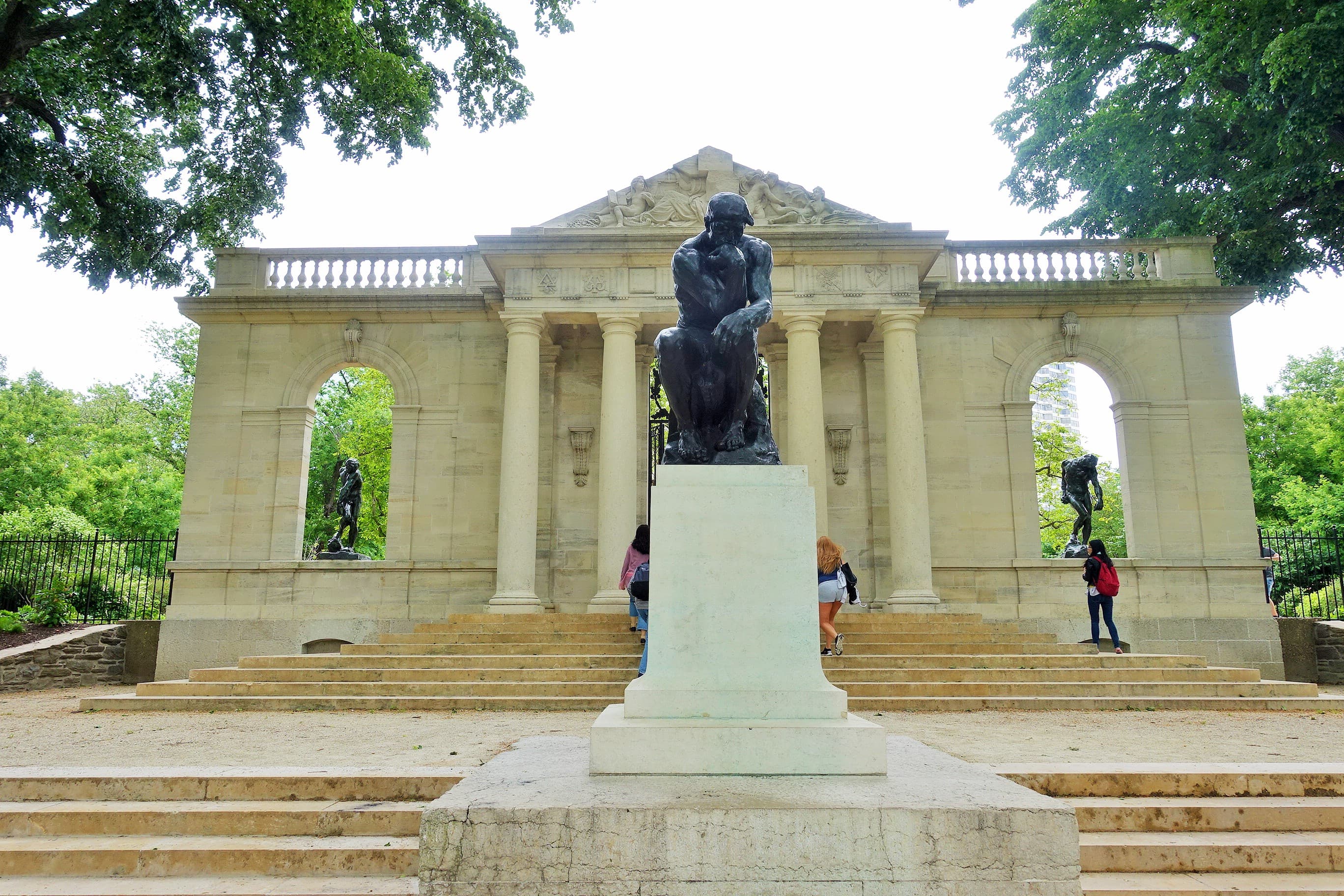
Philadelphia's Benjamin Franklin Parkway is a grand civic gesture — a wide, tree-lined boulevard modeled on the Champs-Élysées, running from City Hall to the Philadelphia Museum of Art — and along it sit the city's great cultural institutions. Halfway down that run, between the Barnes Foundation and the art museum's steps, stands a smaller building that stops first-time visitors in their tracks. It is low, pale, and classically calm, set behind a formal garden and a reflecting pool. And in front of it, on a pedestal, sits a naked man with his chin on his fist, thinking so hard you can see it in his toes.
That is The Thinker, and the building behind it is the Rodin Museum — Philadelphia's museum devoted to a single artist, the French sculptor Auguste Rodin (1840–1917), widely regarded as the founder of modern sculpture. It is one of the most beloved small museums in America, and it holds a superlative that sounds almost too good to be true: the largest collection of Rodin's work outside Paris, nearly 150 bronzes, marbles, and plasters, spanning every phase of his career. You can see the whole museum in about an hour, and that is part of its charm. It is not a warehouse of art. It is a portrait of one genius, told in bronze and marble, in a building designed specifically to hold it.
The Rodin Museum is also, unusually, a museum you can enjoy without ever going inside. The garden is free to wander, and several of Rodin's most famous works stand outdoors among the hedges, pools, and paths — The Thinker, The Burghers of Calais, The Three Shades, The Gates of Hell itself at the entrance. Come for the garden on a fine day, stay for the galleries, and you will have had one of Philadelphia's most complete museum experiences in a single compact visit.
The movie-theatre magnate who fell in love in Paris
The museum exists because of one man's sudden, total passion. Jules E. Mastbaum (1872–1926) was a Philadelphia entrepreneur who had built a fortune in real estate and then in the young motion-picture business, owning a chain of movie theatres across the city. In September 1924, on a visit to Paris, he walked into the fledgling Musée Rodin and bought a small bronze bust. That purchase lit a fuse. Within three years, Mastbaum had assembled the largest collection of Rodin's work outside Paris: more than two hundred sculptures, some six hundred drawings, and a group of marbles and plasters, bought both from casts made during Rodin's lifetime and from new casts struck from the sculptor's original plaster molds after his death.
Mastbaum did not want a private collection. In 1926 he wrote to the commissioners of Fairmount Park offering his collection to the city and asking for land on the Benjamin Franklin Parkway on which to build a museum and garden, at his own expense, to display it. The commission granted a vacant lot, and Mastbaum hired two Frenchmen living in Philadelphia to design it: architect Paul Cret (1876–1945), a professor of architecture at the University of Pennsylvania, and landscape architect Jacques Gréber (1882–1962), the man who had conceived the overall design of the Parkway itself almost a decade earlier. A young Louis Kahn was among the architects who worked on the project.
Mastbaum never saw his museum finished. He died suddenly in 1926, the same year he commissioned it, at the age of fifty. His widow, Etta Wedell Mastbaum, honored his commitment and saw the building completed. The Rodin Museum opened to the public on November 29, 1929, as a gift to the city of Philadelphia, and it was embraced immediately: more than 390,000 visitors came in its first year. Since 1929, the museum has been administered by the Philadelphia Museum of Art, and admission to one has long been tied to the other — but the Rodin has always kept its own intimate character, a single artist's world in a single building.
A Beaux-Arts temple and a French garden
The building Cret and Gréber made is small on purpose, and that is its genius. A temple-like Beaux-Arts structure in pale limestone, it holds a skylit central gallery, two smaller rooms, and a library, with murals by the painter Franklin C. Watkins. It does not overwhelm the sculpture; it frames it. Light falls from above, the rooms are human in scale, and the bronzes stand close enough to walk around, to see the rough, turbulent surfaces Rodin modeled with his fingers — surfaces that broke with the smooth, idealized finish of academic sculpture and announced modern sculpture instead.
Outside, Gréber's formal French garden does the same work in the open air. A reflecting pool, clipped hedges, gravel paths, and a stone balustrade make a setting that deliberately echoes Rodin's own house and studio at Meudon, outside Paris. The entrance façade itself is a replica of the garden façade of the château at Issy that Rodin had purchased and reconstructed at Meudon — so that the Philadelphia arrangement, with The Thinker standing before that façade, matches the arrangement at Rodin's tomb. Eight sculptures stand in the garden, from the small and sensual Eve tucked into an arch of the façade to the massive, rhythmic Burghers of Calais. In 2012, after a three-year, nine-million-dollar renovation that returned the museum to Cret and Gréber's original 1929 vision — sculptures back in their original locations inside and out, nearly all of them refurbished — the garden was rejuvenated again under the landscape firm OLIN, following the spirit of the original plans.
Stand in the garden and you understand the museum's argument: Rodin's work belongs outdoors as much as in a gallery. Bronze was made to weather sun and rain, and figures modeled from living bodies look most alive with sky behind them.
The Thinker at the gate
Every visit begins, whether you plan it or not, with The Thinker. The monumental bronze sits in the entry courtyard, on a pedestal, chin resting on his hand, every muscle taut with inward focus. He is one of the most recognizable sculptures on earth, and Philadelphia's cast is one of the earliest authorized editions: modeled in 1880–81, enlarged in 1902–04, cast in 1919, and installed for the museum's opening in 1929, a bequest of Jules E. Mastbaum.
The Thinker was never meant to stand alone. Rodin first conceived the figure as a smaller element crowning The Gates of Hell, where he was called The Poet — Dante Alighieri himself, seated above the Inferno, pondering the souls suffering below. Rodin exhibited the figure independently in 1889, giving it the title The Thinker, and in 1902 embarked on the larger version that became the monument we know. Foundry workers and the public had already started calling it The Thinker, and the name stuck, turning a study for a doorway into a universal symbol of human contemplation. Rodin himself said the figure thinks with every part of its form — the clenched fist, the gripping toes, the tense back — not just with its brain.
Walk around him before you go in. From the Parkway, his silhouette against the pale limestone is the museum's invitation. Up close, the rough bronze surface, the knotted brow, the weight of the body sunk into thought, repay the attention. A smaller version of The Thinker waits inside the galleries, too — the figure as it first appeared, perched above the Gates, before it outgrew them.
The Gates of Hell: thirty-seven years in bronze
If The Thinker is the museum's greeter, The Gates of Hell is its soul. The towering bronze doorway — some twenty feet tall, five and a half meters — stands at the museum's entrance, and it is the defining project of Rodin's career, the work that consumed him for almost four decades and from which many of his most famous sculptures were born.
The story starts on August 16, 1880, when the French state commissioned Rodin to design a pair of bronze doors for a proposed Museum of Decorative Arts in Paris. The museum was never built, but Rodin kept working on the doors until his death in 1917, continually adding, removing, and altering the more than two hundred human figures that writhe across their surface. His inspiration was Dante's Inferno, with echoes of Baudelaire's Flowers of Evil: a panorama of damnation, desire, and despair, modeled in high and low relief, never finished, never cast in bronze during his lifetime. It was known only as a full-size plaster model kept at his studio in Meudon.
Philadelphia owns the first bronze cast ever made of The Gates. In 1925, Mastbaum paid for two castings from Rodin's plaster: one for Philadelphia, one for the Musée Rodin in Paris. The Philadelphia casting is one of only three original casts. Stand before it and look closely, and the whole museum starts to make sense: there is the small Thinker above the doors; there are the lovers who became The Kiss; there is Adam and Eve, the Three Shades, the crouching and tormented figures that Rodin later pulled out of the doorway, enlarged, and cast as independent works. The Gates is not just a masterpiece in the museum. It is the museum's family tree, with almost every gallery work branching off it. When the museum reopened after its renovation in 2012, its inaugural installation was dedicated to The Gates for exactly that reason.
The Kiss, the Burghers, and the rooms inside
Step inside, and the galleries reward the same slow looking. The highlight of the main gallery is The Kiss — but with a twist that tells you everything about how this collection was made. Philadelphia's Kiss is not a bronze cast by Rodin's hand; it is a marble copy completed in 1929, twelve years after Rodin's death, by the sculptor Henri Gréber — the father of the museum's landscape architect Jacques Gréber — working with the Musée Rodin's permission. The lovers, Paolo and Francesca from Dante's Inferno, were originally modeled as part of The Gates; Rodin removed them because their pure joy and tender romance clashed with the surrounding torment, and exhibited them independently, where critics and the public named them The Kiss. In marble, in a skylit room, they are still startling in their tenderness.
Elsewhere in the rooms: Eternal Springtime (1884), another pair of lovers caught in a different mood; The Age of Bronze (1875–76), the life-size male nude whose realism was so convincing that Rodin was accused of casting it directly from a living model; and the Colossal Head of Balzac, the brooding monument to the novelist that scandalized Paris when it was unveiled. The collection's drawings, prints, letters, and books — Mastbaum collected those too — round out the portrait of the artist at work.
Then go back outside for The Burghers of Calais, the museum's most moving outdoor work, standing in the garden away from the main path. The monument commemorates an episode from 1347, during the Hundred Years' War, when the English king Edward III, after besieging Calais for nearly a year, offered to spare the starving city on one condition: six of its leading citizens must walk out bareheaded, in sackcloth, with nooses around their necks, carrying the keys of the city, to face execution. The city of Calais commissioned the monument in 1884. Rodin sculpted the six men not as heroes on a pedestal but as ordinary men walking to their deaths — hesitant, grieving, resolute in different ways — and he insisted the group stand at ground level, with no pedestal, so viewers could walk among them and share their suffering intimately. Philadelphia's garden lets you do exactly that. Walk between the burghers, look at their faces one by one, and you will feel why this is considered one of the great public monuments ever made.
Why Rodin still matters
It is easy, standing in the garden, to forget how radical Rodin was. Before him, public sculpture was supposed to be smooth, idealized, and noble — gods and generals in perfect marble. Rodin modeled what he saw: bodies that sag and strain, hands that grip, faces caught mid-emotion, surfaces left rough with the marks of his fingers and tools. He let fragments stand as finished works — a torso, a hand, a head — and he let a single figure carry a whole story without narrative props. That is why he is called the founder of modern sculpture: almost every sculptor who came after him, from Brancusi to Giacometti, worked in the space he opened.
The Rodin Museum makes that argument without a lecture. Because it holds only Rodin, and because it holds him at every stage — early academic work, the Gates years, the late monuments — you can watch the revolution happen in one visit, from the smooth Age of Bronze to the storm-tossed Gates to the blocky, haunted Balzac. The museum's smallness is the point. In a big encyclopedic museum, Rodin is one room among hundreds. Here, he is the whole world, and the world is the right size to hold in your head for an afternoon.
How to visit well, and why it endures
The Rodin Museum rewards a simple plan, and it pairs beautifully with its neighbors. Begin in the garden, even if the museum itself is your destination: The Thinker, the Burghers, the Three Shades, and the Gates at the door are the overture. Then go inside for The Kiss, the Age of Bronze, and the Balzac head, and let the skylit galleries slow you down. Allow about an hour for the museum itself, and half a day if you pair it — as most visitors do — with the Philadelphia Museum of Art at the top of the Parkway steps and the Barnes Foundation next door, two of the greatest collections in America within a few minutes' walk.
Come out of the garden and you are on the Parkway itself, Philadelphia's grandest boulevard, with Logan Square behind you and the art museum's steps ahead. The Rodin sits at the hinge of the city's museum district, and that is no accident: Mastbaum chose the Parkway because Gréber had designed it to be Philadelphia's Champs-Élysées, a place where art and civic life meet outdoors. Nearly a century after it opened, the museum still works exactly as its founder intended — a gift to the city, open to anyone walking by, with its most famous citizen thinking in the garden, free to anyone who stops to look.
More than 390,000 people came in the first year, and the crowds have never really stopped. They come for The Thinker, and they stay because the museum gives them something rarer than a famous statue: a single artist, seen whole, in a building and a garden made only for him. That is why the Rodin Museum endures — not as a warehouse of masterpieces, but as a place where one man's lifelong obsession, cast in bronze, still stops strangers on the Parkway and makes them think.
Key Facts
- The Rodin Museum, at 2151 Benjamin Franklin Parkway, Philadelphia, PA 19130, opened to the public on November 29, 1929.
- The museum was the gift of movie-theatre magnate Jules E. Mastbaum (1872–1926) to the city of Philadelphia; he began collecting Rodin's work after a September 1924 visit to the Musée Rodin in Paris, and by 1926 owned more than 200 sculptures plus some 600 drawings, marbles, and plasters.
- Mastbaum commissioned French architect Paul Cret (1876–1945) and French landscape architect Jacques Gréber (1882–1962) to design the building and garden; Gréber had conceived the overall design of the Benjamin Franklin Parkway. Mastbaum died in 1926, and his widow Etta Wedell Mastbaum saw the museum completed.
- The museum is administered by the Philadelphia Museum of Art, which has run it since 1929; it drew more than 390,000 visitors in its first year.
- The collection holds nearly 150 bronzes, marbles, and plasters by Auguste Rodin (1840–1917), the largest collection of his work outside Paris, spanning every phase of his career.
- The Thinker in the entry courtyard was modeled in 1880–81, enlarged in 1902–04, cast in 1919, and installed for the museum's 1929 opening; it began as The Poet (Dante) atop The Gates of Hell, was exhibited independently in 1889, and is a bequest of Jules E. Mastbaum.
- The Gates of Hell was commissioned on August 16, 1880, for a proposed Museum of Decorative Arts in Paris that was never built; Rodin worked on it for 37 years until his death in 1917, with more than 200 figures inspired by Dante's Inferno. It was never cast in bronze in his lifetime; in 1925 Mastbaum paid for two castings, one for Philadelphia and one for the Musée Rodin in Paris. The Philadelphia cast, about 20 feet (5.5 meters) tall, is one of three original casts.
- The Kiss in the main gallery is a marble copy completed in 1929 by sculptor Henri Gréber, father of landscape architect Jacques Gréber, made with the Musée Rodin's permission; the lovers Paolo and Francesca were originally modeled for The Gates of Hell.
- The Burghers of Calais, commissioned by the City of Calais in 1884, depicts the six citizens who in 1347 offered themselves to Edward III after his nearly year-long siege; Rodin designed the group to stand at ground level with no pedestal.
- Other works on view include Eternal Springtime (1884), The Age of Bronze (1875–76), The Three Shades, Adam, The Shade, Eve, and the Colossal Head of Balzac; murals in the museum were executed by Franklin C. Watkins.
- The museum reopened in July 2012 after a three-year, nine-million-dollar renovation restoring Cret and Gréber's original 1929 vision, with sculptures returned to their original locations; the garden was later rejuvenated under the landscape firm OLIN.
- The entrance façade replicates the garden façade of the château at Issy that Rodin reconstructed at his Meudon property, matching the arrangement at Rodin's tomb, with The Thinker before it.
Visitor Details
Address: Rodin Museum, 2151 Benjamin Franklin Parkway, Philadelphia, PA 19130 (Fairmount / Parkway, between 21st and 22nd Streets, between the Barnes Foundation and the Philadelphia Museum of Art)
Transit: SEPTA bus routes 7, 32, 38, 48, and 49 serve the Parkway, and the PHLASH downtown loop stops nearby; Suburban Station is the closest regional rail station, and the museum is walkable from Logan Square and Center City.
Hours/Admission: Hours, admission arrangements, and any timed-entry or joint-ticket details change from time to time — check the official source at rodinmuseum.org (and philamuseum.org) before visiting to confirm current hours, admission, and any special arrangements.
Best timing: Allow about an hour for the museum itself. Start in the garden with The Thinker, The Burghers of Calais, and The Gates of Hell at the entrance, then see the skylit galleries inside, and pair the visit with the Philadelphia Museum of Art and the Barnes Foundation, both within a few minutes' walk on the Parkway.
Location Photography