The museum that holds the whole natural world
There is a short list of New York sights a first-time visitor names without thinking — the Statue of Liberty, the Empire State Building, Times Square, Central Park — and the American Museum of Natural History belongs on it. It is not an art museum, and it is not a history museum in the usual sense. It is a museum of everything else: of dinosaurs and whales, of meteors and minerals, of the peoples of the world and the universe itself. It occupies most of four blocks on the Upper West Side, between Central Park West and Columbus Avenue and 77th and 81st Streets, directly across from Central Park, and it holds more than 30 million specimens in its collections — fossils, plants, animals, rocks, meteorites, and cultural artifacts — of which only a small fraction can ever be on display at once.
That scale is the point. A visit here is not a tour of one subject but a walk through the natural world as science understands it, arranged floor by floor: the universe and the Earth down low, the halls of mammals and ocean life in the middle, the great fossil halls on the fourth floor, and human cultures woven through the building. No visitor sees all of it in one day, and that is fine. The museum rewards a plan, a few chosen halls, and the willingness to stand still in front of something very old and very large.
The museum is also, unusually for a museum of its size, a working research institution. Its scientists study and publish across astronomy, paleontology, anthropology, and biology, and its graduate school grants doctoral degrees in comparative biology — the first museum program in the United States to do so. The exhibits are the public face of that work, and the building has been growing to hold it for a century and a half.
From the Arsenal to Manhattan Square
The museum was the idea of Albert S. Bickmore, a naturalist who in 1861 proposed a museum of natural history for New York. After years of advocacy, and with the backing of prominent New Yorkers including Theodore Roosevelt Sr. and J. P. Morgan, the museum was established on April 6, 1869. It opened to the public on May 22, 1871, inside the Arsenal in Central Park — a borrowed home that it quickly outgrew.
The museum's first purpose-built structure rose in Manhattan Square, now Theodore Roosevelt Park, on the west side of Central Park. Designed by Calvert Vaux and Jacob Wrey Mould, it opened on December 22, 1877, and it is still the core of the complex. Over the decades the museum grew wing by wing around it — more than twenty interconnected buildings in total, housing 45 permanent exhibition halls, a planetarium, and a library. The grand neoclassical entrance pavilion on Central Park West, named for Theodore Roosevelt, came in 1936, designed by John Russell Pope with a great arch modeled on Roman triumphal arches; its terrace and steps are now the museum's familiar front door from the park side. The equestrian statue of Roosevelt that long stood on that terrace was removed in January 2022, after the museum asked the city to relocate it.
That long, piecemeal growth is visible in the building itself, and it is part of the charm. Romanesque stonework sits beside modern glass; a Victorian hall leads into a canyon of sprayed concrete. The museum has never been rebuilt from scratch. It has been added to, for 150 years, by each generation's idea of what a natural history museum should be.
The dinosaurs on the fourth floor
For most visitors, the fourth floor is the destination, and the dinosaur halls are the reason. The museum's fossil halls hold one of the largest collections of dinosaur skeletons in the world, arranged not by era but by evolutionary relationships in the twin Halls of Saurischian and Ornithischian Dinosaurs, which reopened in 1995 after a major reimagining of the fossil galleries.
The star is the Tyrannosaurus rex, specimen AMNH 5027 — a real fossil skeleton, found in Montana in 1908, and the first complete T. rex skeleton ever displayed. It was re-posed between 1992 and 1994 to reflect new understanding of how the animal stood and moved, in a dynamic, stalking posture rather than the old upright drag-tail pose. Around it stand the other great mounts: Apatosaurus, Triceratops, Stegosaurus, and the duck-billed dinosaurs, alongside the extraordinary dinosaur mummy — an Edmontosaurus preserved with skin impressions — and a cast of a 122-foot-long titanosaur, one of the largest animals ever to walk the Earth, whose sheer length fills a gallery of its own in the orientation center.
The fossil halls reward slowness. The skeletons are not lined up like trophies; they are arranged to show how dinosaurs are related to one another and, through the Hall of Vertebrate Origins nearby, how vertebrate life evolved from fish to mammals. Read the labels, look at the feet and the hips, and the fourth floor turns from a hall of monsters into a family tree you can walk through. Children run to the T. rex. Adults tend to linger over the small things: the feathered dinosaurs, the eggs, the delicate skulls that show how much paleontologists can read from bone.
The whale in the Hall of Ocean Life
If the dinosaurs are the museum's most famous residents, the blue whale is its most beloved. The Irma and Paul Milstein Family Hall of Ocean Life, on the first floor, is a vast, dim, blue-lit room of marine dioramas — and above it all hangs a 94-foot model of a blue whale, the largest animal known to have lived, suspended as if swimming through the hall.
The whale's story is almost as good as the sight of it. The model was built in the late 1960s and unveiled when the Hall of Ocean Life opened on February 26, 1969, in the museum's centennial year. It was constructed in two sections — a 66-foot front and a 28-foot tail — lifted into place and joined in midair, weighing some 21,000 pounds. When the hall was renovated and reopened on May 17, 2003, the whale was remade and repainted to match current science, bluer and more anatomically accurate than before. Sit on the benches beneath it and look up: the hall is designed to be experienced from below, with the whale overhead and the dioramas of coral reefs, deep-sea vents, and kelp forests around the walls. It is the single most photographed interior in the museum, and the room where first-time visitors most often stop and simply stare.
Dioramas, gems, and the halls of human cultures
Beyond the dinosaurs and the whale, the museum's great strength is its habitat dioramas — the painstakingly built scenes of animals in their environments that made the museum famous in the early twentieth century. The Akeley Hall of African Mammals, named for the taxidermist and explorer Carl Akeley, centers on a herd of elephants and surrounds them with dioramas of lions, gorillas, and savanna landscapes, each painted backdrop matched to specimens collected on expedition. The halls of North American, Asian, and African mammals work the same way: not cages of stuffed animals but windows onto places, built by artists and scientists working together.
Upstairs and elsewhere, the range keeps widening. The Allison and Roberto Mignone Halls of Gems and Minerals, reopened in the fall of 2021 after a long renovation, hold rare and beautiful specimens including the Star of India, a 563-carat star sapphire, and a massive slab of meteoric iron. The anthropology halls — devoted to the peoples of Asia, Africa, North and South America, and the Pacific — include the great 63-foot Haida war canoe carved from a single cedar, a centerpiece of the Northwest Coast Hall. And the Hall of Biodiversity, tucked into the museum's newer wing, takes on the living world as a whole: what it contains, how it is threatened, and why it matters. These halls are quieter than the dinosaur floors, and they are where the museum's ambition shows most clearly — not just to display nature, but to explain it.
The Rose Center and the Hayden Planetarium
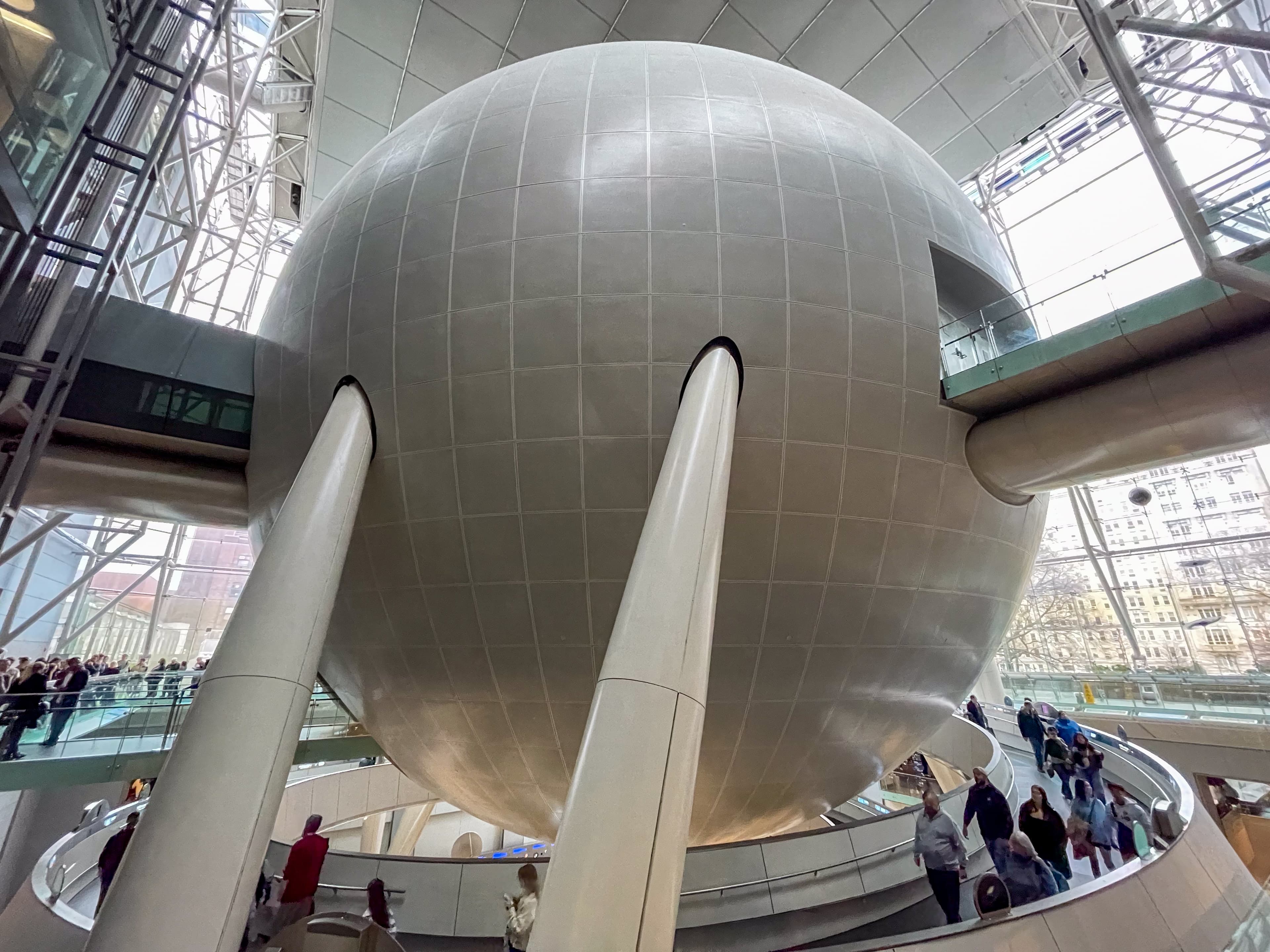
At the museum's northeast corner, facing 81st Street, stands its most recognizable modern form: a great glass cube holding a sphere. This is the Frederick Phineas and Sandra Priest Rose Center for Earth and Space, opened on February 19, 2000, designed by Polshek Partnership to replace the original Hayden Planetarium, which had opened in 1935 with a donation from philanthropist Charles Hayden and served for sixty years before astrophysics outgrew it.
Inside the cube, the 87-foot Hayden Sphere holds the Space Theater, where the planetarium's space shows play, and the Harriet and Robert Heilbrunn Cosmic Pathway spirals down from it, compressing 13 billion years of cosmic history into a single ramp. Around the sphere, the Scales of the Universe exhibit uses the sphere itself as a yardstick for the sizes of things, and the Cullman Hall of the Universe and the Gottesman Hall of Planet Earth take on the cosmos and the Earth respectively. The Rose Center is where the museum stops being about the past and starts being about everything — the deep time of the universe set against the deep time of the fossil halls a few floors away. Its director for many years, astrophysicist Neil deGrasse Tyson, became the museum's most public voice, and the planetarium shows remain one of the best reasons to plan a visit around a timed ticket.
The Gilder Center: the museum's newest chapter
The museum's latest chapter opened on May 4, 2023: the Richard Gilder Center for Science, Education, and Innovation, designed by Studio Gang on the Columbus Avenue side of the complex. The 230,000-square-foot addition gives the museum a new, accessible entrance on Columbus Avenue and replaces a maze of dead ends with more than thirty connections between the museum's buildings, finally linking the campus into the continuous whole its founders envisioned.
Its centerpiece is the five-story Kenneth C. Griffin Exploration Atrium, a cavernous space of curving, shotcrete walls and bridges shaped by the same processes — wind, water, erosion — that shape geological landscapes. The Gilder Center also holds the Invisible Worlds immersive theater, a redesigned research library and learning center, classrooms, and a collections core displaying specimens that were previously behind the scenes. For the visitor, its practical gift is circulation: it is now far easier to move through the museum without retracing your steps, and the atrium itself — light-filled, strange, and calm — is worth a visit even if you see nothing else in the new wing. It is the museum's argument, made in architecture, that a 150-year-old institution can still be remade.
How to visit well, and why it endures
The museum rewards a plan, because it punishes wandering. Pick two or three halls that matter to you — the dinosaurs and the whale are the natural first choices — and build the day around them, rather than trying to see all 45 exhibition halls. The fourth-floor fossil halls and the Hall of Ocean Life are the anchors; the Rose Center's planetarium show needs a timed ticket and is worth booking ahead; the Gilder Center atrium and the gem halls make a good second act. Allow a full day if you want the museum in full, and at least three hours for a satisfying first visit. The diorama halls are best taken slowly, one window at a time, and the benches under the whale are the museum's best resting place.
Pairing the museum with its neighborhood is easy. It sits on the Upper West Side, across from Central Park, and the park's western edge, the neighborhood's cafes and bookshops along Columbus and Amsterdam Avenues, and the 81st Street subway stop all sit within a few minutes' walk. Come out of the museum into Theodore Roosevelt Park, cross to the park or down to the neighborhood, and you will understand why the museum chose this address: it is not tucked away from New York. It is in the middle of it, on the edge of the city's great backyard.
More than 150 years after it opened in a borrowed room in the Arsenal, the American Museum of Natural History endures because it keeps doing the thing it was founded to do: showing people the natural world at full scale, from a single-celled organism to a blue whale, from a trilobite to the edge of the observable universe. The dinosaurs still draw the crowds, the whale still stops visitors in their tracks, and each generation adds a wing — the Rose Center, the Gilder Center — that says the story is not finished. Walk the fossil halls, sit beneath the whale, and stand inside the sphere's glass cube, and you will have seen, in a few hours, the museum's old argument made new again: that the natural world is worth a building of its own, four blocks long, in the greatest city in the world.
Key Facts
- The American Museum of Natural History (AMNH) was established on April 6, 1869, on the proposal of naturalist Albert S. Bickmore, with backing including Theodore Roosevelt Sr. and J. P. Morgan.
- The museum opened to the public on May 22, 1871, inside the Arsenal in Central Park.
- Its first purpose-built structure in Manhattan Square (now Theodore Roosevelt Park), designed by Calvert Vaux and Jacob Wrey Mould, opened on December 22, 1877.
- The museum is located at 200 Central Park West, New York, NY 10024, on the Upper West Side between 77th and 81st Streets, across from Central Park.
- The complex comprises more than 20 interconnected buildings housing 45 permanent exhibition halls, in addition to a planetarium and a library; its collections hold more than 30 million specimens.
- The neoclassical Roosevelt Memorial entrance pavilion on Central Park West, designed by John Russell Pope, opened in 1936; the equestrian statue of Theodore Roosevelt on its terrace was removed in January 2022.
- The Halls of Saurischian and Ornithischian Dinosaurs on the fourth floor reopened in 1995; the Tyrannosaurus rex skeleton AMNH 5027, found in Montana in 1908, was the first complete T. rex skeleton ever displayed and was re-posed in 1992–1994.
- The 94-foot blue whale model in the Irma and Paul Milstein Family Hall of Ocean Life was unveiled when the hall opened on February 26, 1969; the whale weighs about 21,000 pounds and was remade and repainted for the hall's reopening on May 17, 2003.
- The original Hayden Planetarium opened in 1935 with a donation from Charles Hayden; the Rose Center for Earth and Space, designed by Polshek Partnership, opened on February 19, 2000, with the 87-foot Hayden Sphere inside a glass cube.
- The Allison and Roberto Mignone Halls of Gems and Minerals reopened in fall 2021; they include the Star of India, a 563-carat star sapphire.
- The Richard Gilder Center for Science, Education, and Innovation, designed by Studio Gang, opened on May 4, 2023: a 230,000-square-foot addition with a Columbus Avenue entrance, a five-story atrium, the Invisible Worlds theater, and more than 30 connections between museum buildings.
- The museum's research programs span astronomy, paleontology, anthropology, and biology, and its Richard Gilder Graduate School grants doctoral degrees in comparative biology.
Visitor Details
Address: American Museum of Natural History, 200 Central Park West, New York, NY 10024 (Upper West Side, between 77th and 81st Streets, across from Central Park)
Transit: 81st Street–Museum of Natural History station (B and C trains) is at the museum's doorstep; the 79th Street station (1 train) is a short walk south, and several bus routes run along Central Park West, Columbus Avenue, and Broadway.
Hours/Admission: Hours, admission prices, and any special arrangements for planetarium shows and special exhibitions change from time to time — check the official source at amnh.org before visiting to confirm current hours, ticket prices, and timed-entry requirements. Planetarium shows are separately ticketed and worth booking ahead.
Best timing: Arrive early in the day for the quietest fossil halls; allow at least three hours, and a full day if you want the museum in full. Start with the fourth-floor dinosaur halls and the Hall of Ocean Life, take a break on the benches beneath the blue whale, then add the Rose Center planetarium show and the Gilder Center atrium. Pair the visit with Central Park across the street or the cafes and bookshops of the Upper West Side along Columbus and Amsterdam Avenues.
Location Photography