The spiral on Fifth Avenue
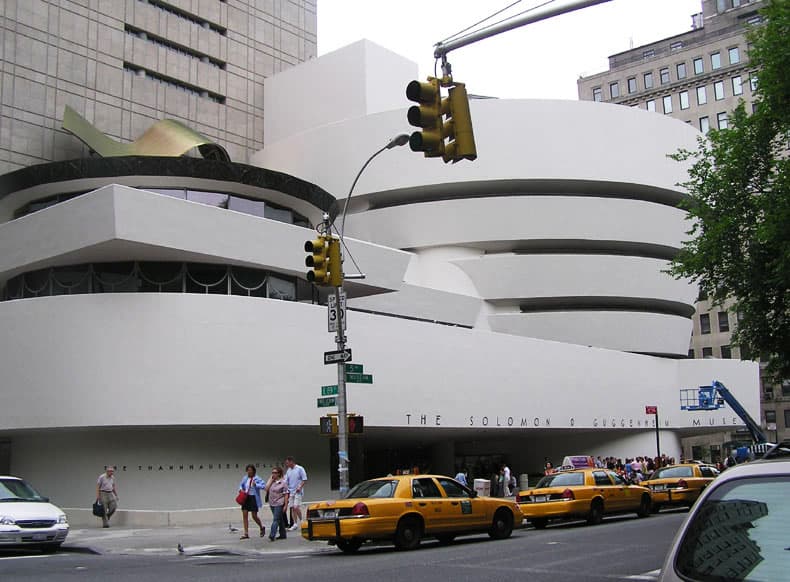
There are museums you visit for what hangs on their walls, and there are museums you visit for the building itself. The Solomon R. Guggenheim Museum, on Fifth Avenue between 88th and 89th Streets on the Upper East Side, is the rare museum where the two are inseparable — and where the building usually wins the first argument. Stand across the street, on the edge of Central Park, and you see it at once: a white, curving coil of concrete, wider at the top than at the bottom, rising above the straight, flat facades of its neighbors like a nautilus shell set down on Museum Mile. It is Frank Lloyd Wright's last completed building, and his only public building in New York City. It is also, more than sixty years after it opened, still the most argued-about museum interior in America — loved by visitors, debated by artists and curators, and impossible to mistake for anything else.
The Guggenheim is not a large museum by New York standards. It does not sprawl across blocks, and it does not hold dozens of halls. Its power is concentration: one idea, carried through from the sidewalk to the skylight. Wright's idea was that a museum should not be a sequence of separate rooms you walk through and then walk back out of. It should be one great space on a continuous floor — a single ramp, roughly a quarter of a mile long, winding gently upward around an open central well, lit from above by a great glass dome. Visitors take the elevator to the top and drift down the ramp, seeing the art in one unbroken sequence, able at any moment to look across the void and see the levels above and below. The building becomes part of the exhibition, and the exhibition becomes part of the building. Whether that helps or hinders the art has been debated since the day it opened. That the experience is unforgettable has never been debated at all.
The museum's collection matches the ambition of its shell. The Guggenheim holds Impressionist, Post-Impressionist, early Modern, and contemporary art, anchored in the abstract and non-objective painting that its founder collected — Wassily Kandinsky above all, alongside Pablo Picasso, Marc Chagall, Paul Klee, Piet Mondrian, and many others — and it mounts special exhibitions throughout the year in the ramp and in the tower galleries behind it. Come for the spiral, and you will find a serious modern-art museum inside it. Come for the art, and you will find yourself looking at the building as much as at the paintings. Either way, you will have seen one of the defining sights of New York.
From non-objective painting to a Fifth Avenue commission
The museum began not with a building but with a collection, and with a conviction. Solomon R. Guggenheim, a mining magnate and philanthropist, had begun collecting modern art in the 1920s under the guidance of the German-born artist Hilla von Rebay, who believed passionately in non-objective painting — art that did not depict the visible world but expressed spiritual and emotional realities through color and form. In 1937 Guggenheim established the Solomon R. Guggenheim Foundation, and in 1939 the foundation opened the Museum of Non-Objective Painting in rented rooms, with Rebay as its first director. For twenty years the museum lived in borrowed space, its growing collection outgrowing every room it occupied.
In 1943, Guggenheim commissioned Frank Lloyd Wright — then in his seventies and the most famous living American architect — to design a permanent home for the collection. It was an unlikely pairing in some ways: Wright, the great architect of houses and prairie landscapes, had never built in New York City, and his vision for a museum broke every convention of museum design. Wright's designs were announced in July 1945, but the road from drawing to building was long. The design went through many revisions, the site shifted, planning approvals dragged, and the relationship between Wright, Rebay, and her successor as director, James Johnson Sweeney, was often strained. Wright imagined paintings hung at a tilt, as on an easel; artists objected — in 1956, before the museum opened, a group of artists signed a letter protesting the curved, sloping walls — and curators have been adapting to the ramp ever since.
Construction finally began in 1956, on a Fifth Avenue site between 88th and 89th Streets, directly across from Central Park — a setting Wright prized, since the park's greenery answered the building's organic curves. Wright did not live to see it finished. He died in April 1959, six months before the museum opened to the public on October 21, 1959. The building he left behind was immediately famous and immediately controversial, and it has been both ever since. It was designated a New York City landmark in 1990 — the youngest building to receive that honor at the time — became a National Historic Landmark in 2008, and in 2019 was inscribed on the UNESCO World Heritage List as part of The 20th-Century Architecture of Frank Lloyd Wright.
One great space on a continuous floor
The Guggenheim's exterior gives away its interior. The main volume curves and widens as it rises, like an inverted ziggurat, built of reinforced concrete in cantilevered slabs — a structural system that alarmed New York's building authorities when it was proposed. The white spiral is the museum: there is no separate facade hiding a conventional box behind it. The smaller, lower wing along Fifth Avenue and the tower behind the rotunda belong to later chapters, but the spiral is the whole argument, made in concrete.
Inside, the argument unfolds as a single space. The ground floor opens into the rotunda, a vast central void open to the skylight far above. From here the ramp begins its slow climb — or, in the way Wright intended the visit to work, from here you take the elevator to the top of the ramp and walk down. The ramp is gentle, about a three percent slope, and roughly a quarter of a mile long from bottom to top. There are no separate galleries along it, no doors to pass through, no rooms to retrace. The paintings hang on the outer wall, tilted slightly back, lit by a continuous band of skylights and by daylight falling through the great glass dome overhead. As you descend, you look inward across the void to the other levels, to other visitors, and to the art on the far side of the spiral. Wright called the building a temple of the spirit, and the rotunda is where that phrase makes sense: it is a space designed for looking up as much as for looking at pictures.
That openness is also the building's famous difficulty. Paintings on a sloping floor and a curving wall do not hang the way they do in a flat-walled gallery, and the ramp's continuous sequence does not allow a visitor to skip a section or linger in a single room without holding up the flow behind them. Curators have answered this over the decades in two ways. First, by treating the ramp itself as a stage: many exhibitions are designed specifically for the spiral, using its curve and its sightlines as part of the show rather than fighting them. Second, by using the flat-floored tower galleries, added in 1992, for exhibitions that need conventional rooms. The result is a museum that works in two registers at once: the ramp for the experience only the Guggenheim can offer, and the tower for the exhibitions that need ordinary walls.
The collection: Kandinsky, Picasso, Chagall, and the modern century
The collection at the heart of the museum is the one Solomon Guggenheim and Hilla von Rebay assembled: the art of the early twentieth-century avant-garde, above all the non-objective painting Rebay championed. Wassily Kandinsky is the collection's presiding spirit — the museum owns a deep holding of his work, from early figurative paintings through the great abstract compositions of the 1920s and beyond, including the celebrated Composition 8 of 1923. Around Kandinsky cluster the other pioneers of abstraction: Piet Mondrian's grids, Paul Klee's intimate, inventive pictures, and works by artists of the Bauhaus and the Paris avant-garde.
But the Guggenheim is not only a museum of abstraction. Its permanent collection reaches back into the nineteenth century, through Impressionism and Post-Impressionism — works by artists including Pablo Picasso, Marc Chagall, Paul Gauguin, and Georges Seurat among them — and forward into contemporary art, with photography, video, and installation work joining painting and sculpture. The Thannhauser Collection, the bequest of the dealer Justin K. Thannhauser, is the museum's great bridge between the nineteenth century and modernism: a gallery of its own, hung in the tower, where Picasso, Manet, Gauguin, Van Gogh, and others hang together in the kind of intimate, salon-style rooms that the ramp deliberately is not. Seeing the Thannhauser rooms after the ramp is one of the museum's best contrasts — the same century of art, shown two completely different ways.
Special exhibitions rotate through the ramp and the tower galleries, and they are often the reason to return. The Guggenheim's exhibition program has ranged across the modern century and around the world, from retrospectives of single artists to thematic shows that use the spiral as a single, unfolding canvas. Because the ramp is one continuous gallery, a special exhibition here feels different from the same show anywhere else: you experience it as a journey, not as a set of rooms, and the building's own drama is always in the frame.
The tower, the restoration, and the museum today
The museum Wright built was, by the 1980s, too small for its collection and its audience. In 1992 it was restored and enlarged with a tower addition designed by Gwathmey Siegel & Associates, rising behind the rotunda along 89th Street. The tower gave the museum what Wright's spiral could not: flat-floored galleries for exhibitions and for the permanent collection, offices, and support space, connected to the ramp at each level so that visitors can step off the spiral into a conventional gallery and back again. The addition was deliberately quiet in expression — it does not compete with the spiral — and it solved, practically, the problem artists had raised in 1956: art that needs a flat wall finally had flat walls.
A major restoration followed in the 2000s, completed in 2008, which repaired the concrete exterior, restored the skylight with modern glazing and ultraviolet filtering, and returned the rotunda to Wright's intended brightness. The restoration mattered because the building's concrete skin and its glass dome are not decoration; they are the museum. The white spiral only works if it is white, and the ramp only works if daylight pours down through the dome the way Wright intended.
Today the Guggenheim sits at the center of Museum Mile, the stretch of Fifth Avenue along Central Park that holds some of the city's greatest museums, and it anchors the Upper East Side end of that walk. It is smaller and more focused than its neighbors — a visit takes a few hours rather than a full day — and that focus is its charm. You do not come here to see everything. You come to walk one extraordinary ramp, to stand in one extraordinary room, and to see modern art in the building that was designed, against all convention, to hold it.
How to visit well, and why it endures
The Guggenheim rewards a simple plan. Take the elevator to the top of the ramp and walk down, the way Wright intended — the descent is gentle, the sequence unfolds in order, and you will see the art and the building together rather than fighting the slope uphill. Pause at the overlooks and look across the void: the view of the spiral from within, with other visitors on the levels above and below, is as much a part of the visit as any single painting. Then step off the ramp into the tower galleries for the Thannhauser Collection and the permanent collection rooms, where the flat walls let you look at pictures the conventional way. Allow two to three hours for a satisfying first visit, and more if a special exhibition catches you.
Pair the visit with its neighborhood. The museum sits on Museum Mile, across from Central Park's Conservatory Garden and the park's eastern edge, and the Upper East Side's Madison Avenue shops, cafes, and townhouse blocks are a short walk west and south. Walk the park side of Fifth Avenue after your visit, or continue south along Museum Mile, and you will understand why Wright wanted this address: the building was designed to face the park, its curves answering the trees across the street.
More than sixty years after it opened, the Guggenheim endures because it is still the most complete expression of a single architectural idea in New York: that a museum need not be a box with rooms, but can be one great space on a continuous floor, lit from above, in which art and architecture are the same experience. Artists still argue about its walls. Curators still adapt to its curve. Visitors still ride the elevator to the top, walk slowly down the ramp, and look up at the skylight — and still find, at the bottom, that they have seen something no other museum in the world can offer.
Key Facts
- The Solomon R. Guggenheim Museum is located at 1071 Fifth Avenue, between 88th and 89th Streets, on the Upper East Side of Manhattan, across from Central Park.
- The museum was established by the Solomon R. Guggenheim Foundation in 1939 as the Museum of Non-Objective Painting, under the guidance of its first director, Hilla von Rebay; it occupied rented rooms until its permanent building opened.
- Frank Lloyd Wright was commissioned to design the museum building in 1943; his designs were announced in July 1945.
- Construction began in 1956; Wright died in April 1959, and the museum opened to the public on October 21, 1959. It was Wright's last completed building and his only public building in New York City.
- The building's main gallery is a continuous spiral ramp, roughly a quarter of a mile long with a gentle slope of about three percent, winding around an open central rotunda topped by a glass skylight. Wright intended visitors to take the elevator to the top and walk down.
- In 1956, before the museum opened, a group of artists signed a letter objecting to the building's curved, sloping walls as a setting for paintings.
- The museum's collection spans Impressionist, Post-Impressionist, early Modern, and contemporary art, anchored in non-objective painting — above all Wassily Kandinsky, whose Composition 8 (1923) is among its celebrated holdings — alongside Picasso, Chagall, Klee, Mondrian, and others.
- The Thannhauser Collection, the bequest of dealer Justin K. Thannhauser, is displayed in the museum's tower galleries and includes works by Picasso, Manet, Gauguin, and Van Gogh.
- The museum was restored and enlarged in 1992 with a tower addition designed by Gwathmey Siegel & Associates, adding flat-floored galleries behind the rotunda.
- A major restoration in the 2000s, completed in 2008, repaired the concrete exterior and restored the skylight with modern glazing and ultraviolet filtering.
- The building was designated a New York City landmark in 1990 (exterior and interior), became a National Historic Landmark in 2008, and was inscribed on the UNESCO World Heritage List in 2019 as part of The 20th-Century Architecture of Frank Lloyd Wright.
Visitor Details
Address: Solomon R. Guggenheim Museum, 1071 Fifth Avenue, New York, NY 10128 (Upper East Side, between 88th and 89th Streets, across from Central Park)
Transit: 86th Street station (4, 5, 6 trains) is a short walk south, and the 96th Street station (6 train) is a short walk north; several bus routes run along Fifth Avenue and Madison Avenue, and the museum sits on Museum Mile along Central Park.
Hours/Admission: Hours, admission prices, and any timed-entry or special-exhibition arrangements change from time to time — check guggenheim.org before visiting to confirm current hours, ticket prices, and entry requirements.
Best timing: Allow two to three hours for a satisfying first visit. Take the elevator to the top of the ramp and walk down, pause at the overlooks to look across the rotunda, then step into the tower galleries for the Thannhauser Collection. Pair the visit with Central Park across the street or a walk south along Museum Mile and Madison Avenue.
Location Photography