Center City's living room
If you want to understand Philadelphia at its most at ease, go to Rittenhouse Square and sit down. On any fair day the six-acre park in the southwest quadrant of Center City is full in the best possible way: office workers eating lunch on benches, dog walkers circling the paths, children climbing onto a small bronze goat, friends meeting under the trees before dinner, and visitors pausing, guidebooks in hand, to work out why this particular patch of green feels so different from an ordinary city park. Philadelphians call it their living room, and the nickname is exact. Rittenhouse Square is not a park you pass through on the way to something else. It is the destination itself — the place where the neighborhood gathers, and where a first-time visitor can, in a single hour, grasp what Center City Philadelphia is for.
The square sits between 18th and 19th Streets, bounded by Walnut Street to the north, in the heart of the neighborhood that took its name. That neighborhood is one of the city's most fashionable addresses, known for high-end shopping along Walnut Street, restaurants and cafes facing the park, hotels, and handsome apartment buildings and surviving mansions. Yet the park itself remains public and free to stroll, and that openness is the point. Wealth built the houses around the square, but the square belongs to everyone who walks into it — a democratic green at the center of a very elegant district, and the reason the district feels alive rather than merely expensive.
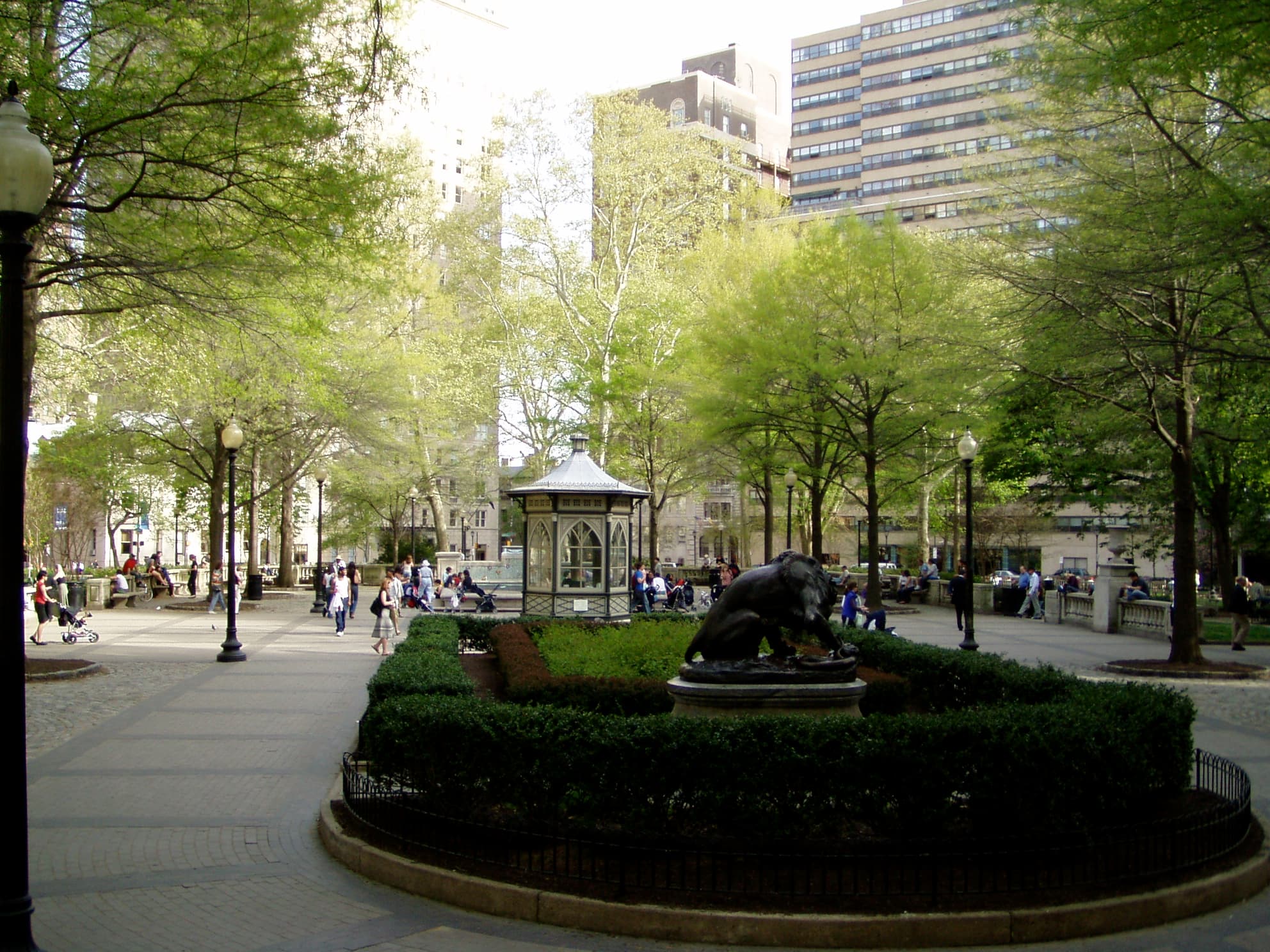
What makes Rittenhouse Square so inviting is its scale and its design. Six acres is small enough to cross in a few minutes and large enough to lose yourself in for an afternoon. Mature trees shade broad lawns and flower beds, benches line the walks, and the whole park is organized around a central oval plaza, so that wherever you enter, the paths draw you inward. It is a formal garden, not a wild one, and its formality is part of its charm: this is a park designed for promenading, people-watching, and sitting still, in the manner of a Parisian garden, and it has been doing that job, in essentially its present form, for more than a century.
One of William Penn's five original squares
Rittenhouse Square is older than the United States, older than the city around it in any recognizable form, and that long history is written into its very shape. It was one of the five original open squares in William Penn's plan for Philadelphia, laid out in the late 17th century with surveyor Thomas Holme: a grid of streets punctuated by public green spaces, one in each quadrant of the city plus a central square. The other original squares — Logan, Washington, Franklin, and the central square now occupied by City Hall — survive in various forms, but Rittenhouse is the one most completely identified with its neighborhood, and the one that has kept its role as a neighborhood green most continuously.
Originally called Southwest Square, for its position in the southwest quadrant of Penn's plan, the square was renamed in 1825 for David Rittenhouse, the Philadelphia clockmaker, astronomer, and Revolutionary-era patriot who served as the first Director of the United States Mint. The renaming honored a man of science and public service, and it suited a square that was beginning its long transformation from open ground to civic ornament. In its early years the square was far from fashionable: it was used as pasture for livestock, and the surrounding land was given over to brickyards and woods. Unlike some of the other original squares, it was never used as a burial ground, and it never hosted the public executions and horse races that marked other early Philadelphia greens. It was, for a long time, simply open space at the edge of a growing town — waiting for the city to grow west toward the Schuylkill River and catch up with it.
That growth came in the 19th century, and it changed the square completely. As Philadelphia expanded from the Delaware toward the Schuylkill, Rittenhouse Square became a highly desirable address. In about 1840, merchant and former congressman James Harper built a stately townhouse at 1811 Walnut Street, on the square's north side, setting the patrician tone that would define the neighborhood. The house later became the home of the Rittenhouse Club, which added its present facade around 1901. Around it, in the second half of the 19th century, some of the wealthiest families in America built mansions on the streets facing the square — railroad presidents, department-store founders, industrialists, and philanthropists — and the neighborhood became the home of Philadelphia's Victorian aristocracy. A few of those grand houses survive, among them the former mansions now housing cultural institutions, but most gave way in the 20th century to apartment buildings and condominiums that kept the district's elegant character while opening it to a broader population.
The 1913 redesign: a French-style garden in Philadelphia
The square you see today is largely the work of one redesign, and knowing its date explains its character. In 1913, the newly formed Rittenhouse Square Improvement Association hired French-born architect Paul Philippe Cret — already known in Philadelphia for his work on the Benjamin Franklin Parkway and the Rodin Museum — to remake the square. Cret gave it the formal, French-influenced layout it still keeps: diagonal walkways crossing from all four corners to meet at a central oval plaza, a circular path ringing that plaza, stone balustrades, urns on low pedestals, and classical entryways framed by an ornamental iron fence separating the park from the four busy streets around it.
The design works because it does two things at once. The diagonal walks make the square easy to cross from any direction, so it functions as a true neighborhood crossroads rather than a fenced-off garden. At the same time, the central plaza gives the park a heart — a place to arrive at, pause, and look around — so that the square feels like a room, not a thoroughfare. Urbanist Jane Jacobs, in her influential book The Death and Life of Great American Cities, praised Rittenhouse Square for exactly these qualities, admiring its intricacy and its centering, and later planning writers have called it one of the great public spaces in America. The square was listed in the National Register of Historic Places, along with Penn's other squares, in 1981.
Cret's plan also fixed the square's planting character: generous lawns, seasonal flower beds, and mature trees — sycamores, horse chestnuts, maples, and oaks among them — that give shade in summer and color in autumn. The beds are replanted through the seasons, so the square never looks quite the same from one visit to the next, and the Friends of Rittenhouse Square, the nonprofit that cares for the park alongside the city, helps keep that standard. Walk the square slowly and you will notice how deliberately the views are composed: every diagonal walk frames a glimpse of the central plaza, every bench sits where a vista opens, and the mature canopy makes even a busy Saturday feel sheltered.
The central plaza, the fountain, and the sculptures
At the center of Cret's design sits the oval plaza, with its reflecting pool and fountain, and it is here that Rittenhouse Square's sculpture collection — one of the best-loved groups of outdoor sculpture in Philadelphia — gathers. The most dramatic piece is Antoine-Louis Barye's Lion Crushing a Serpent, at the west end of the central plaza. Barye's original work, created in 1832 as an allegory of the French Revolution of 1830, shows a lion — good — overpowering a serpent — evil — and the bronze cast in Rittenhouse Square, made about 1890, carries all of the French Romantic sculptor's muscular drama. It is a fierce, taut composition, and it anchors the plaza with a seriousness that balances the park's lighter pleasures.
At the other end of the plaza, in the reflecting pool itself, stands Paul Manship's Duck Girl, a 1911 bronze of a young girl in Greek costume carrying a duck under one arm. It is a lyrical, early work by the sculptor who would later design the Aero Memorial at Logan Square, and it gives the central water its focal point: a figure that seems to belong to the pool rather than merely stand in it. Between the two, the plaza's fountain and pool catch the sky and the surrounding trees, and on a warm day the sound of water softens the traffic noise from Walnut and 18th Streets to a murmur.
The square's smaller sculptures are, if anything, even more beloved, because they are made to be touched. Halfway down the southwest walk, in its own small plaza before a hemispherical stone bench, stands Albert Laessle's Billy, a 1914 bronze billy goat barely two feet high — 26 inches on a granite base — whose head, horns, and spine have been polished to a shine by generations of children climbing aboard. In the northeast section, Cornelia Van Auken Chapin's Giant Frog, a sleek granite amphibian, sits in a flower bed near the Evelyn Taylor Price Memorial Sundial, Beatrice Fenton's 1947 bronze of two children holding aloft a giant sunflower that serves as the dial. Two small stone dogs, added in 1988, perch on the balustrades at the southwest corner entrance. None of these pieces is grand in scale. Together, they make Rittenhouse Square feel inhabited — a park with a cast of characters, not just a collection of monuments.
The neighborhood around the square
A park is only as good as the streets around it, and Rittenhouse Square's streets are among the finest walking streets in Philadelphia. Walnut Street, on the park's north side, is the city's high-end shopping spine, lined with national retailers, boutiques, and cafes. The east side of the park, along 18th Street, has become a restaurant row, with celebrated dining rooms and bars facing the green — a transformation that has made the square a popular evening destination as well as a daytime one, with tables spilling onto sidewalks in warm weather and the park itself glowing under its lamps after dark. The surrounding blocks mix grand old apartment buildings, hotels, offices, and cultural institutions, so that the square is used at all hours, by residents, workers, shoppers, and visitors alike.
That mixture is what keeps the square safe and lively. Because homes, shops, offices, and restaurants all front onto it, there are almost always people coming and going, and the park never empties into the eerie quiet that afflicts single-use districts. The neighborhood also preserves some of its 19th-century fabric on the side streets: the narrow, picturesque blocks of Delancey Place, Spruce Street, and Locust Street, where the families who served the great houses once lived, still hold rows of brick townhouses, and the area around the square, together with nearby Fitler Square, forms the Rittenhouse-Fitler Historic District. A walk around the square, then, is also a walk through Philadelphia's architectural history — from Victorian mansions and Beaux-Arts apartment houses to modern condominiums, all arranged around a green that predates them all.
The square also hosts the neighborhood's public life. A farmers' market brings local growers and producers to the park on a seasonal basis, and the square hosts art shows, a spring festival, and a flower show with a history stretching back more than a century, along with holiday lights in December that draw evening crowds. These events are seasonal and their schedules change, so check the Friends of Rittenhouse Square or the market organizer before planning a visit around a particular market day or festival. The everyday life of the square needs no schedule, though: it is there every day, in the benches, the lawns, the dog walkers, and the goat.
A visit, at the square's own pace
The best way to see Rittenhouse Square is to do what Philadelphians do: arrive without a strict agenda. Enter from any corner and let a diagonal walk carry you to the central plaza. Pause at Lion Crushing a Serpent, then turn to Duck Girl in the pool, and listen for the fountain before you look for it. Find Billy on the southwest walk — children will likely have found him first — and the Giant Frog and the sundial on the northeast side. Walk the full circuit of the park rather than cutting straight across it, and sit for a while on a bench or on the lawn: the square rewards sitting more than it rewards hurrying, and its benches, under mature trees with a view of the plaza, are among the best seats in Center City.
Then step outside the fence and let the neighborhood complete the visit. Walk Walnut Street for shopping and cafes, 18th Street for restaurants, and the side streets to the south and west for the brick townhouses and small gardens of the historic district. Pair the square with nearby Center City sights — City Hall and the Benjamin Franklin Parkway to the north, Fitler Square a short walk to the southwest, and the Schuylkill riverfront to the west — and you will have a sense of how Philadelphia's original plan still orders the modern city: green squares, set in a grid, each anchoring its own neighborhood, with Rittenhouse the most vivid of them all.
Rittenhouse Square endures because it has never stopped being useful. It was a pasture, then a fashionable address, then a French-style garden, then a gathering place for every kind of Philadelphian, and it is all of those things still, layered into six acres. For a first-time visitor, it offers something no museum or monument quite can: a chance to sit, for an hour, in the middle of Philadelphia's daily life, in a park that William Penn imagined, that David Rittenhouse lent his name to, and that Paul Philippe Cret shaped into the garden Philadelphians still call home.
Key Facts
- Rittenhouse Square is one of William Penn's five original open squares in his late-17th-century plan for Philadelphia, laid out with surveyor Thomas Holme; it was originally called Southwest Square.
- The square was renamed in 1825 for David Rittenhouse, Philadelphia clockmaker, astronomer, Revolutionary-era patriot, and first Director of the United States Mint.
- Unlike some of the other original squares, Rittenhouse Square was never used as a burial ground; in its early years it served as pasture for livestock, and the surrounding land held brickyards and woods.
- The square covers about six acres in Center City Philadelphia, between 18th and 19th Streets, bounded by Walnut Street to the north.
- In about 1840, merchant and former congressman James Harper built a townhouse at 1811 Walnut Street, setting the square's patrician residential tone; the house later became the Rittenhouse Club, which added its present facade around 1901.
- In 1913, the Rittenhouse Square Improvement Association hired French-born architect Paul Philippe Cret to redesign the square; his formal, French-influenced plan — diagonal walks meeting at a central oval plaza, a circular path, balustrades, and classical entries — remains largely intact.
- The square's sculptures include Antoine-Louis Barye's Lion Crushing a Serpent (original 1832, bronze cast about 1890) at the west end of the central plaza; Paul Manship's Duck Girl (1911) in the reflecting pool; Albert Laessle's Billy, a 1914 bronze billy goat, on the southwest walk; Cornelia Van Auken Chapin's Giant Frog in granite in the northeast section; and Beatrice Fenton's Evelyn Taylor Price Memorial Sundial (1947) nearby.
- Urbanist Jane Jacobs praised Rittenhouse Square in The Death and Life of Great American Cities for its intricacy and centering; the square was listed in the National Register of Historic Places, with Penn's other squares, in 1981.
- Together with nearby Fitler Square, the Rittenhouse neighborhood and the square comprise the Rittenhouse-Fitler Historic District.
- The square is ringed by high-end shopping on Walnut Street, restaurants along 18th Street, hotels, offices, and apartment buildings, with surviving 19th-century mansions and brick townhouses on the surrounding side streets.
Visitor Details
Address: Rittenhouse Square, bounded by 18th Street, Walnut Street, 19th Street, and Rittenhouse Square South, Philadelphia, PA 19103 (Center City)
Transit: The square is in central Center City, walkable from City Hall and from SEPTA subway and regional rail stations in Center City; several bus routes serve Walnut and Chestnut Streets. Confirm the best route for your starting point before traveling.
Hours/Admission: Rittenhouse Square is a public park, free to stroll. Farmers' markets, art shows, festivals, and the flower show are seasonal events whose schedules change — check the Friends of Rittenhouse Square or the event organizer before planning a visit around a particular market day or event, rather than assuming a fixed day or time.
Best timing: Any fair day rewards a visit; spring and summer bring flower beds and full canopy, autumn brings color, and December brings holiday lights on the park's trees. Arrive in the morning for quieter paths, walk the full circuit, pause at the central plaza, find Billy, Duck Girl, and the Giant Frog, then explore Walnut Street and the historic side streets around the square.
Location Photography