Boston's formal garden, next door to its oldest park
Every first-time visitor to Boston ends up here, whether they planned to or not. Walk west from Boston Common across Charles Street and the ground changes underfoot: the Common's broad, unstructured green gives way to something altogether more deliberate — curving paths, a four-acre lagoon, flower beds laid out in patterns, and willows trailing into the water. This is the Boston Public Garden, and the difference between the two parks is the whole story. The Common, founded in 1634, is America's oldest public park, a place that has served as pasture, parade ground, and protest ground. The Public Garden, established in 1837, is America's first public botanical garden — a park designed, from the start, to be beautiful.
That distinction matters because it explains everything you see. The Public Garden was not left over from colonial grazing land; it was made. Its 24 acres sit on what was once tidal flats and marsh at the edge of the Common, filled and landscaped in the mid-19th century as Boston pushed west into the new Back Bay. The result is a Victorian garden in the English style, with winding paths rather than straight axes, a lagoon rather than a lawn, and plantings that are reworked every season. It is, by design, the prettiest acreage in downtown Boston — and it has been the city's front garden for so long that its images have become shorthand for Boston itself: the Swan Boats on the lagoon, the little bridge, the bronze ducklings marching along Beacon Street.
The garden also anchors the top of the Emerald Necklace, the chain of parks designed by Frederick Law Olmsted that runs south from here through the Back Bay Fens, the Riverway, Jamaica Pond, and Franklin Park. You do not need to walk the whole necklace to understand the idea. Stand on the lagoon bridge at the Public Garden and you are standing at its northern terminus, where Olmsted's great green system begins — in a garden that predates Olmsted's Boston work by decades, and that taught the city what a designed public landscape could be.
1837: a botanical garden the city almost sold
The Public Garden's founding is a story of near misses. In 1837, philanthropist Horace Gray petitioned for the use of the land as a public botanical garden, the first of its kind in the United States. But for nearly twenty years the garden's future was uncertain: the Boston City Council repeatedly tried to sell the land, and Gray spent years marshalling political resistance to those attempts. The question was finally settled in 1856, when an act establishing the land's use as a public garden was submitted to the voters on April 26 of that year and passed with only 99 dissents. Boston had voted, overwhelmingly, to keep its garden a garden.
The landscape that emerged from that vote is largely the work of George F. Meacham, whose plan gave the garden its lagoon, its winding paths, and its beds of formal plantings. The four-acre lagoon, completed in 1861, is the garden's centerpiece — not a natural pond but a designed one, shaped to catch reflections of the surrounding trees and the Back Bay townhouses beyond. Around it, Meacham arranged the garden as a sequence of views rather than a single vista: every turn of a path opens a new composition of water, bridge, trees, and skyline. It is a small park that feels much larger than 24 acres, because it never lets you see all of it at once.
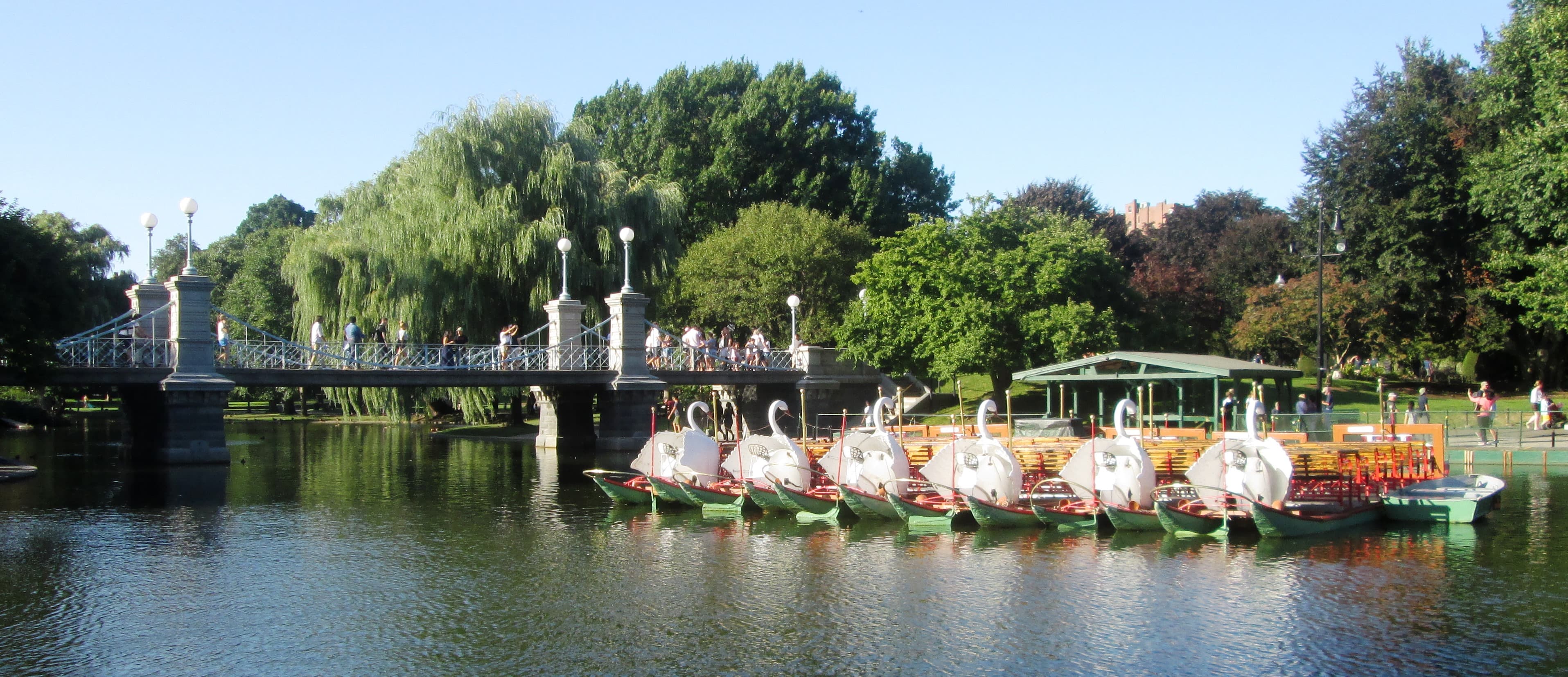
The garden's Victorian character was fixed in the 1860s, when its two most recognizable structures went up: the equestrian statue of George Washington at the Arlington Street entrance in 1869, and, two years earlier, the lagoon bridge itself. The bridge, designed by architect William Gibbons Preston and finished in 1867, is a graceful suspension footbridge — the smallest of its kind in the world, according to long-standing local lore. Whether that superlative survives strict engineering scrutiny is less important than what the bridge does: it gives visitors a reason to pause mid-lagoon, to look both ways along the water, and to take the photograph that, more than any other single image, says "Boston."
The Swan Boats: pedaling since 1877
If the Public Garden has a signature experience, it is the Swan Boats. They have been operating on the lagoon since 1877, when Robert Paget began running foot-pedaled pontoon boats ornamented with a white swan at the rear, the boat pedaled around the lake by a guide sitting within the swan. The Paget family has operated the boats ever since, through generations, and a slow loop around the lagoon remains one of the most enduringly popular things to do in the entire city — especially with young children on a warm afternoon, when the boats share the water with real swans.
The boats are worth understanding for what they are not. They are not a thrill ride, and they are not fast. A Swan Boat ride is fifteen minutes or so of gentle pedaling past willows, flower beds, and the bridge, with a guide's commentary and a view of the garden from its best angle: water level. That slowness is the point. The garden was designed to be experienced at walking pace, and the Swan Boats extend that pace onto the water. They are also a living link to the garden's Victorian origins — a 19th-century pleasure-boat tradition that has survived, essentially unchanged, into the 21st century, while almost everything around it has been rebuilt.
The Swan Boats are seasonal, and that seasonality is part of the garden's rhythm. The boats run in the warmer months only, and the swans themselves are wintered elsewhere and returned to the lagoon each spring in a small ceremony that draws a crowd. If a Swan Boat ride is the reason for your visit, check the official Swan Boats source before you go to confirm the season's dates and times rather than assuming they are running. The garden itself is a place to stroll in any season, but the boats belong to summer — and a summer afternoon on the lagoon, with the boats out and the flower beds in full color, is the Public Garden at its most itself.
Make Way for Ducklings, and the garden's other monuments
Near the Beacon Street entrance, on the garden's northern edge, a second Boston institution waits at ankle height. The Make Way for Ducklings statues — a bronze Mrs. Mallard followed by her eight ducklings, Jack, Kack, Lack, Mack, Nack, Ouack, Pack, and Quack — were installed on October 4, 1987, as a tribute to Robert McCloskey, whose 1941 children's book is set in the Public Garden. Sculptor Nancy Schön's caravan spans 35 feet from front to back along a path of old Boston cobblestones, though the tallest statue stands only 38 inches high — a scale chosen, deliberately, for children, who climb onto Mrs. Mallard for photographs in numbers that would alarm a museum curator and delight everyone else.
The statues work because the book works. In McCloskey's story, Mr. and Mrs. Mallard search Boston for a safe place to raise their ducklings, are fed peanuts by the people on the Swan Boats, and are escorted by a policeman across the streets to the Public Garden, where they settle on an island in the lagoon. Generations of children have arrived at the garden already knowing that story, and finding the ducks in bronze — often dressed in seasonal outfits, for sports teams, the Boston Marathon, or holidays — is a small, joyful shock of recognition. Since 1978, Boston has also hosted an annual Duckling Day parade each spring, with children dressed as ducklings retracing part of the Mallards' route to the garden. The statues are routinely described as one of the most photographed spots in Boston, and on a busy day the line of small photographers proves it.
The garden's monuments do not stop at the ducks. At the Arlington Street entrance stands the equestrian statue of George Washington by Thomas Ball, installed on July 3, 1869 — a commanding bronze that greets visitors arriving from the Back Bay and that has become a meeting point in its own right. Elsewhere in the garden, the Ether Monument by John Quincy Adams Ward commemorates the first successful public demonstration of ether anesthesia, and statues of figures including Wendell Phillips and Charles Sumner line the paths. The garden is, in this way, an open-air gallery of 19th-century Boston's heroes — but unlike a museum gallery, you encounter them between flower beds, under trees, and on the way to somewhere else, which is exactly how a public garden should present its monuments.
A garden for every season
The Public Garden repays repeat visits because it refuses to look the same twice. In spring, the tulip beds — tens of thousands of bulbs planted in formal patterns — turn the garden into a blaze of color, and the return of the swans marks the start of the warm season. Summer brings the Swan Boats, the full green canopy, and the garden at its most crowded and most festive. Autumn thins the crowds and sets the trees along the lagoon alight in reds and golds, with the reflections in the water doubling the effect. Winter strips the garden back to its structure — the bridge, the paths, the statues, the bare branches — and reveals the bones of Meacham's design, often dusted with snow.
That seasonal rhythm is maintained by the Friends of the Public Garden, the nonprofit that works alongside the City of Boston to care for the garden and the Common, funding plantings, tree care, and restoration. The garden's formal beds are replanted several times a year, so the patterns of color you see in May will not be the patterns you see in August. It is worth slowing down for the plantings themselves: the garden is a botanical garden, after all, and its beds, its specimen trees — including weeping willows, European beeches, and a dawn redwood — and its seasonal displays are the reason the place exists, not merely decoration around the boats and statues.
A good visit follows the garden's own logic. Enter from Boston Common across Charles Street, or from Arlington Street past the Washington statue, and let the paths curve. Cross the lagoon bridge and pause at its midpoint. Walk the lagoon's full circuit rather than cutting across it — the garden rewards the long way around. Find the ducklings on the Beacon Street side, then wander the southern paths, where the beds are quieter and the benches emptier. And leave time to simply sit: the Public Garden is one of the few places in downtown Boston designed, above all, for sitting and looking, and its benches beside the lagoon are among the best seats in the city.
Why the Public Garden endures
Boston has grander sights and older ones, but few that are loved in quite the way the Public Garden is loved. Part of it is the garden's democratic character: it has always been free to enter and free to enjoy, a place where a child's duckling photograph and a retiree's morning bench sit side by side without hierarchy. Part of it is the garden's scale — large enough to lose yourself in for an hour, small enough to cross in ten minutes, and placed so centrally that it belongs to every Boston itinerary, from the Freedom Trail to a Back Bay shopping afternoon. And part of it is sheer continuity: the Swan Boats have run since 1877, the bridge since 1867, the garden itself since 1837, and the ducks since 1987. In a city that rebuilds constantly, the Public Garden is a place that keeps its promises.
For a first-time visitor, the garden is also the perfect introduction to Boston's double nature — historic and living at once. The Common next door tells you about Boston's past; the Public Garden shows you Boston's present, at play, in a landscape that was designed for pleasure and has never stopped delivering it. Walk it slowly, ride a Swan Boat if the season allows, say hello to Mrs. Mallard, and cross the little bridge. You will understand, in an hour, why Bostonians fought to keep this land a garden in 1856 — and why they still do.
Key Facts
Boston Public Garden was established in 1837, when philanthropist Horace Gray petitioned for the land's use as a public botanical garden — the first public botanical garden in the United States.
The garden's future was settled by a public vote on April 26, 1856, when an act devoting the land to the Public Garden passed with only 99 dissents, after years of City Council attempts to sell the land.
The garden covers 24 acres beside Boston Common, bounded by Beacon Street, Charles Street, Boylston Street, and Arlington Street, at the Back Bay / Beacon Hill edge of downtown Boston.
The four-acre lagoon, designed as part of George F. Meacham's plan, was completed in 1861 and is the garden's centerpiece.
The lagoon bridge, a suspension footbridge designed by William Gibbons Preston, was finished in 1867 and is long described in local lore as the smallest suspension bridge in the world.
The Swan Boats have operated on the lagoon since 1877, begun by Robert Paget; the Paget family has operated them through successive generations, and the boats are seasonal.
The Make Way for Ducklings statues by Nancy Schön were installed on October 4, 1987, as a tribute to Robert McCloskey, author of the 1941 children's book set in the garden; Mrs. Mallard stands 38 inches tall and the caravan of eight ducklings spans 35 feet along a cobblestone path.
The equestrian statue of George Washington by Thomas Ball was installed at the Arlington Street entrance on July 3, 1869.
The Ether Monument by John Quincy Adams Ward commemorates the first successful public demonstration of ether anesthesia.
Together with Boston Common, the Public Garden forms the northern terminus of the Emerald Necklace, the chain of parks designed by Frederick Law Olmsted.
Boston has hosted an annual Duckling Day parade each spring since 1978, with children dressed as ducklings retracing part of the Mallards' route to the garden.
Visitor Details
Address: Boston Public Garden, bounded by Beacon St, Charles St, Boylston St, and Arlington St, Boston, MA 02116 (Back Bay / Beacon Hill edge)
Transit: Arlington station on the MBTA Green Line sits at the garden's western edge; Park Street station (Green and Red Lines) is a short walk east across Boston Common. Several bus routes serve Boylston and Arlington Streets.
Hours/Admission: The garden is a public park to stroll. Swan Boats are seasonal — check the official Swan Boats source before visiting to confirm the season's dates, times, and fares, as these change year to year. Garden hours and any event information should likewise be confirmed with the City of Boston / Friends of the Public Garden before a visit.
Best timing: Spring for the tulip beds and the swans' return; summer for Swan Boat rides; autumn for foliage reflections on the lagoon. Arrive in the morning for quieter paths, cross the lagoon bridge at its midpoint, walk the full lagoon circuit, and pair the garden with Boston Common across Charles Street and Beacon Hill to the north.
Location Photography