A railway that refused to die
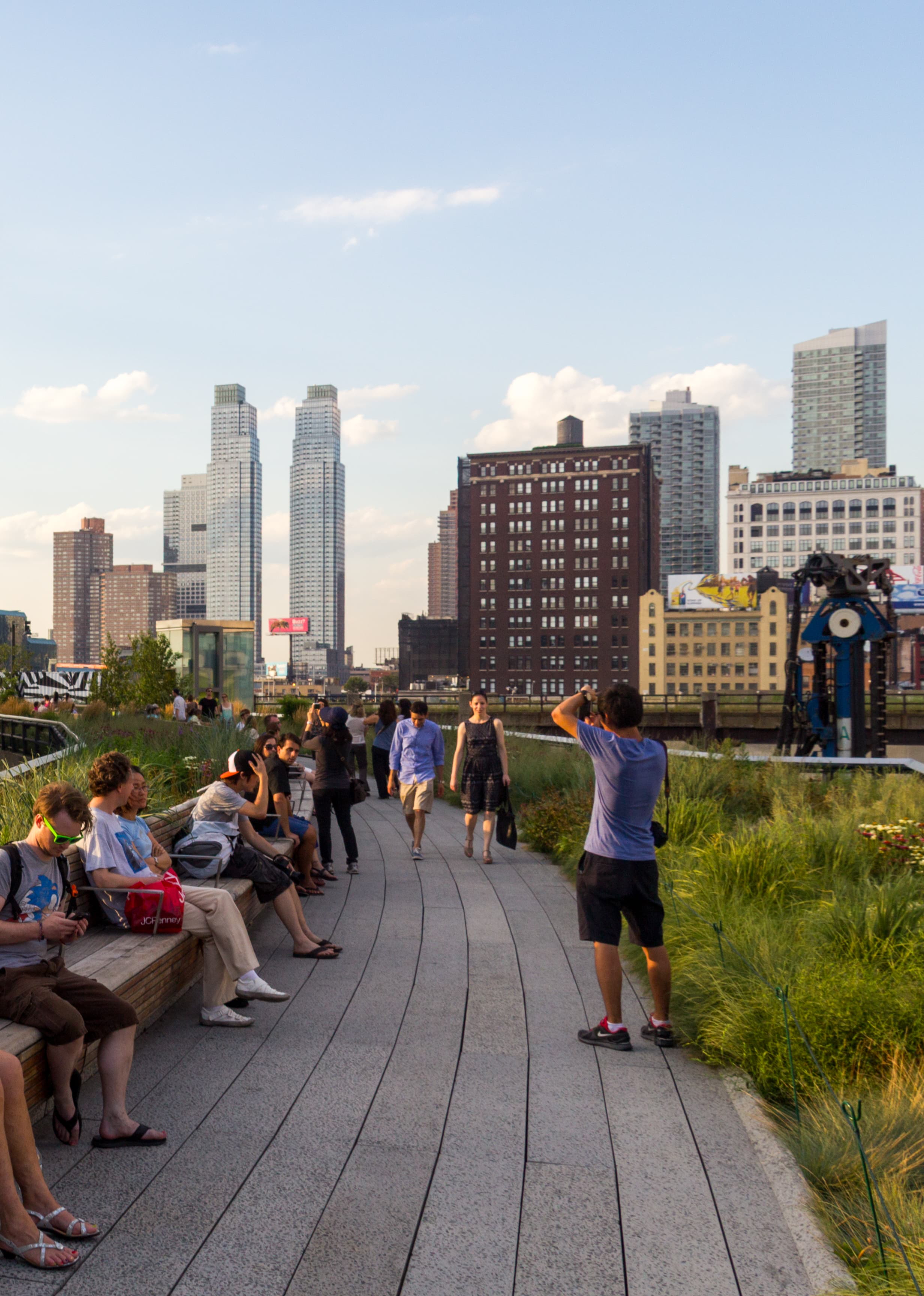
Stand on the High Line at sunset, somewhere around 23rd Street, and Manhattan rearranges itself. The traffic on Tenth Avenue flows nine metres below your feet. The Hudson River opens to the west between the buildings. Grasses and wildflowers sway at knee height where freight trains once rolled, and the path ahead curves gently north through a corridor of brick warehouses, glass towers, and open sky. It is the most improbable park in New York: a garden built on top of a railway that the city had already decided to tear down.
The railway came first, and it came because the street below was deadly. In the 1840s, freight trains ran at street level along Tenth Avenue through what was then a meatpacking and industrial district, and the avenue's casualty rate earned it the name "Death Avenue." The solution, completed in 1934, was the West Side Line: an elevated viaduct built through the blocks themselves, with trains running inside warehouses and above the streets, carrying meat, dairy, and manufactured goods into the heart of the West Side. For decades it worked. Then trucking took the freight, the warehouses emptied, and the last train ran in 1980. The viaduct sat abandoned, rusting, and — improbably — blooming: seeds blown onto the gravel ballast took root, and the line grew wild with grasses, shrubs, and small trees, a self-seeded meadow thirty feet in the air.
By the 1990s the owners of the land beneath the viaduct wanted it demolished, and the city under Mayor Rudy Giuliani moved toward tearing it down. That is when two Chelsea residents, Joshua David and Robert Hammond, founded Friends of the High Line in 1999 to save it. Their pitch borrowed from Paris, where the Promenade plantée — a disused railway viaduct converted into an elevated walkway in 1993 — had shown what a dead line could become. The campaign worked. The city took ownership of the structure, and a design competition selected a team led by James Corner Field Operations for landscape architecture, Diller Scofidio + Renfro for architecture, and the Dutch plantsman Piet Oudolf for planting. Their guiding idea was "agri-tecture": keep the feeling of the wild, self-seeded landscape that had colonised the tracks, and build a garden that looked as if it had grown there on its own.
Three openings, one continuous walk
The High Line opened in three sections, and walking it north is walking through its own history. The first section, from Gansevoort Street in the Meatpacking District to 20th Street, opened in June 2009. It is the most intimate stretch: narrow, planted close, passing through the old meatpacking warehouses and under the canopy of the Standard Hotel, which straddles the line at 13th Street. The second section, from 20th Street to 30th Street, opened in June 2011 and widened the experience — broader lawns, the great amphitheatre-like seating at 10th Avenue Square, and the long, straight run through Chelsea, where the path passes the gallery district and the Chelsea Market passage below. The third section, the Rail Yards stretch from 30th Street around the curve to 34th Street, opened in September 2014, taking the walk past the vast Hudson Yards development and ending above 34th Street near the Javits Center.
The full walk is 1.45 miles (2.33 kilometres), and it is best done slowly, from south to north, so that the city unfolds in the order the designers intended: the low, brick Meatpacking District giving way to Chelsea's galleries, then the open sweep of the Rail Yards and the Hudson River views. Along the way the path rises and falls gently, with stairs and elevators at regular intervals — the park is fully step-free, with elevator access at many entrances, including Gansevoort Street, 14th Street, 16th Street, 23rd Street, and 30th Street.
What you actually see up there
The High Line's genius is that it never lets you forget you are on a railway, and never lets you forget you are in a garden. The designers kept the original steel rails embedded in the walkway, surfacing the path in precast concrete planks that taper like railway sleepers, and the planting follows Oudolf's design: more than 500 species of plants, chosen to echo the wild meadow that grew on the abandoned line, with grasses, perennials, and small trees that change colour through the seasons. In spring the planting is fresh and low; in summer it is lush and tall; in autumn the grasses turn amber and the sumac flames; in winter the seed heads stand against the snow and the skyline sharpens.
The set pieces along the route are worth slowing down for. At 10th Avenue Square, between 17th and 18th Streets, a sunken amphitheatre of wooden bleachers faces a huge street-level window cut into the viaduct wall, framing the traffic on Tenth Avenue like a piece of theatre — the city itself as the performance. At 26th Street, the Viewing Spur juts east over Tenth Avenue, a small plaza of benches and planting with a framed view down the avenue. The 23rd Street Lawn is the park's picnic ground, a broad open lawn where visitors sprawl in summer. The Sundeck, between 14th and 15th Streets, has wooden loungers on rails that roll along the old tracks — you can slide your deck chair into the sun or the shade, exactly as the railway's workers once moved freight cars. And at the northern end, the Interim Walkway around the Rail Yards curves above the train yards themselves, with wide views west to the Hudson and north to the Midtown skyline.
Art is part of the walk, not an afterthought. The High Line Art programme commissions installations along the route and on the billboard at 18th Street, so the park's art changes through the year. Murals, sculptures, and video works appear on the walls and plinths beside the path, and the park's own history is told on interpretive panels that show the line as it was: freight cars, meatpacking workers, and the wild meadow that saved it.
The Spur and the park's second life
One part of the High Line has its own story, and its own article on this site: the Spur, the short branch that juts east at 30th Street above Tenth Avenue. Opened in 2019, the Spur is a small plaza with a giant-scale art installation space and views down Tenth Avenue, and it is where the Moynihan Connector — a newer link added in 2023 — branches off toward Moynihan Train Hall at Penn Station. The Spur matters because it shows the High Line is still growing: what began as a rescue of a condemned viaduct has become a network, linking the park to the city's newest train hall and to the streets around Hudson Yards.
That growth is also the High Line's most debated legacy. The park draws millions of visitors a year — around eight million in 2019, before the pandemic — and its success transformed the neighbourhoods beneath it. Galleries, hotels, and luxury towers followed the path north, and the Meatpacking District and Chelsea look very different from the working districts the railway once served. The park's founders and the city have wrestled openly with that tension: a free public park that made its surroundings more expensive, and the question of who the park is for. It is worth holding both truths on the walk — the garden is genuinely free and open to everyone, and the city around it has changed because of it.
How to walk it
The simplest route, and the best first visit, is the full south-to-north walk. Start at the Gansevoort Street entrance in the Meatpacking District, beside the Whitney Museum of American Art — itself worth a visit before or after the walk — and walk north. Give yourself at least an hour, and more if you like to sit: the bleachers at 10th Avenue Square, the lawn at 23rd Street, and the benches at the Viewing Spur are all designed for lingering. Go early in the morning for the quietest walk, or late in the afternoon for the light over the Hudson. The park is a public park operated by New York City Parks with Friends of the High Line, and there is no admission charge to walk it; hours vary by season, so check the official High Line information before your visit rather than relying on a fixed schedule.
Pair the walk with the streets below. Drop down at 14th Street for Chelsea Market and the Meatpacking District's shops and restaurants; at 23rd Street for the Chelsea galleries; at 30th Street for Hudson Yards and the Vessel (a context sight beside the park's northern end, not part of the park itself). Or walk the whole line and finish at 34th Street, where the Javits Center and the Hudson River Park waterfront are a short walk west. The High Line rewards the unhurried: it is a mile and a half of garden, railway, and skyline, and the best way to see it is the way it was saved — slowly, on foot, looking both ways.
Key Facts
- The High Line is a 1.45-mile (2.33 km) elevated linear park on Manhattan's West Side, running from Gansevoort Street in the Meatpacking District to 34th Street at Hudson Yards.
- It is built on the former West Side Line freight viaduct of the New York Central Railroad, completed in 1934 to replace street-level freight trains on Tenth Avenue ("Death Avenue"); the last train ran in 1980.
- After abandonment, the line grew wild with self-seeded grasses and trees; Friends of the High Line, founded in 1999 by Joshua David and Robert Hammond, campaigned to save it from demolition, inspired by Paris's Promenade plantée (1993).
- The design team was James Corner Field Operations (landscape architecture), Diller Scofidio + Renfro (architecture), and Piet Oudolf (planting); the planting includes more than 500 species chosen to echo the wild meadow that colonised the tracks.
- The park opened in three sections: Gansevoort to 20th Street in June 2009, 20th to 30th Street in June 2011, and the Rail Yards section (30th to 34th Street) in September 2014.
- The Spur, a branch at 30th Street above Tenth Avenue, opened in 2019 and is covered separately on this site; a Moynihan Connector link to Moynihan Train Hall was added in 2023.
- Signature features include the 10th Avenue Square amphitheatre with its street-level viewing window, the 26th Street Viewing Spur, the 23rd Street Lawn, and the Sundeck with rolling loungers on the old rails.
- The High Line is owned by the City of New York and operated by NYC Parks with Friends of the High Line; it drew around 8 million visitors in 2019.
- The park is step-free, with stairs and elevators at entrances including Gansevoort Street, 14th Street, 16th Street, 23rd Street, and 30th Street.
Visitor Details
Address: The High Line, Manhattan — southern entrance at Gansevoort Street in the Meatpacking District; northern end at 34th Street near Hudson Yards. The walk runs through Chelsea and the Meatpacking District.
Transit: A/C/E/L trains to 14th Street–8th Avenue or 8th Avenue–14th Street for the southern half; 7 train to 34th Street–Hudson Yards for the northern end; multiple bus routes serve Tenth Avenue and the surrounding streets. Elevator access is available at several entrances, including Gansevoort Street, 14th Street, 16th Street, 23rd Street, and 30th Street.
Hours/Admission: The High Line is a public park with no admission charge to walk it. Hours vary by season and the park can occasionally close for weather or events — check the official High Line visitor information before your visit rather than relying on a fixed schedule.
Best timing: Early morning for the quietest walk, or late afternoon for Hudson River light. Allow at least an hour for the full south-to-north walk, longer if you linger at 10th Avenue Square, the 23rd Street Lawn, or the Viewing Spur. Start at Gansevoort Street (beside the Whitney Museum), walk north through Chelsea, and finish at 34th Street — or drop down at 14th Street for Chelsea Market, at 23rd Street for the galleries, or at 30th Street for Hudson Yards.
Location Photography