The walk that is Miami Beach
There is one walk in Miami Beach that contains the whole city. It begins at South Pointe Park, where the island narrows to a point above Government Cut and cruise ships slide past close enough to read their names, and it runs north along the Atlantic — past the pastel hotels of Ocean Drive, past the volleyball nets and weight racks of Lummus Park, past the long, quieter hotel rows of Mid-Beach — all the way to North Beach and the Surfside border. Locals call it the Beachwalk; visitors call it the Boardwalk. Either way, it is the single best first thing to do in Miami Beach, because it shows you the place the way it wants to be seen: on foot, at the edge of the sand, with the ocean on your left and the city on your right.
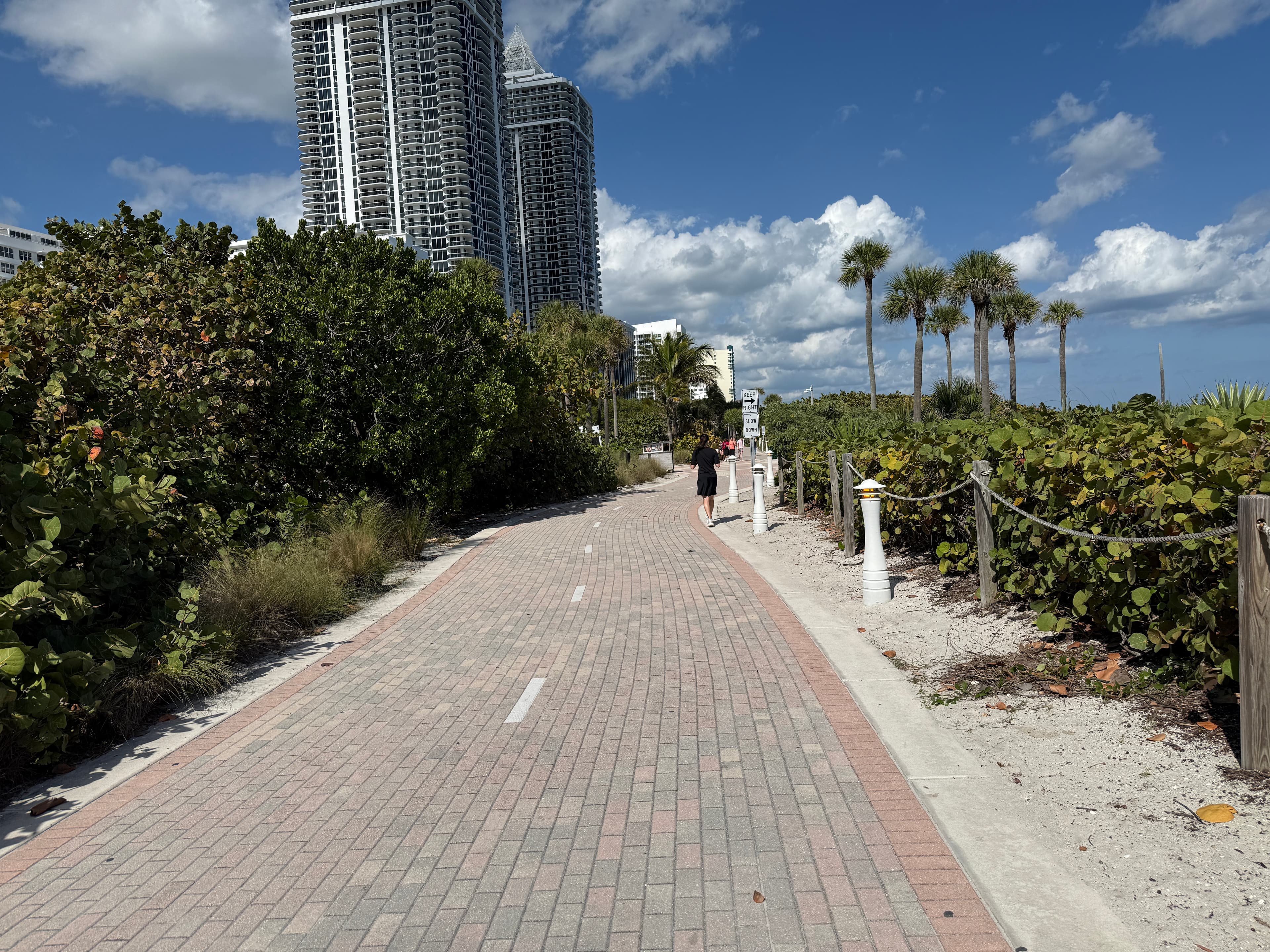
What surprises first-time walkers is that the path is not really a boardwalk anymore, at least not for most of its length. The original wooden boardwalk ran a single stretch through Mid-Beach, from 23rd Street to 46th Street. Over the years, the city's separate waterfront promenades and paver paths — in South Beach, at South Pointe Park, through the northern parks — were gradually connected to it, until the pieces joined into one continuous oceanfront thoroughfare. South of 23rd Street the surface becomes pavement: the Ocean Drive Promenade carries walkers down through Lummus Park to 5th Street, and South Pointe Park finishes the route at the island's southern tip. The full connected route, now known as the Miami Beach Walk, runs roughly nine miles from South Pointe Park to the northern end of the island, and it never crosses a street.
That continuity is the point. You can step onto the path anywhere — at a hotel door on Collins Avenue, at a beach access ramp in South Beach, at a park in North Beach — and be on the same walk as everyone else: the sunrise runners, the cyclists, the parents with strollers, the visitors in rented beach cruisers, the lifeguards heading to their stands. It is Miami Beach's front porch, its gym, its promenade, and its postcard, all at once.
From planks to pavers
The boardwalk's story begins in the 1920s, when Miami Beach was still inventing itself as a resort. The first sections of seaside promenade were built as a wooden walkway through Mid-Beach, giving hotel guests a clean, sandy-free route along the shore. It was a modest amenity for a young city — a plank path between the hotels and the surf — but it established the idea that the beachfront belonged to walkers, not just to the hotels that lined it.
That idea survived everything the island threw at it: hurricanes, the Depression-era bust, the Art Deco rebuilding of South Beach, the condo towers of Mid-Beach, and the long decades when the path existed in disconnected pieces. The work of joining those pieces took more than a decade, and the modern, fully connected Beachwalk was completed in 2022, replacing the aging wooden boardwalk with a wide, paved, accessible path. The new surface is typically around 15 feet wide, patterned in places with decorative pavers, and built to carry walkers, runners, cyclists, and wheelchairs side by side. The wooden boardwalk is gone as a structure, but its name stuck — and so did its purpose.
The result is a rare thing in Florida: a long, uninterrupted public edge between the city and the sea. So much of the state's beachfront is fenced, privatized, or broken by development; here, for nine miles, the view is open to anyone who shows up. That is why the path feels less like a tourist attraction and more like civic infrastructure — because it is.
South Pointe to Lummus: the Ocean Drive stretch
Start at the southern end and the walk begins with a spectacle. South Pointe Park occupies 17 acres at the island's tip, with wide limestone walkways, lawns, a fishing pier, and a promenade that looks straight down Government Cut toward Fisher Island and the downtown Miami skyline. The park opened in the mid-1980s and was rebuilt and reopened in 2009; today its neon-lit promenade towers glow after dark, and its pier is one of the best places in the city to watch a cruise ship depart — close enough that you can wave at the passengers on deck.
From South Pointe, the path runs north along the beach and into Lummus Park, the famous beachfront park that fronts Ocean Drive from 5th Street to 15th Street. This is the stretch most people picture when they picture Miami Beach: wide sand, rows of palm trees, volleyball courts, outdoor gym equipment, and, behind the park, the low-rise pastel hotels of the Art Deco Historic District. A wavy pedestrian promenade weaves through the north end of Lummus Park and continues up along the beach to 21st Street, where it meets the boardwalk proper. Ocean Drive itself — the street behind the park, running 1.3 miles from South Pointe Drive to 15th Street — was laid out in 1915, and its hotels, built mostly in the 1930s and early 1940s after the 1926 hurricane cleared the way, form the largest collection of Art Deco architecture anywhere in the world, some 800 buildings strong.
Walk this section in the morning and you will share it with the city's most dedicated regulars: runners finishing their miles before the heat, swimmers coming out of the surf, hotel guests in robes carrying coffee. Walk it in the late afternoon and the mood flips — music from the Ocean Drive cafes drifts across the park, the light goes gold, and the promenade fills with strollers, photographers, and people just watching the parade go by. Both versions are worth seeing, and they are only a few hours apart.
The lifeguard stands: Miami Beach's exclamation points
No walk along the boardwalk is complete without the lifeguard stands. There are 31 of them along Miami Beach, each one a different color and shape — a pink tower here, a turquoise one there, one shaped like a rocket, one like a beach hut crossed with a cartoon. They are the work of architect William Lane, who redesigned the city's stands after Hurricane Andrew devastated the old ones in 1992. Lane's first five stands went up in Lummus Park, and the rest followed, each one an individual design rather than a repeated model.
The stands are more than decoration. They are working lifeguard stations, and they have become the city's unofficial logo — the image on postcards, swimwear, and a thousand Instagram feeds. Spotting them all has become a minor quest for regular walkers, and the stretch of path through Lummus Park and South Beach, where the stands are densest and most flamboyant, is the best place to start. They also make perfect mile markers: pick a color, walk to the next one, and you have measured your morning without ever looking at your phone.
Mid-Beach: the classic boardwalk miles
North of 23rd Street, the path settles into its classic boardwalk character. This is the original boardwalk's territory — the Mid-Beach stretch from 23rd to 46th Streets — and it is quieter than South Beach in the best way. The hotels here are taller and grander: the Fontainebleau, the Eden Roc, and the long row of mid-century resorts that made Mid-Beach famous in the 1950s, when the city was the winter capital of American glamour. The path runs between the hotels and the dunes, with the sand on one side and landscaped resort grounds on the other, and the crowds thin out enough that you can hear the surf again.
This is also the stretch where the boardwalk earns its reputation as a fitness trail. The surface is smooth and wide, the route is flat, and the mile markers — hotels, parks, beach access points — tick by steadily. Indian Beach Park, around 46th Street, marks the northern end of the original wooden boardwalk's run, and it is a good turnaround point for a Mid-Beach out-and-back: the path here looks straight north along an emptier stretch of sand, and the photograph of the boardwalk looking north from this park is the classic image of the route at its calmest.
North Beach: the quiet end of the island
Keep going past 46th Street and the city changes tempo again. North Beach — the neighborhoods of Normandy Isle and the North Shore — is residential Miami Beach: smaller hotels, apartment blocks, local cafes, and the wide, dune-backed sands of North Shore Open Space Park. The path continues through it to the Surfside border near 87th Terrace, and the further north you go, the more the walk belongs to locals: dog walkers, fishermen, families with coolers, and cyclists doing the full island ride.
There is a particular pleasure in walking the whole thing, or at least a long piece of it, because the island reveals itself in sequence — the cruise ships and skyline at South Pointe, the Art Deco theater of Ocean Drive, the grand hotels of Mid-Beach, the quiet dunes of the north — and no single neighborhood tells the whole story. If you only have an hour, walk the South Beach section. If you have a morning, walk from South Pointe to 46th Street and back. If you have a day and a rented bike, ride the whole island and back; the path is built for it, and rental bikes are available at stations and shops all along the route.
Walking it well
The boardwalk is free, public, and flat, and it rewards the simplest plan: go early. Sunrise over the Atlantic is the boardwalk's great daily show — the sky goes pink over the water, the sand is empty, and the path belongs to runners and fishermen for an hour before the beach crowds arrive. Sunset is beautiful too, but the sun sets over the bay, behind the city, so the evening light on the path is softer and golden rather than spectacular; morning is when the ocean side shines.
Come prepared for a Florida walk: water, sunscreen, and a hat, because shade is scarce on the path itself and the sun is strong even on cloudy days. Restrooms, showers, and water fountains sit at intervals along the route, and beach access ramps let you step off the path onto the sand whenever you want. Cyclists share the path with walkers — keep to one side, listen for bells, and expect the path to be busiest on weekend mornings and holidays. And remember that the path is a working beachfront: conditions, access points, and lifeguard coverage can change with weather, maintenance, and the season, so check the City of Miami Beach's current beach information before you go if you are planning around a specific access point or activity.
The boardwalk asks very little of you and gives a great deal back: nine miles of ocean, a century of Miami Beach history in a single line, and the rare feeling, in a city built for cars, of being exactly where you are supposed to be — on foot, at the water's edge, going wherever the path goes next.
Key Facts
- The Miami Beach Boardwalk is the oceanfront promenade running the length of the barrier island of Miami Beach, from South Pointe Park in the south to the Surfside border near 87th Terrace in the north.
- The original wooden boardwalk ran through Mid-Beach from 23rd Street to 46th Street; its first sections were built as a seaside promenade in the 1920s.
- South of 23rd Street the route becomes a paved surface: the Ocean Drive Promenade carries walkers through Lummus Park to 5th Street, and South Pointe Park completes the route at the island's southern tip.
- The connected route is now known as the Miami Beach Walk; the full path runs roughly nine miles, is typically around 15 feet wide, never crosses a street, and was completed in its modern paved form in 2022.
- Ocean Drive, the street behind Lummus Park, runs 1.3 miles from South Pointe Drive to 15th Street and was laid out in 1915.
- The Miami Beach Art Deco Historic District, fronting the path from 5th to 23rd Streets, holds some 800 historic buildings, most built in the 1930s and early 1940s after the 1926 hurricane.
- Lummus Park fronts Ocean Drive from 5th to 15th Streets; a wavy promenade weaves through its north end and continues along the beach to 21st Street, where it meets the boardwalk.
- South Pointe Park covers 17 acres at the island's southern tip, with a fishing pier, limestone walkways, and views of Government Cut, Fisher Island, and the downtown Miami skyline; it opened in the mid-1980s and was rebuilt and reopened in 2009.
- Miami Beach has 31 lifeguard stands, each a different color and design, redesigned by architect William Lane after Hurricane Andrew; the first five were built in Lummus Park.
- The path is a free public promenade, shared by walkers, runners, cyclists, and wheelchair users, with restrooms, showers, and beach access points at intervals along the route.
Visitor Details
Access: The boardwalk is a free public promenade open along the oceanfront. Join it anywhere: South Pointe Park (1 Washington Avenue) at the southern end; Lummus Park beach access points along Ocean Drive from 5th to 15th Streets; Mid-Beach access points along Collins Avenue from 23rd to 46th Streets; or North Shore Open Space Park in North Beach. The path never crosses a street, so any beach access ramp puts you on the same continuous route.
Getting there: South Beach is served by Miami Beach's bus routes along Collins Avenue and Washington Avenue; rideshare and taxi drop-offs are easiest at South Pointe Park, Lummus Park, or any Collins Avenue hotel. Parking near the beachfront is limited and in demand — public lots and garages fill early on weekends, so transit or rideshare is the simpler choice.
Hours/Admission: The boardwalk itself is a free public promenade — no ticket, no fee to walk it. Beach and park rules, lifeguard coverage, and access conditions vary by season, weather, and maintenance, so check the City of Miami Beach's current beach information before visiting if you are planning around a specific access point.
Best timing: Sunrise, when the sun rises over the Atlantic and the path is at its quietest; late afternoon for golden light and people-watching along Ocean Drive. Weekend mornings are the busiest time on the path.
Good routes: One hour — South Pointe Park to Lummus Park and back along Ocean Drive. One morning — South Pointe Park north to 46th Street (Indian Beach Park) and back, through the full Art Deco and Mid-Beach stretches. Full day — bike the whole island from South Pointe to Surfside and back; rental bikes are available at stations and shops along the route (rental rates vary, so check the provider before you ride).
Location Photography