A Quaker Farmer Who Became a Botanist
John Bartram (1699–1777) was not trained as a scientist. He was a Quaker farmer in Kingsessing, west of the Schuylkill River and, in his day, miles outside Philadelphia, who taught himself botany and turned curiosity into a system. In September 1728 he purchased a 102-acre farm on the river for personal use and began developing it as a systematic collection — not an ornamental garden in the European sense, but a working place to grow, study, and compare North American plants. The Swedish botanist Carl Linnaeus is reported to have called him the greatest natural botanist in the world, and in 1765 King George III appointed him Royal Botanist for North America. Those titles followed the work rather than preceding it: decades of plant collecting on journeys through the colonies, from New England to Florida and west to Lake Ontario, and a correspondence network that exchanged seeds, specimens, and information with botanists on both sides of the Atlantic.
The Stone House and the Systematic Garden
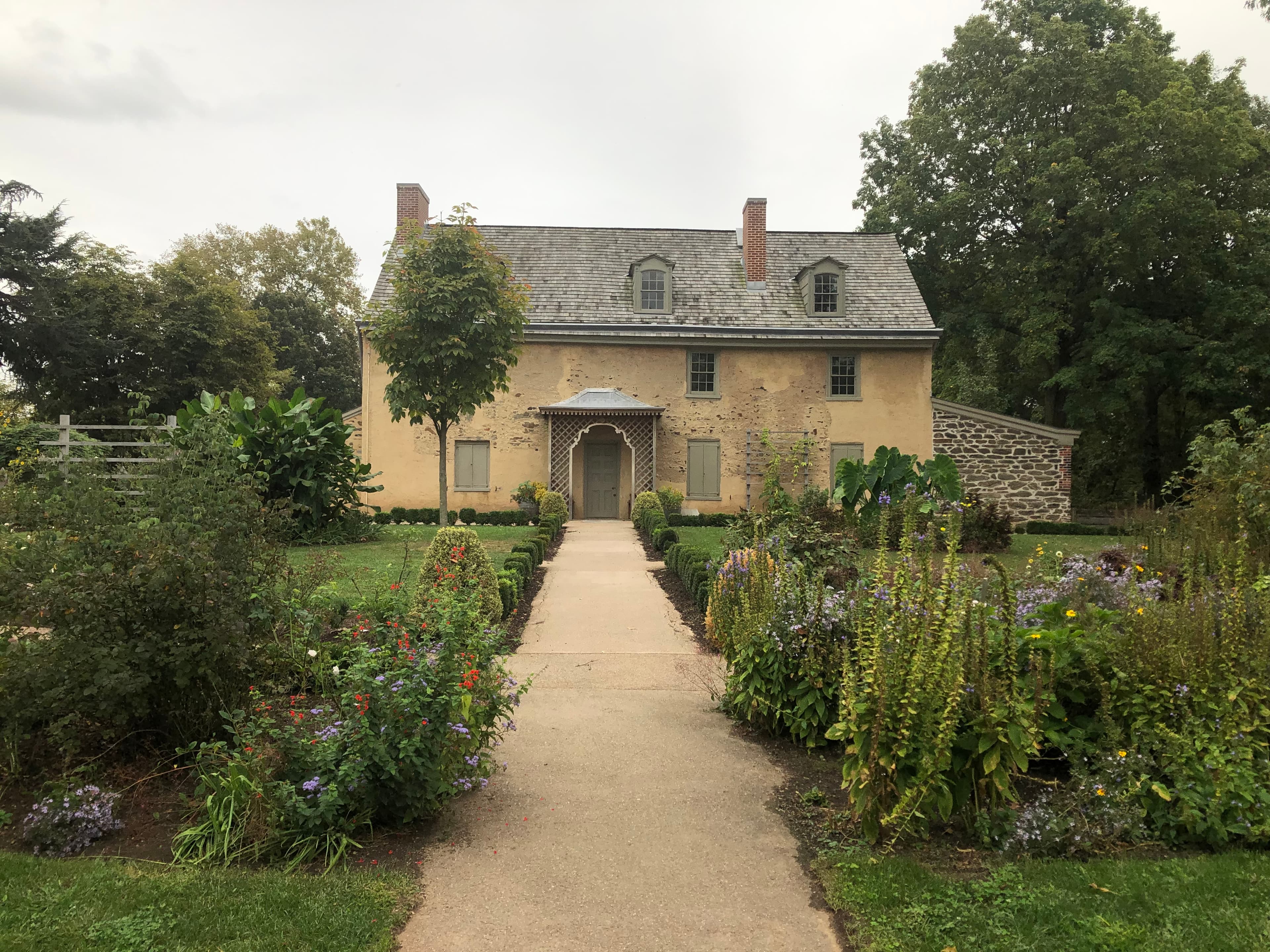
Bartram built the garden's stone house between 1728 and 1731, added a kitchen around 1740, and between 1758 and 1770 installed the Palladian-inspired carved facade that still faces the garden — a farmer's house dressed, by its owner's own hand, in the classical language of the Enlightenment. A stone carving dated 1770 survives on its east side. Below the house he laid out the garden in a rectilinear framework of paths and beds running down toward the river, a grid that can still be recognized in the landscape today despite losses in the years when the site was neglected. A greenhouse followed in 1760. The point of the layout was order for study: plants arranged so they could be observed, propagated, and shipped. By the mid-18th century, contemporaries judged the collection the most varied assemblage of North American plants in the world, and most of what grows there now traces to the family's 1783 broadside, the Catalogue of American Trees, Shrubs and Herbaceous Plants, and its later editions — the first printed plant catalogue in America.
A Transatlantic Plant Business
The garden was also a business, and the business funded the science. The Bartrams operated a flourishing transatlantic trade, packing seeds and live plants for European collectors, landscapers, and scientists who considered American species exotic and desirable, and supplying American customers as domestic demand grew. That trade is why the garden mattered far beyond Kingsessing: it was the clearinghouse through which hundreds of North American species entered cultivation. After the Revolution, and after John Bartram's death in 1777, his sons William Bartram (1739–1823) and John Bartram Jr. (1743–1812) continued and expanded both the botanic garden and the nursery. Prominent visitors came to see the collection for themselves, including members of the Continental Congress in 1784 and President George Washington in 1787, while Philadelphia served as the temporary capital. William became a respected naturalist, artist, and author in his own right; his 1791 Travels, recording his explorations in the South, became a classic of American nature writing, and he used the garden to train the next generation of explorers and natural scientists.
Three Generations, and the Trees That Outlived Them
Three generations of Bartrams ran the garden as the premier collection of North American plant species in the world. After John Bartram Jr. died in 1812, his daughter Ann Bartram Carr (1779–1858) took over with her husband, Colonel Robert Carr, shipping as many as 2,000 species worldwide, adding a specimen garden west of the house for popular new flowering plants, and becoming the first Bartram to open the garden deliberately to the public. The living collection still carries individual witnesses to that era. The Franklinia alatamaha, or Franklin tree — named for John Bartram's friend Benjamin Franklin — was found by William and John Jr. on October 1, 1765, beside Georgia's Altamaha River; William brought seed back, planted in 1777, and the species, last seen in the wild in 1803, survives today only because the Bartrams propagated and distributed it — every Franklinia now growing descends from theirs. The garden's male ginkgo, east of the Bartram Barn, is believed to be the oldest ginkgo in North America, the last of three introduced from China via London in 1785. A notably old yellowwood near the Kitchen Garden may have been collected in Tennessee in 1796 by the French explorer André Michaux and sent to William Bartram.
Sold, Neglected, and Saved as a Public Park
Financial difficulties ended the family's tenure: in 1850 the Bartrams sold the historic garden to Andrew M. Eastwick (1811–1879), a railroad magnate who preserved it as a private park for his estate. After Eastwick's death in 1879 the garden was left wanting — plants were stolen, died, or were damaged — until the botanist Thomas Meehan organized a Philadelphia campaign to preserve it, aided nationally by Charles Sprague Sargent of the Arnold Arboretum. The City of Philadelphia assumed control in 1891 and protected it as a city park, and the John Bartram Association was formally organized in 1893 to oversee preservation of the garden, house, and outbuildings. The site was designated a National Historic Landmark in 1960, with National Register listing dating to October 9, 1960. Today the 45-acre garden is operated by the non-profit John Bartram Association in coordination with Philadelphia Parks and Recreation — the rescue Meehan argued for, made permanent.
A Living Garden on the Tidal Schuylkill
The modern garden is both a historic landscape and a working neighborhood park. It holds the only recreational access to the Tidal Schuylkill River and its wetlands, its trails form segments of the East Coast Greenway and the Bartram's Mile trail, and a community boathouse supports rowboating, kayaking, and fishing on the river. The John Bowman Bartram Special Collections Library holds documents on the garden, Philadelphia, and the development of botany. Restoration has recovered lost pieces, including the Ann Bartram Carr Garden, reopened in 2016, and in 2011 four acres along the southern border became the Sankofa Community Farm, an African Diaspora-focused crop farm. The official site describes a place that is, in its own words, many things to many people — a home for horticulture, an ancient riverfront, and a place of untold histories, spanning nearly 50 acres. That breadth is the honest summary: Bartram's is not a garden frozen in 1728, but one that has kept growing, in public, for almost 300 years.
Key Facts
• Founded in September 1728, when John Bartram (1699–1777) bought a 102-acre farm in Kingsessing on the Schuylkill River; it is the oldest botanical garden to survive in North America, now 45 acres.
• The stone Bartram House was built 1728–1731, with a kitchen added c. 1740, a Palladian-inspired carved facade installed 1758–1770, and a greenhouse built in 1760; John Bartram was appointed Royal Botanist to King George III in 1765.
• Three generations of Bartrams ran an international plant trade from the site, publishing the first printed American plant catalogue in 1783; visitors included members of the Continental Congress in 1784 and President George Washington in 1787.
• Signature trees: the Franklinia, saved from extinction by Bartram propagation after its 1765 discovery in Georgia and last seen wild in 1803; North America's oldest ginkgo (introduced 1785); and a yellowwood possibly collected by André Michaux in Tennessee in 1796.
• Sold by the family in 1850 to Andrew M. Eastwick; rescued after his death by a preservation campaign led by Thomas Meehan, taken over by the City of Philadelphia in 1891, and designated a National Historic Landmark in 1960.
Visitor Details
Address: 5400 Lindbergh Boulevard, Philadelphia, PA 19143 (Southwest Philadelphia, on the west bank of the Tidal Schuylkill River)
Transit: Accessible by the SEPTA Route 36 trolley, by bike via the Bartram's Mile / East Coast Greenway trails, and by car, with parking on site — check the official site for current directions and gate information.
Hours/Admission: The garden describes itself as open free every day as a public park; Visit Philadelphia lists the grounds as open daily, sunrise to sunset, with the Welcome Center open on a more limited schedule. Confirm current Welcome Center hours, house tour availability, and any program fees on the official website at bartramsgarden.org before visiting — do not rely on third-party listings, which conflict.
Best timing: Spring and early fall for the historic gardens in bloom and comfortable riverfront walking; allow at least two hours to cover the house grounds, the notable trees, the meadow, and the river trail. Late afternoon gives the best light across the Schuylkill toward the Center City skyline.
Location Photography