An Airport Built on Sand
There is no land under Floyd Bennett Field that nature put there. The field stands on what used to be Barren Island and a scattering of marsh islands in Jamaica Bay, stitched together when dredges pumped sand from the bottom of the bay and filled in the channels between them. The result was a flat, treeless plain jutting into the water across from what is now JFK — a blank slate big enough for runways, at a time when aviation was outgrowing the rough grass strips it had started on.
It was New York City's first municipal airport, dedicated on June 26, 1930, and officially opened on May 23, 1931. The name belonged to Floyd Bennett, a Brooklyn resident, Congressional Medal of Honor recipient, and the pilot on Admiral Richard Byrd's 1926 flight over the North Pole. Bennett died in 1928, and the city named its new airport for him. The dedication drew the royalty of early aviation: Charles Lindbergh, Jimmy Doolittle, and Byrd himself were all in attendance, a measure of how seriously the field was taken as a statement about the future.
The field never became the commercial hub its builders imagined — Newark and then LaGuardia pulled scheduled traffic away — but what it lost in airlines it gained in legend. For a decade, if you were going to attempt something impossible in an airplane, you started from Floyd Bennett Field.
The Record-Setters' Runway
On July 15, 1933, Wiley Post took off from the field in his Lockheed Vega, the Winnie Mae, attempting the first solo flight around the world. Seven days, eighteen hours, and forty-nine minutes later he set the plane down on the same patch of ground he had left, having covered 15,957 miles. His record would stand for five years.
Five years later, on the morning of July 17, 1938, Douglas Corrigan filed a flight plan for California, pointed his patched-together Curtiss Robin west, and then turned east. Twenty-eight hours and thirteen minutes later he landed at Baldonnel Aerodrome outside Dublin, Ireland, explaining that his compass had misled him in the clouds. Authorities had repeatedly refused him permission for a transatlantic crossing, judging his plane unfit. His suspension lasted two weeks; his nickname, "Wrong Way" Corrigan, lasted forever. He was given a ticker-tape parade on his return.
The same summer, Howard Hughes and a crew of four left the field on July 10 in a silver Lockheed Electra and circled the globe in three days, nineteen hours and change. Amelia Earhart flew from the field too, and in November 1937, after her disappearance, the field hosted an air parade of Navy, Coast Guard, and Army aircraft in her memory. Jacqueline Cochran set the women's west-to-east transcontinental record from Burbank to the field in 1938 — ten hours, twenty-seven minutes. And in 1957 the field received a young John Glenn at the end of a record transcontinental dash from Los Angeles: three hours, twenty-three minutes, eight and four-tenths seconds.
For one strange decade, this patch of filled-in marsh was the starting line of the heroic age of flight.
The Navy Takes Over
The municipal airport era ended in 1941. With war engulfing the Atlantic, the U.S. Navy bought the field and renamed it Naval Air Station New York. Patrol aircraft flew from here hunting U-boats off the East Coast, and the Naval Air Ferry Command moved newly built warplanes through the station on their way to combat units. The Navy ran the field for three decades, through the Korean and early Vietnam years, before closing it in 1971.
A year later, in 1972, the field passed to the National Park Service as part of the newly created Gateway National Recreation Area — the first urban park in the national park system. The historic core, eight original hangars plus the administration building, was listed on the National Register of Historic Places in 1980 and is considered one of the largest and best-preserved collections of commercial aviation architecture from the interwar years: low-slung, Art Deco-influenced hangars with curved roofs, built between 1930 and 1931, lined up in two rows along Flatbush Avenue.
The Abandoned Eight
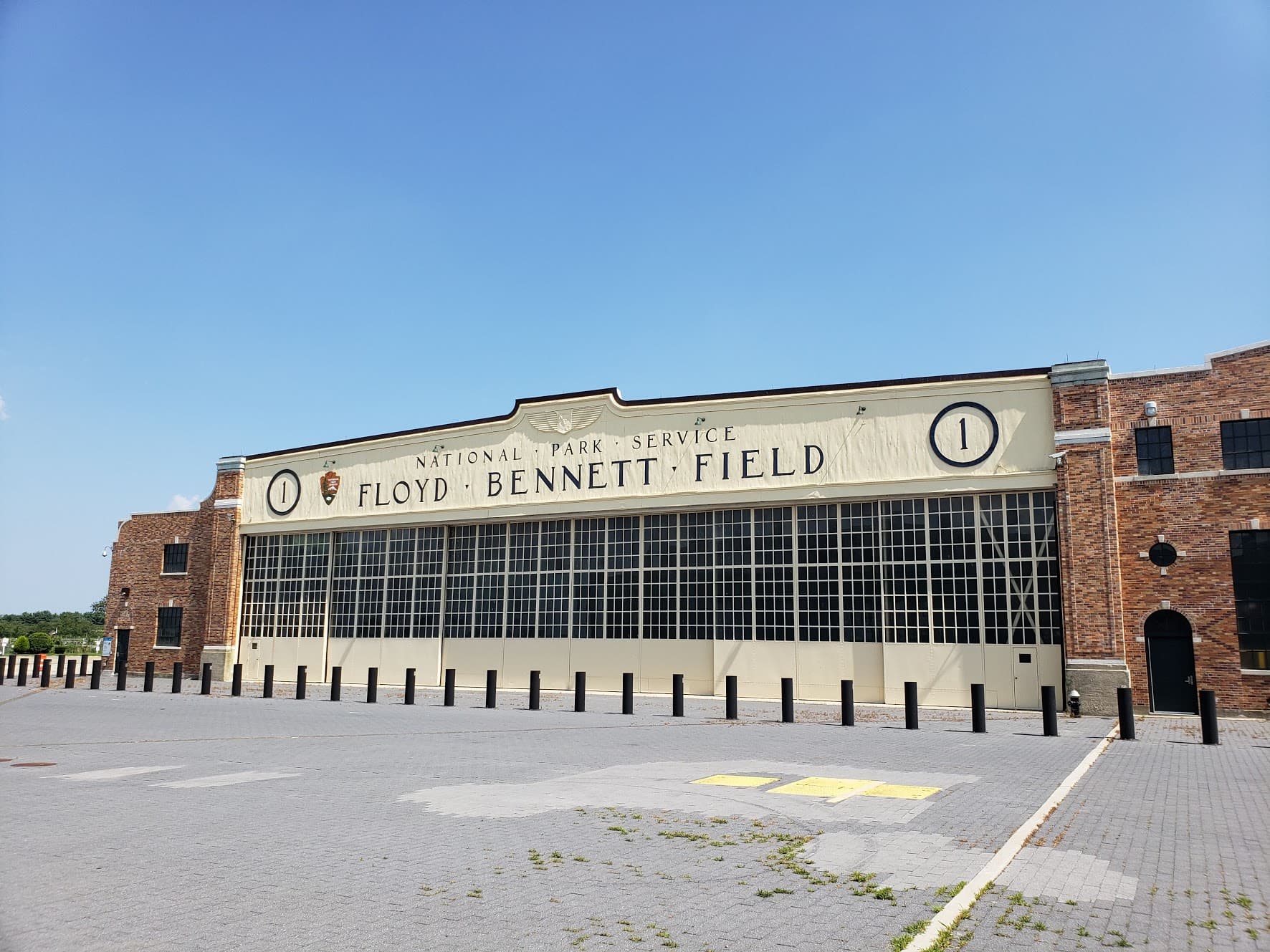
Stand on Flatbush Avenue today and the hangars are still there, flanking the Ryan Visitor Center — the former airport terminal and administration building, with its control tower, named for Congressman William Fitts Ryan. The eight hangars read as four buildings, but each structure is really two hangars joined together.
Their fates diverged. Hangars 5 through 8 were converted into Aviator Sports, an indoor complex with ice rinks, courts, and a restaurant. Hangars 1 and 2 were restored and now serve as a natural gas metering station. Hangars 3 and 4 remain in National Park Service hands, used for storage, with a $25 million renovation announced in August 2024. Meanwhile, Hangar B is home to the Historic Aircraft Restoration Project, where volunteers spend their weeks rebuilding vintage aircraft and engines, exactly the kind of labor the field has always attracted.
The airfield itself is done flying — the one exception is the NYPD helicopter base still operating from one corner of the grounds. The runways are closed to aircraft but open to walkers, cyclists, and birders. A permit-based archery range operates on the grounds. Beyond the concrete, more than 1,300 acres of grassland, saltmarsh, and tidal mudflat stretch toward Jamaica Bay, some of the best birdwatching in the five boroughs. Admission is free; the one thing you can't do is camp — the NPS campsite remains closed.
Visiting Today
Floyd Bennett Field rewards slow exploration. Walk the old runways and you can still see the geometry of a 1930s airfield from the ground: the long diagonals, the wide aprons, the hangars in formation. Inside the Ryan Visitor Center you'll find exhibits on the field's aviation years, and the restored terminal still shows its bones — passenger lounges, administrative rooms, a control tower from the days when commercial flight was a glamorous gamble.
Go on a weekend morning, when the volunteers are often in the hangars and the light is flat and honest over the grassland. Bring binoculars as well as curiosity: the same emptiness that makes the place feel like a film set also makes it a refuge for egrets, ospreys, and migrating warblers. It's the rare New York destination where the loudest sound is the wind moving across an acre of nothing — which is, of course, exactly what made it perfect for airplanes.
Location Photography


Key Facts
- NYC's first municipal airport: dedicated June 26, 1930; opened May 23, 1931; named for aviator and Medal of Honor recipient Floyd Bennett.
- Launchpad for record flights: Wiley Post's 1933 solo round-the-world flight, "Wrong Way" Corrigan's 1938 flight to Dublin, Howard Hughes's 1938 round-the-world record.
- U.S. Navy air station 1941–1971; part of Gateway National Recreation Area (NPS) since 1972; National Register historic district listed 1980.
- Eight original 1930–31 hangars survive along Flatbush Avenue; NYPD still operates a helicopter base on the grounds; over 1,300 acres of grassland and marsh.
Visitor Details
Address: 3159 Flatbush Ave, Brooklyn, NY
Transit: Q35 bus along Flatbush Avenue stops at Floyd Bennett Field and the Ryan Visitor Center; by car, Belt Parkway to Exit 11S (Flatbush Avenue South).
Hours/Admission: No entrance fee. The park is generally open daily 6 am–9 pm per NPS; the Ryan Visitor Center keeps weekend hours (recently Sat–Sun 9 am–12 pm). The NPS campsite remains closed. Check nps.gov/gate before visiting, as schedules change.
Best timing: Weekend mornings for hangar access and volunteer activity; spring and fall for bird migration over the grasslands.