Preserving the Last Remnant of West Side Freight
When CSX Transportation ceded the viaduct, the Spur over 10th Avenue was originally scheduled for demolition during the development of Hudson Yards. Grassroots advocacy from Friends of the High Line preserved this historic spur, transforming it into the final park section to open in 2019.
Before the Park, "Death Avenue"
The High Line exists because 10th Avenue was killing people. In the mid-19th century, the New York Central Railroad ran freight trains at street level along the West Side waterfront, serving markets, factories, and warehouses. Men on horseback — the "West Side Cowboys" — rode ahead waving flags to clear the way. It was not enough: by 1910, more than 500 pedestrians had been killed, and 10th Avenue had earned its nickname, "Death Avenue." The answer was the West Side Improvement Project. Construction began in 1929, and the viaduct was fully operational by 1934, running from West 34th Street to the Spring Street terminal. It rose thirty feet above the street, strong enough to carry two fully loaded freight trains, and passed directly through buildings — including the National Biscuit Company factory, now Chelsea Market — so freight could be loaded indoors. The Spur branched off to serve the Postal Service's Morgan Processing and Distribution Center on 30th Street, where elevated tracks carried mail trains to upper-floor loading docks. The line cost over $150 million in 1930 dollars. For a quarter century it hummed: trains feeding meatpackers and Nabisco's Oreo plant, with St. John's Terminal at the southern end holding 227 rail cars on eight indoor tracks. Trucking and container shipping hollowed out the waterfront economy. The southern stretch from Spring to Bank Streets was demolished in the 1960s, and the last freight delivery ran in 1980 — three cars loaded with frozen turkeys.
The Fight to Save the Spur
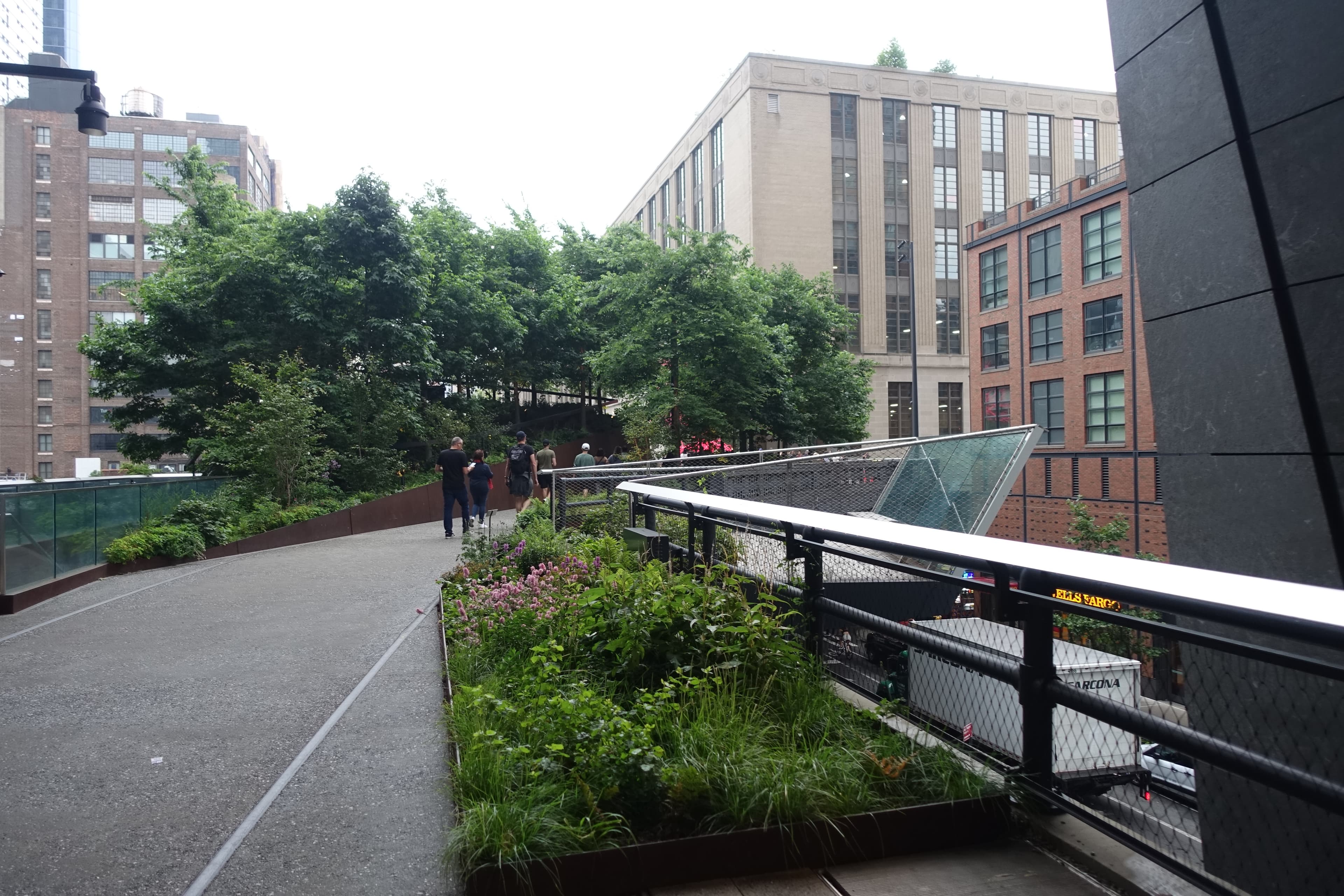
When the Spur stood abandoned over 30th Street and 10th Avenue, the Hudson Yards development rising around it saw a demolition site. In 2005 the city declared the first two sections saved, but the fate of the Rail Yards and the Spur remained undetermined. Friends of the High Line — the group Joshua David and Robert Hammond had founded in 1999 — refused to let it go. In 2008 they organized a "Save the Spur" rally, and hundreds of supporters in red t-shirts showed up. It worked. The city acquired the Spur in 2012, and in 2016 the final design was announced from the same team behind the rest of the park: James Corner Field Operations, Diller Scofidio + Renfro, and Piet Oudolf. The Spur opened to the public in June 2019, the last section of the original elevated rail to be converted into public space. The 420-foot stretch extends east along West 30th Street and ends above 10th Avenue — the widest open space on the High Line, a broad deck with stepped seating and views in every direction. You enter through the Coach Passage, a lofted space along 30th Street, into a woodland that opens into a clearing dominated by the Plinth. The raised planters hold the deepest soil on the High Line, allowing bigger trees than anywhere else on the park. Look down at the deck and you can still trace the remnants of the rails that once carried mail to the Farley Post Office.
The Plinth's Rotating Monuments
The Plinth is the first site on the High Line dedicated to rotating monumental contemporary commissions. The first cycle began in 2016 with an international committee soliciting more than fifty proposals; a shortlist of twelve artists exhibited maquettes in 2017, and the public weighed in before the selections were made. Works rotate every eighteen months. The inaugural commission was Simone Leigh's Brick House, a sixteen-foot bronze bust of a Black woman whose torso merges a skirt with a clay house. Leigh drew on Batammaliba architecture from Benin and Togo, Mousgoum building traditions from Chad and Cameroon, and Mammy's Cupboard, a Natchez, Mississippi restaurant shaped like a Black woman's skirt. Fabricated in Philadelphia at Stratton Studio, it was Leigh's largest work to date. She had just won the Guggenheim's 2018 Hugo Boss Prize; the piece later anchored her 2022 Venice Biennale presentation, where she won the Golden Lion. Sam Durant's Untitled (drone), a large fiberglass installation, followed in 2021. Then came Pamela Rosenkranz's Old Tree in 2023, a twenty-five-foot tree painted hot pink and red, its 145 branches suggesting both limbs and blood vessels. Fabricated outside San Diego, it shipped cross-country in two trucks and was assembled on site, with the plinth covered in an earthy surface so it reads as soil. The fourth commission, Colombian artist Iván Argote's giant hyperrealist pigeon, was announced for the fall of 2024. Each arrival turns the Spur's deck into a small public square — the one place on the High Line built to stop and look up.
Walking the Spur Today
The Spur reads differently from the rest of the High Line: where the older sections thread through Chelsea's blocks, it pushes east over 10th Avenue and 30th Street, an antechamber between the park and Hudson Yards. The Moynihan Connector, opened in 2023, now extends east from the Spur toward Moynihan Train Hall. Look for the original rail switches and freight turnouts set into the planting beds, and the Coach Passage, where Claudia Rankine's We Are Here — text-based sound installations written with Helga Davis and LaTasha N. Nevada Diggs — filled the park's balconies during the opening summer. By 2019 the High Line was drawing eight million visitors a year, and the Spur absorbed them better than any other section: it is the only part of the park with room to gather in a crowd, a stage-sized clearing ringed with seating, built on tracks that once carried mail through the night.
The Plinth and Design Features
- The High Line Plinth is a dedicated monumental plinth site exhibiting rotating contemporary public sculptures.
- Dense birch groves and stepped wooden seating tiers overlook the street below.
- Original rail switches and heavy freight turnouts are integrated directly into the planting beds.
Hero photo: Tdorante10, CC BY-SA 4.0, via Wikimedia Commons.
Location Photography


Gallery photos: Tdorante10 (CC BY-SA 4.0), Tdorante10 (CC BY-SA 4.0), Tdorante10 (CC BY-SA 4.0), Tdorante10 (CC BY-SA 4.0) via Wikimedia Commons.