A Hospital on the Island's Edge
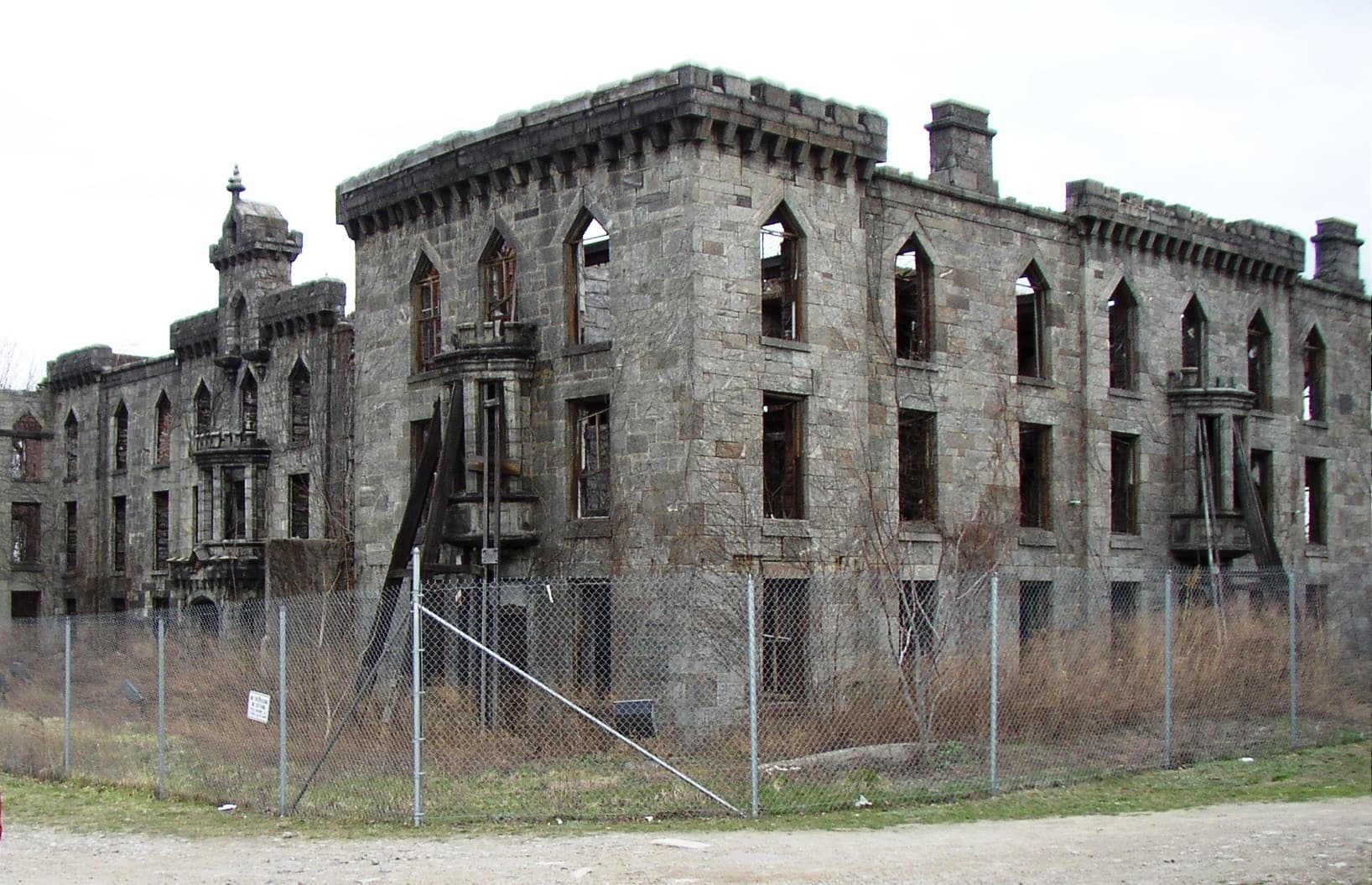
The southern tip of Roosevelt Island ends in a paradox: a manicured memorial park dedicated to Franklin D. Roosevelt, and beside it, a roofless Gothic ruin with ivy threading through empty window arches. This is the Smallpox Hospital, sometimes called the Renwick Smallpox Hospital after its architect. Built between 1854 and 1856, it was the first major hospital in the United States dedicated to the care of smallpox patients — a disease that, despite Edward Jenner's vaccine, still ravaged New York through the arrival of infected immigrants in the mid-19th century. Construction began on April 1, 1854, on what was then Blackwell's Island. The location was deliberate: an isolated strip in the East River, separated from Manhattan by water, where the city's poor and sick could be quarantined. The island already held a penitentiary, a workhouse, and the New York City Lunatic Asylum. The hospital joined them as part of a municipal archipelago for those the city wanted at a distance.
Renwick's Gothic Vision
James Renwick Jr. was twenty-five when he won the competition to design Grace Church. By the time he designed the Smallpox Hospital, he had also completed the Smithsonian Institution Building in Washington. He would go on to design St. Patrick's Cathedral. For the hospital, he chose Gothic Revival — pointed arches, crenelated parapets, a central tower with recessed arches on corbels, and a cupola over the main entrance. The building was constructed of granite gneiss quarried from the island itself, faced as a granite veneer in random ashlar pattern over load-bearing rubble masonry. When completed, it was a three-story, nine-bay U-shaped structure. The central block had a hipped roof with corbeled crenelated parapets on the projecting sections. At the center of the front facade, a porch open on three sides held the main entrance under a wide pointed arch, with an oriel window above. The hospital opened on December 18, 1856, with 100 beds. Charity cases occupied wards on the lower floors; paying patients had private rooms above. It was, by the standards of its time, a humane and architecturally ambitious institution — a place where the city acknowledged that even the poorest smallpox victims deserved a building with pointed arches.
Nineteen Years of Smallpox
The hospital operated as a smallpox facility from 1856 to 1875 — nineteen years during which it treated roughly 7,000 patients. Many were impoverished immigrants who had not been vaccinated or did not trust the immunization process. Others were Union soldiers. The disease was brutal and the treatments limited; the hospital's wards saw suffering on a scale that is hard to comprehend from the quiet ruin today. In 1875, the hospital closed. The Board of Health took over smallpox care, moving it to Riverside Hospital on North Brother Island — even more remote, even more isolated. The Blackwell's Island building was converted into a training center for nurses attached to City Hospital, later renamed Charity Hospital. Renwick's Gothic shell began its second life.
From Hospital to Nurses' Home
The building's new role as the Home for the Nurses of the Maternity and Charity Hospital Training School required more space. Between 1903 and 1905, two wings were added in character with Renwick's original design. The south wing (1903–04) was designed by York & Sawyer; the north wing (1904–05) by Renwick, Aspinwall & Owen, successors to Renwick's firm. The wings had mansard roofs with dormers — the one element not drawn from Renwick's Gothic vocabulary — to provide dormitories, classrooms, laboratories, and training wards. The nursing school ran for nearly seventy years. In 1921, Blackwell's Island was renamed Welfare Island, reflecting the institutions it housed. In the 1950s, both Charity Hospital and the nursing school closed, their operations moving to new buildings in Queens. The Smallpox Hospital — by then the Maternity and Charity Hospital Training School — was abandoned. Stripped of its floors, stairwells, and windows, it began the slow collapse into ruin. In 1973, Welfare Island became Roosevelt Island. The ruin remained, fenced and deteriorating, at the island's southern tip.
Collapse and Stabilization
In 1972, the hospital was added to the National Register of Historic Places. On March 23, 1976, the Landmarks Preservation Commission designated it a New York City Landmark — the only ruin in the city with that designation. The LPC's report speculated that "The Smallpox Hospital could easily become the American equivalent of the great Gothic ruins of England and Wales, such as the late 13th century Tintern Abbey." But designation did not stop decay. The building had been illuminated nightly since 1995 in an effort to raise preservation funds. On December 26, 2007, during a snowstorm, a section of the north wing collapsed, adding urgency to stabilization efforts. In 2009, ground was broken on the Franklin D. Roosevelt Four Freedoms Park, designed by Louis Kahn, on the southern tip of the island. The project included a $4.5 million stabilization of the Smallpox Hospital ruins. The work secured the walls and made the site safe for public viewing — though the ruin itself remains fenced, visible from the park's walkways.
Seeing the Ruin Today
You cannot go inside the Smallpox Hospital. A fence keeps visitors at a distance, and the interior — open to the sky, with only the outer walls and some interior partitions standing — is not accessible. But the view from Southpoint Park and the Four Freedoms Park is striking: the Gothic shell framed against the Manhattan skyline across the East River, the East River itself flowing past. The ruin is most atmospheric at dusk, when the nightly illumination (a tradition since 1995) lights the stone. Come in the late afternoon, walk from the Roosevelt Island Tramway or the F train station south through the island's parks, and watch the light change on the granite. The building is a reminder that New York once built beautiful architecture for its most stigmatized patients — and then left it to become beautiful in a different way.
Hero photo: Wusel007, CC BY-SA 3.0, via Wikimedia Commons.
Key Facts
- Designed by James Renwick Jr. in Gothic Revival style; construction began April 1, 1854; opened December 18, 1856 with 100 beds.
- First major U.S. hospital dedicated to smallpox care; operated 1856–1875, treating roughly 7,000 patients.
- Converted to nurses' training school (Maternity and Charity Hospital Training School); wings added 1903–05; closed 1950s.
- Listed on National Register of Historic Places March 16, 1972; designated NYC Landmark March 23, 1976 — the city's only landmarked ruin.
Location Photography