From Horse Trade to The New York Times
In the late 19th century, the intersection of Broadway and Seventh Avenue was named Longacre Square, after London’s carriage-building center. The turning point arrived in 1904 when Adolph Ochs moved The New York Times into its newly constructed headquarters at One Times Square. Mayor George McClellan officially renamed the junction Times Square shortly before the opening of the city’s first subway line.
The Modern Pedestrian Plazas
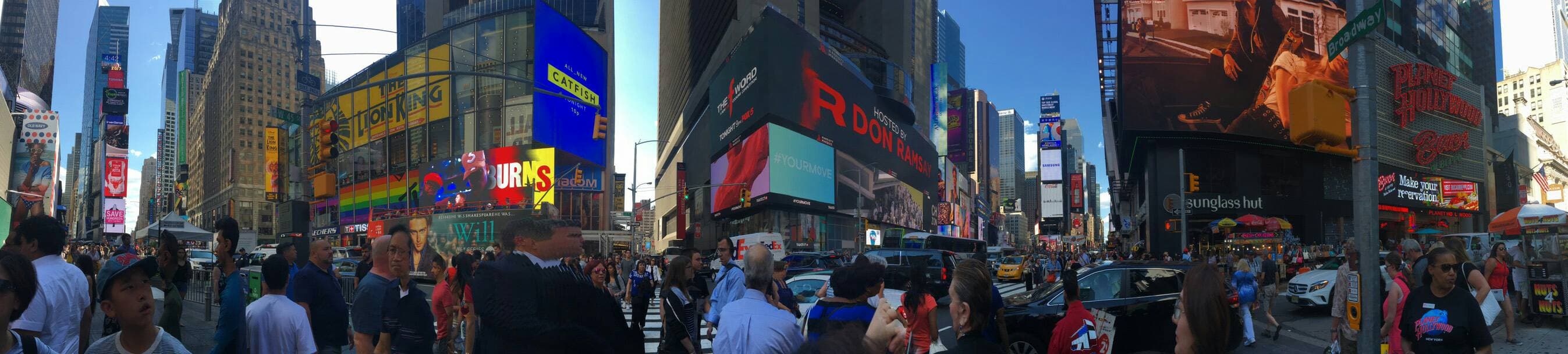
Beginning as an experimental traffic closure under Transportation Commissioner Janette Sadik-Khan in 2009, Broadway was transformed into permanent granite pedestrian plazas, returning open walking space to one of the densest pedestrian corridors on earth.
The Great White Way is born
The nickname came from the light. In the late 1890s, Broadway was among the first streets in America to be fully illuminated by electric lamps, and the white glow of its theater marquees gave the district its name: the Great White Way. The theaters had followed the crowds uptown — and the subway lines — and once the subway arrived they clustered around the new Times Square station. Between 38th and 54th Streets there were once a dozen houses facing Broadway itself — the Empire at 40th Street, Hammerstein's huge Olympia between 44th and 45th, Abbey's down at 38th. The Shubert brothers built and bought houses by the score, and by the 1920s they controlled most of them. Colored bulbs burned out too fast for the marquees, so the signs went up in white — thousands of them, blazing from every theater front — and the river of light became the district's signature. The Ziegfeld Follies made the stretch the national stage; the great restaurants fed the after-theater crowds. What had been a carriage-trading square at the turn of the century was, within a decade, the place America went to be entertained. The street itself predates the city grid — Broadway began as a Lenape trail — and most of the 41 surviving Broadway houses were built in the early 1900s, many by the Shuberts' house architect Henry J. Krapp. A Broadway theater, by the industry's own definition, is simply a Manhattan house with more than 500 seats.
The first ball
Adolph Ochs invented the New Year's Eve party as a publicity stunt. When his newspaper moved into One Times Square, he christened the building on December 31, 1904, with a rooftop fireworks show for a crowd the Times put at 200,000 — pulling the city's celebration uptown from Trinity Church. The fireworks ran for three years until the city banned them as a hazard, and the paper's chief electrician, Walter Palmer, proposed a substitute: a time ball, like the ones that had long dropped at noon from observatories and the Western Union building downtown to set ship captains' clocks. Ochs hired the sign company Artkraft Strauss, run by Ukrainian immigrant metalworker Jacob Starr, to build it: five feet across, 700 pounds of iron and wood, ringed with one hundred 25-watt bulbs. Six men hauled it up the building's seventy-foot flagpole with ropes. At ten seconds to midnight it began to drop; when it hit the roof it closed a circuit that lit five-foot-tall "1908" signs on the tower's sides, while waiters in nearby restaurants switched on battery-powered top hats spelling out the new year. The ball has dropped every year since, with two exceptions: 1942 and 1943, when wartime dim-outs darkened the city and the crowds marked midnight with a minute of silence instead. The ball itself kept evolving — a 400-pound wrought-iron replacement in 1920, a 150-pound aluminum one in 1955 that stayed put until the 1980s, when red bulbs and a green stem turned it into an apple for the "I Love New York" campaign from 1981 to 1988 — and a 1978 refit that swapped in halogen lamps, because the ball has to read from blocks away — and today it is a twelve-foot geodesic sphere of 2,688 Waterford crystal triangles, lit by tens of thousands of LEDs and weighing 11,875 pounds. For most of the twentieth century, Starr's company, Artkraft Strauss, ran the descent — the ball travels a 77-foot flagpole and the drop takes exactly one minute. The Times, reporting the first drop, claimed with probable exaggeration that the crowd's roars were heard as far north as Yonkers, ten miles up the Hudson.
The long decline
The lights stayed on, but the neighborhood hollowed out. From the 1960s through the early 1990s, Times Square became the national symbol of urban decay: go-go bars, peep shows, sex shops, and adult theaters packed the blocks around 42nd Street. As early as 1960 the Times called 42nd between Seventh and Eighth "the worst block in town"; by 1984 a single block saw 2,300 reported crimes in a year, 460 of them serious felonies. At the peak, in the late seventies and early eighties, some 140 sex-related businesses operated in and around the square, and the Daily News was calling the area "a sinkhole." The grand old movie palaces were part of the slide: the New Amsterdam, birthplace of the Ziegfeld Follies, had been converted to a movie house in 1937 and by the sixties was showing cheap genre pictures; by the eighties it sat abandoned. Midnight Cowboy fixed the era on film — the Times Square of hustlers and neon that tourists were warned away from. At one point the whole district paid the city just $6 million a year in property taxes, less than a single midsize Manhattan office tower. The city tried to zone the problem away: in 1977 the City Planning Commission passed amendments to disperse the concentration of adult businesses and keep them from residential blocks — but the effort died at the Board of Estimate, and the Deuce kept its neon for another decade.
From the Deuce to the plazas
The turnaround was a twenty-year municipal project. The 42nd Street Development Project, launched in the early nineties, began buying up the block's derelict theaters, and in 1992 the city acquired the New Amsterdam. Disney — the family brand with the squeaky-clean image — took it over and restored it, reopening in the spring of 1997 with the premiere of Hercules; The Lion King opened there that November and never left. Crime fell through the nineties as the adult businesses were zoned and policed out, and the billboards came back bigger than ever — the NASDAQ tower's seven-story screen, the zipper news ticker still running on One Times Square. Then came the second transformation, of the street itself. In May 2009, Transportation Commissioner Janette Sadik-Khan closed Broadway to cars between 42nd and 47th Streets as an experiment — paint, planters, and folding chairs at first — to see if Midtown gridlock would survive it. It did; pedestrian injuries fell and foot traffic surged, and a year later the closure was made permanent. Norwegian firm Snøhetta won the competition to design the permanent plaza — the site, known as the "Bowtie," is bounded by Broadway and Seventh Avenue between 42nd and 47th — and while the design was finalized, artist Molly Dilworth laid a temporary surface treatment, "Cool Water, Hot Island," across the Broadway asphalt. Between 2012 and 2016 the experiment became granite: ten fifty-foot benches, two-tone paving set with metal discs that catch the neon, 140,000 square feet of new pedestrian space — roughly double what the square had before. The crossroads of the world, re-engineered for the people standing in it. The numbers followed: some 45 million people pass through every year, and since the plazas arrived, retail rents in the area have more than doubled. In one survey, 72 percent of New Yorkers said they liked the plazas — a street experiment, voted in by foot traffic. The formula traveled: the plaza program went on to carve 59 new public spaces out of traffic lanes across the city, handing 39 acres back to pedestrians.
Key Milestones
- Renamed Times Square in April 1904 upon the arrival of The New York Times.
- First New Year’s Eve celebration organized by Ochs in December 1904; the first ball drop debuted in 1907.
- Subway connections: The 42nd St subway hub serves the 1, 2, 3, 7, N, Q, R, W, and S shuttle trains.
Hero photo: H.R. Tsua, CC BY-SA 4.0, via Wikimedia Commons.
Location Photography


Gallery photos: Anthony Quintano (CC BY 2.0), Nielsoncaetanosalmeron (CC BY 4.0), ISO Legacy (CC0 1.0), Luca Bravo (CC0 1.0) via Wikimedia Commons.