The Corner That Could Not Be Bought
In 1900, the Straus family (owners of Macy’s) quietly began acquiring land around 34th Street and Broadway. Sensing the opportunity, Robert H. Smith—acting on behalf of rival store Siegel-Cooper—bought the tiny corner lot at 1313 Broadway for $375,000 to extract a fortune or stall Macy’s relocation from 14th Street.
Building Around the Obstacle
Macy’s refused to give in to astronomical buyout demands. Instead, architect Theodore De Lemos simply designed the department store around the small building. Today, Macy’s leases the billboard rights draped across the holdout, while the corner building itself remains under separate private ownership.
The Clergyman's Corner and the Double-Cross
The plot Macy's needed was almost theirs. A realtor working for the Straus family had struck a deal with the Reverend Alfred Duane Pell, a clergyman who owned the small corner lot at 1313 Broadway, for $250,000. Then "R. Smith and Company" stepped in and persuaded Pell to sell to them instead — for $375,000, a premium that only made sense as a weapon. The National Park Service's landmark nomination for the Macy's building preserves the paper trail of this maneuver. The buyer was Robert H. Smith, a New York businessman widely believed to have been acting for Siegel-Cooper, the rival dry-goods store on Sixth Avenue. In 1896 Siegel-Cooper had built what it boasted was the world's largest store, and its president Henry Siegel had no intention of surrendering the title. The Strauses suspected the purchase was engineered either to block Macy's move outright or to hold the corner hostage until they sold Siegel their old 14th Street building. Macy's ignored the tactic and built around the lot, opening its Broadway section in 1902 with the corner conspicuously left out. Siegel demolished the original corner structure and erected the five-story building that still stands there today. On December 6, 1911, that building sold for $1 million — a record at the time, worth roughly $34.6 million in today's dollars — and the name "Million Dollar Corner" was born. Macy's never did acquire the tract.
A Century of Advertising on the Facade
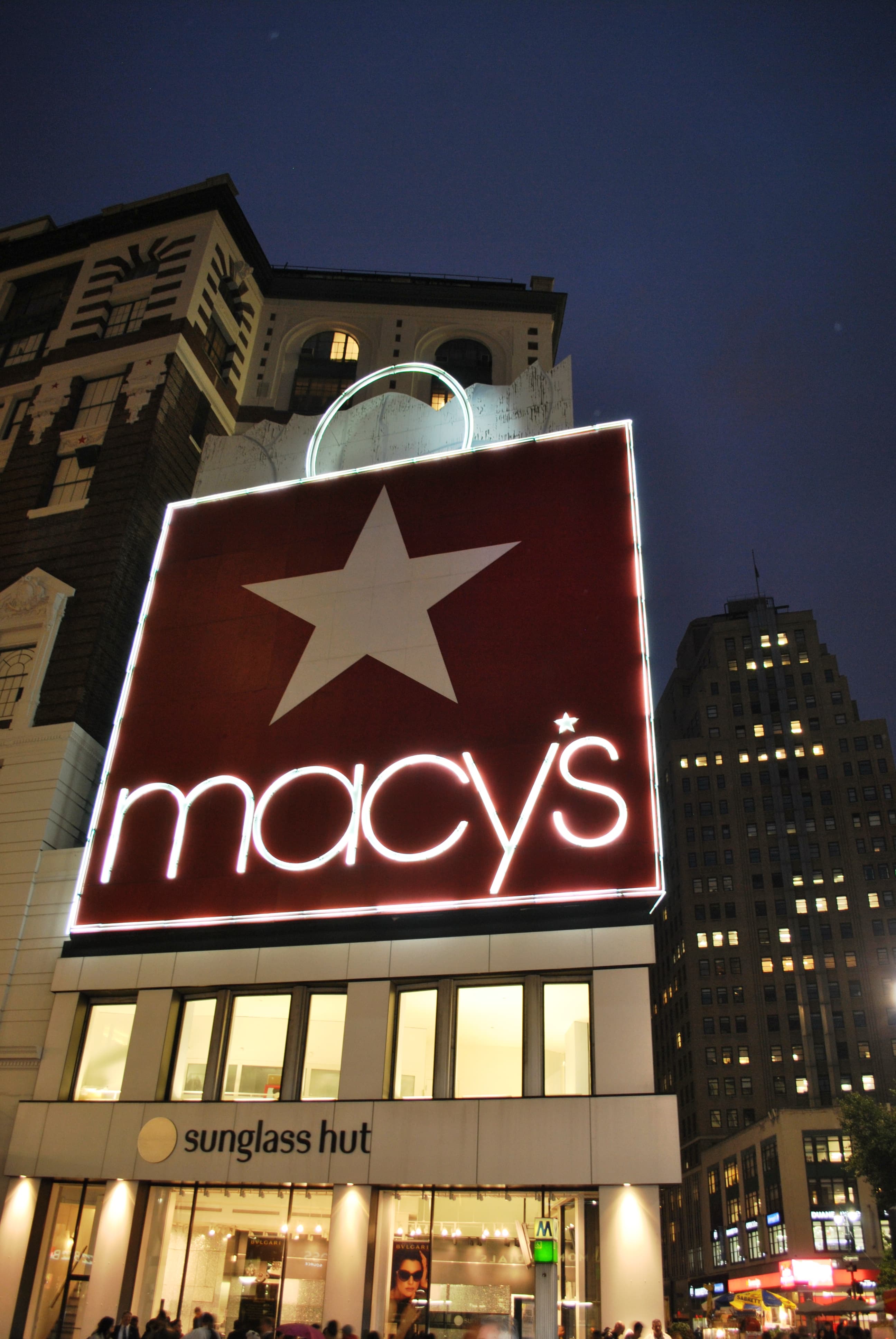
Defeated in real estate, Macy's won the corner back in a different currency: signage. The company struck a lease giving it the building's facade for a billboard, which for decades proclaimed Herald Square "the world's largest store" in the form of a giant red shopping bag. A billboard of some kind had occupied the spot since the 1950s; the red-bag design itself dated to 1994, according to an ABC 7 survey of archival Getty images. The sign measured roughly 2,200 square feet — a wrap-around advertisement seen by some 240,000 pedestrians passing the corner each day. The arrangement outlived the people who made it and kept generating friction. In September 2021, Macy's accused the building's owner, Kaufman Realty, of negotiating to lease the billboard to a competitor before Macy's lease expired that August. Macy's believed the lessee was almost certainly Amazon and went to court for an injunction, arguing that a 1963 agreement barred such a lease "forever" — and that an Amazon billboard looming over the Macy's Thanksgiving Day Parade route would be intolerable. Kaufman denied talking to Amazon but did not dispute that it was shopping the space to a rival. The corner is still under separate private ownership, and Macy's still does not own it. In July 2026, crews dismantled the shopping-bag sign, briefly exposing the hundred-year-old brick facade that had been hidden behind advertising for decades. Macy's promised refreshed branding would follow — but the holdout itself endures.
Inside the Store the Corner Couldn't Stop
What Smith and Siegel failed to prevent was extraordinary. The original Broadway store was designed in 1901–1902 by architects Theodore de Lemos and A. W. Cordes and erected by the Fuller Construction Company, with a Palladian facade and a main entrance on 34th Street flanked by caryatids carved by Scottish-American sculptor J. Massey Rhind. Additions by Robert D. Kohn in 1924, 1928, and 1931 pushed the store westward, growing increasingly Art Deco, until the complex spanned 2.2 million square feet. In 1978 it was designated a National Historic Landmark. It held the title of world's largest store until 2009, when Shinsegae's 3.2-million-square-foot flagship in South Korea overtook it. Step inside and the old store still announces itself. Macy's Herald Square was among the first American retail stores with escalators, and its original wooden escalators remain in operation today — survivors of both the 2012–2015, $400 million storewide renovation and the entire digital age. The human story behind the move is darker. Isidor Straus, the Macy's co-owner who drove the Herald Square relocation, and his wife Ida died together on the Titanic in 1912. When the ship sank, Ida refused a lifeboat seat, reportedly saying she would not be separated from her husband — "as we have lived, so will we die, together" — and gave her fur coat to her newly hired maid, Ellen Bird, insisting she would not be needing it. Isidor's body was recovered; Ida's never was. To reach shoppers at the new uptown address, Macy's paid for a steam wagonette to ferry customers up from 14th Street.
Hero photo: Elisa Rolle, CC BY-SA 3.0, via Wikimedia Commons.
Location Photography


Gallery photos: Arild Vågen (CC BY-SA 4.0), Tdorante10 (CC BY-SA 4.0), Kidfly182 (CC BY 4.0), Zeete (CC BY-SA 4.0) via Wikimedia Commons.