The park that made the city livable
Ask anyone visiting New York for the first time what they want to see, and the answer almost always includes it: Central Park. No other urban park on earth is as instantly recognizable or as woven into the cultural life of its city. At 843 acres — stretching from 59th Street to 110th Street and from Fifth Avenue to Eighth Avenue — it is one of the largest manufactured landscapes ever built in an American city, and it was deliberately designed to be a refuge from exactly the kind of dense, vertical Manhattan that now towers around it.
Before it was a park, the land was rocky, swampy, and uneven — farmland, quarries, and pig farms interspersed with small settlements. In 1853, the New York State Legislature set aside the land for a public park, and in 1857 the city held a design competition. The winners were landscape architect Frederick Law Olmsted and architect Calvert Vaux, whose "Greensward Plan" imagined a pastoral landscape that looked natural but was almost entirely artificial: lakes drained and re-dug, hills built from blasted bedrock, and millions of trees, shrubs, and plants imported and planted. Construction employed as many as 20,000 workers at its peak, and much of the park you walk today sits on fill and engineered terrain.
Olmsted and Vaux's genius was in how they hid the city inside the park. Four transverse roads cross the park below its surface, sunken into cut stone so carriages — and later cars — pass without interrupting the scenery. Pathways were graded so that pedestrians, riders, and carriages each had their own circulation, a separation of traffic that felt radical in the 1860s. The result is a landscape that feels discovered rather than designed, even though every vista was drawn on paper first.
Bethesda Terrace and Fountain: the park's living room
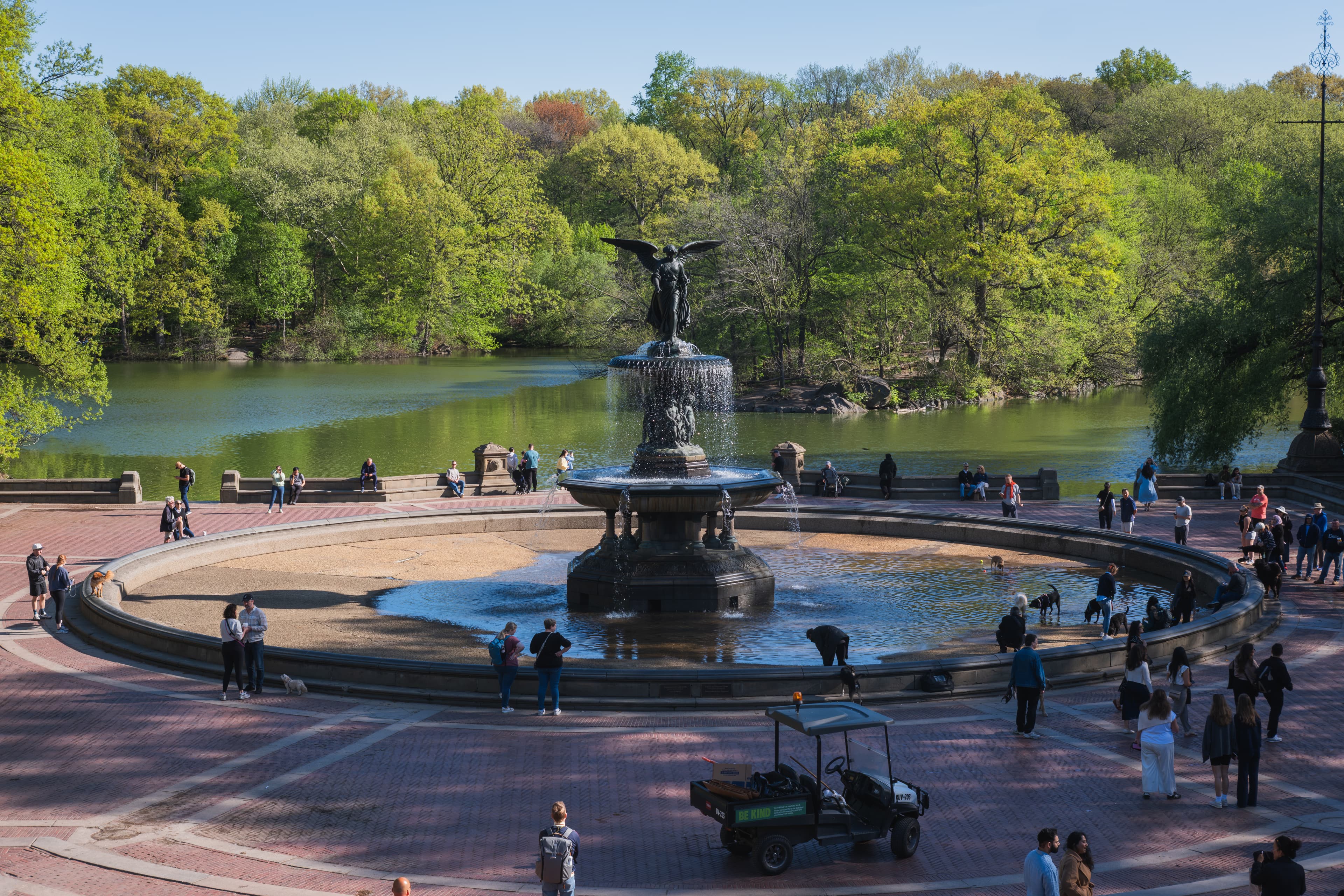
If Central Park has a single center, it is Bethesda Terrace, midway through the park at about 72nd Street. Vaux designed the terrace as the grand architectural answer to the Mall, the formal promenade that leads to it, and it remains the park's most photographed set piece. Descending the grand staircases, you reach the lower plaza where the Bethesda Fountain — officially the Angel of the Waters — rises from the pool.
The fountain's centerpiece, sculpted by Emma Stebbins and unveiled in 1873, depicts a winged angel landing lightly on the water, an allegory of the Croton Aqueduct, which had brought clean drinking water to New York in 1842 and made the city's explosive growth survivable. It is also a quiet landmark in art history: Stebbins's angel was among the first major public sculptures in America by a woman. On any warm afternoon the terrace hums with street musicians, portrait artists, and wedding parties, and the fountain plaza opens directly onto the Lake, where rowboats drift past in summer.
Bow Bridge, the Ramble, and Belvedere Castle
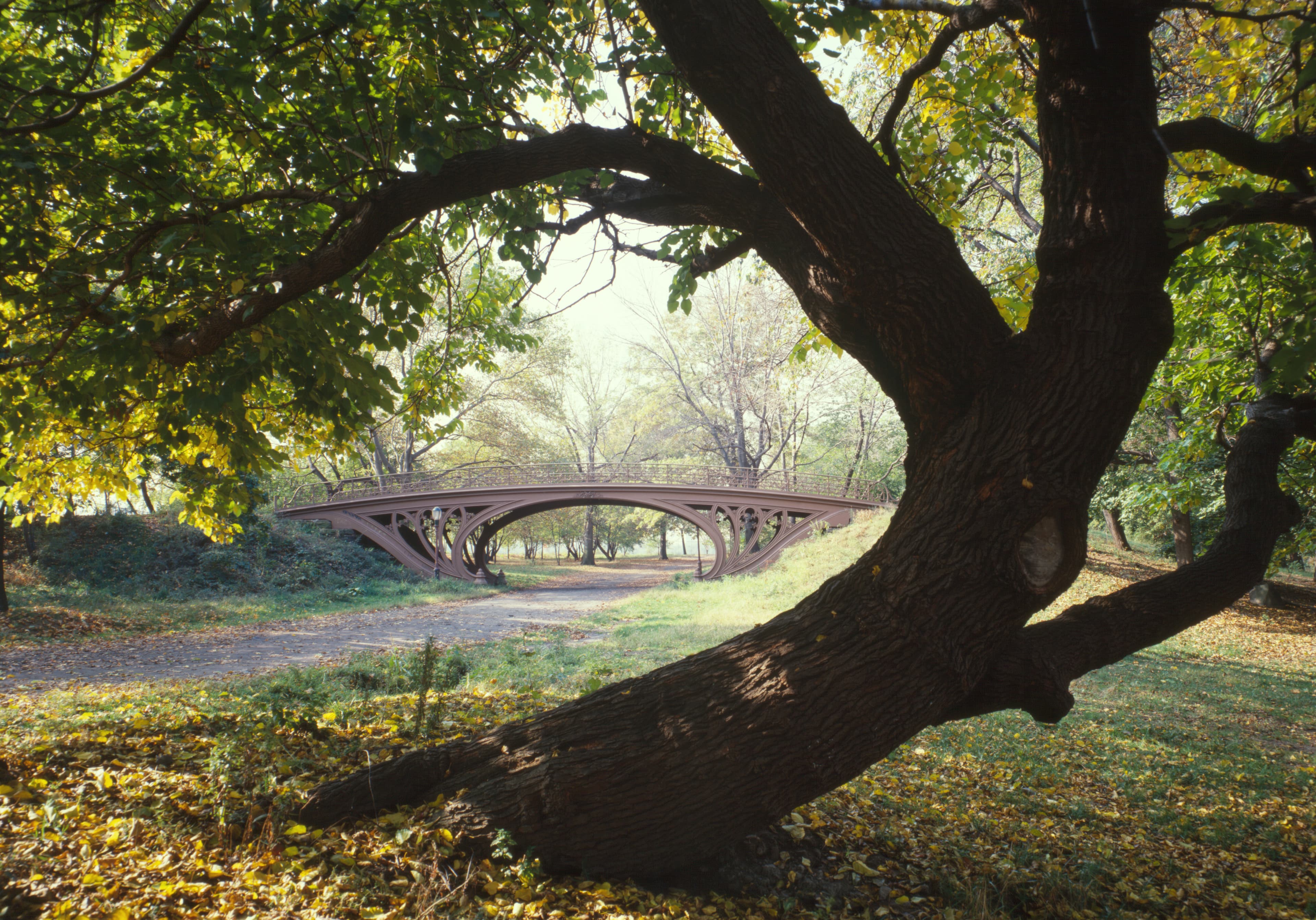
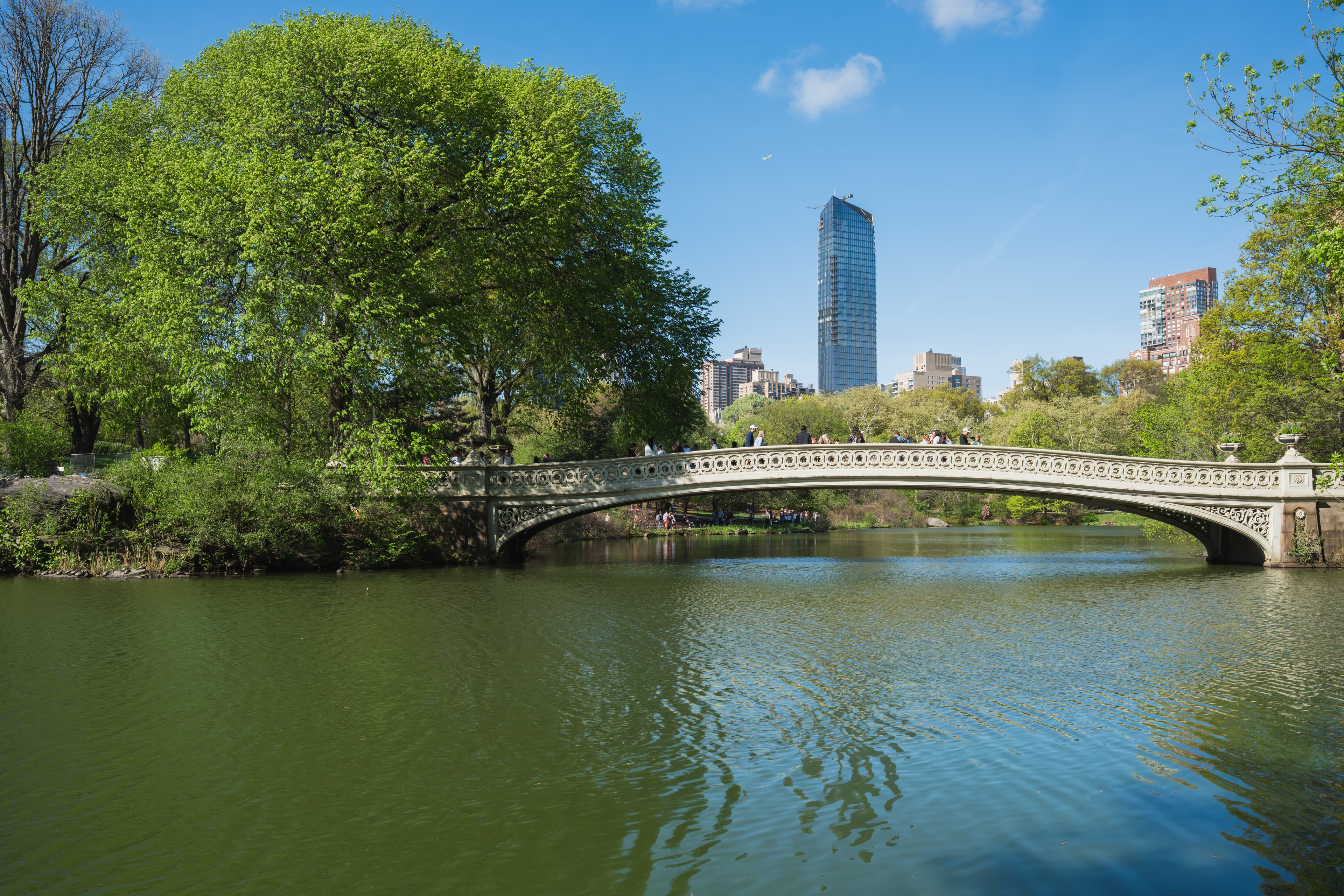
West of Bethesda Terrace, the Lake narrows, and crossing it is Bow Bridge — the park's most elegant span, a 60-foot cast-iron arc completed in 1862. It is the oldest cast-iron bridge in the park and, arguably, the most romantic spot in Manhattan: standing at its crown you look one way toward the Dakota and the Upper West Side, the other toward the wooded tangle of the Ramble.
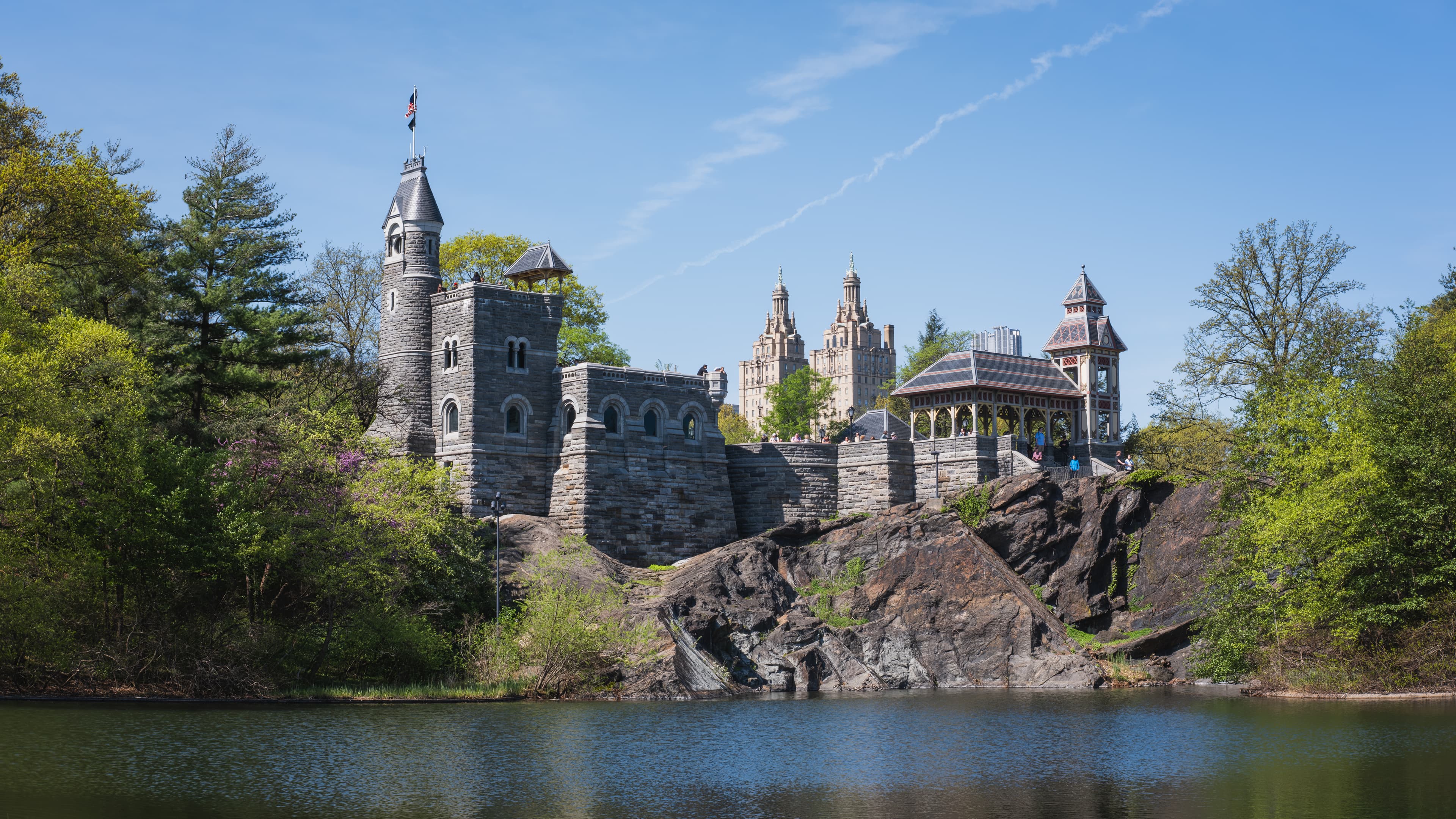
The Ramble is the 36-acre woodland between the Lake and the Reservoir, and it is the closest the park comes to wilderness. Olmsted intended it as a "wild garden," dense with winding paths, rustic bridges, and native plantings, and it remains one of the best birding spots in the Northeast — over 200 species pass through each year, and dawn in May brings serious binocular traffic. Just north of the Ramble rises Belvedere Castle, Vaux's 1869 stone folly perched on the park's highest outcrop of Manhattan schist. From its terraces you get a panorama that stitches the whole mid-park together: Turtle Pond below, the Great Lawn to the north, the Reservoir to the west, and the skyline pressing in from every side. The castle houses a small visitor center and weather station, and in winter it becomes one of the park's best sunset viewpoints.
Strawberry Fields, the Great Lawn, and the park's east side
At the park's western edge near 72nd Street lies Strawberry Fields, the 2.5-acre memorial to John Lennon, designated by the city in 1981 and opened in 1985. Its centerpiece is the circular "Imagine" mosaic, gifted by the city of Naples, which has become a permanent site of pilgrimage — fans gather there daily, especially on Lennon's birthday and the anniversary of his death, and the Dakota, where he lived and was killed, stands directly across the street.
North of Strawberry Fields spreads the Great Lawn, the park's vast central meadow — 55 acres of open turf that was once a reservoir, filled in during the 1930s and reborn as the city's great gathering place. It has hosted some of the largest concerts in American history, from Simon and Garfunkel to the Metropolitan Opera, and on any given weekend it holds thousands of picnickers, sunbathers, and softball games. Its oval is ringed by American elms, one of the last great stands of them in the country.
Along the park's eastern edge, Fifth Avenue from 82nd to 105th Street forms Museum Mile, where the Metropolitan Museum of Art anchors a run of institutions including the Guggenheim and the Cooper Hewitt. The Met's park-facing facade is itself a Central Park sight, and the museum's rooftop garden — open in the warmer months — offers one of the city's finest views back across the park's canopy.
The zoo, the rinks, and the park through the seasons
At the park's southeast corner, the Central Park Zoo — operated by the Wildlife Conservation Society — has stood in various forms since the 1860s, when the first animals were gifts to the city. Today's zoo is compact but beloved, centered on its sea lion pool and tropical rainforest house, and it remains many New York children's first encounter with wildlife. It is a paid attraction within the otherwise free park; check the official site for current admission before you go.
In winter, the park trades rowboats for ice: Wollman Rink near the southeast corner and Lasker Rink at the park's northern end have drawn skaters for generations, with the Midtown skyline glowing behind the ice at Wollman. Spring brings the cherry blossoms around the Reservoir's bridle path; summer brings Shakespeare in the Park at the Delacorte Theater and the park's famous outdoor concerts; autumn turns the Ramble and the North Woods into the city's best foliage walk. There is no bad season to visit — the park is designed to reward repeat visits, and locals treat it as a second backyard.
Key Facts
- Central Park covers 843 acres, from 59th to 110th Street and Fifth to Eighth Avenue, in the heart of Manhattan.
- Designed by Frederick Law Olmsted and Calvert Vaux; their 1857 "Greensward Plan" won the park's design competition.
- Construction at its peak employed around 20,000 workers; the seemingly natural landscape is almost entirely engineered.
- Bethesda Fountain's Angel of the Waters, by Emma Stebbins (1873), honors the Croton Aqueduct's clean water.
- Bow Bridge (1862) is a 60-foot cast-iron span over the Lake, the park's oldest surviving cast-iron bridge.
- Belvedere Castle (1869) sits on Manhattan schist and offers panoramic views of Turtle Pond, the Great Lawn, and the skyline.
- Strawberry Fields, the John Lennon memorial with its "Imagine" mosaic, opened in 1985 across from the Dakota.
- The 55-acre Great Lawn was once a reservoir, filled in during the 1930s and converted to public meadow.
- The park's four sunken transverse roads carry crosstown traffic below the landscape, invisible to parkgoers.
- The Central Park Zoo at the southeast corner dates to the 1860s in its earliest form and is run by the Wildlife Conservation Society.
Visitor Details
Address: Central Park, New York, NY (the park is bounded by 59th St, 110th St, Fifth Ave, and Eighth Ave)
Transit: Subway stations ring the park — Columbus Circle (59th St), 5th Ave/59th St, 72nd, 86th, 96th, and 110th St stops on the west and east sides; check the MTA for the entrance nearest your route
Hours/Admission: The park itself is open daily and free to enter; the Central Park Zoo and some attractions charge admission and keep their own hours — check official sites before visiting
Best timing: Weekday mornings are calmest for the Ramble and Belvedere Castle; late afternoons give the best light at Bow Bridge and Bethesda Terrace; autumn foliage and spring blossoms are the scenic peaks