Miami's living museum of the tropics
Most of Miami's famous sights are about the city people built — the Art Deco hotels, the beaches, the skyline. Fairchild Tropical Botanic Garden is about the plants that made Miami possible, and about the wider tropical world those plants came from. On 83 acres in Coral Gables, just south of downtown Miami and bordered at the north and west by Matheson Hammock Park, Fairchild holds one of the great tropical plant collections on earth: palms, cycads, orchids, bromeliads, flowering trees, vines, and fruit trees from South Florida, the Caribbean, Latin America, Africa, Madagascar, and Southeast Asia, growing outdoors in the one part of the continental United States where tropical plants can live outside all year.
That last point is the reason Fairchild exists, and the reason it is in Miami. South Florida's frost-free climate is the only place in the mainland United States where a garden like this can be an outdoor garden rather than a greenhouse collection. Fairchild is at once a museum, a laboratory, a learning center, and a conservation research facility, and its stated main role is preserving biodiversity. It is also, simply, one of the most beautiful places to spend a slow morning in South Florida: lakes drawn from natural sinkholes, shaded lanes, wide vistas over the lowlands, and a garden designed so that no two openings between plantings are alike, leading the visitor from view to view on what the garden's own history calls "a journey of discovery."
Fairchild is a first-time visitor's essential Miami stop for the same reason the city's great gardens and estates are: it shows you the Miami that existed before the condominiums, and the Miami that the city's founders dreamed of planting. The garden's neighbor to the north, Vizcaya, shows you one man's tropical estate. Fairchild shows you the whole tropical world, collected, studied, and kept alive.
1938: a plant explorer's garden
Fairchild is named for Dr. David Fairchild (1869–1954), one of the great plant explorers in American history. At the age of 22, Fairchild created the Section of Foreign Seed and Plant Introduction at the United States Department of Agriculture, and for the next 37 years he traveled the world in search of plants of potential use to the American people. He visited every continent except Antarctica and brought back more than 75,000 plants, including mangos, alfalfa, nectarines, dates, cotton, soybeans, bamboos, and the flowering cherry trees that now grace Washington, D.C. He retired to Miami in 1935, to the private garden at The Kampong in Coconut Grove, where he continued to collect and cultivate exotic plants.
The garden itself was the dream of Colonel Robert H. Montgomery (1872–1953), a Miami accountant, attorney, and businessman who shared Fairchild's passion for plant collecting. Montgomery purchased the 83-acre site along Biscayne Bay, and in 1936 the garden was founded on land donated by Montgomery and his wife Nell, along with funds for developing the plant collections. Montgomery named the garden for Fairchild in recognition of the scientist's lifelong dedication to introducing plants to the country. After two years of preparation, Fairchild Tropical Garden officially opened to the public on March 23, 1938. Montgomery later deeded most of the garden in large part to Miami-Dade County.
The grounds were designed by landscape architect William Lyman Phillips, a member of the Frederick Law Olmsted partnership tradition and a leading landscape designer of the 1930s, who directed the work over 28 years. Phillips's design, largely implemented by the Civilian Conservation Corps, is built on variety, consistency, and contrast, with openness as its guiding idea. The property is divided by a bare rock escarpment into upland and lowland sections: on the upper section, radial paths originate near the oolitic limestone gatehouse, pass through alternating grass lawns and pools, and converge in the Palm Glade overlooking the expansive lowlands; in the lower section, densely planted formality gives way to loosely structured open spaces and lakes. The primary buildings and landscape features — the Montgomery Palmetum, the Bailey Palm Glade, the Allée and Overlook, the Vine Pergola, the amphitheatre, the Gate House, the Montgomery Library and Museum, 14 lakes, stone terracing walls, and the Moos Sunken Garden — were all built in the first fifteen years, and the 560-foot stone-and-wood Vine Pergola near the Visitor Center, originally built by the Civilian Conservation Corps, was restored in 1994.
Fairchild has been tested by South Florida's weather and rebuilt from it. In 1992, Hurricane Andrew devastated the garden's plantings, and a complete restoration was required, including replanting palms around the Garden Club of America Amphitheatre. The garden that stands today — its mature canopy, its restored structures, its collections rebuilt and expanded — is the product of that recovery as much as of its founding, and it is a living demonstration of why a garden that conserves plants matters in a place where storms can erase decades of growth in a night.
Palms, cycads, and the Montgomery Palmetum
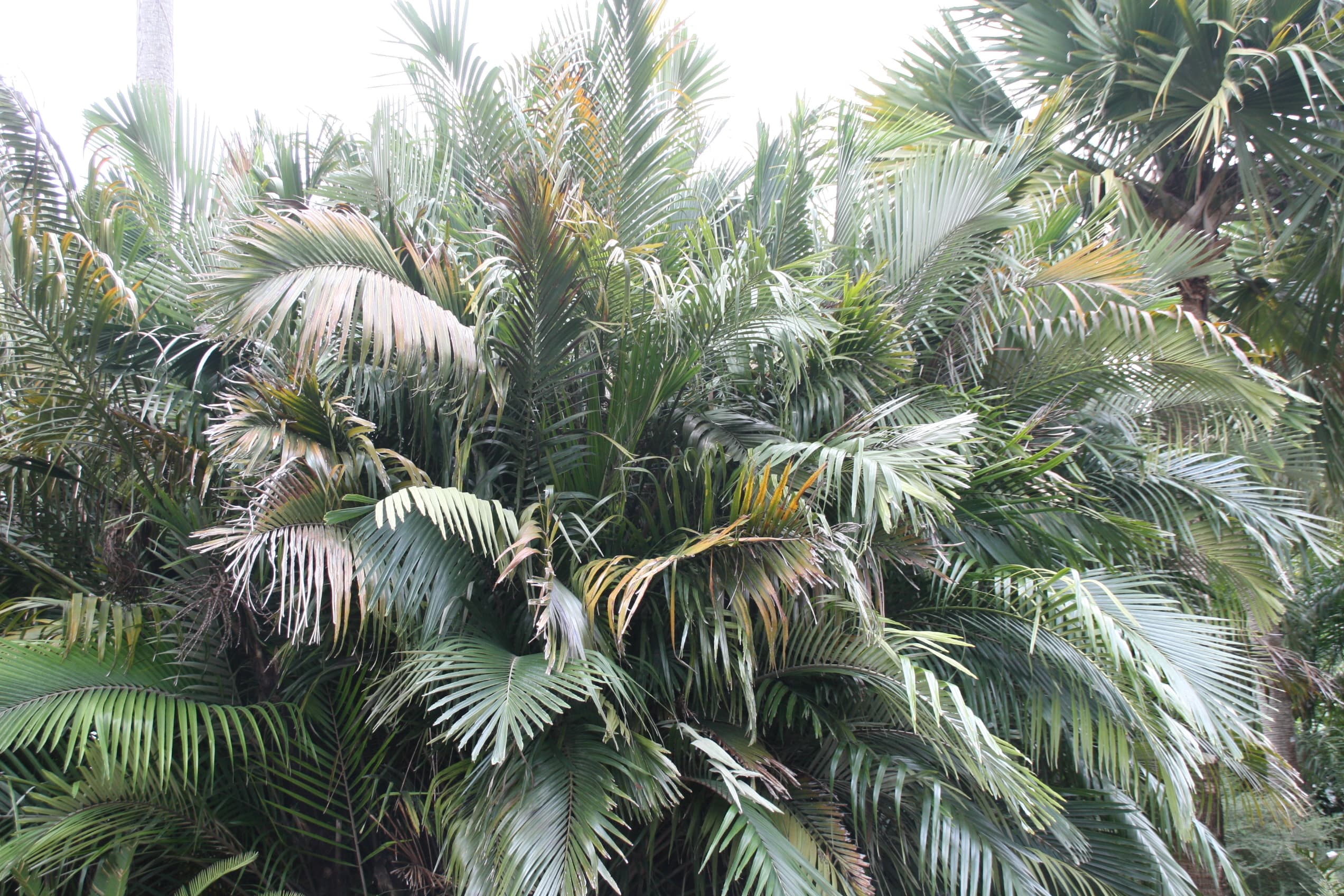
If Fairchild has a heart, it is the Montgomery Palmetum: a display and research collection of palms from all over the world, generally recognized as the most documented palm collection anywhere, and, according to the World Conservation Monitoring Center, holding more endangered palm species than all other botanical gardens combined. Palms are the signature plants of the tropics, and Fairchild treats them as a scientific collection rather than mere scenery. The Palmetum's species are documented, studied, and conserved as a genetic bank — a living library that matters all the more as palm species disappear in the wild.
Beside the palms, the cycads are Fairchild's other great ancient lineage. Cycads look like palms, but they are an older group altogether — plants whose fossil record reaches back some 280 million years, often called living fossils, with individual specimens known to live more than a thousand years. Fairchild holds one of the world's great cycad collections, and its Cycad Circle includes specimens planted in the garden's earliest years. The oldest of the collection, a Mexican cycad (Dioon edule) on the northwest edge of Cycad Circle, was donated in 1940 and had originally been imported from Scotland in 1873 — a plant that was already old when Fairchild opened, and that links the garden to the 19th-century plant trade that Fairchild himself inherited.
The garden's other collections are just as deep. Fairchild holds the largest collection of tropical bamboo in the world, with 125 species. Its Tropical Flowering Trees collection displays more than 740 species of flowering trees from all over the world, in an eight-acre arboretum, and its most famous flowering tree is the cannonball tree, planted in 1938 from stock that came originally from the Hope Gardens of Jamaica — one of the only cannonball trees in the United States, known for its fragrance and its extraordinary cannonball-sized fruit. The orchid collections, the bromeliads, the gingers, the vines, and the Michaux Bahamas Collection of native woody plants from botanical expeditions to the Bahamian islands round out a collection that, by the end of 1940, already numbered 5,400 introduced plantings and was described as the best living collection of tropical plants in the continental United States.
Walk the Bailey Palm Glade for the garden's classic vista: a display of unusual palms framing a long, narrow view across the landscape, eastward toward the mangrove preserves and Biscayne Bay. Then climb to the Allée and Overlook, the octagonal terrace that offers the garden's great panorama over the lowland lakes — the wide, architectural counterpart to the Glade's narrow view. The two views together are Phillips's design in miniature: formal and open, narrow and wide, planted and wild, in a single walk.
Wings of the Tropics: the butterfly conservatory
The garden's most beloved single experience is Wings of the Tropics, the butterfly house in the 25,000-square-foot Clinton Family Conservatory, part of the Paul and Swanee DiMare Science Village complex that opened in December 2012. Inside, exotic butterflies mainly from Central America, South America, and Southeast Asia fly freely — longwings, blue Morphos, and owl butterflies among them — around tropical plants and feeding stations stocked with overripe fruits such as banana and mango. Butterflies are released twice a day, in the morning and afternoon, and visitors walk a concrete path through the landscaped enclosure, where a butterfly may land on a shoulder or a head. Triple sets of doors minimize the risk of escape by species that do not belong to the local fauna, and the facility is approved by the U.S. Department of Agriculture.
Close to the conservatory, an outdoor butterfly garden shows the native side of the story: monarchs, zebra longwings, julias, and gold rim swallowtails that belong to South Florida and can be seen at any time. The contrast is the point. The conservatory lets you stand inside the tropics of three continents; the outdoor garden reminds you that South Florida has its own butterfly fauna worth planting for, and Fairchild's conservation work connects the two — the garden's scientists work on the butterflies' host plants and habitats as well as on the butterflies themselves.
Time your visit around a butterfly release if you can: the morning and afternoon releases are the moments when the conservatory is at its most alive, with newly emerged butterflies taking their first flights around visitors. And linger in the conservatory's warmth — it is humid by design, a little pocket of rainforest climate, and the contrast with the air-conditioned visitor center or the breezy lakeside paths is part of the experience.
The Rainforest, the Edible Garden, and the fruit pavilion
Fairchild's two-acre Richard H. Simons Rainforest is the garden's most immersive landscape: a forest of plants collected from the Amazon and from tropical forests in Latin America and beyond, with waterfalls and cascades, a stream meandering through it, wide pathways, labeled plants, and a misting system that emulates an authentic rainforest. It is a place to slow down and listen — water, birdsong, and the hush of a dense canopy — and to understand, in miniature, the ecosystems that Fairchild's scientists work to protect in the wild. A Chachi house, built in the rainforest tradition with the help of the Peace Corps by Chachi people indigenous to the rainforest of Ecuador, once stood nearby as a reminder that rainforests are human homes as well as plant collections.
The Edible Garden and the William F. Whitman Tropical Fruit Pavilion show the other side of Fairchild's mission: plants people eat. The pavilion shelters some of the world's most exotic fruit trees, including mangos and durians from the Amazon, Borneo, Indonesia, Malaysia, and Thailand, and a visit can sometimes be a hands-on experience, with a chance to touch and sometimes taste unusual varieties. The garden's tropical fruit collection is a direct inheritance from David Fairchild himself, who spent his career introducing food plants to the United States, and it remains a research collection as well as a display — Fairchild's scientists study tropical fruit diversity, conservation, and cultivation in South Florida and the Caribbean.
Elsewhere in the garden, the Geiger Tropical Flower Garden near the entrance offers a Caribbean-flavored welcome, with highlights including the Jamaican kapok tree, and the Jewels of the Caribbean exhibit on the garden's eastern edge displays endemic Caribbean plants near the shores of the Central Lake. The Windows to the Tropics conservatory, a 16,000-square-foot house of plants from the humid tropics, displays some 1,900 species, including rare orchids, bromeliads, and vines, arranged by themes such as plant coloration, plant-animal interactions, and reproduction. The desert exhibits, by contrast, show the spiny forests of Madagascar and the Atacama desert of South America on shallow sand and pebble beds that drain South Florida's generous rainfall — a reminder that "the tropics" is not one climate but many.
Research, conservation, and the Million Orchid Project
Fairchild is a working research institution, not only a beautiful garden, and that work is the reason the garden matters beyond a pleasant day out. Fairchild scientists conserve tropical plants, attempting to avoid the extinction of species and their habitats, with priority regions in South Florida, the Caribbean, oceanic islands, tropical Africa, and Madagascar, and priority plant groups in palms, cycads, tropical fruit, and tropical trees. Main activities include field exploration of important plant areas, conservation assessments, species recovery, and direct support to conservation in the wild. The garden's Center for Tropical Plant Conservation employs specialists who work both at the garden and in the field, and Fairchild partners with Florida International University, the University of Miami, Miami Dade College, and the University of Florida to train graduate and postdoctoral students. Since 2015, the garden has also partnered with NASA's Kennedy Space Center on the Growing Beyond Earth Challenge, testing edible plants for future space missions with equipment that emulates conditions aboard the International Space Station.
The garden's best-known public conservation program is the Million Orchid Project. In 2014, Fairchild and the City of Coral Gables partnered to restore native orchids lost during the development of Miami more than a century ago, reintroducing species including the Florida butterfly orchid, the cowhorn orchid, and the cockleshell orchid. Orchids are cultured in closed flasks with sterile medium, grown in the garden's laboratories, and then attached to trees in public, urban, and suburban places across South Florida — not only back into wild areas, but onto the street trees and park trees where Miamians actually live. The Fairchild Challenge, the garden's education program, brings school gardens, teacher workshops, and grants to about 20,000 students at more than 120 schools across Miami-Dade County, so the next generation of South Floridians learns botany by growing plants themselves.
That combination — a beautiful garden that is also a seed bank, a laboratory, and a classroom — is what makes Fairchild a signature Miami sight rather than simply a pretty park. The plants you walk among are not only displayed; they are studied, propagated, and, when their wild populations fail, replanted. A visit to Fairchild is a visit to a place that is actively keeping tropical diversity alive.
Seasons, festivals, and a good visit
Fairchild rewards visits in every season, because something is always in flower, but the garden's calendar gives each season its own character. Through the year the garden hosts seasonal weekend festivals, including the International Mango Festival each July, the International Chocolate Festival, the Butterfly Festival, the Bird Festival, the Orchid Festival, the Ramble plant sale usually held in the fall, the Food and Garden Festival, and the Edible Garden Festival, along with concerts, plant society meetings, and art exhibitions — since 2003 the garden has hosted art exhibits, with artists including Dale Chihuly, Yayoi Kusama, Fernando Botero, and Roy Lichtenstein, and new artists exhibit starting each December. Holiday-season evenings bring the popular Night at the Garden, when thousands of colored lights and interactive displays illuminate the grounds.
A good first visit starts with the narrated tram tour, which gives the lay of the land and the garden's history before you set out on foot. Then walk: the Allée and Overlook for the panorama over the lowlands and lakes, the Vine Pergola for shade, the rainforest for the mist, Wings of the Tropics for the butterflies, and the Bailey Palm Glade for the classic palm vista. Wear sun protection and bring water — the garden is 83 acres, much of it in open sun between shaded lanes, and the most rewarding walks are the long ones. The garden is also a place for wildlife watching: iguanas bask on the lawns, herons and other water birds work the lakes, and the garden provides a home for diverse birds, reptiles, and other creatures alongside its plants.
Pair Fairchild with its neighbors for a full Coral Gables day. Matheson Hammock Park borders the garden to the north and west, Vizcaya Museum and Gardens lies a short drive north for the city's other great garden estate, and The Kampong — David Fairchild's own former home and garden, now part of the National Tropical Botanical Garden — sits about three miles north, closing the circle from the explorer's private collection to the public garden that bears his name. Fairchild is the place where Miami's tropical story becomes a landscape you can walk through, and it is the essential counterpoint to the beach and the skyline: the Miami that grows.
Key Facts
Fairchild Tropical Botanic Garden is an 83-acre botanic garden in Coral Gables, Miami-Dade County, just south of Miami, surrounded at the north and west by Matheson Hammock Park.
The garden was founded in 1936 by Colonel Robert H. Montgomery, who donated the 83-acre site with his wife Nell, and officially opened to the public on March 23, 1938, named for plant explorer Dr. David Fairchild.
David Fairchild (1869–1954) created the USDA's Section of Foreign Seed and Plant Introduction at age 22 and brought more than 75,000 plants to the United States, including mangos, dates, bamboos, and Washington's flowering cherry trees; he retired to Miami in 1935.
Landscape architect William Lyman Phillips, of the Olmsted partnership tradition, designed the grounds over 28 years; the design was largely implemented by the Civilian Conservation Corps, and the 560-foot Vine Pergola was restored in 1994.
The Montgomery Palmetum is among the most documented palm collections in the world, and holds more endangered palm species than all other botanical gardens combined, according to the World Conservation Monitoring Center.
Fairchild holds the largest collection of tropical bamboo in the world, with 125 species, and a Tropical Flowering Trees collection of more than 740 species, including a cannonball tree planted in 1938.
The garden's two-acre Richard H. Simons Rainforest features plants collected from the Amazon, waterfalls and cascades, and a misting system that emulates an authentic rainforest.
Wings of the Tropics, in the 25,000-square-foot Clinton Family Conservatory, is a USDA-approved butterfly house where exotic butterflies from Central America, South America, and Southeast Asia fly freely; butterflies are released twice a day, morning and afternoon.
The William F. Whitman Tropical Fruit Pavilion shelters exotic fruit trees including mangos and durians; the Windows to the Tropics conservatory displays some 1,900 species of humid-tropic plants.
In 2014, Fairchild and the City of Coral Gables partnered on the Million Orchid Project, reintroducing native orchids including the Florida butterfly orchid, the cowhorn orchid, and the cockleshell orchid; the Fairchild Challenge reaches about 20,000 students at more than 120 Miami-Dade County schools.
Since 2015, Fairchild has partnered with NASA's Kennedy Space Center on the Growing Beyond Earth Challenge, testing edible plants for future space missions.
In 1992, Hurricane Andrew devastated the garden's plantings, requiring a complete restoration, including replanting palms around the Garden Club of America Amphitheatre.
Seasonal festivals include the International Mango Festival each July, the International Chocolate Festival, the Butterfly Festival, the Bird Festival, the Orchid Festival, and the Ramble plant sale usually held in the fall.
Visitor Details
Address: Fairchild Tropical Botanic Garden, 10901 Old Cutler Road, Coral Gables, FL 33156 (just south of Miami; bordered at the north and west by Matheson Hammock Park)
Getting there: The garden sits in Coral Gables on Old Cutler Road, a short drive south of downtown Miami; driving is the most straightforward way to arrive, and the garden is often paired with Vizcaya Museum and Gardens to the north and Matheson Hammock Park next door.
Hours/Admission: Fairchild is a private garden open to the public for a fee. Hours, admission, and festival dates change through the year — check the official Fairchild website (fairchildgarden.org) before visiting to confirm current hours, admission, and any special-event information rather than relying on third-party listings.
Best timing: Mornings are cooler and quieter, and the butterfly releases in the morning and afternoon are the best moments in Wings of the Tropics. Plan for a half day: start with the narrated tram tour for orientation, then walk the Allée and Overlook, the Bailey Palm Glade, the Vine Pergola, the rainforest, and the conservatory. Bring sun protection and water, and wear comfortable walking shoes for 83 acres of paths. Summer brings the mango festival season and lush growth; winter brings cooler, drier walking weather and the garden's holiday-season evening events.
Palms and tropical fruit at Fairchild