A university museum that digs its own exhibits
Most museums buy their collections. The Penn Museum largely dug up its own. That is the first thing to understand about the University of Pennsylvania Museum of Archaeology and Anthropology, and it explains why the place feels different from an art museum: almost everything on display arrived in Philadelphia with a field notebook attached — a record of where it was found, in what layer of earth, beside what other objects, by which expedition. Since its founding, the museum's scientists have conducted more than 300 archaeological and anthropological expeditions around the world, and the galleries are, in effect, the public face of that fieldwork.
The museum sits on Penn's campus in University City, at 3260 South Street, across from Franklin Field and just west of the Schuylkill River. It is a working part of the university — students study here, researchers work in its laboratories and archives, and its magazine, Expedition, has reported on its fieldwork since 1958 — but it is also, unmistakably, a public museum, and one of Philadelphia's signature sights. A first-time visitor who knows nothing about archaeology can walk in, meet a sphinx, and come out two hours later with a sense of how much of the human story fits under one roof. A visitor who already loves the ancient world will find objects here that appear in textbooks: the gold of Ur, the oldest writing, a palace of a pharaoh.
The scale is part of the appeal. The museum holds well over a million artifacts, with three floors of gallery space and eleven permanent galleries covering Africa, Asia, Egypt, the Sphinx, the Middle East, the Eastern Mediterranean, Etruscan Italy, Greece, Rome, Native American Voices, and Mexico and Central America. You cannot see it all properly in one visit, and you should not try. The route below hits the highlights in the order a first-time visitor will meet them, and leaves the rest for a return trip.
Founded in 1887, on a promise about Nippur
The museum was founded in 1887, during the administration of Provost William Pepper. Pepper persuaded the university's trustees to erect a fireproof building to house the artifacts expected from an upcoming expedition to Nippur, an ancient Mesopotamian city in what is now Iraq, then part of the Ottoman Empire. The first displays opened on the top floor of College Hall, and the museum opened to the public on January 2, 1890. In 1894 the city gave the museum land between 33rd and 34th Streets and the Schuylkill River, and the institution took the name Free Museum of Science and Art — free, because it did not charge admission until 1987.
The present building grew in sections over more than a century, and it was never finished as originally planned. The master plan drawn up by Wilson Eyre, Cope and Stewardson, and Frank Miles Day — all Philadelphia architects who taught at Penn — imagined a grand complex of three domed rotundas and a series of courtyards, one of the largest museum buildings in the United States. What was actually built is roughly a third of that vision, which is still a very large building. The first section opened in 1899 and housed the finds from Nippur. The Harrison Rotunda, which houses the Harrison Auditorium below it, was completed in 1915. The Coxe Memorial Wing, built to house the Egyptian collection, opened in 1926. The Sharpe Wing followed in 1929, the Academic Wing in 1971, and the Mainwaring collections-storage wing in 2002. A major Building Transformation project in 2019 renovated galleries, restored original features, and created the new Main Entrance Gallery where the sphinx now stands.
The Sphinx of Ramses II: the greeting you never forget
The first thing visitors see on entering is the museum's unofficial mascot and its single most famous object: the Sphinx of Ramses II, a colossal red-granite lion with a human head, weighing about 13 tons — roughly the weight of eight cars — and more than 3,000 years old. It is the largest sphinx in the Western Hemisphere, and one of the largest outside Egypt. It stands in the light-filled Main Entrance, where it has greeted visitors since June 2019, when it was floated 250 feet across the museum's courtyard on air dollies — a move watched around the world — from the Lower Egyptian Gallery where it had stood since 1926.
The sphinx's own story is as remarkable as its size. It was excavated in 1912 by the British archaeologist Sir William M. Flinders Petrie near the temple of the god Ptah at Memphis, the ancient capital of Egypt, and offered to the Penn Museum in return for the museum's support of the British excavations, with the agreement of Egypt's Antiquities Service. It reached Philadelphia in the autumn of 1913, sat for a time in the museum's courtyard — photographs show it standing in snow — and was moved inside in 1916. Carved from a single block of red granite quarried at Aswan, near Egypt's southern border, it bears around its base the five-fold titulary, the full formal name, of Ramses II, who ruled in the thirteenth century BCE; Ramses' son and successor, Merenptah, later added his own cartouches to its shoulders. Look closely and you can see the weathering on the face, worn by millennia in which the statue lay buried up to its shoulders, and the evidence that Ramses' sculptors reworked the monument of an earlier, now unidentifiable pharaoh. It is a portrait of kingship as the Egyptians understood it: the body of a lion, the head of a king, the protector of the people and conqueror of Egypt's enemies.
The sphinx does not stand alone. Around it, the museum's Egyptian holdings — more than 40,000 objects spanning ancient Egypt from around 4000 BCE through the seventh century CE — include monumental architectural elements from the palace of Merenptah at Memphis, the best-preserved royal palace ever excavated in Egypt and the only museum display of so much of an Egyptian royal palace anywhere in the world. The museum's Egyptian collection is one of the largest in the United States, and most of it was excavated by Penn archaeologists working in Egypt and Nubia over more than a century.
Mummies, and the Egyptian galleries reborn
Upstairs, the Egypt (Mummies) Gallery — long one of the museum's most popular rooms — tells the other half of the Egyptian story: how ancient Egyptians buried and honored their dead. Statues of pharaohs and high officials line the soaring gallery, including a seated Ramses II, and gods and goddesses of the afterlife — Osiris, Sekhmet, Neith — stand among them. A special section on mummification traces burial practice from the earliest bodies preserved naturally in hot desert sand to the sophisticated funerary techniques of later periods, with human and animal mummies, their coffins, and their tomb goods. Before modern imaging, archaeologists unwrapped mummies to see inside; today, the museum's researchers use X-rays and CT scans, and the gallery explains what those scans revealed, including the small mummy of Hapi-Men and, beside him, his dog.
One timing note matters for a visit now. The museum has been reinstalling its Ancient Egypt and Nubia Galleries in a project it calls the largest transformation in its history, and in July 2026 it announced that the reimagined Egypt Galleries: Life and Afterlife — more than 1,000 artifacts spanning 4,000 years, arranged around daily life, kingship, and the afterlife, including a reconstructed 4,300-year-old Old Kingdom tomb chapel — would open on December 12, 2026, in the renovated Coxe Wing. While that work was under way, the museum kept Egyptian material on view in the interim exhibition Ancient Egypt: From Discovery to Display, with a visible-storage section and an Artifact Lab where visitors could watch conservators at work. Before visiting, check penn.museum for which Egyptian galleries are open on the day you go; the sphinx in the Main Entrance is the constant, and the new galleries are the reason to return.
Mesopotamia: Ur, the first writing, and the gold of a queen
If Egypt is the museum's crown jewel, Mesopotamia is its founding story, and the Middle East Galleries are where that story is told. The museum's first expedition went to Nippur, and its most famous later expedition — the joint expedition of the British Museum and the Penn Museum to Ur, in what is now Iraq, in the 1920s — produced the treasures that still anchor these galleries. The Royal Cemetery at Ur, excavated by Leonard Woolley, yielded the burials of Sumerian royalty from around 2600–2450 BCE, and the Penn Museum's share includes the headdress and jewelry of Queen Puabi, a crown of gold leaves and lapis lazuli beads laid out as she wore it some 4,500 years ago. It is exquisite, intimate work — the gold still bright, the design still legible — and it stops visitors in a way that monumental sculpture does not, because it is personal: a woman's crown, made to be worn.
Beside the gold are the clay tablets that carry some of the world's oldest writing: Sumerian and Akkadian cuneiform, wedge-shaped marks pressed into wet clay, recording everything from temple accounts to the Epic of Gilgamesh. The museum's Nippur tablets include versions of the flood story that predate the biblical account by centuries, and the galleries use them to make a point the whole museum embodies: writing was invented here, in Mesopotamia, as a tool for keeping accounts, and it changed everything. The Mesopotamian galleries also hold the great stone monuments and carved reliefs of later empires, and the Eastern Mediterranean Gallery, renovated and reopened in November 2022, carries the story westward, with nearly 400 artifacts from the Middle Bronze Age to the Ottoman period showing the crossroads of peoples — Israel, Jordan, Lebanon, Syria, the Palestinian Territories, and Cyprus — trading, fighting, and borrowing from one another for more than 4,000 years.
Africa, Asia, and the Americas: three floors, the whole world
Beyond Egypt and the Near East, the museum's three floors fan out across the globe, and a first-time visitor should sample widely rather than trying to be exhaustive. The Africa Galleries, renovated and reopened in November 2019, draw on one of the largest African ethnographic and archaeological collections in the country, with objects from the Democratic Republic of the Congo, Gabon, Angola, Morocco, Sierra Leone, Nigeria, Kenya, Ethiopia, and South Africa, among others — masks, textiles, sculpture, and the tools of daily life, displayed with attention to the living cultures that made them. The gallery's opening featured a new dress, "Wearable Literature," designed by Breanna Moore and Emerson Ruffin, a reminder that these are not dead traditions but continuing ones.
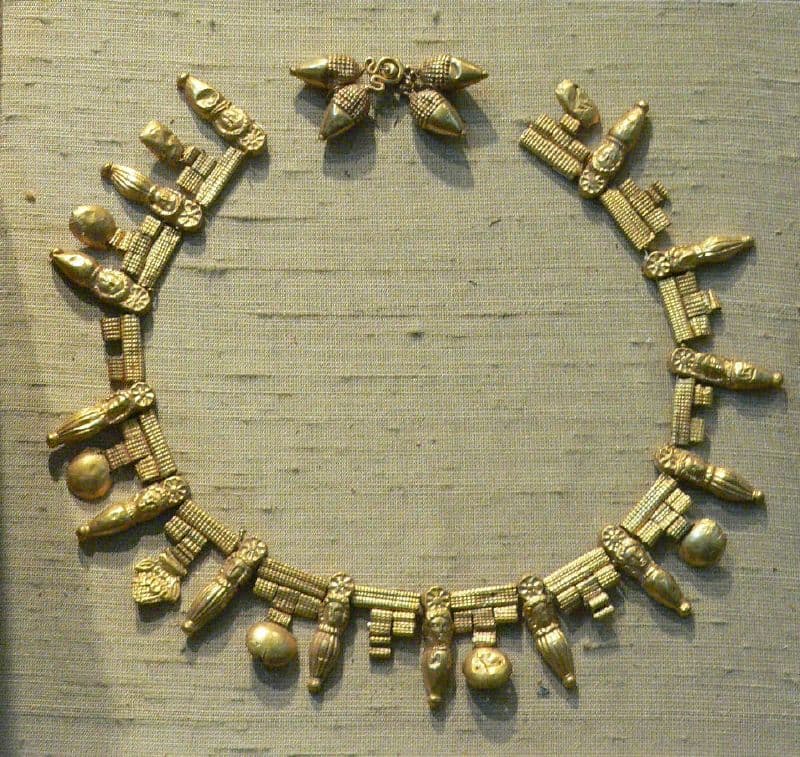
The Asia galleries are anchored by the Chinese Rotunda, a dome-topped, ninety-foot-tall space that holds the museum's celebrated Chinese collection, including two stone reliefs of the six horses of Emperor Taizong, carved in the seventh century CE, and the great rock-crystal sphere — a 49-pound, ten-inch ball of flawless crystal on a wave-shaped metal stand, long said to have belonged to the Dowager Empress Cixi — that has fascinated visitors for nearly a century. The Mexico and Central America Gallery holds the largest collection of Maya stone monuments in the United States, some 250 artifacts, including towering carved stelae that bring the world of the Classic Maya into a Philadelphia room. The Native American Voices gallery, the museum's largest section by collection size, presents the heritage of Indigenous peoples of North America from twenty thousand years ago to the present, and the Classical World galleries — Etruscan, Greek, and Roman — include Etruscan gold jewelry of the kind displayed here in 2005, fine enough to rival anything in Italy.
The building itself: rotunda, courtyards, and gardens
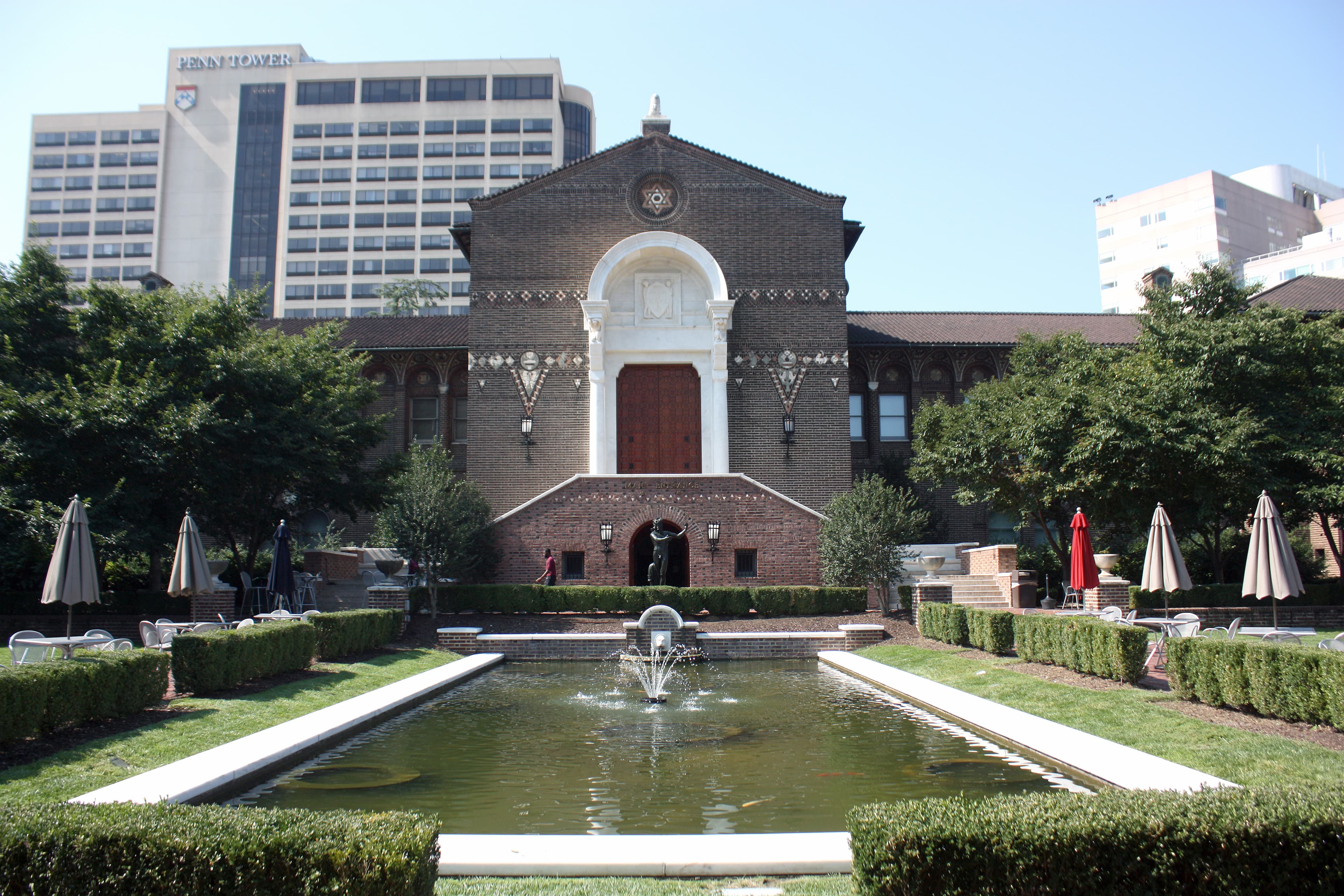
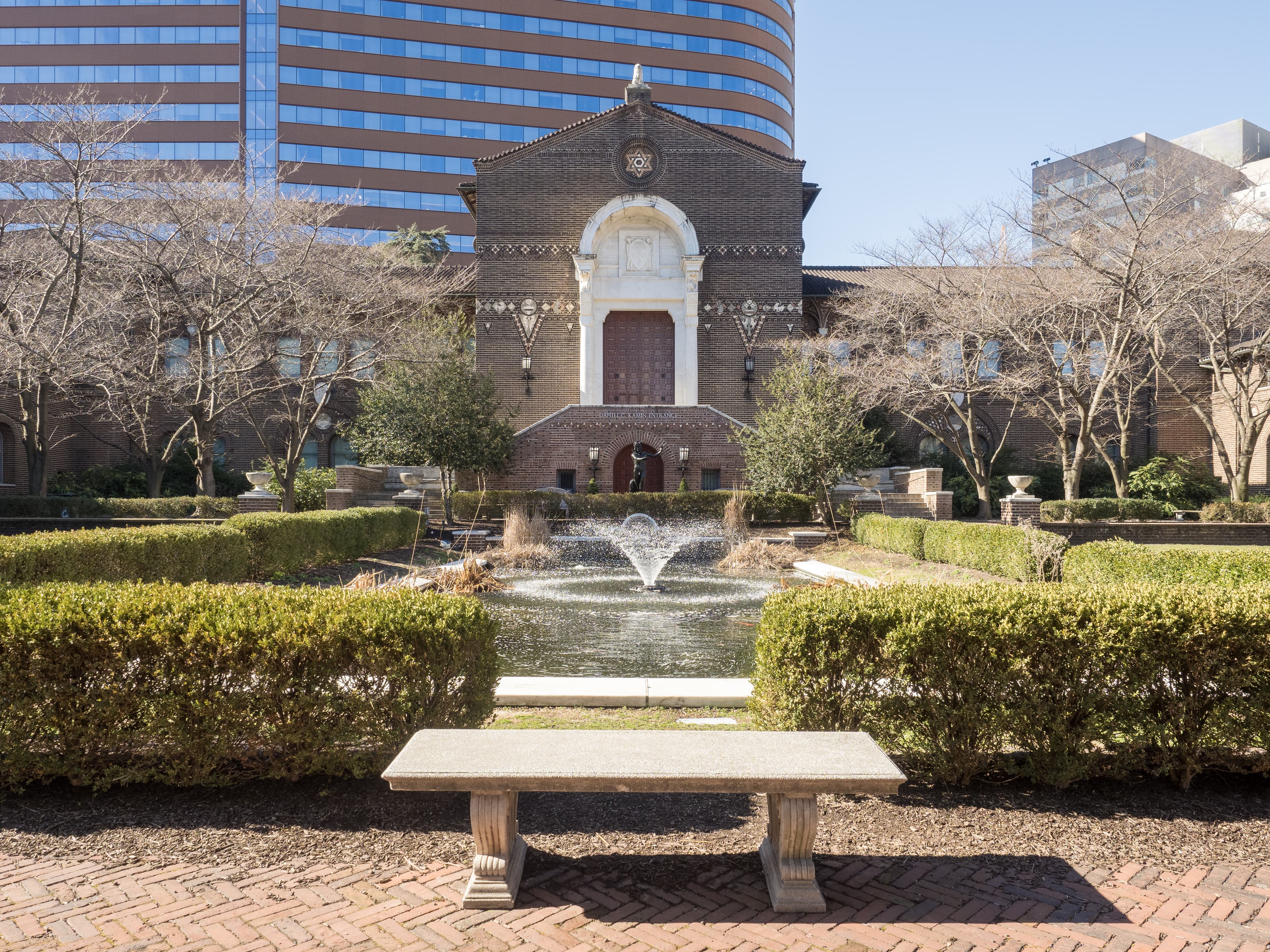
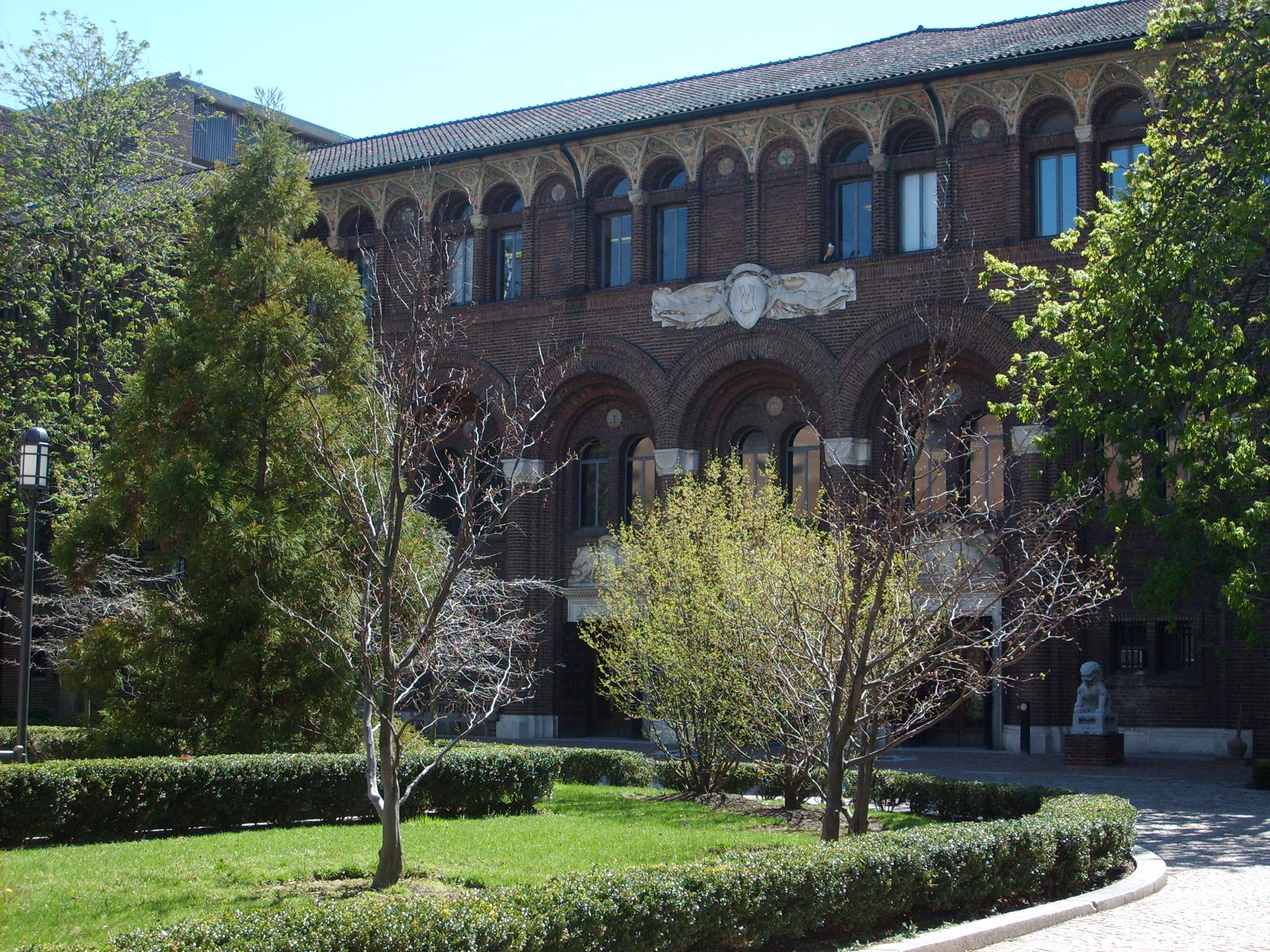
Do not rush past the architecture, because the building is one of the exhibits. Its style is usually described as Arts and Crafts and Eclectic, built mainly of imported brick in a nominally Northern Italian Renaissance manner, but the experience is simpler than the label: warm brick, stone trim, glass mosaics, iron gates, and stone statuary, arranged around courtyards and gardens that were part of the original design. Wilson Eyre's plan called for six landscaped courtyards; only two were completed, and two more inner courtyards were created by the Academic Wing in 1971, but the ones that exist are lovely. The Warden Garden, the upper courtyard, is a formal, geometric garden with a reflecting pool and expansive lawns, named in 1978 for Nancy Warden, who oversaw its replanting with magnolia, holly, pine, and yew; the Stoner Courtyard, with its Calder-designed fountains and the Trescher Main Entrance, offers a quieter outdoor room. The Harrison Rotunda, the museum's dramatic domed hall, crowns the building's center, and the Museum Café, glass-enclosed, overlooks the inner gardens — a good place to rest between floors.
The gardens also carry the museum's history in miniature. The site was originally reserved by the city for a public park, and the university persuaded the city to transfer it for a "museum and botanical garden and park." That founding idea — a museum that is also a garden, a public green space as much as a research institution — survives in the courtyards today. On a fine day, come out of the galleries, sit by the reflecting pool, and look back at the brick facade: it is one of the calmest views in University City, and a reminder that this museum was designed to be a place, not just a container.
How to visit well
A good first visit takes about two hours, and the route almost plans itself. Start in the Main Entrance with the sphinx — give it a full ten minutes, walk around it, read the inscriptions panel, and look for the weathering on the face and the cartouches on the shoulders. Go from there to the Middle East Galleries for Ur and Queen Puabi's gold, then to the Egyptian galleries upstairs for the mummies and the story of burial, checking penn.museum first for what is on view during the Egypt Galleries reinstallation. Sample the Africa Galleries and the Chinese Rotunda, and finish in the Mexico and Central America Gallery with the Maya monuments, before coming back down to the gardens and the café. If you have a third hour, add the Eastern Mediterranean Gallery and the Classical World galleries, and the Native American Voices gallery for the full sweep.
Families should know that the museum leans into its younger visitors: the sphinx has its own children's book, The Sphinx That Traveled to Philadelphia, and the museum's long-running "40 Winks with the Sphinx" sleepovers let children explore the galleries by flashlight. Adults coming for research will find something rarer still: a museum whose labels still carry the voice of the excavators, and whose archives, library, and digital collections — more than 400,000 artifacts documented online — extend the visit long after you leave the building.
The Penn Museum is not Philadelphia's grandest museum, and it is not its most famous. It is something better for a first-time visitor: the museum where Philadelphia's university went out into the world, dug carefully, and brought the world home — a sphinx, a queen's crown, the first writing, and a garden to sit in afterward. Walk through the Warden Garden, past the reflecting pool, and into the Main Entrance, and you are walking into more than a century of expeditions, and more than five thousand years of human history.
Key Facts
The Penn Museum, formally the University of Pennsylvania Museum of Archaeology and Anthropology, is located at 3260 South Street, Philadelphia, PA 19104, on Penn's campus in University City, at the intersection of 33rd and South Streets, across from Franklin Field.
The museum was founded in 1887, when Provost William Pepper persuaded the university's trustees to erect a fireproof building to house artifacts from an upcoming expedition to Nippur in modern-day Iraq; its first displays opened on the top floor of College Hall, and the museum opened to the public on January 2, 1890.
The museum's scientists have conducted more than 300 archaeological and anthropological expeditions around the world; its collections hold well over one million artifacts, with more than 400,000 documented in its online digital collections.
The present building was designed by Wilson Eyre, Cope and Stewardson, and Frank Miles Day; the first section opened in 1899, the Harrison Rotunda was completed in 1915, the Coxe Memorial Wing opened in 1926 to house the Egyptian collection, the Sharpe Wing was completed in 1929, and a major Building Transformation project in 2019 created the new Main Entrance Gallery.
The Sphinx of Ramses II is a red-granite sphinx weighing about 13 tons, carved from a single block quarried at Aswan, excavated in 1912 by Sir William M. Flinders Petrie near the temple of Ptah at Memphis, brought to Philadelphia in autumn 1913, moved inside the museum in 1916, housed in the Lower Egyptian Gallery from 1926, and moved to the Main Entrance in June 2019; it is the largest sphinx in the Western Hemisphere, bearing the titulary of Ramses II around its base and cartouches of his son and successor Merenptah on its shoulders.
The Egyptian collection holds more than 40,000 objects spanning from around 4000 BCE through the seventh century CE, including monumental elements from the palace of Merenptah at Memphis, the best-preserved royal palace ever excavated in Egypt.
The Egypt (Mummies) Gallery presents pharaohs, officials, gods of the afterlife, and the practice of mummification from natural desert preservation to later funerary techniques, including human and animal mummies studied today with X-rays and CT scans.
The museum announced in July 2026 that its reimagined Egypt Galleries: Life and Afterlife, with more than 1,000 artifacts spanning 4,000 years including a reconstructed 4,300-year-old Old Kingdom tomb chapel, would open on December 12, 2026, in the renovated Coxe Wing; the interim exhibition Ancient Egypt: From Discovery to Display kept Egyptian material on view during the reinstallation.
The Middle East Galleries hold the treasures of the Royal Cemetery at Ur, excavated by the joint British Museum–Penn Museum expedition, including the headdress and jewelry of Queen Puabi from around 2600–2450 BCE, and Sumerian and Akkadian cuneiform tablets carrying some of the world's oldest writing.
The museum's eleven permanent galleries are Africa, Asia, Egypt, Sphinx, Middle East, Eastern Mediterranean, Etruscan, Greece, Rome, Native American Voices, and Mexico and Central America; the Mexico and Central America Gallery holds the largest collection of Maya monuments in the United States, and the Chinese Rotunda holds the stone reliefs of Emperor Taizong's horses and the great rock-crystal sphere.
The building's courtyards and gardens include the Warden Garden, with its reflecting pool and lawns, named in 1978 for Nancy Warden, and the Stoner Courtyard with Calder-designed fountains and the Trescher Main Entrance; the Museum Café overlooks the inner gardens.
Visitor Details
Address: The Penn Museum, 3260 South Street, Philadelphia, PA 19104 (University City, on the University of Pennsylvania campus at 33rd and South Streets, across from Franklin Field).
Transit: Penn Medicine Station (SEPTA Regional Rail) serves the museum area, and SEPTA bus routes 30, 40, 42, and 49 and the LUCY circulator run nearby; the museum is a short walk from the Penn campus core and across the Schuylkill River from Center City.
Hours/Admission: Hours, admission, and which Egyptian galleries are open change from time to time, especially around the December 12, 2026 opening of the reimagined Egypt Galleries — check the official source at penn.museum before visiting to confirm current hours, admission, and what is on view. Allow about two hours for a first visit: Sphinx in the Main Entrance, Middle East Galleries (Ur and Queen Puabi), the Egyptian galleries, the Africa Galleries, the Chinese Rotunda, and the Mexico and Central America Gallery, finishing in the Warden Garden or the Stoner Courtyard.
Best timing: Arrive in the morning for the quietest galleries; the gardens and reflecting pool are at their best in fair weather, and the Main Entrance sphinx is worth seeing in daylight, when the red granite is at its warmest.