A memorial on the water
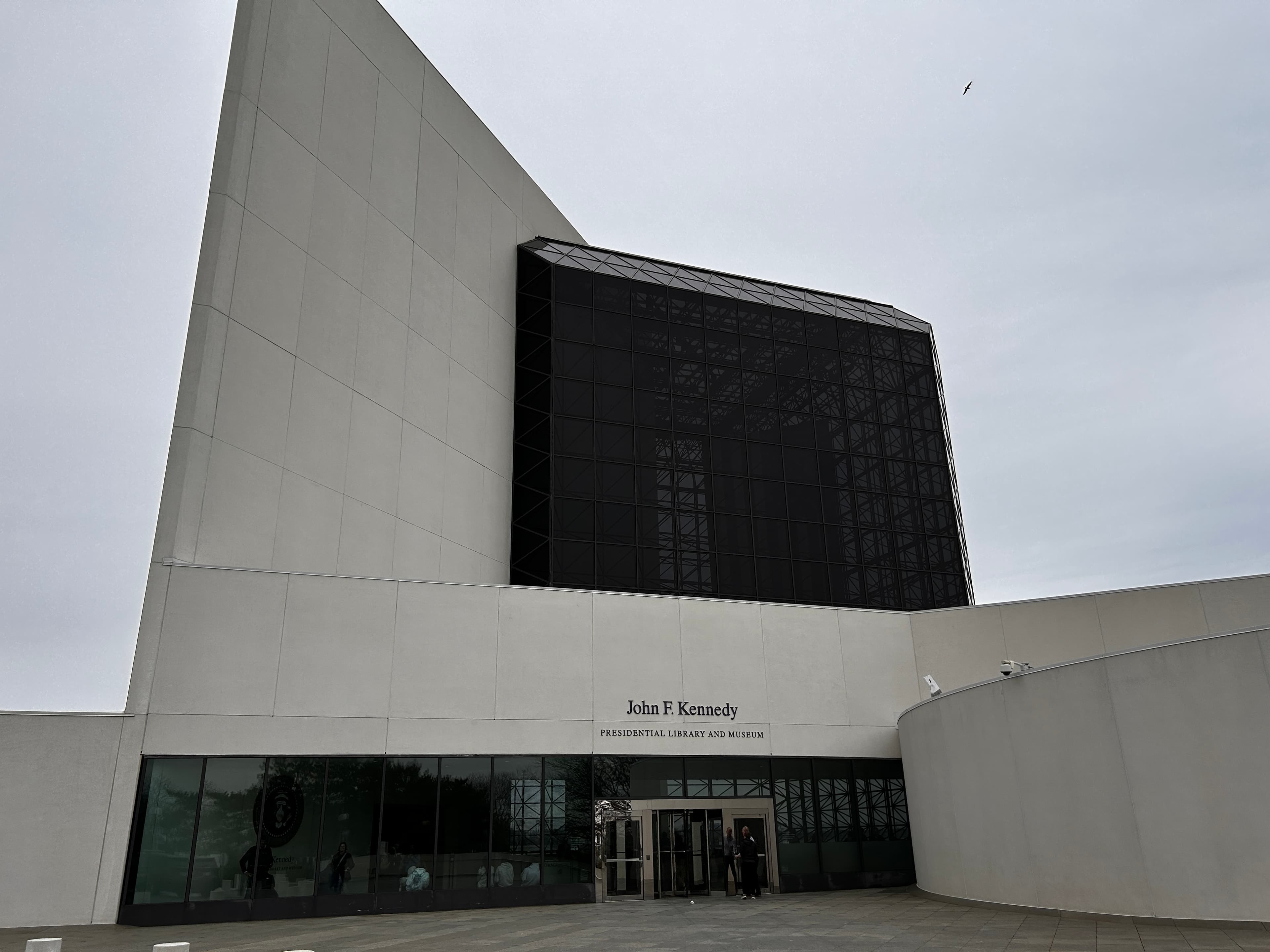
There is no mistaking the John F. Kennedy Presidential Library and Museum when you come down Morrissey Boulevard toward Columbia Point. The building rises at the very edge of the land, where Dorchester Bay opens into Boston Harbor: a tall white concrete tower, a low circular wing, and between them a great glass pavilion that catches the light off the water. It is one of the most recognizable silhouettes in Boston, and it was designed to be. The architect, I.M. Pei, called it the most important commission of his life, and he gave the memorial to a young president a form that is at once monumental and open — solid concrete on one side, transparent glass on the other, with the harbor itself as the backdrop.
The building is three things at once, and a visit touches all three. It is a museum, telling the story of John F. Kennedy's life and presidency through films, artifacts, and reconstructed rooms. It is a presidential library, the official repository of the papers and records of the Kennedy administration, administered by the National Archives and Records Administration. And it is a memorial, a place built for reflection on a presidency cut short — a purpose the architecture makes explicit in its final, empty room, where there is nothing to look at except a suspended American flag and the panorama of sky, land, and open sea.
Kennedy's Boston roots are the reason the library stands here. He was born in Brookline on May 29, 1917, educated at Harvard, and elected to the House of Representatives from Massachusetts in 1946 and to the Senate in 1952. The presidency he won in 1960 was, in his own telling, a Massachusetts story as much as an American one: days before his inauguration he returned to the Massachusetts State House to deliver his "city upon a hill" speech to the legislature, invoking the Puritan image of a community watched by the world. When the search for a site for his presidential library ended, after years of debate and several rejected locations, it ended here, on a peninsula in Dorchester within sight of the harbor he sailed as a boy and a young man.
Fifteen years to a building
The library's road to Columbia Point was long. After Kennedy's assassination on November 22, 1963, the Kennedy family and a board of trustees set out to build a presidential library, and in 1964 they selected I.M. Pei, then a young architect known for the Mile High Center in Denver and the National Center for Atmospheric Research in Boulder, as the building's architect. The original plan placed the library at Harvard, near the university Kennedy had attended, but that site fell through after disputes with the surrounding community. Other sites were considered and rejected before Columbia Point — a former landfill and dump site on a peninsula jutting into Dorchester Bay, next to what is now the University of Massachusetts Boston campus — was chosen. The choice turned a liability into an asset: a prominent, open, waterfront site where the building could stand alone against the sky.
Pei's design is a composition of pure geometry. A nine-story (often described as ten-story) triangular concrete tower, 125 feet tall, houses the archives, offices, and educational spaces. A circular section, two stories high, contains theaters. Between them rises the glass pavilion, 115 feet long and about 115 feet high, a space-frame structure of steel and glass that is the building's emotional center. The concrete, left exposed in part because of budget constraints, gives the building its weight and permanence; the glass gives it its openness. The landscape, by Dan Kiley, sets the building in open lawns that run down toward the seawall. Construction took years, and the library and museum were dedicated on October 20, 1979, by President Jimmy Carter and members of the Kennedy family, nearly sixteen years after Kennedy's death.
A later addition, the Stephen E. Smith Center, designed by Pei's firm and opened in 1991, added space for educational and cultural programs. But the original composition — tower, cylinder, and pavilion — remains exactly as Pei drew it, and it remains one of the finest examples of modernist civic architecture in New England.
The museum: from Brookline to the White House
The museum visit begins, as Kennedy's public life began, with the campaign. The first galleries trace his early life — the Brookline birthplace, the large and famously competitive Kennedy family, the Harvard years, the wartime service in the Pacific aboard PT-109 — and then the road to the presidency: the 1960 campaign, the televised debates with Richard Nixon that made television a decisive force in American politics, and the inauguration of January 20, 1961, with its call to "ask not what your country can do for you — ask what you can do for your country."
The heart of the museum is the presidency itself, told through a sequence of galleries and three theaters showing documentary films built from archival footage, much of it narrated in Kennedy's own voice. The exhibits move through the defining episodes of the thousand days: the Bay of Pigs invasion and its aftermath; the space race, from the early Mercury flights to Kennedy's 1962 Rice University speech committing the nation to landing a man on the Moon within the decade; the thirteen days of the Cuban Missile Crisis in October 1962, when the world came closer to nuclear war than at any other point in the Cold War; the push for civil rights legislation, including the June 1963 address in which Kennedy called civil rights a moral issue; and the creation of the Peace Corps, which sent young Americans abroad in the spirit of the inaugural address. The galleries do not shy away from the presidency's failures and controversies alongside its achievements, and they give the crises their full weight: the missile crisis gallery in particular, with its maps, recordings, and artifacts, is one of the most absorbing rooms in any presidential museum.
Two reconstructed rooms anchor the museum experience. The first is a partial replica of the Oval Office as it appeared during Kennedy's presidency, furnished with his desk, the rocking chair he used for his chronic back pain, and the objects he kept around him — including the coconut shell inscribed with the message that helped rescue the PT-109 crew, and the models of ships that reflected his love of the sea. The second is a replica of the office of his brother Robert F. Kennedy as Attorney General, a reminder of how central the younger Kennedy was to the administration. Standing in these rooms, with their period furnishings and personal objects, is the closest a visitor can come to the working White House of 1961–1963, and they are the galleries visitors remember longest.
The visit ends, deliberately, in darkness and then in light. The final museum gallery addresses the assassination in Dallas on November 22, 1963, and the days of mourning that followed, in a darkened room where news footage of the time plays. From that darkened setting, visitors emerge into the glass pavilion — a sun-filled, silent, almost entirely empty space, roughly 80 feet square and more than 100 feet high, with only an enormous American flag suspended above. The contrast is the point, and it is why the pavilion is the most moving room in the building: after the density of the museum, the emptiness and the view — the harbor, the Boston skyline across the water, the open sea — give visitors room to contemplate what they have just seen.
The archives below the museum
Beneath and behind the museum, the tower holds one of the great research collections in American history. The library is the official repository for the papers and records of the Kennedy administration — millions of pages of documents, photographs, recordings, and film — along with the personal papers of Kennedy family members and associates. Its holdings include the papers of Robert F. Kennedy, the records of the Peace Corps' early years, and, in a notable special collection, the books and papers of Ernest Hemingway, whose widow donated his manuscripts and personal library to the Kennedy Library in recognition of Kennedy's admiration for the writer.
The archives are open to researchers, and much of the collection has been digitized and made available online, including the famous White House tapes and thousands of photographs. For the casual visitor, the archives' presence is felt in the museum itself: nearly every exhibit draws on original documents, and the library's rotating temporary exhibitions regularly bring archival material — letters, memos, photographs — out of the stacks and into the galleries. Check what special exhibition is on before visiting; it is often the most distinctive part of a return trip.
The harbor, the sailboat, and the setting
Step outside and the setting completes the story. Kennedy was a lifelong sailor — he raced as a boy off Cape Cod, sailed through his presidency, and kept a 25-foot Wianno Senior sloop named Victura, a wedding gift from his parents, for family sailing. In the warmer months, Victura is displayed on the library grounds, a small wooden boat against the scale of Pei's concrete and glass, and it is the most photographed object outside the building. The seawall walk around the point offers views across Dorchester Bay to the Boston skyline and, on a clear day, out to the harbor islands. The neighboring campus of the University of Massachusetts Boston, the Edward M. Kennedy Institute for the United States Senate, and the Massachusetts Archives share the point, making Columbia Point a small civic campus at the water's edge.
The building rewards a slow visit. The museum's films and galleries take time — most visitors spend two to three hours inside — and the pavilion should not be rushed. Stand in it for a while, look out at the water, and then walk the grounds. The library's position at the edge of the city, away from the Freedom Trail crowds downtown, is part of its character: it is a destination you choose to go to, at the end of a peninsula, and the quiet of the site is inseparable from the experience.
How to visit well
A good first visit takes about half a day. Begin with the museum's introductory film, then follow the galleries in order — campaign, presidency, crises, civil rights, space — rather than skipping ahead to the Oval Office replica, since the rooms build on one another. Save time for the pavilion at the end, and for the grounds and Victura afterward. The library is at 220 Morrissey Boulevard in Dorchester, reachable by the MBTA Red Line to JFK/UMass station plus a shuttle or a walk, and by bus along Morrissey Boulevard; drivers should note that parking is on site. Hours, admission arrangements, and special-exhibition details change from time to time — check the official source at jfklibrary.org before visiting to confirm current hours and any ticketing, and note that the library is closed on certain holidays.
More than four decades after it opened, the Kennedy Library endures because it does two things at once that few buildings manage: it tells a complicated presidency honestly, in rooms full of evidence, and then it gives visitors an empty room and a view of the sea in which to think about it. Pei's building, like the president it memorializes, is young, open, and turned toward the water. Go to the end of the peninsula, walk through the darkened galleries, and emerge into the glass pavilion — and you will understand why Bostonians treat this building not just as a museum but as their city's memorial to its most famous son.
Key Facts
- The John F. Kennedy Presidential Library and Museum is located on Columbia Point in the Dorchester neighborhood of Boston, Massachusetts, at 220 Morrissey Boulevard, on a ten-acre site overlooking Dorchester Bay and Boston Harbor, next to the University of Massachusetts Boston campus.
- The library and museum were dedicated on October 20, 1979, by President Jimmy Carter and members of the Kennedy family; the building was designed by architect I.M. Pei, selected in 1964, after earlier sites (including Harvard) were rejected and Columbia Point was chosen.
- The building is a modernist composition of three elements: a tall triangular concrete tower (about 125 feet) housing archives, offices, and educational spaces; a low circular section containing theaters; and a glass-and-steel pavilion (about 115 feet long and high) between them, largely empty except for a suspended American flag, offering views of the harbor, the Boston skyline, and the open sea.
- The library is part of the Presidential Library System administered by the National Archives and Records Administration (NARA) and is the official repository for the papers and records of the Kennedy administration, as well as special collections including the books and papers of Ernest Hemingway.
- The museum traces Kennedy's life and presidency: his Brookline birth and Harvard years, PT-109 wartime service, the 1960 campaign and televised debates with Richard Nixon, the inauguration, the Bay of Pigs, the space race and the Mercury program, the Cuban Missile Crisis of October 1962, civil rights, and the Peace Corps, told through galleries and three theaters of documentary film.
- The museum includes a partial replica of the Kennedy Oval Office (with his desk, rocking chair, and personal objects including the PT-109 coconut shell) and a replica of Robert F. Kennedy's office as Attorney General.
- The museum visit ends with a darkened gallery on the assassination of November 22, 1963, followed by the glass pavilion, designed as a space for reflection.
- The Stephen E. Smith Center, an addition designed by Pei's firm, opened in 1991 for educational and cultural programs.
- Kennedy's 25-foot Wianno Senior sloop Victura is displayed on the library grounds in the warmer months; the landscape was designed by Dan Kiley.
- Kennedy was born in Brookline, Massachusetts, on May 29, 1917, served as a U.S. Representative (1947–1953) and Senator (1953–1960) from Massachusetts, and was the 35th president of the United States (1961–1963).
Visitor Details
Address: The John F. Kennedy Presidential Library and Museum, Columbia Point, 220 Morrissey Boulevard, Boston, MA 02125 (Dorchester, on Columbia Point next to the UMass Boston campus). Transit: MBTA Red Line to JFK/UMass station, then a shuttle or walk to Columbia Point; buses run along Morrissey Boulevard; on-site parking is available for drivers. Hours/Admission: Hours, admission arrangements, and special-exhibition details change from time to time — check the official source at jfklibrary.org before visiting to confirm current hours, any ticketing, and holiday closures. Allow two to three hours for the museum, plus time for the pavilion and the grounds. Best timing: Arrive in the morning for the quietest galleries; follow the museum in order (campaign through presidency to the assassination gallery), finish in the glass pavilion, then walk the grounds to see Victura (displayed in the warmer months) and the harbor views from the seawall.
Photo Gallery