Ordered From London, Broken on Arrival
The bell was a routine purchase that went wrong immediately. In 1751 the Pennsylvania Assembly, fitting out the tower of its new State House, ordered a bell of about 2,000 pounds from the London founders Lester and Pack — the firm later famous as the Whitechapel Bell Foundry. Speaker Isaac Norris chose the inscription, from Leviticus: "Proclaim LIBERTY Throughout all the Land unto all the Inhabitants Thereof." The choice fit the moment — 1752 was the jubilee year, the fiftieth anniversary of Penn's Charter of Privileges. The bell arrived in Philadelphia in August 1752, was mounted on a stand for a test ring — and at the first stroke of the clapper, the rim cracked.
London blamed rough handling; Philadelphia blamed the casting. Sending it back proved impractical, so two local founders, John Pass and John Stow, offered to recast it. They broke the bell up, melted it down, added copper to what they judged an overly brittle alloy — and produced a bell whose tone one listener compared to two coal scuttles banged together. Mortified, they recast it a second time. The result, hung in the State House steeple in June 1753, sounded acceptable, and it carries their verdict on the whole affair in raised letters: "Pass and Stow / Philada / MDCCLIII." A 1975 Winterthur Museum analysis of the metal confirmed the founders were fighting bad material from the start — an unusually tin-heavy, brittle alloy that would shape everything that happened to the bell afterward.
The Working Bell: Summons, Celebration, and a Hiding Place
For its first eighty years the State House bell was municipal equipment. It summoned assemblymen to sessions, called citizens to proclamations and public meetings, and rang for the calendar's great days — accessions, elections, Washington's Birthday, the Fourth of July. Whether it rang on July 8, 1776, when the Declaration of Independence was first read aloud in the State House yard, no contemporary record says; the famous image of the old bellman waiting for word from Congress that July was invented by writer George Lippard in an 1847 short story, and only later hardened into legend. What is documented is less romantic and more impressive: in September 1777, with the British about to occupy Philadelphia and melt its bells into cannon, the bell was taken down, wagoned north under guard, and hidden beneath the floorboards of Zion Reformed Church in Allentown. It stayed there nine months, returning in June 1778 as the British evacuated — a working bell important enough to smuggle out of its own city.
The Crack
Nobody knows when the bell cracked. The damage dates to sometime between 1817 and 1846; the best modern research, done for the National Park Service, points to 1841–45, most likely worn out by a hard life of ringing rather than a single dramatic blow. The beloved story — that it cracked tolling for Chief Justice John Marshall's funeral in 1835 — surfaced only in 1876 and rests on one man's say-so. What the record does show is an attempted save: in early 1846 workmen filed the sides of the fissure wider, hoping to keep the edges from vibrating against each other. On February 23, 1846, the day after Washington's Birthday (the 22nd fell on a Sunday), the bell was rung for the holiday observance — and the crack ran. Philadelphia's Public Ledger reported that the old bell now hung "irreparably cracked and forever dumb."
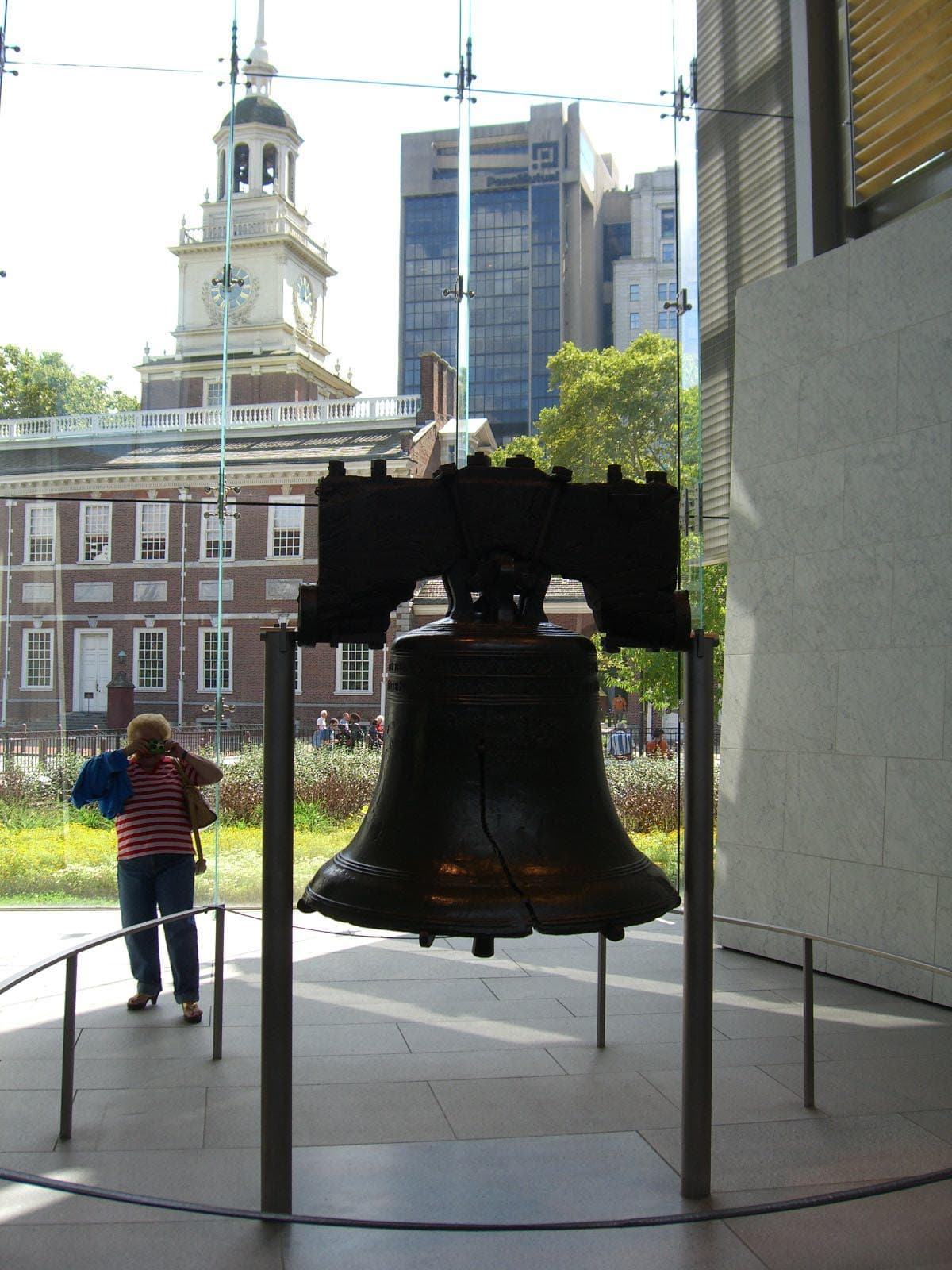
It has been essentially silent ever since — but not untouched. The bell is still tapped, gently, with a rubber mallet on ceremonial occasions: on D-Day, V-E Day, and V-J Day during the Second World War, and each Fourth of July, when descendants of the Declaration's signers tap it in Independence National Historical Park's annual ceremony. The crack everyone photographs today is that widened, filed fissure, running from the lip up toward the crown — less a wound than a signature.
Abolitionists Give It a Name
For most of its life the bell was simply the State House bell. Its famous name was an act of criticism. In the 1830s, abolitionists seized on Norris's inscription and threw it back at a slaveholding republic: an 1835 issue of the Anti-Slavery Record pointed out that the bell had "not obeyed the inscription," its peals "a mockery, while one sixth of 'all inhabitants' are in abject slavery." The journal called it the Liberty Bell. The name stuck and spread — on the cover of the abolitionist journal Liberty in 1837, in a poem titled "The Liberty Bell" reprinted in William Lloyd Garrison's Liberator in 1839, and as the title of The Liberty Bell, the antislavery gift book Boston abolitionists published annually to raise funds. The inscription's own language — the jubilee year of Leviticus, when slaves were freed — made the argument for them.
The irony was not lost on everyone. In the 1850s, with Independence Hall doubling as a federal courthouse, Black newspapers noted the obscenity of fugitive-slave hearings held in the same building that housed the bell of liberty. The bell's deepest 19th-century moment came in April 1865, when Lincoln's coffin lay in state in the Assembly Room and the bell was placed at the head of the casket, its inscription facing the 120,000-plus mourners who filed past. The abolitionists' reading had become the nation's: liberty, proclaimed to all the inhabitants, was now the bell's official meaning — and a yardstick the country would keep being measured against, by civil rights protesters who gathered at the bell in the 1960s among others.
Seven Journeys, and Then Home for Good
Between 1885 and 1915 the bell became a traveling relic, sent by rail to seven expositions: New Orleans (1885), Chicago's World's Columbian Exposition (1893), Atlanta (1895), Charleston (1902), Boston (1903), St. Louis (1904), and San Francisco's Panama-Pacific Exposition (1915). The trips built its national fame — in Chicago, John Philip Sousa premiered The Liberty Bell March as the bell arrived; in Biloxi in 1885, former Confederate president Jefferson Davis stood before it and preached national unity; on the 1915 western journey, an estimated five million people saw the bell from trackside, and it was tapped to transmit the signal — over the new transcontinental telephone line — that opened the San Francisco fair.
But each journey cost the bell something. It came home from Chicago with a new crack; souvenir hunters chipped away more than one percent of its weight; a private watchman was caught cutting off pieces. Philadelphia hardened its heart. Petitions signed by millions of schoolchildren failed to pry it loose for Chicago in 1933 or New York in 1939, and during the Second World War a proposal to store it at Fort Knox for safety provoked a national outcry and was dropped. The Whitechapel Foundry — the London firm that had cast the original — offered in 1944 to recast the bell for free, as a gesture of friendship. Philadelphia declined. By then the crack was not damage to be repaired. It was the whole point.
The Bell at Rest
After the war the City of Philadelphia, which still owns the bell, transferred its custody to the National Park Service, and the bell settled into its modern roles: Cold War emblem of freedom, backdrop for dignitaries and demonstrators alike. On January 1, 1976, for the Bicentennial, it moved out of Independence Hall for the first time in nearly two centuries, into a glass pavilion on Independence Mall — close enough that its old tower still framed the view. In October 2003 it moved once more, into the larger Liberty Bell Center, where it hangs in a glass-walled chamber with Independence Hall directly behind it: bell in front, birthplace behind, one composed photograph that millions of visitors a year now take for themselves. The exhibits along the Center's hall tell the story the way the abolitionists insisted it be told — not just a bell that rang for independence, but a text that keeps being argued with. It no longer rings. It no longer needs to.
Key Facts
- Commissioned by the Pennsylvania Assembly in 1751 from Lester and Pack of London (later the Whitechapel Bell Foundry); it arrived in August 1752 and cracked at its first test ring.
- Recast twice in Philadelphia by founders John Pass and John Stow and hung in the State House steeple in June 1753; their names and the date MDCCLIII appear on the bell, which weighs 2,080 pounds and carries the inscription "Proclaim LIBERTY Throughout all the Land unto all the Inhabitants Thereof" (Leviticus 25:10).
- Hidden under the floor of Zion Reformed Church in Allentown from September 1777 to June 1778 to keep it out of British hands during the occupation of Philadelphia.
- The famous crack developed sometime between 1817 and 1846 — its exact cause is unknown, despite the popular John Marshall legend — and the bell last rang for Washington's Birthday observances on February 23, 1846.
- Abolitionists coined the name "Liberty Bell" in the 1830s (first in the Anti-Slavery Record, 1835); the bell then traveled to seven expositions between 1885 and 1915 and has not left Philadelphia since.
- Moved to the Liberty Bell Center in 2003; owned by the City of Philadelphia and cared for by the National Park Service; admission is free.
Visitor Details
Address: Liberty Bell Center, 526 Market Street, Philadelphia, PA 19106 — between 5th and 6th Streets on Independence Mall, directly across from Independence Hall; visitors exit at the south end near Chestnut Street.
Transit: SEPTA's Market-Frankford Line 5th Street (Independence Hall) station is on the same block; the Philly PHLASH and Market Street buses stop at the Mall, and Jefferson Station (Regional Rail) is a short walk.
Hours/Admission: Per the National Park Service (checked 2026-10-21): open daily 9 am–5 pm; admission is FREE and no tickets are required — entry is first-come, first-served, and all visitors and bags pass through security screening before entering. Confirm current hours on nps.gov/inde before a special trip.
Best timing: Arrive at the 9 am opening or in the final hour before closing to beat the security line, which peaks late morning in summer. Late-afternoon light through the chamber's glass wall gives the classic photograph — the bell in the foreground, Independence Hall behind it. Allow 30–45 minutes to read the exhibits along the hall before you reach the bell itself.
Location Photography