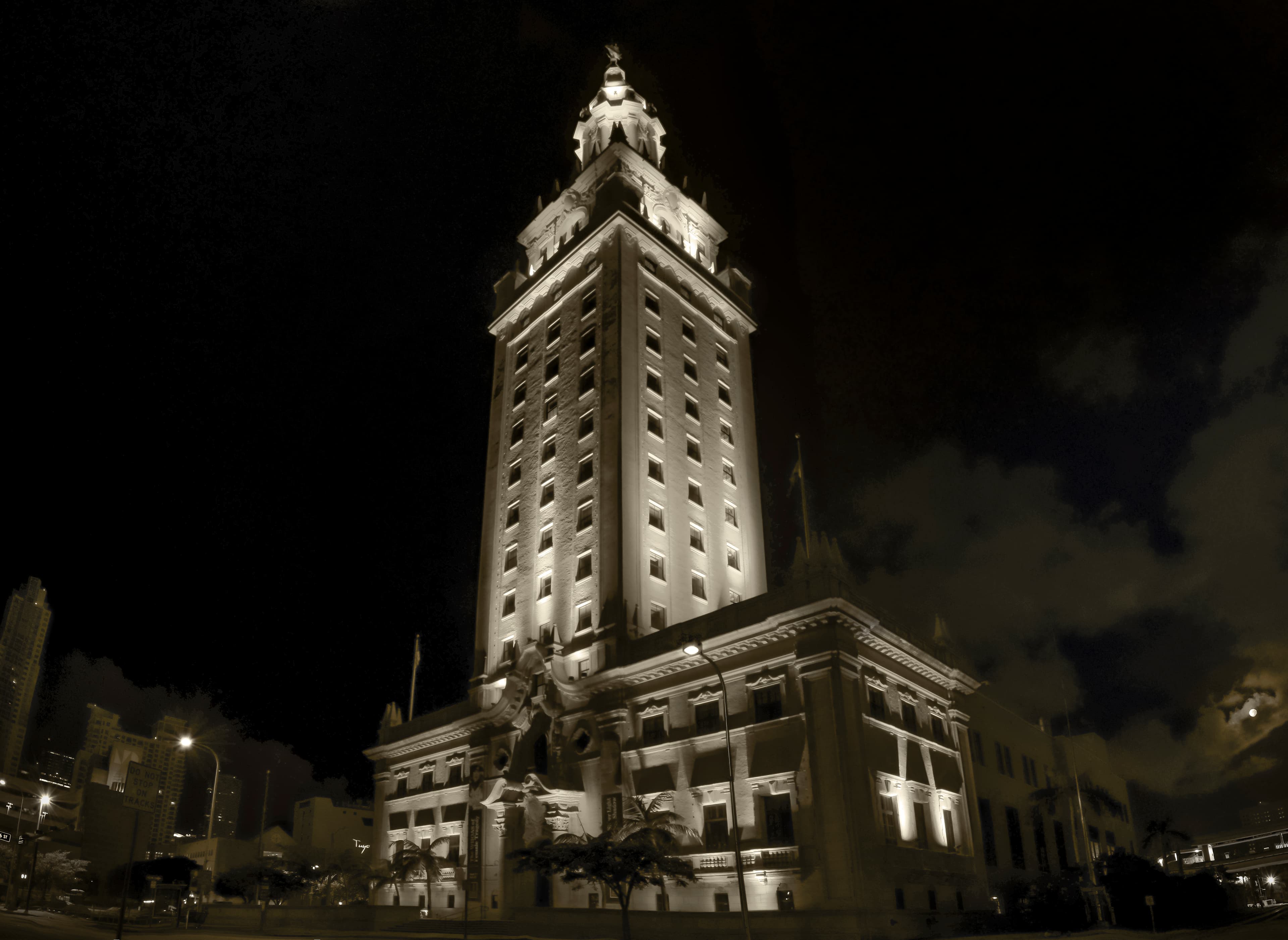
A Newspaper Tower Modeled on Seville
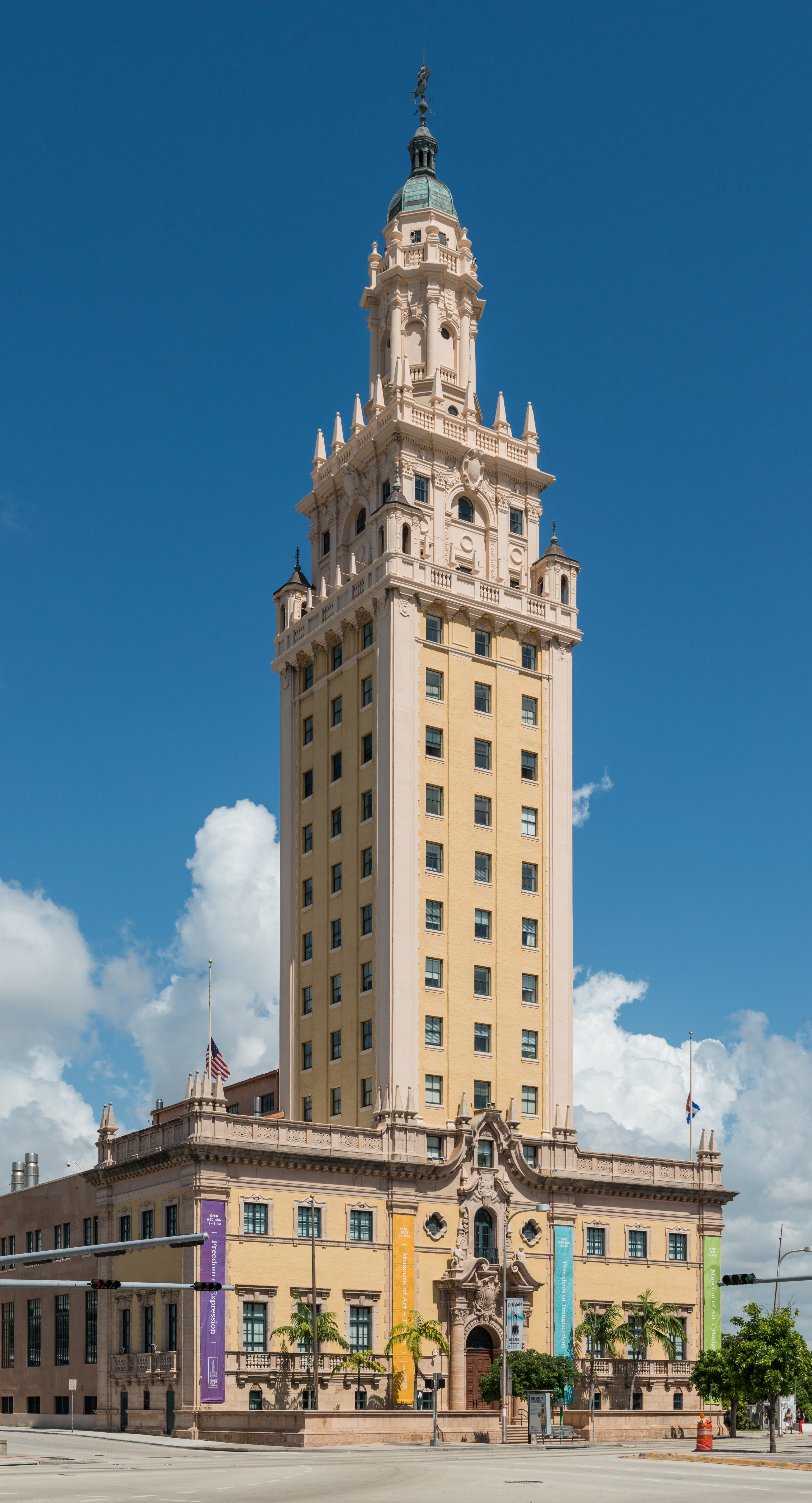
The tower at 600 Biscayne Boulevard went up in 1924–25 as the headquarters and printing plant of The Miami News, the city's afternoon paper, owned by former Ohio governor James M. Cox. Its architects, the New York firm Schultze and Weaver — designers of grand hotels including Miami's Biltmore — reached back to Spain for the silhouette: the 255-foot tower, seventeen stories of Spanish Renaissance Revival, is modeled on the Giralda, the famous bell tower of Seville Cathedral, and crowned with a cupola that once held a decorative beacon. It was among the tallest buildings in Florida when it opened, a working newspaper factory dressed as a cathedral tower — presses below, landmark above. The second floor's Grand Hall carried the tower's artistic signature, the New World Mural depicting Ponce de León's 1513 landing, commissioned in 1926. The News eventually left for other quarters, and by the end of the 1950s the great tower stood largely empty over Biscayne Bay, waiting for the role that would rename it.
El Refugio: The Ellis Island of the South
That role arrived with the Cuban Revolution. After 1959, and especially in the early 1960s, Cuban exiles reached Miami by the tens of thousands, most with little more than the clothes they wore. In 1962 the federal government converted the empty newspaper tower into the Cuban Refugee Assistance Center — El Refugio, "the refuge" — and for more than a decade this building was the single doorway through which a new community entered American life. Inside, refugees were registered and documented, given medical and dental care in clinics on the tower's floors, offered food, modest financial assistance, and help finding work, and — for the many who would resettle beyond Miami — processed onward to cities across the United States. The flow only grew: the Freedom Flights, the twice-daily airlift that ran from 1965 to 1973, brought roughly a quarter-million more Cubans to Miami, and they arrived into the same system headquartered in the tower. The work was deliberately dignifying. New arrivals received a health screening, an identification process, and a small measure of cash assistance — remembered by many families simply as la ayuda, "the help" — along with donated clothing and the all-important paperwork that turned a refugee into a resident with a work permit and a future. By the most common counts, more than 650,000 Cubans passed through the center's programs before it closed in 1974. The comparison Miamians drew was immediate and has stuck ever since: as Ellis Island was to an earlier generation of immigrants, the Freedom Tower was to Cuban exiles — the first American room they stood in, and the place a community's memory keeps returning to. The tower's beacon, lit for arrivals, became the symbol.
Abandonment, and a Landmark in Waiting
When the refugee center closed in 1974, the federal government sold the tower to private buyers, and the building entered its hardest decades. Tenants came and went, maintenance failed, and one of the most recognizable silhouettes in Florida deteriorated in plain sight of the bay it had watched for half a century. Recognition, at least, kept pace with decay: the tower was added to the National Register of Historic Places on September 10, 1979. But a listing is not a rescue, and through the 1980s and into the 1990s the Freedom Tower was a landmark mainly in the legal sense — beloved, symbolic, and quietly falling apart, its revival dependent on finding an owner who understood that the building's value was precisely the history that had happened inside it.
The Rescue: A Memorial Built by Exiles Themselves
That owner arrived in 1997, when the family of Jorge Mas Canosa — the Cuban-American businessman and exile leader who had come to Miami in the revolution's wake — bought the tower for $4.1 million and restored it to its 1925 appearance. Under the Mas family it became a memorial to the exile experience, housing a museum, library, and meeting spaces, and the headquarters of the Cuban American National Foundation. The building resumed its place as the community's ceremonial front room: when singer Celia Cruz, the queen of salsa and herself an exile, died in 2003, more than 200,000 mourners filed past her casket at the Freedom Tower. In 2005 the property passed to developers Pedro and David Martin of Terra Group, who donated the tower to Miami Dade College — a transfer structured so the college would preserve it as a museum and develop the "Cuban exile experience" at its core. On October 6, 2008, the federal government designated the Freedom Tower a National Historic Landmark, honored not principally for its architecture but for its role in the Cuban refugee story — the rare landmark whose significance is measured in people rather than in stone.
A College Landmark, Restored for Its Centennial
Miami Dade College made the tower the cultural anchor of its Wolfson Campus: exhibition galleries, the college's museum programming, lectures, and civic ceremonies, from a presidential campaign announcement in 2015 to a state visit by the King of Spain. The New World Mural — the original 1926 work ruined, it was recreated in 1988 by a team of Miami artists — glows again in the Grand Hall. Then, in July 2023, the college closed the tower for the deepest restoration of its life: roughly $25 million in state-supported work on the structure, the exterior, and the historic interiors. The timing was deliberate. The Freedom Tower reopened to the public on September 16, 2025 — its centennial year — with renewed exhibition spaces devoted to the exile story and to contemporary art. A century after it rose as a newspaper plant, the tower stands in its third career, and the most Miami of its careers: the one where the building itself is the document, proof in terracotta and stucco of how this city was made — by people who arrived with nothing and walked through one famous door.
Why Miami Keeps This Tower
Other American cities have taller landmarks; few have one so directly wired into a community's founding story. For Miami's Cuban-American families — now generations deep, and central to the city's politics, business, and culture — the Freedom Tower is not a monument to something that happened elsewhere. It is where grandparents were photographed, vaccinated, and handed their first American paperwork; family histories in Miami routinely begin with the sentence "we came through the Freedom Tower." That is why the building draws the events it draws: presidential politics launched on its steps, a Spanish king honored in its hall, a beloved singer mourned by a crowd that filled the surrounding streets. The preservation battles that saved it, and the public money that restored it, were never really about a 1925 newspaper plant. They were about keeping the room where Miami's modern story started — a tower that began as a copy of a Spanish cathedral and ended up as the most American building in Florida: an entrance hall.
Key Facts
- Built 1924–25 as headquarters and printing plant of The Miami News; designed by Schultze and Weaver in Spanish Renaissance Revival style modeled on the Giralda of Seville; 17 stories, 255 feet, at 600 Biscayne Boulevard.
- From 1962 to 1974 the building housed the federal Cuban Refugee Assistance Center ("El Refugio"), registering and aiding Cuban exiles — more than 650,000 by common counts — with documentation, medical and dental care, food, and resettlement help; hence its nickname, "the Ellis Island of the South."
- Added to the National Register of Historic Places in 1979; purchased and restored in 1997 by the family of exile leader Jorge Mas Canosa as a memorial and home of the Cuban American National Foundation; over 200,000 mourners paid respects to Celia Cruz there in 2003.
- Donated to Miami Dade College in 2005 and designated a U.S. National Historic Landmark on October 6, 2008, for its role in the Cuban refugee experience.
- The Grand Hall's New World Mural 1513 (originally 1926, recreated 1988) depicts Ponce de León's Florida landing.
- Closed in July 2023 for a roughly $25 million restoration; reopened to the public September 16, 2025, its centennial year, as Miami Dade College's museum and cultural center.
Visitor Details
Address: 600 Biscayne Boulevard, Miami, FL 33132, on Miami Dade College's Wolfson Campus, across from Bayfront Park and the Kaseya Center.
Transit: Metromover's Freedom Tower station (Omni Loop) stops at the building; Metrorail's Government Center station is a short walk or one Metromover stop away. Downtown garages and street parking serve drivers; the area is also an easy walk from Bayside Marketplace and Bayfront Park.
Hours/Admission: The tower reopened in September 2025 after restoration and operates as Miami Dade College's museum and cultural center, with exhibitions and events on a changing schedule — check the college's Freedom Tower / MDC museum pages for current opening hours and any admission details before visiting, as programming rotates. The exterior, one of downtown's great photo subjects, is viewable from Biscayne Boulevard and Bayfront Park at any hour.
Best timing: Morning light for the tower's east face above the bay, and golden hour from Bayfront Park for the full silhouette. Pair the visit with the exhibitions inside when open, and allow extra time for the Grand Hall and the exile-history displays — this is a landmark where the interior carries the story.
Location Photography