A Publishing Empire's Front Hall
The Curtis Building fills a full square block at 6th and Walnut Streets, between 6th and 7th Streets and Walnut and Sansom, directly facing Independence Square. It was built in 1910 in the Beaux-Arts style, to a design by Edgar Viguers Seeler, as the headquarters of the Curtis Publishing Company — the empire behind The Saturday Evening Post and the Ladies' Home Journal, then two of the most widely read magazines in America. Publisher Cyrus Curtis believed a great publishing house should present itself to the public through art as well as print, and the building's marble lobby was meant to be the company's front hall to the city. The man charged with its decoration was Edward Bok, senior editor of the Ladies' Home Journal, working under Curtis. Bok wanted a single commanding artwork for the lobby's main wall, something that would do for the room what the magazines' famous covers did for the newsstand. What he eventually got took years, outlasted several earlier plans for the space, and became the building's defining feature: a mural that was not painted at all, but assembled, piece by piece, out of glass.
Parrish Designs, Tiffany Builds
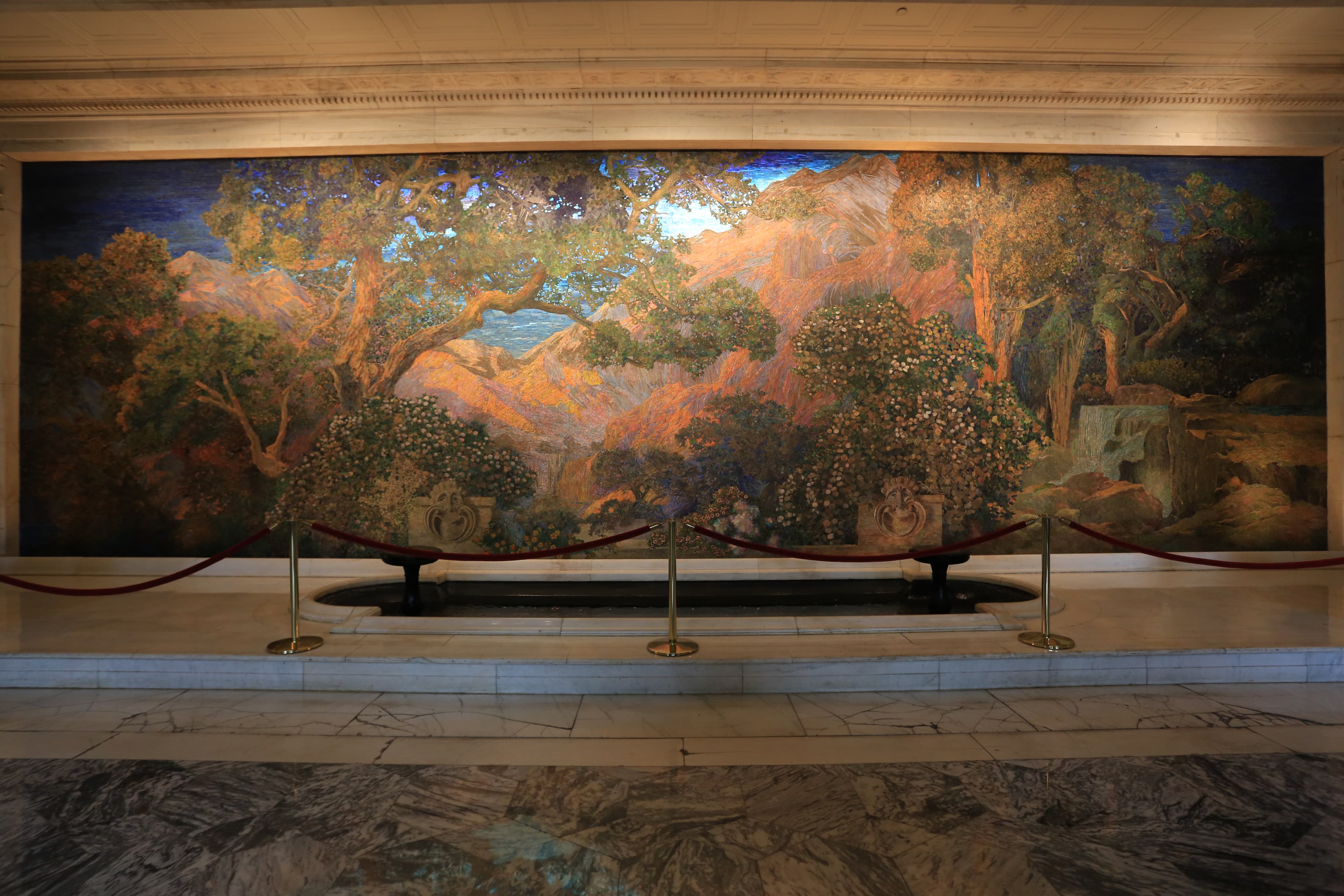
Bok turned to Maxfield Parrish (1870–1966), a Philadelphia-born artist and alumnus of the Pennsylvania Academy of the Fine Arts whose illustrations — luminous, dreamlike, and drenched in a cobalt intensity the public came to call "Parrish Blue" — had made him one of the most popular image-makers in the country, Curtis's own magazines included. Parrish supplied the design: an imagined garden landscape of terraced greenery, flowering trees, classical urns, and still pools, with waterfalls and blue mountains dissolving into the distance. To translate that painted vision into a permanent lobby mural, Bok engaged the other great colorist of the age, Louis Comfort Tiffany, and Tiffany Studios in Corona, Queens. It was the only collaboration between the two men, and it reads like a meeting of equals across mediums. Parrish thought in layered glazes of paint; Tiffany thought in glass that carried its color all the way through. The finished mosaic was exhibited at Tiffany Studios in New York before it ever reached Philadelphia, where more than 7,000 people came to see it, and it was then installed in the Curtis lobby in 1916, where it has remained ever since.
A Landscape Made of Glass
The numbers behind the work still startle. The Dream Garden measures 15 feet high by 49 feet wide and is built from more than 100,000 individual tesserae of Favrile glass — Tiffany's patented iridescent glass, each piece hand-fired, cut, and set. The palette runs to more than 260 distinct color tones, which is how the mosaic manages effects painters achieve with blending: mist softening a ridge line, light pooling on water, foliage shifting from gold to deep green across a few inches. The whole composition is assembled in twenty-four panels, framed in white marble, and weighs more than four tons. Stand close and the illusion dissolves into a glittering mineral surface, every fragment catching the lobby's light at a slightly different angle. Step back across the marble floor and the fragments knit together again into Parrish's impossible garden — a landscape with no season and no hour, permanently lit from inside the glass itself. Critics at its debut treated it as a technical landmark, and it remains among the largest and most ambitious glass mosaics Tiffany Studios ever produced.
The Fight to Keep It in Philadelphia
For eighty years the mosaic was simply part of the building, easy to take for granted. That ended in 1998, when word broke that the work was to be sold and removed. Casino magnate Steve Wynn wanted to buy The Dream Garden and move it to Las Vegas. The response was a civic uproar. Preservationists argued that the mosaic was site-specific — designed for this wall, this lobby, and this light — and that prying four tons of glass off the building risked destroying the very thing being purchased. Mayor Ed Rendell nominated the work for protection, and the Philadelphia Historical Commission designated The Dream Garden the city's first "historic object," using a provision of the preservation ordinance that had never before been applied to a work of art. The owners, the estate of developer and arts patron Jack Merriam, appealed the designation and sought a demolition permit, and the case worked its way through the city's review board and up to the Commonwealth Court over more than three years, with the Association for Public Art, the Preservation Alliance, state preservation officials, and the National Trust all defending the designation in the public interest.
Owned by PAFA, at Home in the Curtis Lobby
The rescue, when it came, was a purchase rather than a verdict. In 2001 the Pew Charitable Trusts provided the funds — $3.5 million — to buy out the interest of the estate's heirs, and the remaining beneficiaries transferred The Dream Garden to the Pennsylvania Academy of the Fine Arts, Parrish's own school. The terms carried the condition the whole fight had been about: the mosaic would stay exactly where it was, in the Curtis Building lobby. PAFA remains its owner and custodian today, while the building around it, now known as the Curtis Center, has been redeveloped around offices and residences. In 2015 a Pennsylvania state historical marker honoring Parrish was dedicated outside the building, a short walk from the mosaic itself. The arrangement is unusual — a museum-owned masterpiece that never hangs in its museum — and it is also the reason an unguarded office lobby in Old City holds one of the great American works in glass. Anyone can walk in off Walnut Street and stand in front of it, which is what Bok and Curtis, publishers to millions, intended from the start.
Standing in Front of It Today
The Dream Garden rewards the double viewing it demands. From the far side of the lobby the scene reads whole: garden terraces in the foreground, water at the center, mountains stacked in blues behind, the entire landscape glowing rather than merely lit. Up close — close enough to see the marble frame and the seams between the twenty-four panels — the surface turns abstract, a field of irregular glass shards in hundreds of tones, no two pieces fired to exactly the same color. Visitor photographs struggle with it for the same reason painters envied it: the color seems to come from behind the wall. Build ten unhurried minutes into a walk around Independence Square and Washington Square, enter through the columned 6th Street or Walnut Street entrances, and you will likely share the lobby with office workers crossing it without looking up. That contrast is the charm of the place. Philadelphia's most improbable mural is hidden in plain sight, in a working building, still doing the job it was made for in 1916.
Key Facts
• The Dream Garden (1916) is a 15-by-49-foot glass mosaic in the lobby of the Curtis Building (the Curtis Center) at 6th and Walnut Streets, designed by Maxfield Parrish and fabricated by Louis Comfort Tiffany's Tiffany Studios — their only collaboration.
• It contains more than 100,000 Favrile glass tesserae in more than 260 color tones, assembled in 24 marble-framed panels weighing more than four tons; before installation it was exhibited at Tiffany Studios in Corona, Queens, where over 7,000 people viewed it.
• The work was commissioned by Edward Bok, senior editor of the Ladies' Home Journal, under Cyrus Curtis, for the headquarters of the Curtis Publishing Company, publisher of The Saturday Evening Post.
• In 1998 casino owner Steve Wynn sought to buy and remove it to Las Vegas; Philadelphia designated it the city's first "historic object," and after years of litigation the Pew Charitable Trusts provided $3.5 million in 2001 so ownership could pass to the Pennsylvania Academy of the Fine Arts, on the understanding it remains in the Curtis lobby.
Visitor Details
Address: The Curtis Center (Curtis Building), 601 Walnut Street, Philadelphia, PA 19106 — the mosaic is in the lobby, entered from 6th Street or Walnut Street, facing Independence Square
Transit: Old City / Independence Square location, a short walk from Independence Hall; the SEPTA Market-Frankford Line's 5th Street station is nearby.
Hours/Admission: The mosaic is viewed from a working office-building lobby, so access follows the building's public hours — generally weekday business hours, with more limited Saturday access in published visitor listings. There is no admission charge to view it, but confirm current Curtis Center lobby hours before visiting, as building hours change.
Best timing: A weekday visit during lobby hours is the reliable option. Give it at least 10–15 minutes: view it first from across the lobby, then close up, where the individual glass tesserae become visible. Combine it with Independence Square and Washington Square, both steps away.
Location Photography