A Village That Never Touches Land
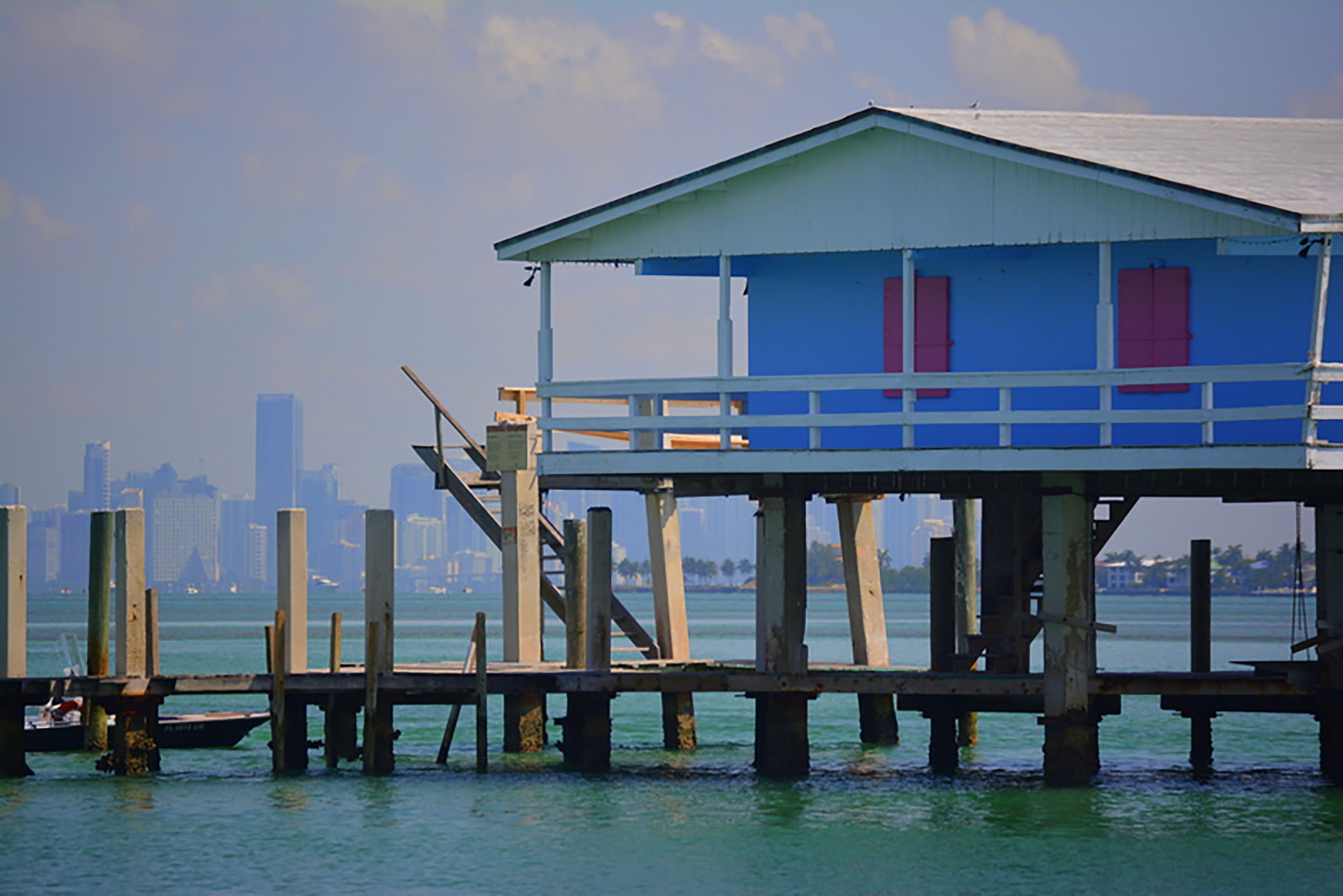
From the top of the Cape Florida lighthouse, look south across the glittering shallows and you will see them: a scatter of wooden houses standing in open water, a mile from the nearest shore, with nothing beneath them but sand flats, seagrass, and one to three feet of Biscayne Bay. This is Stiltsville — houses built on wood or reinforced concrete pilings that hold them roughly ten feet above the water on the sand banks of the Safety Valve, in Miami-Dade County. There is no road and no way in except by boat, and there never has been. At its peak in 1960, Stiltsville counted 27 structures: fishing shacks, private weekend houses, and full-blown social clubs with bars, dining rooms, and yacht slips. Today six houses remain, owned by the National Park Service, posted against trespassing, and maintained by a nonprofit trust of the same families who once partied in them. The gambling lore, the hurricanes, the government fight to tear it down — it is pure Miami, a city that has always preferred its history slightly offshore and loosely legal.
Crawfish Eddie and the One-Mile Loophole
Most sources date the first stilt shack to 1933, when "Crawfish" Eddie Walker built a shack on pilings above the flats toward the end of Prohibition — allegedly to facilitate gambling, which was said to be legal one mile offshore. Eddie sold bait and beer to passing fishermen and became known for a dish he called chilau, a crawfish chowder made with the spiny lobsters he caught beneath his own floorboards. The spot was practical as well as notorious: the flats were a popular fishing ground, and shipwrecking and channel dredging kept boats passing through. Eddie's fishing buddies Thomas Grady and Leo Edward built their own shack in 1937, others followed, and local newspapers took to calling the growing colony "the shacks." Some Dade County historians push the story earlier still, claiming a dozen shacks stood in the flats as early as 1922. Either way, the formula was set from the start: build beyond the beach, beyond the zoning map, and — the founders hoped — beyond the reach of the law. Eddie's original shack was destroyed by the late-season Hurricane King in 1950, but by then Stiltsville no longer needed its founder. It had become an institution.
The Quarterdeck Club and the Party Years
The colony's social era opened in the late 1930s with the Calvert Club, the first social club on the flats, where the Miami Beach Rod & Reel Club held its first official outing in August 1938. Then, in November 1940, Commodore Edward Turner opened the Quarterdeck Club, built on a barge — and Stiltsville went national. Life magazine featured it on February 10, 1941, describing "a $100,000 play-palace equipped with bar, lounge, bridge deck, dining room and dock slips for yachts," an "extraordinary American community dedicated solely to sunlight, salt water and the well-being of the human spirit." Tourists treated the club as a must-see, and rumors of gambling trailed it until a 1949 raid found no evidence of any. Through the 1940s and 1950s the flats were where Miami's lawyers, bankers, and politicians went to relax. Florida Governor LeRoy Collins was a frequent guest of Jimmy Ellenburg, whose barge had been anchored near Crawfish Eddie's since 1939 and who was known as the unofficial mayor of Stiltsville. The Quarterdeck never recovered its early glamour: damaged by Hurricane King in 1950, battered by Hurricane Donna in 1960, and destroyed by a fire in 1961 that burned it to the pilings.
Bikinis and Blue-Collar Clubs
Stiltsville's 1950s and 1960s architecture matured from ramshackle to lodge-like — most houses wrapped in full porches, some genuinely distinctive, like the A-frame house and the Leshaw House with its Mansard roof. The era's two emblematic clubs could not have been more different. In the late 1950s, twelve blue-collar workers of the Miami Springs Power Boat Club bought a sunken barge for one dollar, refloated it, towed it to the flats, and built their clubhouse on it; after Hurricane Betsy tore at the barge in 1965, they rebuilt on concrete pilings, and their house still stands today. At the other pole was the Bikini Club: in 1962, a businessman named Harry Churchville, also known as "Pierre," grounded a 150-foot yacht named Jeff in the flats and converted it into a club offering free drinks to women wearing bikinis, a sun deck for nude sunbathing, and staterooms for rent. The Florida Beverage Commission raided it in the summer of 1965 and shut it down for selling liquor without a license; Hurricane Betsy wrecked the boats that September, and what remained burned to the waterline in 1966. Between the power boat club's scout troops and the Bikini Club's scandals, Stiltsville contained the whole spectrum of mid-century Miami.
Hurricanes Do the Demolition
The sea, ultimately, was the strictest regulator. Hurricane Betsy in 1965 flattened most of Stiltsville and triggered the state's first real rules: from August 1965, owners had to lease their quarter-acre "campsites" for $100 a year, no new construction permits were issued, and any structure damaged more than 50 percent could not be rebuilt. Commercial operations were banned after 1969. In 1976 the leases were renewed at $300 a year — with an expiration date of July 1, 1999, after which remaining structures were to be removed at the owners' expense. In June 1980, Congress expanded Biscayne National Park to include the flats, and in 1985 Florida deeded the submerged land to the federal government; the Park Service honored the existing leases. Then came the reckoning. Fourteen structures stood at the start of 1992. On August 24, Hurricane Andrew — a Category 5 storm — tore through Biscayne Bay and left exactly seven buildings standing. The National Park Service noted pointedly that none of the seven dated from Stiltsville's heyday: the legend had survived, but every physical piece of it was newer than the legend itself.
Saved by Petition: The Trust and the Six That Remain
As the 1999 lease deadline approached, the Park Service told leaseholders it had no authority to renew, and suggested they seek a National Register of Historic Places listing instead. Stiltsville twice failed to qualify — the surviving houses were not yet 50 years old. What saved it was the public. A petition drive drew more than 75,000 signatures, historian Dr. Paul George called it "an only-in-Miami kind of thing," and in August 2000 the Park Service reversed itself: the houses would not be demolished, and the leases would be extended while a preservation plan was developed. In 2003, the nonprofit Stiltsville Trust was established, joining the seven remaining leaseholders — now called caretakers — with eight community members. The Park Service added hurricane strapping; caretakers still perform basic maintenance. Then fire took one more: in January 2021, the Leshaw House burned, leaving six houses — the Jimmy Ellenburg House, the A-Frame House, the Baldwin House, Bay Chateau, the Hicks House, and the Miami Springs Power Boat Club. They are owned by the National Park Service, posted with no-trespassing signs, and entry is by permit only through the Trust. For everyone else, Stiltsville is a view: from a boat circling the flats, or as a mirage south of the Cape Florida Light — still standing, still offshore, still Miami's to argue about.
Key Facts
- Stiltsville stands one mile south of Cape Florida on the Safety Valve sand banks in Biscayne Bay; houses sit on wood or reinforced concrete pilings about 10 feet above water that is 1–3 feet deep at low tide. (Header coordinates are for the Baldwin Sessions house, from a NOAA study of Biscayne National Park sites.)
- "Crawfish" Eddie Walker built the first well-documented shack in 1933, selling bait, beer, and his crawfish chowder called chilau; gambling was allegedly legal one mile offshore.
- The Quarterdeck Club (opened November 1940) was featured in Life magazine in February 1941 as a "$100,000 play-palace"; it burned to the pilings in 1961. The Bikini Club, a grounded 150-foot yacht, was raided and closed in 1965.
- At its 1960 peak Stiltsville had 27 structures. Hurricane Andrew (August 24, 1992) reduced 14 remaining structures to 7; a January 2021 fire destroyed the Leshaw House, leaving 6.
- Florida deeded the bay bottom to the federal government in 1985 as part of Biscayne National Park; after a 75,000-signature petition, the Park Service spared the houses in 2000, and the nonprofit Stiltsville Trust was established in 2003 to preserve them.
Visitor Details
Address: No street address — Stiltsville sits in open water about one mile south of Cape Florida, at the southern tip of Key Biscayne, inside Biscayne National Park.
Transit: Boat only. There is no road, ferry, or public landing. Private boats and kayak launches operate from Key Biscayne and Miami marinas; narrated boat tours that circle Stiltsville (including HistoryMiami Museum cruises) depart from Miami-area marinas — check the operators and the Stiltsville Trust for current schedules.
Hours/Admission: The houses are closed to the public and posted with no-trespassing signs. Per the National Park Service, public access to the structures themselves is by permit only — contact the Stiltsville Trust for permit details. There is no admission fee to view the houses from the water.
Best timing: See them in the morning, when the light is on the houses and the bay is calmest, from a boat out of Key Biscayne; the distant view from the Cape Florida lighthouse at Bill Baggs Cape Florida State Park gives the full geography — village, lighthouse, and skyline in one frame. Keep a respectful distance and do not anchor on the seagrass beds.
Location Photography