A row of houses that were never meant to match
Stand on Kelly Drive on a clear morning and look at Boathouse Row, and the first thing you notice is that it is not one building repeated fifteen times. It is fifteen buildings, side by side along the east bank of the Schuylkill River, each with its own roofline, its own stone or brick, its own personality. One is castle-like, with a tower. One is low and broad. One is trim and Gothic. Together they make a skyline unlike anything else in Philadelphia: a Victorian village built not for living in, but for rowing from.
That is the essential fact about Boathouse Row. These are not museum pieces, and they are not stage scenery. They are clubhouses, built by rowing clubs for rowing clubs, and they still do the job they were built for. On a spring or autumn morning, shells slide out of the boathouse doors onto the Schuylkill, coaches call from launches, and high-school, college, and club crews train on the same stretch of water where Philadelphians have rowed for nearly two centuries. The Row sits just north of the Fairmount Water Works and the Philadelphia Museum of Art, in Fairmount Park, with addresses on both Boathouse Row and Kelly Drive — Kelly Drive named for Philadelphia oarsman John B. Kelly Jr. It is a historic site, a working sports ground, and a postcard view, all at once, and it works as a visit precisely because those three things are true at the same time.
Boathouse Row is a National Historic Landmark, listed on the National Register of Historic Places on February 27, 1987, and its architectural styles are catalogued as Late Victorian and Gothic, among other late-19th- and early-20th-century revivals. But the official designation only partly explains why Philadelphians love it. The Row is loved because it is particular. Each club built its own house, in its own taste, at its own moment, and the result is a row that rewards slow looking: compare the stonework from one house to the next, notice where a tower interrupts the roofline, and you are reading the history of Philadelphia rowing in architecture.
How a dam made a rowing river
Boathouse Row begins, indirectly, with water engineering. The Fairmount Water Works was completed in 1815, and the Fairmount Dam was built in 1821 to keep brackish tidal water from entering the city's water supply through the works. The dam transformed the stretch of the Schuylkill between the dam and East Falls from a tidal river into a slack-water river resembling a very long freshwater lake. That calm, flat surface was ideal for ice skating in winter — and for rowing in summer.
Rowing took hold fast. In 1835, the first regatta took place between the Blue Devils and the Imps Barge clubs, and the excitement of that race sparked the formation of several barge clubs, many of them short-lived. A secondary effect of taming the river, however, was less welcome: the calm water provided a breeding ground for mosquitoes, which drove wealthy residents from their riverside mansions, and the abandoned estates were bought by the City of Philadelphia. In 1844, the city purchased the Lemon Hill Estate, and the estate's leaseholder operated a beer garden and allowed rowing and barge clubs to build frame boathouses on the estate's property along the Schuylkill.
In 1855, the city founded Fairmount Park by converting the Lemon Hill Estate into a public park. At the same time, some of the established clubs wanted to regulate rowing to prevent unscrupulous practices and fixed races. As a result, in 1858, the Schuylkill Navy was founded — the association of amateur rowing clubs that still governs the sport on this river, and whose member clubs occupy most of the Row today. Boathouses numbered 2 through 14 are part of the Schuylkill Navy group, which also encompasses several other boathouses along the river. Boathouse #1 is Lloyd Hall, the only public boathouse facility on the Row, and Boathouse #15 houses the Sedgeley Club, which operates the Turtle Rock Lighthouse.
From condemned frame sheds to Victorian clubhouses
The Row you see today did not arrive all at once. In 1859, the city condemned the frame boathouses along the Schuylkill, but in 1860 it passed an ordinance permitting construction of three new boathouses, for the Pacific Barge Club, the clubs of the Schuylkill Navy, and the Philadelphia Skating Club. Several clubs then built one-story boathouses in brick and stone without city approval, similar to the frame structures that had been condemned. In 1868, following an expansion of Fairmount Park, the city ordered the removal of all of those one-story brick and stone boathouses except for the buildings belonging to the Philadelphia Skating Club (#14), the Pacific Barge Club (#2–3), and the Bachelors Barge Club (#6).
What followed was the great building period that gives the Row its Victorian character. Between 1869 and 1871, the Pennsylvania Barge Club and the Crescent Boat Club erected a double boathouse at #4 and #5. In 1871, the Fairmount Park commission allowed the University Barge Club and the Philadelphia Barge Club to build a double boathouse at #7–8. In 1873, the Malta Boat Club and the Vesper Boat Club built a double boathouse at #9 and #10. In 1874, the College Boat Club built #11; in 1878, the West Philadelphia Boat Club built #12; and in 1883, the Undine Barge Club constructed #13. Later replacements kept the Row evolving: the Pennsylvania Barge Club tore down and replaced its half of the #4 double house in 1892, the Bachelors Barge Club replaced its 1860 building at #6 in 1894, the Sedgeley Club was allowed to build #15 in 1902, and in 1904 the Fairmount Rowing Association demolished the stone building built by the Pacific Barge Club at #2 and replaced it with a new brick structure — leaving #3 and #14 as the only remaining boathouses dating from 1860.
The result is a textbook of late-19th-century taste, compressed into a few hundred yards. Local histories credit the Crescent house to architect Charles Balderston and the Malta and Vesper houses to G. H. Hewitt, in a semi-attached Victorian Gothic manner, while the Undine house, with its leaded glass and castle-like massing, is nicknamed Castle Ringstetten and is often called the most striking house on the Row. You do not need to know every architect's name to enjoy the effect. Walk the Row slowly and the differences announce themselves: Gothic arches here, a Tudor inflection there, a tower, a broad porch, a steep roof. The clubs were rivals on the water, and their houses compete, politely, on land — each one trying to outdo its neighbor in character without breaking the line.
The lights that saved the Row
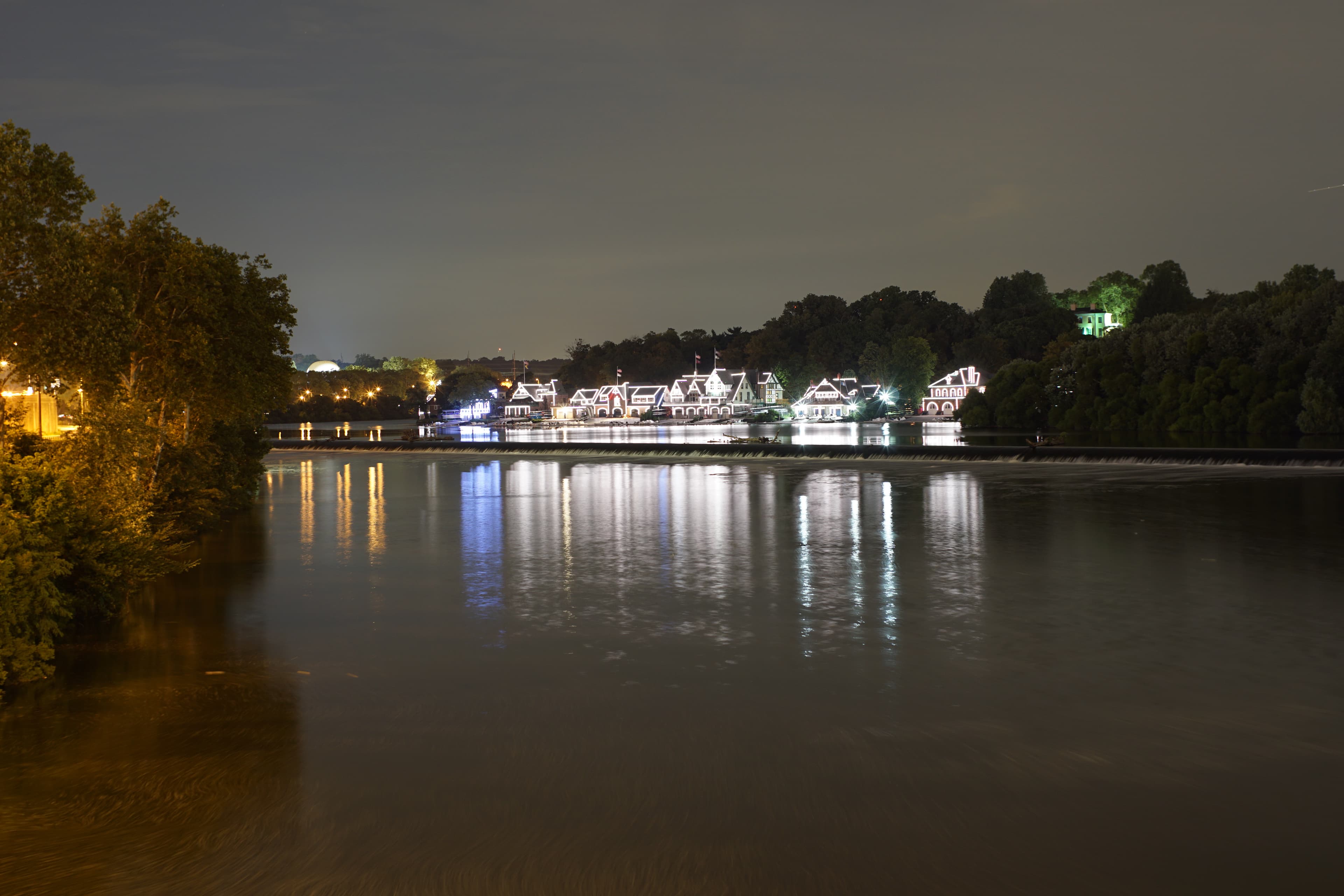
By day, Boathouse Row is handsome. By night, it is famous. In 1979, lights designed by architectural lighting designer Ray Grenald were installed to outline each of the boathouses, giving them a nightly, Christmas-like gingerbread-house appearance, reflected in the Schuylkill River. Grenald proposed the lights after hearing talk of destroying the decaying Victorian boathouses: lights on the buildings at night would make them more noticed and appreciated. He was right. The lights turned a row of aging clubhouses into one of Philadelphia's signature nighttime sights, beloved by drivers on the Schuylkill Expressway, by walkers on the far bank, and by photographers ever since.
The lighting has been renewed more than once. In 2005, after two refurbishings, the houses were outfitted with computerized LEDs that could light up in various colors, depending on the event or season. That system, in turn, began to fail — outages caused by weather, animals, and aging equipment — and the houses went dark in March 2023 so the old system could be removed. During the dark period, the clubs invested in building repairs that had previously been inaccessible behind the lights. A new system, designed by the Philadelphia firm The Lighting Practice and managed by the Fairmount Park Conservancy, was unveiled to the public in March 2024: 6,400 individual LED lights, with millions of potential color combinations, able to fade from one color to the next, to sparkle or appear to dance along the houses, and to highlight the eclectic architectural features of the historic structures in different colors. The lights are programmed to change for seasons, holidays, civic events, and Philadelphia sports teams — so a return visit on a different night can genuinely look different.
That is why the standard advice about Boathouse Row is to see it twice: once by day, when you can study the architecture and watch the rowers, and once after dark, when the outlines glow and double in the river. The daytime visit explains the Row; the nighttime visit explains why the city fought to keep it.
Rowing culture: the Schuylkill Navy and the regattas
To understand Boathouse Row, you have to understand that it is not a monument to rowing. It is rowing, still happening. The Schuylkill Navy, founded in 1858, transformed what had been a professional, sometimes rough-edged sport into an amateur one, and its clubs remain the backbone of rowing on this river. Rowers from the boathouses compete at every level, from local clubs and high schools through colleges and summer racing programs to international-level athletics. Local universities including Drexel, Penn, Thomas Jefferson University, and La Salle row out of houses on Boathouse Row, while Temple and Saint Joseph's row out of other boathouses along the Schuylkill that are not part of the Row.
The regatta calendar is the Row's other season. Boathouse Row hosts several major rowing regattas, including the Philadelphia Scholastic Rowing Association's Manny Flick regatta series, the Stotesbury Cup Regatta, the Navy Day Regatta, the Independence Day Regatta, and the Head of the Schuylkill Regatta. The Head of the Schuylkill, held in the autumn, is one of the great fall fixtures of American rowing: a head race, in which crews race against the clock rather than side by side, drawing large fields of high-school, college, and club boats to the Schuylkill. On a regatta day, Kelly Drive fills with trailers, tents, and spectators, the river fills with shells, and the Row is at its busiest and most festive. If you visit on a regatta weekend, expect crowds and road arrangements that differ from an ordinary day, and enjoy it — a regatta is the Row doing exactly what it was built to do.
Even on an ordinary day, the rhythm is visible. Early mornings belong to training crews. Midday brings walkers, runners, and cyclists on Kelly Drive and the Schuylkill River Trail. Evenings bring photographers waiting for the lights. The clubs themselves are private — these are members' clubhouses, not public museums, and visitors should not expect to walk into a boathouse uninvited — but the Row is meant to be seen from outside, from the public paths, and that outside view is the whole show.
The best viewpoints
Boathouse Row rewards a little planning about where to stand, because the view changes completely with your position.
Start on Kelly Drive itself, on the street side of the houses. This is the close-up view: you can read the individual architecture, the plaques, the doors, the boathouse numbers, and the details that make each house different. Walk the full length of the Row at this range, south to north or north to south, and the houses reveal themselves one by one. This is also the view for watching rowers carry shells out and launch — the working side of the Row.
Then cross to the opposite bank for the classic view. From the west bank of the Schuylkill, the whole Row composes itself into a single panorama: fifteen houses in a line, the river in the foreground, the trees behind. This is the view in most postcards, and it is the best view at night, when the lights reflect in the water and the houses read as a single glowing frieze. If you only have time for one photograph, take it from across the river.
The third classic viewpoint is from the south, around the Philadelphia Museum of Art steps and the Eakins Oval area. From here, the Row sits in the middle distance beyond the Fairmount Water Works, with the museum on its hill above — a layered Philadelphia composition of water, historic industry, art museum, and rowing clubs in a single frame. Pairing the Row with the museum steps and the Water Works makes a natural half-day: the museum and the Water Works are the grand neighbors, and the Row is the human-scaled surprise between them.
For a longer outing, follow the Schuylkill River Trail. The trail runs along the river and connects the Row to the Water Works, the museum, and miles of riverfront path in both directions, so the Row can be a stop on a walk or ride rather than a destination you drive to and leave. However you arrive, plan to linger. The Row is small enough to see in twenty minutes and rich enough to repay an hour, especially if you catch both daylight and dusk.
Why Boathouse Row endures
Philadelphia has grander landmarks — Independence Hall, the Liberty Bell, City Hall — but Boathouse Row has something they do not: it is still used, daily, for the purpose it was built for, by the community that built it. The houses are all at least a century old, and some were built more than 150 years ago, yet they are not preserved in amber. They have been rebuilt, replaced, repaired, rewired, and relit, by generations of volunteers and club members who kept rowing while the city changed around them. The lights, installed to save decaying houses in 1979, ended up doing more than saving them: they made the Row a civic emblem, a sight Philadelphians point to when they want to show a visitor what their city looks like after dark.
For a first-time visitor, Boathouse Row is also the perfect introduction to Philadelphia's river city character. The Schuylkill is not a backdrop here; it is the reason the place exists. The dam made the water, the water made the sport, the sport made the clubs, and the clubs made the architecture. Stand on Kelly Drive, then stand across the river, then come back after dark, and you will have followed that chain from engineering to sport to beauty — and you will understand why fifteen boathouses on a riverbank became one of the most beloved sights in the city.
Key Facts
- Boathouse Row is a row of fifteen boathouses on the east bank of the Schuylkill River in Philadelphia, Pennsylvania, just north of the Fairmount Water Works and the Philadelphia Museum of Art, with addresses on both Boathouse Row and Kelly Drive.
- The Fairmount Water Works was completed in 1815 and the Fairmount Dam was built in 1821; the dam turned the Schuylkill between the dam and East Falls into a slack-water river resembling a long freshwater lake, ideal for rowing.
- The first regatta took place in 1835, between the Blue Devils and the Imps Barge clubs; the Schuylkill Navy, the association of amateur rowing clubs, was founded in 1858.
- The city purchased the Lemon Hill Estate in 1844, founded Fairmount Park from it in 1855, condemned the frame boathouses in 1859, and passed an ordinance in 1860 permitting three new boathouses.
- The great Victorian building period ran from 1869 to 1883: double houses at #4–5 (1869–1871), #7–8 (1871), and #9–10 (1873), plus #11 (1874), #12 (1878), and #13 (1883); later replacements include #6 (1894), #15 (1902), and #2 (1904), leaving #3 and #14 as the only houses dating from 1860.
- Boathouses #2 through #14 are part of the Schuylkill Navy group; #1 is Lloyd Hall, the only public boathouse facility on the Row; #15 houses the Sedgeley Club, which operates the Turtle Rock Lighthouse.
- The houses are all at least a century old, and some were built more than 150 years ago; architectural styles include Late Victorian and Gothic, with individual houses credited in local histories to architects including Charles Balderston (Crescent) and G. H. Hewitt (Malta and Vesper), and the Undine house nicknamed Castle Ringstetten.
- In 1979, lights designed by Ray Grenald were installed to outline the boathouses, proposed after talk of destroying the decaying Victorian houses; the houses were outfitted with computerized LEDs in 2005.
- The houses went dark in March 2023 for removal of the failing system; a new system of 6,400 individual LED lights, designed by The Lighting Practice and managed by the Fairmount Park Conservancy, was unveiled in March 2024, with millions of color combinations and the ability to fade, sparkle, or highlight architectural features.
- Boathouse Row was added to the National Register of Historic Places and designated a National Historic Landmark on February 27, 1987.
- Boathouse Row hosts major regattas including the Manny Flick series, the Stotesbury Cup, the Navy Day Regatta, the Independence Day Regatta, and the Head of the Schuylkill Regatta; rowers from the houses compete from local club level to international level, and universities including Drexel, Penn, Thomas Jefferson University, and La Salle row out of houses on the Row.
Visitor Details
Address: Boathouse Row, Kelly Drive, Philadelphia, PA 19130 (Fairmount / Schuylkill River, in Fairmount Park, just north of the Fairmount Water Works and the Philadelphia Museum of Art)
Viewing: The Row is viewed from outside, from the public paths along Kelly Drive and from the opposite (west) bank of the Schuylkill. The clubhouses themselves are private members' clubs, not public museums — do not expect to walk into a boathouse uninvited. Lloyd Hall (#1) is the Row's public boathouse facility.
Hours/Admission: There is no ticket to look at the Row from the public paths. No fixed hours, fees, or tour prices are stated here, because club access and any event arrangements vary; check the Fairmount Park Conservancy's Boathouse Row lights page and the Schuylkill Navy before a visit for current lighting and event information. Regatta days bring crowds and changed road arrangements along Kelly Drive.
Best timing: Visit twice if you can — once by day for the architecture and the rowers, and once after dark for the lights reflected in the river. Walk the full length on Kelly Drive for close-up detail, cross to the west bank for the classic panorama and the best night photograph, and pair the Row with the Philadelphia Museum of Art steps area and the Fairmount Water Works to the south. Autumn regatta season, especially the Head of the Schuylkill, is the Row at its busiest and most festive.
Boathouse Row in Photographs