Miami's museum on the bay
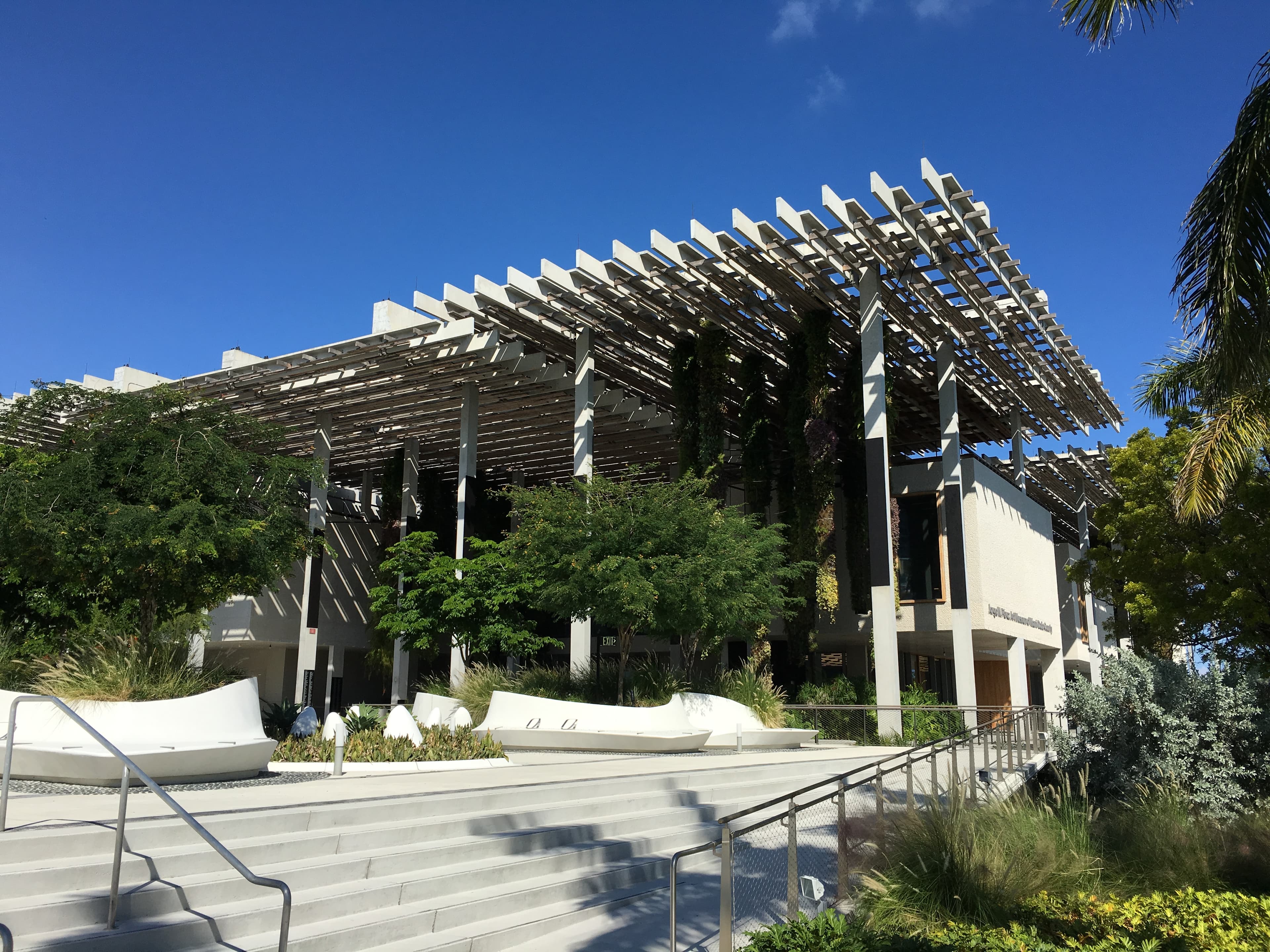
Stand on the wide staircase of the Pérez Art Museum Miami and you are standing in two places at once: inside one of America's most talked-about museum buildings, and outside on a shaded veranda open to Biscayne Bay. The museum — PAMM to everyone in Miami — sits at the water's edge in downtown's Maurice A. Ferré Park, its low concrete form lifted on stilts above the ground, its broad canopy throwing deep shade over terraces and stairs, its columns hung with vertical gardens. Behind you are galleries of modern and contemporary art; in front of you, across the water, is Miami Beach. The building's architects, the Swiss firm Herzog & de Meuron, called the idea "permeability": no hard line between inside and outside, between the art and the city that made it.
That openness is the point. PAMM presents itself as the art museum of a city at the crossroads of the Americas, and its collection follows that geography: 20th- and 21st-century art with a deep emphasis on Latin America, the Caribbean, and the African diaspora, alongside work from the United States, Western Europe, and Africa. It is, by design, a museum you visit as much for the building and the bay as for any single exhibition — and it has become, since it opened in December 2013, one of the first places a first-time visitor to Miami is told to go.
From a downtown fine-arts hall to a museum of its own
PAMM's history begins modestly, and a long way from the bay. It was founded in 1984 as the Center for the Fine Arts, a hall for traveling exhibitions in the Miami-Dade Cultural Center on West Flagler Street, in a Spanish-style complex designed by Philip Johnson. It did not begin acquiring art in earnest until 1996, when it was reborn as the Miami Art Museum — and even then it was cramped, with little storage and little exhibition space for a city of Miami's size and ambition.
The move to the waterfront had been decades in the making. A county bond approved by voters in 1972 had seeded the idea of a downtown arts investment; the 2004 "Building Better Communities" bond supplied capital funding for a new museum building. In November 2010, construction began on a new home in what was then called Bicentennial Park — renamed Museum Park, and later Maurice A. Ferré Park — on Biscayne Bay, beside the site where the Phillip and Patricia Frost Museum of Science would rise. The Swiss architects Herzog & de Meuron, already famous for London's Tate Modern and Beijing's Bird's Nest stadium, were commissioned to design it, hired by museum director Terence Riley.
The new building opened on December 4, 2013, timed to the Art Basel Miami Beach fair, and the institution was renamed at the same moment: the Jorge M. Pérez Art Museum of Miami-Dade County, for the developer and collector Jorge M. Pérez, a longtime trustee whose gift of $35 million in cash and art anchored the campaign. The renaming was controversial — several board members resigned, and critics noted that city and county taxpayers had supplied about $100 million of the capital campaign against Pérez's roughly $40 million — but the name stuck, and so did the building. In its first four months the new museum drew more than 150,000 visitors, against about 60,000 a year at the old Flagler Street location.
A building that learned from Stiltsville
Herzog & de Meuron's design starts from Miami itself: the heat, the storms, the water, and the vegetation. "Miami is known for its iconic art deco district — decorated boxes with no great relationship and exchange between inside and outside," Jacques Herzog said at the opening. "The greatest thing, however, that makes Miami so extraordinary is its amazing climate, lush vegetation and cultural diversity. How can these assets be fully exploited and translated into architecture? That's the way we tried to go with our design."
The answer was a building on stilts. Like the wooden houses of Stiltsville — the small community of stilt houses standing in Biscayne Bay off Key Biscayne — PAMM is lifted above the ground, which puts the art above storm-surge level and leaves the space beneath open for parking and air. Above the platform, the museum is a three-story structure of about 200,000 square feet of indoor and outdoor program space: roughly 120,000 square feet inside and 80,000 outside. Thick concrete walls give the building thermal mass against the heat; a broad, slatted canopy extends far beyond the walls, shading the verandas and terraces that wrap the building on all sides. A grand staircase nearly the full 180-foot width of the platform runs down to the waterfront promenade, so the museum meets the bay with a gesture rather than a door.
Inside, the galleries are arranged to be flexible rather than monumental. Floor-to-ceiling windows in several galleries frame views of the bay and the downtown skyline — the city itself becomes a backdrop to the art — while other galleries can be closed off for light-sensitive work. The architects divided the spaces into anchor galleries for the permanent collection, focus galleries for single artists or themes, and overview galleries for rotating shows, so the museum could hang a young, growing collection in different ways rather than in one fixed procession. An auditorium doubles as a monumental stair between the first and second floors, keeping the museum's education programs at the center of the building rather than tucked away.
The building's most photographed feature was its hanging gardens: columns of tropical plants designed by the French botanist Patrick Blanc, suspended from the canopy and wrapping the verandas in living green. Blanc selected some 80 plant species meant to survive subtropical heat and hurricanes, and the gardens became the building's signature — a jungle hanging from a concrete roof. Visitors should know one honest update: after years of maintenance trouble, PAMM began replacing the living columns in August 2022 and completed the change by fall 2023, so the columns today are wrapped mostly in uniform artificial turf with a few real orchids. The structure and the shade remain; the jungle is, for now, a memory preserved in photographs — including the ones in this article's gallery, taken while the gardens were still alive.
The collection: the Americas, the Caribbean, the diaspora
PAMM has collected art only since 1996, so it does not have the deep old-master holdings of an older museum — and it has turned that youth into a curatorial identity. At the new building's opening the collection numbered about 1,800 works; it has since grown toward 3,000, with a focus on the second half of the 20th century and the contemporary moment, and on what the museum calls the cultures of the Atlantic Rim: the Americas, Western Europe, and Africa.
The strengths follow Miami's own map. The Pérez gift brought 110 works, including pieces by the Cuban painters José Bedia Valdés and Wifredo Lam, the Mexican artists Diego Rivera and Damián Ortega, the Uruguayan Joaquín Torres-García, and the Colombian Beatriz González. Developer Craig Robins pledged 102 more works from his collection in 2013. A dedicated acquisitions fund for African American art, seeded by Pérez in 2012 and matched by the Knight Foundation, brought in work by Terry Adkins, Romare Bearden, Kevin Beasley, Ed Clark, Faith Ringgold, Tschabalala Self, and others; in 2016 Pérez gave a further group of more than 200 works of contemporary Cuban art, making PAMM's Cuban holdings among the largest in the United States. The permanent collection also includes second-half-of-the-20th-century and contemporary work by Purvis Young, Joseph Cornell, Kehinde Wiley, James Rosenquist, Frank Stella, and Kiki Smith.
Outside, the sculpture garden carries the same argument into the open air. Jedd Novatt's stainless-steel Chaos SAS (2012) stands on the museum grounds; Mark di Suvero's painted-steel La Plume de Pierrot (1974) anchors the Mary M. and Sash A. Spencer Sculpture Garden; Pablo Atchugarry's Endless Evolution (2015) is among the outdoor works visitors meet before they ever enter a gallery. The opening exhibitions set the tone: the first major international retrospective of Ai Weiwei, alongside shows of the Cuban modernist Amelia Peláez and the Haitian-born artist Edouard Duval-Carrié — a program that said, plainly, that this museum's center of gravity would be the art of the wider Americas.
Beyond the galleries, PAMM has built itself into a civic institution: education programs and a library, media lab, and classrooms in the building; the PAMM Student Pass, launched with Miami-Dade County Public Schools in 2018, giving public-school students free entrance; the Inside|Out program, which carried reproductions of the collection into neighborhoods across Miami-Dade; and, since September 2023, PAMMTV, a free on-demand streaming platform for video art. In 2019 the museum received a $1 million Mellon Foundation gift for its Caribbean Cultural Institute, dedicated to art of the Caribbean and its diaspora; in 2024 collector Kenneth C. Griffin gave $10 million toward the collection and a named gallery.
How to see it
PAMM rewards the slow visit. Start outside: walk the park from the Museum Park Metromover station, circle the building on its shaded verandas, and climb the great bay-side staircase to take in the view the architects designed the museum around. Then go in and let the building do its work — the galleries with bay windows first, where the art and the water share the frame, then the more enclosed galleries, then the sculpture garden on the way out. Leave time for the waterfront itself: the museum's restaurant, Verde, sits on the bay side of the building, and the park's promenade runs north and south along the water to the Frost Museum of Science next door and downtown beyond.
Come with the weather in mind. The verandas are shaded but open to the air, and a summer afternoon on the bay side is hot even under the canopy; the galleries are the cool refuge, and the late afternoon light across the water is the museum's best free show. Pair the visit with the Frost Museum next door for a full Museum Park day, or with a walk south along Biscayne Boulevard into downtown and the Adrienne Arsht Center — the cultural corridor the museum was built to anchor.
PAMM's achievement is not that it is old or grand. It is that a museum founded as a borrowed hall for traveling shows, in a city long accused of caring more about the beach than about art, built itself a building that belongs to its climate and a collection that belongs to its hemisphere — and then opened both to the bay. The canopy, the stilts, the staircase to the water: they are not decoration. They are the museum's argument, made in concrete and shade, that art in Miami should be as open as the city itself.
Key Facts
- Pérez Art Museum Miami (PAMM) — officially the Jorge M. Pérez Art Museum of Miami-Dade County — is a contemporary art museum at 1103 Biscayne Boulevard, Miami, FL 33132, in Maurice A. Ferré Park (formerly Bicentennial Park / Museum Park) in downtown Miami.
- Founded in 1984 as the Center for the Fine Arts in the Miami-Dade Cultural Center on West Flagler Street; became the Miami Art Museum in 1996; renamed for Jorge M. Pérez upon moving to its new building in 2013.
- The new building, designed by Herzog & de Meuron, opened December 4, 2013, during Art Basel Miami Beach; construction began in November 2010.
- The three-story building has about 200,000 square feet of indoor and outdoor program space (roughly 120,000 interior, 80,000 exterior); its design lifts the museum on stilts above storm-surge level, inspired by Biscayne Bay's Stiltsville houses.
- The hanging vertical gardens were designed by French botanist Patrick Blanc with some 80 plant species; after maintenance problems, PAMM replaced the living columns with mostly artificial turf (plus a few real orchids) between August 2022 and fall 2023.
- Jorge M. Pérez's leadership gift was $35 million in cash and art, including 110 works; the capital campaign drew about $100 million in public bond funding. The renaming prompted several board resignations.
- At the new building's opening the collection held about 1,800 works; it has since grown toward 3,000, focused on 20th- and 21st-century art of the Americas, the Caribbean, and the African diaspora, plus Western Europe and Africa.
- The 2012 African American art acquisitions fund (Pérez, matched by the Knight Foundation) brought work by Terry Adkins, Romare Bearden, Kevin Beasley, Ed Clark, Faith Ringgold, Tschabalala Self, and others; the 2016 Pérez gift of 200+ works made PAMM's contemporary Cuban holdings among the largest in the United States.
- Outdoor works include Jedd Novatt's Chaos SAS (2012, stainless steel), Mark di Suvero's La Plume de Pierrot (1974, painted steel) in the Spencer Sculpture Garden, and Pablo Atchugarry's Endless Evolution (2015).
- The museum drew more than 150,000 visitors in its first four months at the new building, versus about 60,000 a year at the old Flagler Street site; it was chosen for the 2015 American Society of Landscape Architects Professional Awards.
- PAMM is directly served by the Museum Park Metromover station; Metrorail connects via transfer at Government Center station.
- PAMMTV, a free on-demand video-art streaming platform, launched in September 2023; the PAMM Student Pass (free entrance for Miami-Dade public-school students) launched in March 2018.
Visitor Details
Address: Pérez Art Museum Miami, 1103 Biscayne Boulevard, Miami, FL 33132 — in Maurice A. Ferré Park on Biscayne Bay, downtown Miami
Transit: Museum Park station (Metromover) serves the park directly; Metrorail riders transfer to the Metromover at Government Center station
Hours/Admission: Hours, admission prices, and free-admission days change — check the museum's official site (pamm.org) before your visit rather than relying on a fixed schedule. The museum's galleries, waterfront restaurant Verde, and museum shop are all on site; the building and park are shared with the neighboring Frost Museum of Science, so the two pair naturally for a single Museum Park day.
Best timing: Late afternoon for the bay light from the verandas and the great staircase; weekday mornings for the quietest galleries. Start outside — circle the verandas, climb the bay-side staircase — then work through the bay-window galleries, the enclosed galleries, and the sculpture garden.
Location Photography