The crown jewel of the City Beautiful
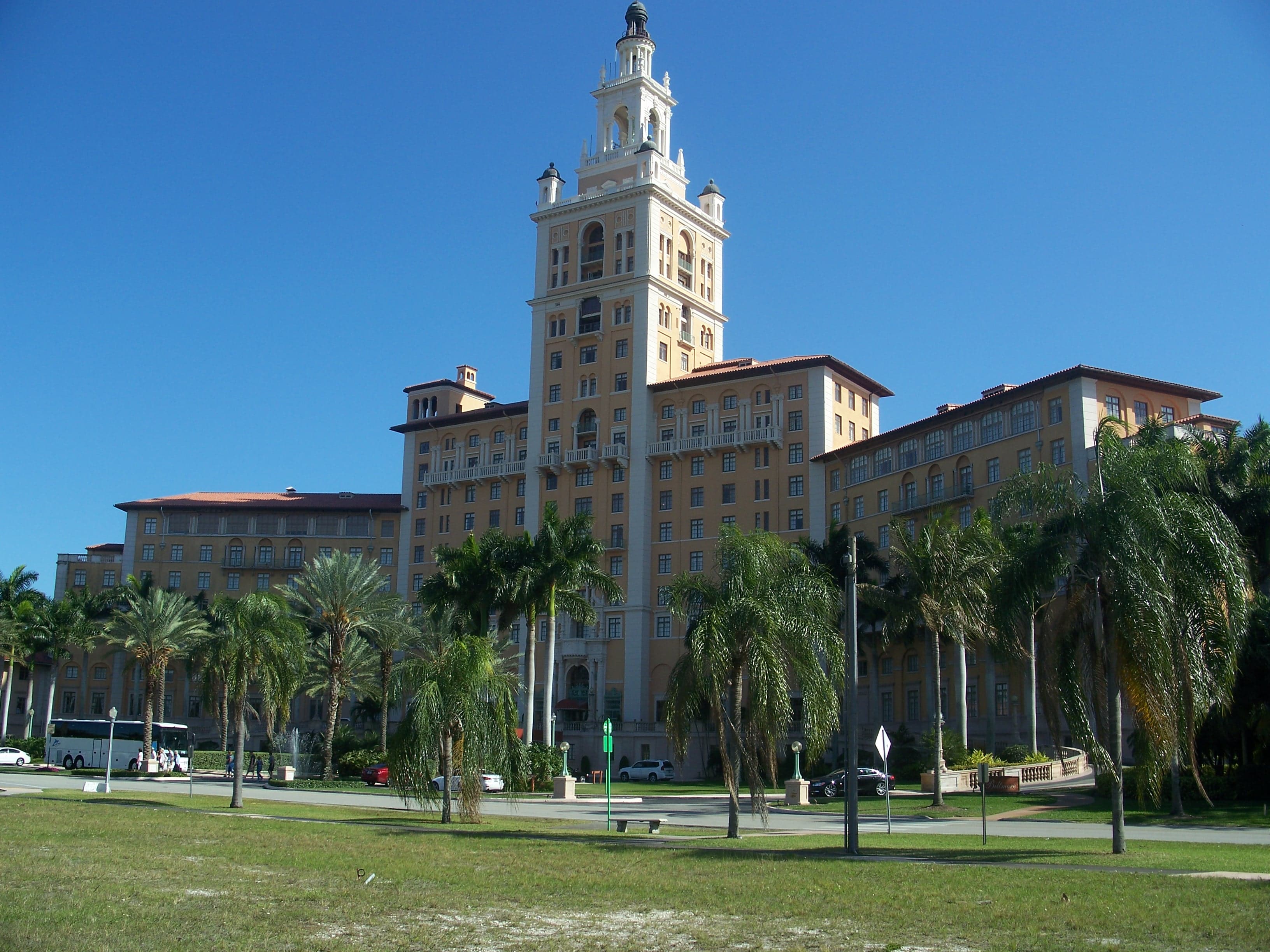
There is a moment, driving through Coral Gables, when the trees part and a tower appears above the canopy — pale stone, tiered and tiled, impossibly tall for a suburb of low Mediterranean villas. That is the Biltmore Hotel, and it has been the exclamation point at the end of Coral Gables' story since the city itself was barely a year old. It was the centerpiece of George Merrick's planned "City Beautiful," the luxury hotel that would prove his new city was not a real-estate scheme but a place of consequence. A century later, it still does that job.
The hotel was the joint dream of Merrick, the developer building Coral Gables out of his family's citrus groves, and John McEntee Bowman, president of the Bowman-Biltmore hotel chain. Bowman hired the New York firm of Schultze and Weaver — Leonard Schultze, who had been chief designer on Grand Central Terminal, and S. Fullerton Weaver — to design it. Ground was broken in 1925, and after ten months of construction at a cost of $10 million, the Miami-Biltmore Hotel and Country Club opened on January 15, 1926, with a grand weekend gala. Special trains marked "Miami Biltmore Specials" brought guests down from northern cities, three orchestras played, and some 1,500 guests attended the opening dinner-dance. The tower was lit for the first time, and it could be seen for miles across the flat South Florida landscape.
The timing could hardly have been more dramatic. The hotel opened at the very apex of the Florida land boom, and just eight months later, on September 18, 1926, the great Miami Hurricane struck. The Biltmore itself was undamaged and sheltered more than 2,000 survivors, but the storm broke the boom it had been built to celebrate. Merrick's Coral Gables company declared bankruptcy in April 1929; Bowman bought out Merrick's stake that November for $2.1 million, and in September 1931 he resold the hotel to millionaire Henry Latham Doherty. The palace had outlived the party that built it — and it was only getting started.
A tower borrowed from Seville
The Biltmore's architecture is Mediterranean Revival in its grandest register: Spanish, Moorish, and Italian influences fused into a single composition of stucco walls, terra-cotta tile, arched loggias, and carved stone. The hotel spreads across 150 acres of tropical grounds, its horseshoe-shaped plan wrapping a colonnaded courtyard with a marble fountain at its center. But everything in the design points to the tower.
The 315-foot tower is modeled on the Giralda, the medieval bell tower of the cathedral of Seville in Spain, and it was the defining gesture of the whole building. When it was completed in 1926, it made the Biltmore the tallest building in Florida, a record it held until the Dade County Courthouse surpassed it in 1928. It remains the landmark by which Coral Gables is recognized, visible from boulevards all over the city, and it is the reason the hotel photographs the way it does: a vertical accent rising out of horizontal gardens, exactly as Merrick intended when he set out to build "Castles in Spain" in South Florida.
Inside, the grandeur continues at ground level. The lobby runs on two rows of Corinthian columns beneath ceilings that mix bright blue Gothic-arched vaults with elaborately painted coffered panels, all in hand-painted fresco, travertine, and marble. Dark wood details and elaborate ironwork complete the effect, and the lobby leads directly onto the open-air courtyard, flanked by wings holding the ballrooms and restaurants. It is a sequence designed to impress on arrival, and a century of renovations has kept it that way: the building was listed on the National Register of Historic Places in 1972, designated a National Historic Landmark in 1996, and placed on the American Institute of Architects' Florida Chapter list of "Florida Architecture: 100 Years, 100 Places" in 2012.
The Jazz Age playground
If the tower is the Biltmore's face, the pool is its legend. At the time of the hotel's opening, its pool was the largest hotel pool in the United States — and, by many accounts, the largest pool in the world. It remains one of the largest hotel pools in the country, roughly 23,000 square feet, holding hundreds of thousands of gallons, with an 85-foot diving platform that was later converted into a tropical waterfall. In the 1930s, when the Depression made filling rooms hard, the hotel filled the pool instead: aquatic galas drew as many as 3,000 spectators to watch synchronized swimmers, bathing beauties, and alligator wrestling.
The pool's most famous employee was Johnny Weissmuller, hired as a swimming instructor before Hollywood made him Tarzan. He taught guests, showed off his aquatic skill, and broke a world record in the Biltmore pool. The guest list around him reads like a Jazz Age roll call: the Duke and Duchess of Windsor, Ginger Rogers, Judy Garland, Bing Crosby, the Vanderbilts, and assorted Roosevelts — Franklin D. Roosevelt even had a temporary White House office set up at the hotel when he vacationed in Miami. And where there was glamour, there were gangsters: Al Capone was a guest, and the hotel's underworld associations, including the speakeasy lore and the story of mobster Thomas "Fats" Walsh, have fed the Biltmore's reputation as one of America's most storied — and, some say, haunted — hotels.
The hotel's social life was not just about the pool. In its heyday, guests arrived by gondola along a canal system that ran from the grounds toward Biscayne Bay, played polo and fox-hunted on the grounds, and danced in ballrooms under chandeliers. The 18-hole championship golf course, designed by the legendary Donald Ross, was part of the original complex and remains one of the finest courses in South Florida, restored to Ross's design in 2007 and home each year to the Junior Orange Bowl International Golf Championship.
From palace to hospital and back
The Biltmore's most unlikely chapter began in November 1942, when the War Department took over the hotel and converted it into a 1,200-bed convalescent hospital. Guest rooms became wards, public spaces became surgical suites, marble floors were covered with government-issue linoleum, and many windows were sealed with concrete. In 1946 the building became Pratt General Hospital under the Army, and in July 1947 it was transferred to the Veterans Administration. The University of Miami established its medical school in the building during those years. The hospital closed in May 1968, and the building was vacated.
What followed was the Biltmore's long sleep. In 1973, through the federal Legacy of Parks program, ownership of the complex was transferred to the City of Coral Gables. The building sat unoccupied for almost a decade — long enough to become a film set for the 1977 cult horror movie Shock Waves, shot in its abandoned halls — while preservationists fought to save it from far worse fates. Restoration began in 1983, and on December 31, 1987, sixty-one years after it first opened, the Biltmore reopened as a luxury hotel. A multinational consortium led by Seaway Hotels Corporation took over operations in 1992 and carried out further extensive refurbishments, including a full guest-room renovation and a new spa.
The second life has proven durable. The hotel has since served as a setting for Bad Boys, The Specialist, CSI: Miami, and Miami Vice, among others; it opened a recreational cooking school, the Biltmore Culinary Academy, in 2009; and its theater company, GableStage, stages contemporary plays in the hotel. In January 2026, the Biltmore marked its centennial with a gala beneath its tower — a thousand drones tracing the Giralda silhouette in light above a ballroom full of black tie. The palace that was supposed to anchor a 1920s land boom turned out to anchor a city instead.
Visiting the Biltmore: how to do it well
You do not need to be a hotel guest to appreciate the Biltmore, and the best way to see it is slowly, from the outside in. Approach along Anastasia Avenue and take in the tower first — it is the building's signature, and it reads best from a little distance, framed by palms. Then walk the grounds: the courtyard fountain, the arcades, and the pool terrace, where the scale of the place finally makes sense. The lobby is open to visitors and rewards a slow look at the frescoed ceilings and Corinthian columns; the hotel has historically offered guided tours, and the courtyard restaurant, Fontana, sits around the fountain at the building's heart.
Come at golden hour if you can. The pale stucco and terra-cotta tower catch the late light the way Mediterranean buildings are meant to, and the grounds are at their most atmospheric as the heat breaks. Pair a visit with a walk through the rest of Merrick's Coral Gables — Miracle Mile, a few minutes away, is the downtown his plan drew, and the Venetian Pool, built in a former coral rock quarry in 1924, is the city's other great 1920s landmark. The Biltmore is the reason Coral Gables feels like a place that was imagined before it was built, and standing beneath its tower is the fastest way to understand what Merrick was dreaming of.
Key Facts
- The Miami-Biltmore Hotel and Country Club opened on January 15, 1926, after ten months of construction at a cost of $10 million.
- It was built by Coral Gables founder George Merrick and hotel magnate John McEntee Bowman, and designed by the New York firm Schultze and Weaver.
- The 315-foot tower is modeled on the Giralda, the medieval bell tower of Seville Cathedral in Spain, and made the hotel the tallest building in Florida until 1928.
- The hotel's pool was the largest hotel pool in the United States at its opening and remains one of the largest in the country, at roughly 23,000 square feet.
- Johnny Weissmuller, later Hollywood's Tarzan, worked at the pool as a swimming instructor and broke a world record there.
- Guests over the decades have included the Duke and Duchess of Windsor, Judy Garland, Bing Crosby, Al Capone, and Franklin D. Roosevelt, who kept a temporary White House office at the hotel.
- The September 18, 1926 Miami Hurricane left the hotel undamaged; it sheltered more than 2,000 survivors even as the storm ended the Florida land boom.
- In November 1942 the War Department converted the hotel into a 1,200-bed hospital; it served as an Army and then Veterans Administration hospital until May 1968, and housed the early University of Miami medical school.
- Ownership passed to the City of Coral Gables in 1973; after restoration, the hotel reopened on December 31, 1987.
- The hotel was added to the National Register of Historic Places in 1972, designated a National Historic Landmark in 1996, and named to the AIA Florida Chapter's "Florida Architecture: 100 Years, 100 Places" list in 2012.
Location Photography