The people's palace of the Depression
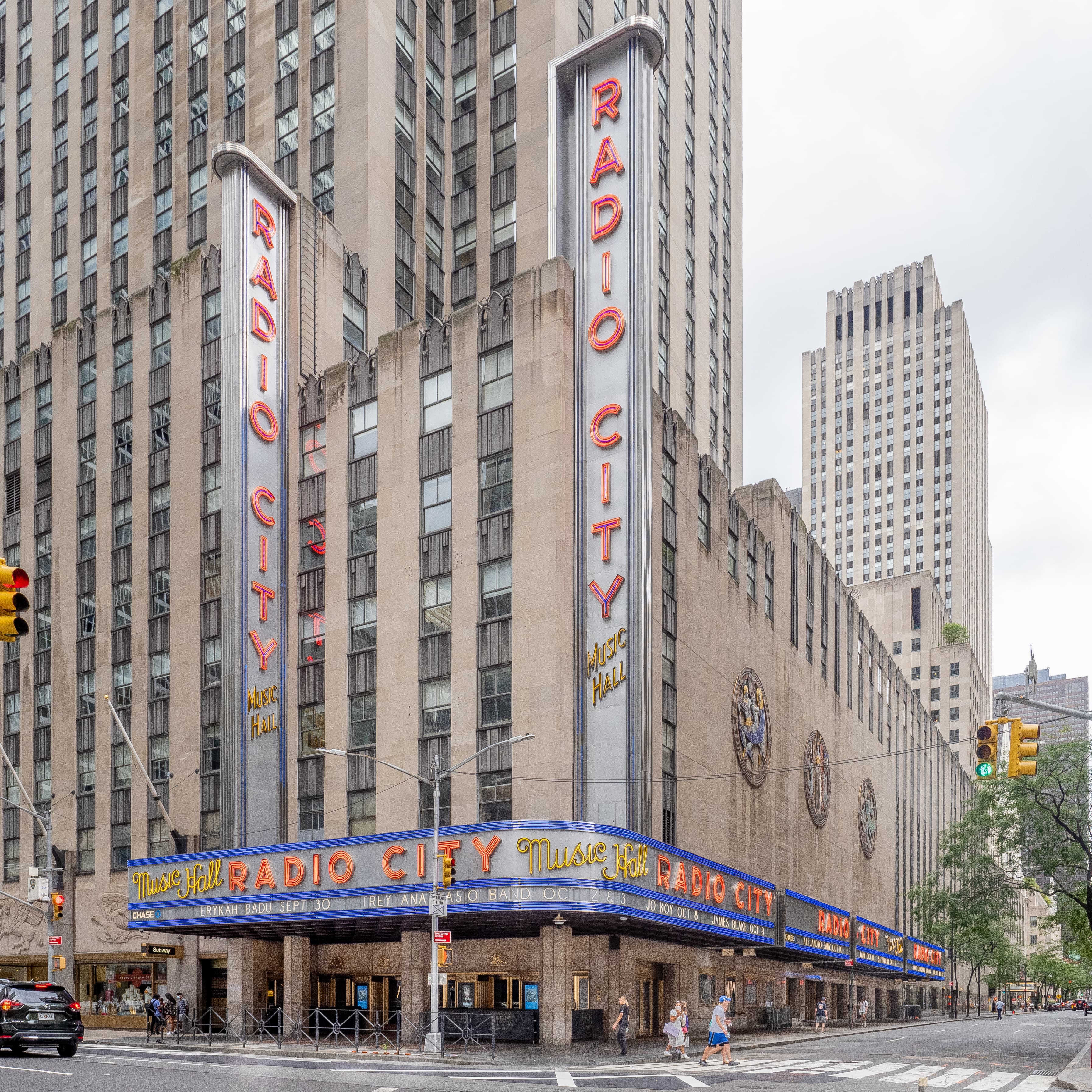
There is no building in New York that announces itself quite like Radio City Music Hall. On Sixth Avenue between 50th and 51st Streets, in the heart of Rockefeller Center, its marquee wraps the corner in neon, and three towering vertical signs spell out its name in letters seven stories tall. Even before you step inside, you understand what this place was built to be: in the darkest year of the Great Depression, a palace for ordinary people.
Radio City Music Hall opened on December 27, 1932, as the centerpiece of John D. Rockefeller Jr.'s new Rockefeller Center, a twelve-acre complex rising on land leased from Columbia University. The vision belonged to Samuel "Roxy" Rothafel, the showman famous for lavish movie-palace presentations, backed by Rockefeller's fortune. Roxy wanted a "people's palace" where hard-working New Yorkers could enjoy first-class entertainment at prices they could afford. The opening night gala, with more than 500 performers ranging from opera to slapstick vaudeville, ran for hours — and, famously, it ran too long. The show was a flop as a piece of programming, but the building itself was a sensation, and it has never really stopped being one.
The name came from the complex's first tenants, RCA, the Radio Corporation of America. The hall had originally been planned as the International Music Hall, but the Radio City name stuck, and it stuck so well that the whole surrounding district became known as Radio City. When it opened, the hall was the largest indoor theater in the world, seating nearly 6,000 people — a scale no Broadway house could match, and one that still puts it among the largest indoor theaters anywhere.
Art Deco on a monumental scale
Radio City was designed by architect Edward Durell Stone, working with the Associated Architects who were shaping the rest of Rockefeller Center, with interiors by Donald Deskey, chosen through a competition from among 35 submissions. The exterior uses the same Indiana limestone as the rest of the Center, but Stone gave the theater its own identity: the long wraparound marquee, the ornamental fire escapes on the 50th and 51st Street sides, and the signs that made the building legible from blocks away.
Look closely at the facade and you will find the building's theme written in metal. Above the entrance, the artist Hildreth Meière created six small bronze plaques of musicians playing different instruments, and three larger metal-and-enamel plaques, eighteen feet across, representing dance, drama, and song. They are among the most accessible and most admired works of Art Deco public art in the city, and they tell you exactly what the hall was for.
The sequence inside is one of the great architectural progressions in New York. The ticket lobby is deliberately low and intimate, with a coffered ceiling and circular light fixtures, so that stepping into the Grand Foyer feels like a revelation. The foyer runs about 165 feet long and rises some 60 feet high, with gold-backed mirrors, curved bronze balustrades, and tubular chandeliers. On its northern wall hangs Ezra Winter's 2,400-square-foot mural, "Quest for the Fountain of Eternal Youth." Deskey reportedly hated Winter's painting, but he furnished the space around it in a warm rococo style of his own, with custom carpet and upholstery in reds, golds, and browns — a palette that still defines the hall today.
The auditorium built like a sunrise
The auditorium is the reason the building matters. Roxy had strong ideas about how a theater should work: no deep balcony overhanging the orchestra, no rows of boxes facing each other across the house like an opera house, and no columns blocking anyone's view. Instead, the auditorium is a great oval bowl, some 160 feet long with an 84-foot ceiling, its seats arranged in shallow tiers that cantilever from the back wall so that every one of the nearly 6,000 seats has a clear sightline to the stage.
The stage itself is framed by a proscenium arch 60 feet high and 100 feet wide, the first of a series of concentric arches that step back toward the audience like the rays of a rising sun. That was Roxy's own image: he told the press he wanted to recreate, in architecture and light, the effect of a sunrise he had once watched from a transatlantic liner. Colored lights hidden behind each arch let the house shift through a whole vocabulary of effects, from dawn gold to deep evening blue. The curved ceiling and the plaster of the arches were also tuned for sound, absorbing excess reverberation so that the hall's speakers and its great Wurlitzer organ carry cleanly to the back row.
Beneath the glamour, the stage is a machine. A hydraulic system of elevators and turntables can raise and lower whole sections of the stage, change sets in seconds, and even bring up the orchestra pit. It was built for the speed of variety entertainment, and it is still what makes the hall's biggest spectacles possible.
The Rockettes and the Christmas Spectacular
No story of Radio City is complete without the Rockettes. The precision dance company, founded in St. Louis in 1925 as the Missouri Rockets, became the hall's resident company, and their high-kicking chorus line — dozens of dancers moving as a single instrument — is the most famous dance image in America. Their signature show, the Christmas Spectacular, has been a New York holiday institution since 1933, built around the "Parade of the Wooden Soldiers," a living Nativity, and a finale in which Santa Claus flies over the audience. For generations of families, a December trip to Radio City has been as much a part of the holiday as the tree at Rockefeller Center across the plaza.
The hall has lived many lives beyond the Spectacular. After its early years as a variety house, it became a movie palace, then a concert stage for the biggest names in music, and the home of awards shows including the Tony Awards and the Grammy Awards, the MTV Video Music Awards, and even the NFL Draft. More than 300 million people have passed through its doors. It survived a near-demolition in the late 1970s — public outcry helped save it — and was designated a New York City landmark and listed on the National Register of Historic Places in 1978. A major restoration in 1999 returned the lobbies, lounges, and auditorium to their 1932 glory, right down to the carpet patterns and the gold leaf.
Visiting Radio City: how to do it well
The best way to see the building itself is the guided Stage Door Tour, which runs when the hall is not in rehearsal or performance and takes you through the Grand Foyer, the lounges — no two of which are decorated alike — and onto the great stage itself, where you can stand beneath the 60-foot proscenium and look back out at the empty house. Guides also show the Roxy Suite, the private apartment Roxy kept above the theater. Even if you come only for a show, arrive early enough to linger in the foyer and the lounges; the building rewards slow looking the way a museum does.
Come at night if you can. The marquee and the vertical signs are at their best after dark, when the neon turns Sixth Avenue into a canyon of light, and the walk from the hall to the Rockefeller Center ice rink and the Fifth Avenue storefronts is one of the great evening strolls in Midtown. Pair a show with dinner in the neighborhood, and you have the classic New York night out — the same night out, in the same palace, that audiences have been enjoying since the Depression.
Key Facts
- Radio City Music Hall opened on December 27, 1932, as part of Rockefeller Center, the vision of showman Samuel "Roxy" Rothafel backed by John D. Rockefeller Jr.
- The hall was designed by architect Edward Durell Stone, with interiors by Donald Deskey, chosen from 35 competition submissions.
- It takes its name from RCA, the Radio Corporation of America, the complex's first tenants; it was originally planned as the International Music Hall.
- At its opening it was the largest indoor theater in the world, seating nearly 6,000 people; its capacity is listed today at about 5,945.
- The Grand Foyer is about 165 feet long and 60 feet high, with gold-backed mirrors and Ezra Winter's 2,400-square-foot mural "Quest for the Fountain of Eternal Youth."
- The proscenium arch is 60 feet high and 100 feet wide, the first of a series of arches designed to evoke a sunrise, Roxy's own image.
- The facade carries Hildreth Meière's six bronze musician plaques and three large enamel plaques representing dance, drama, and song.
- The Rockettes, the hall's resident precision dance company, have performed the Christmas Spectacular there since 1933.
- The hall was designated a New York City landmark and listed on the National Register of Historic Places in 1978, after a public campaign saved it from demolition.
- A major restoration in 1999 returned the lobbies, lounges, and auditorium to their 1932 appearance, and the hall has welcomed more than 300 million visitors in its history.
Visitor Details
Address: 1260 Avenue of the Americas, New York, NY 10020
Transit: The 47th–50th Streets–Rockefeller Center subway station (B, D, F, M trains) has an entrance on Sixth Avenue directly adjacent to the hall's marquee
Hours/Admission: Show times, tour availability, and ticket prices vary by event and season — check the official Radio City Music Hall site before visiting for current schedules and prices
Best timing: Evening shows show off the neon marquee at its best; the guided Stage Door Tour is the best way to see the foyer, lounges, and stage when no performance is running; arrive early to linger in the Grand Foyer before the house opens
Location Photography