A city within a city
Stand on Fifth Avenue at 50th Street, look west through the Channel Gardens, and the whole of Rockefeller Center opens in front of you like a stage set: the long, planted promenade, the flags, the sunken plaza below, and above it all the great limestone slab of 30 Rockefeller Plaza, 70 stories of Art Deco geometry rising over Midtown. It is the most complete piece of urban design in New York — not a single building but a whole district, 19 buildings across 22 acres, built as one idea, and it has been the city's front parlor for nearly a century.
Rockefeller Center is where New York goes to celebrate and to be seen. The Christmas tree goes up in the plaza every winter, and millions come to stand under it. The ice rink fills with skaters beneath the golden Prometheus. The Rockettes kick at Radio City Music Hall. Presidents and pop stars arrive through the same doors office workers use every morning. And yet the place began as an act of faith in the worst possible moment: construction started in 1931, at the bottom of the Great Depression, on land leased by John D. Rockefeller Jr. from Columbia University, and the complex was built, floor by floor, through the hardest decade in American history.
That is the first thing to understand about Rockefeller Center. It was not built because the moment was right. It was built because one family decided the moment would come back — and designed a place that would be ready for it.
From an opera house to a whole district
The story starts with a different building altogether. In 1928, Columbia University, which owned the land between 48th and 51st Streets, leased it to John D. Rockefeller Jr., and the original plan was to build a new home for the Metropolitan Opera there. The Met could not afford the move, the plan collapsed, and Rockefeller Jr. was left holding a long lease on some of the most valuable land in Manhattan. Rather than walk away, he decided to build something bigger than any single tenant: a commercial and cultural district of his own, designed from scratch.
The design fell to a team led by Raymond Hood, with Wallace Harrison and others, and the result was radical for its time. Instead of filling the blocks with separate towers, the architects planned a unified complex: a tall central slab — what became 30 Rockefeller Plaza — flanked by lower buildings arranged around plazas, gardens, and a private street, Rockefeller Plaza, running through the middle. The buildings were clad in the same Indiana limestone, trimmed with the same Art Deco detailing, and linked underground by a concourse of shops and restaurants. It was, in effect, a small city designed by one hand — the largest private building project ever undertaken in the United States at the time.
Construction began in 1931 and the first buildings opened in 1933, with the core of the original complex complete by 1939. The timing meant the center opened into a city still deep in the Depression, and its early years were a struggle: space sat empty, rents were low, and the project was mocked as "Rockefeller's folly." But the buildings were there, the design was coherent, and when the economy recovered, the center filled — with RCA and its new radio and television studios, with publishers, with shops, with the whole apparatus of mid-century American media. The bet paid off, and the center became the template for the modern mixed-use district.
30 Rock and the skyline it anchors
The heart of the complex is 30 Rockefeller Plaza, the 70-story, 850-foot tower at its center — the building New Yorkers call 30 Rock, after the NBC sitcom that took its name from the address. Its limestone face rises in a series of setbacks, the classic Art Deco silhouette, and its lobby is one of the great interior spaces in the city: dark marble, gold leaf, and the enormous murals and reliefs that were part of the original decorative program. The tower's top floors hold the Rainbow Room, the storied restaurant and ballroom that has been a symbol of New York glamour since 1934, and the Top of the Rock observation deck, whose open-air terraces look out over Central Park to the north and the Empire State Building to the south.
The tower's most famous tenant is NBC, which has broadcast from 30 Rock since the 1930s — the Today show from its street-level studio, Saturday Night Live from Studio 8H, the whole apparatus of American television humming behind the limestone. That is part of what makes Rockefeller Center feel alive in a way other landmarks do not: it is not a museum of itself. People work here, broadcast here, eat here, and shop here, every day, in the same spaces tourists photograph.
Look up at the tower from the plaza and you see the building's most famous decorative feature: the great limestone reliefs and the gilded figures by Lee Lawrie at the entrance, Wisdom with Light and Sound flanking it — Art Deco allegory carved in stone, the building announcing its own ambitions. The whole complex is decorated this way, inside and out: more than a hundred works of art were commissioned for the original buildings, by some of the finest artists of the era, and they are still there, free to look at, if you slow down and look.
Prometheus, Atlas, and the art you walk past
The two sculptures everyone photographs are the center's twin guardians. Down in the sunken plaza, at the base of 30 Rock, Paul Manship's Prometheus lounges in gold above the fountain — an 18-foot gilded bronze figure of the Titan who stole fire for humanity, ringed by the zodiac, with the Aeschylus quotation carved into the red granite wall behind him: "Prometheus, Teacher in Every Art, Brought the Fire That Hath Proved to Mortals a Means to Mighty Ends." In winter the ice rink fills the plaza beneath him, and the Christmas tree rises above him, and the whole composition — gold figure, white ice, green tree, limestone tower — becomes the postcard image of New York at Christmas.
Up at the Fifth Avenue entrance, on the other side of the complex, stands the other icon: Lee Lawrie's Atlas, a 45-foot bronze Titan carrying the celestial vault on his shoulders, installed in 1937 in front of the International Building. Atlas is the largest sculpture in the center, 14,000 pounds of bronze, and its armillary sphere is aligned so its north-south axis points toward the North Star's position over New York. It is the meeting point, the photograph, the statue that has ended up on postage stamps — and it is also the front door, the figure that greets you as you enter from Fifth Avenue, across from St. Patrick's Cathedral.
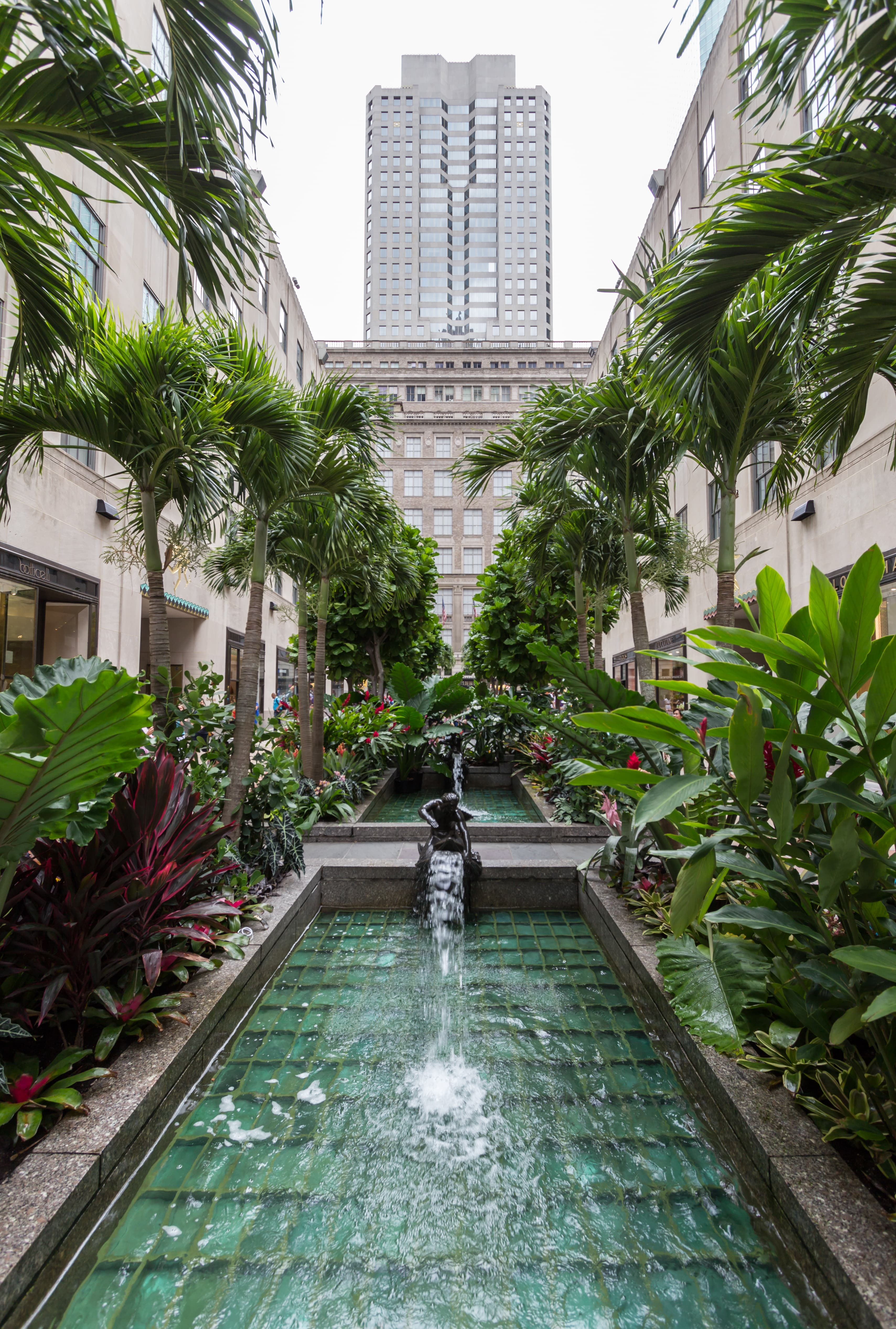
Between the two, the Channel Gardens run like a green carpet: the long, narrow planted promenade between the British Empire Building and La Maison Française, named for the English Channel that separates the two nations the buildings honor, and replanted with seasonal flowers through the year. At Christmas the gardens fill with trumpet-blowing angels and lights, and the walk from Fifth Avenue to the plaza becomes the most festive hundred yards in the city. The gardens are the center's best lesson in urban design: a small, carefully planted space that turns a walk between buildings into an experience.
The lost mural and the art that survived
No Rockefeller Center story is complete without the mural that is not there. For the lobby of 30 Rock, the center commissioned Diego Rivera to paint "Man at the Crossroads," a great fresco celebrating human progress through technology. Rivera, a committed Marxist, included a portrait of Lenin among the figures, and when he refused to remove it, the mural was covered, then destroyed in 1934 — one of the most famous acts of art censorship in American history. The lobby today holds a replacement mural, José María Sert's "American Progress," but the Rivera story still hangs over the building: the center that set out to celebrate modern art collided, almost immediately, with the politics of modern art.
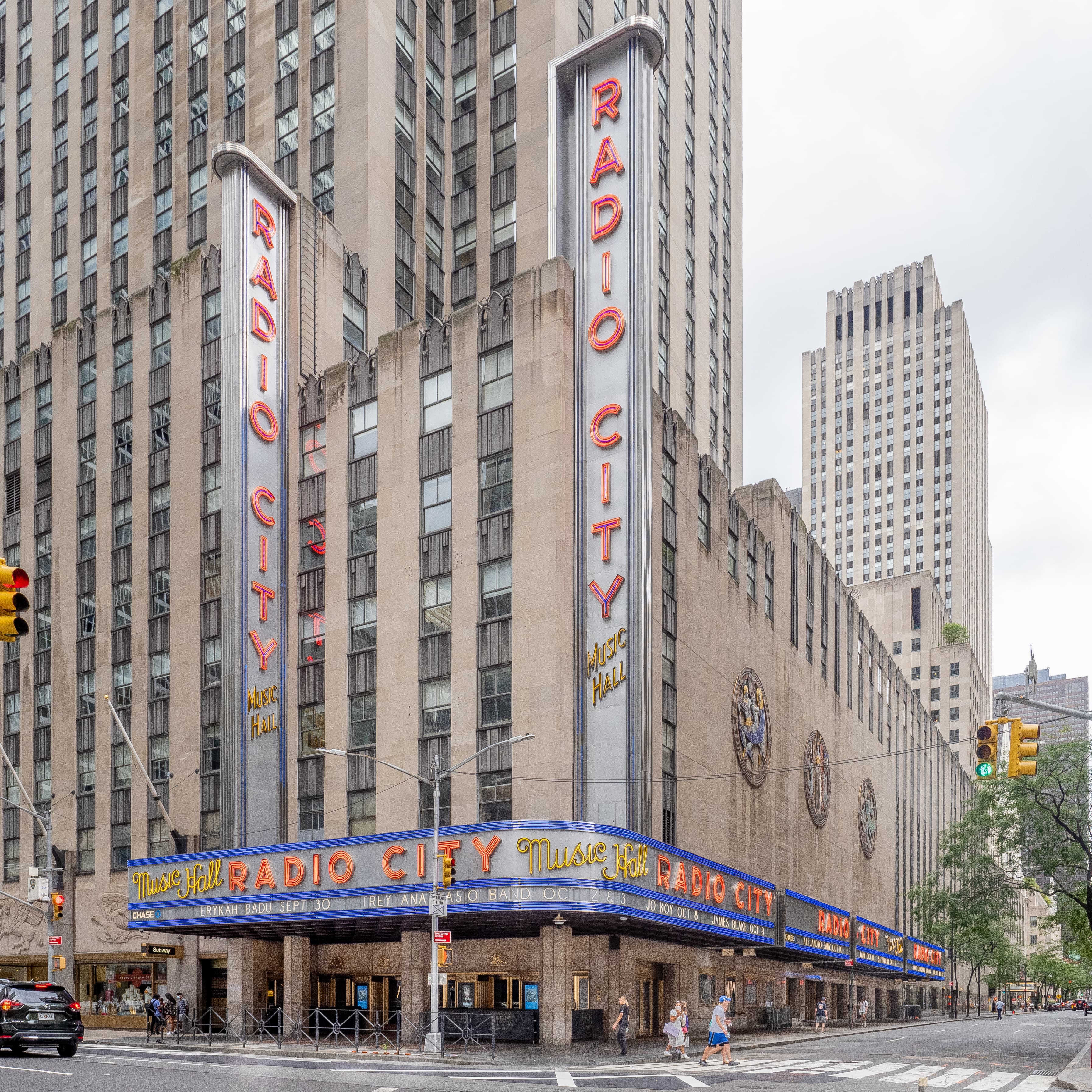
What survived is almost everything else. Radio City Music Hall, at the center's northwestern corner, opened in 1932 as the largest indoor theater in the world, its Art Deco interior by Donald Deskey — all chrome, glass, and geometric pattern — and its stage machinery so advanced that the U.S. Navy later borrowed its hydraulic elevator design for aircraft carriers. The Rockettes have danced there since the beginning, and the Christmas Spectacular remains the city's great holiday show. The hall is a landmark in its own right, and a tour of it is one of the best ways to understand what the center's builders were aiming at: not just offices, but a whole culture, under one roof.
The center's art program extends to the details most visitors walk past: the limestone reliefs on the building facades, the bronze doors, the mosaics in the lobbies, the rooftop gardens on the International Building's wings, planted with ivy and terracotta and paved with stones from Italian roads. The whole complex rewards the slow walk and the upward glance — the kind of looking that the Art Deco designers, who believed a commercial building could be a work of art, built into every surface.
Landmark, then and now
Rockefeller Center's official honors came in the 1980s, when the city and the nation caught up with what New Yorkers already knew. It was designated a New York City landmark in 1985 and a National Historic Landmark in 1987 — recognition not of a single building but of the whole complex, all 19 buildings, as a historic district. It was one of the first great commercial developments to be landmarked as a whole, and the designation protected not just the facades but the plazas, the gardens, and the public spaces that make the center what it is.
The center has kept evolving since. The Top of the Rock observation deck, closed for years, reopened in 2005 with new terraces and a new entrance. The concourse below has been reworked, the shops and restaurants have turned over, and the plaza has been reprogrammed for each season — ice rink in winter, outdoor dining in summer, the tree lighting every December, broadcast live, drawing crowds that fill the surrounding streets. Through it all, the limestone has stayed the same color, the setbacks have kept their silhouette, and the place has kept its role: the front parlor of Midtown, the spot where New York gathers.
That is Rockefeller Center's real achievement. It was built in the Depression as a bet on the future, designed as a whole city rather than a collection of buildings, and decorated with the conviction that a commercial district could be beautiful. The bet paid off so completely that the center became the image of New York itself — the tree, the rink, the gold figure, the tower — reproduced on postcards, in films, and in the minds of everyone who has ever pictured the city at Christmas.
Visiting Rockefeller Center: how to see it well
Rockefeller Center is best seen on foot, from the outside in, and slowly. Start at Fifth Avenue and 50th Street, at the Atlas statue, and walk west through the Channel Gardens toward the plaza — the classic approach, and the one the designers intended. Stop in the sunken plaza to look at Prometheus and the fountain, then look up: the full height of 30 Rock rises above you, and the setbacks and limestone detailing reward a long look. Walk the full complex if you have time — around the plaza, past Radio City Music Hall on Sixth Avenue, through the concourse below — to feel how the buildings fit together as one design.
Come in December if you can, when the tree is up and the rink is full and the whole complex is lit — it is crowded, and that is part of it. Come on a weekday morning if you prefer the center to yourself, when the office workers are arriving and the gardens are quiet. And go up to the Top of the Rock if the sky is clear: the view north over Central Park, with the whole green rectangle of the park laid out below, is the single best panorama in Manhattan, and the open-air deck means there is no glass between you and the city. Pair the visit with St. Patrick's Cathedral across Fifth Avenue, and with a walk south down Fifth Avenue into the shopping district the center anchors. Rockefeller Center rewards the same thing it has always rewarded: walking slowly, looking up, and taking your time.
Location Photography


Key Facts
- Rockefeller Center is a complex of 19 commercial buildings covering 22 acres (8.9 hectares) between 48th and 51st Streets in Midtown Manhattan, between Fifth and Sixth Avenues.
- The 14 original Art Deco buildings were commissioned by the Rockefeller family; construction started in 1931, the first buildings opened in 1933, and the core complex was completed by 1939.
- The site was leased in 1928 by John D. Rockefeller Jr. from Columbia University; the original plan for a new Metropolitan Opera house fell through, and the current complex was approved in 1932.
- The complex was designed by a team led by Raymond Hood, with Wallace Harrison and others, in the Modern and Art Deco styles, clad in Indiana limestone.
- 30 Rockefeller Plaza, the central tower, is 70 stories and 850 feet (260 meters) tall, and has housed NBC's headquarters and New York studios since the 1930s.
- Paul Manship's gilded bronze Prometheus (1934), 18 feet tall, stands in the sunken plaza fountain at the base of 30 Rock; Lee Lawrie's bronze Atlas (1937), 45 feet tall and 14,000 pounds, stands at the Fifth Avenue entrance of the International Building.
- The Channel Gardens, the planted promenade between the British Empire Building and La Maison Française, are named for the English Channel between the two nations the buildings honor.
- Diego Rivera's lobby fresco “Man at the Crossroads” was destroyed in 1934 after Rivera refused to remove a portrait of Lenin; the lobby now holds José María Sert's “American Progress.”
- Radio City Music Hall, opened in 1932, was the largest indoor theater in the world at the time, and its stage hydraulics were later borrowed by the U.S. Navy for aircraft carriers.
- Rockefeller Center was designated a New York City landmark in 1985 and a National Historic Landmark in 1987.
Visitor Details
Address: 45 Rockefeller Plaza, New York, NY 10111
Transit: 47–50 Streets–Rockefeller Center station (B, D, F, M trains) on Sixth Avenue, steps from the plaza; 5th Avenue/53rd Street station (E, M trains) is a short walk northeast
Hours/Admission: The plaza, Channel Gardens, and public areas are open to the public free of charge; the Top of the Rock observation deck, Radio City Music Hall tours, and the ice rink are ticketed attractions. Hours and admission vary by season and attraction, so check the official Rockefeller Center source before visiting.
Best timing: December, when the Christmas tree is lit and the rink is open — expect crowds; or a weekday morning for a quieter visit. For the best panorama, visit Top of the Rock on a clear day and allow time on the open-air deck. Start at the Atlas statue on Fifth Avenue and walk west through the Channel Gardens to the plaza.