A village of property owners
In 1825, free Black New Yorker Andrew Williams bought three lots in upper Manhattan between what is now 82nd and 89th Streets. More Black families followed, building homes, three churches, and a school. By the 1850s Seneca Village held about 300 residents: Black landowners — a rarity anywhere in America then — alongside Irish and German immigrants. Because New York required Black men to own property to vote, the village's landowners were among the few enfranchised Black voters of the era. By the standards of the day, it was a remarkably stable, integrated community.
Erased for the park
In 1853 the state authorized Central Park, and in 1857 the city seized the village's land through eminent domain. Residents were paid far below what the land was worth and forced out; by late 1857 Seneca Village was gone, its buildings razed, its people scattered — some to Weeksville, Brooklyn. For over a century, the park's official histories barely mentioned it.
Rediscovered
In 2011, archaeologists excavated the site, unearthing home foundations, household goods, and a child's shoe — physical proof of the village the city tried to forget. Today the Central Park Conservancy marks the site with signage, and the story is finally part of the park's official history.
Three lots for $125
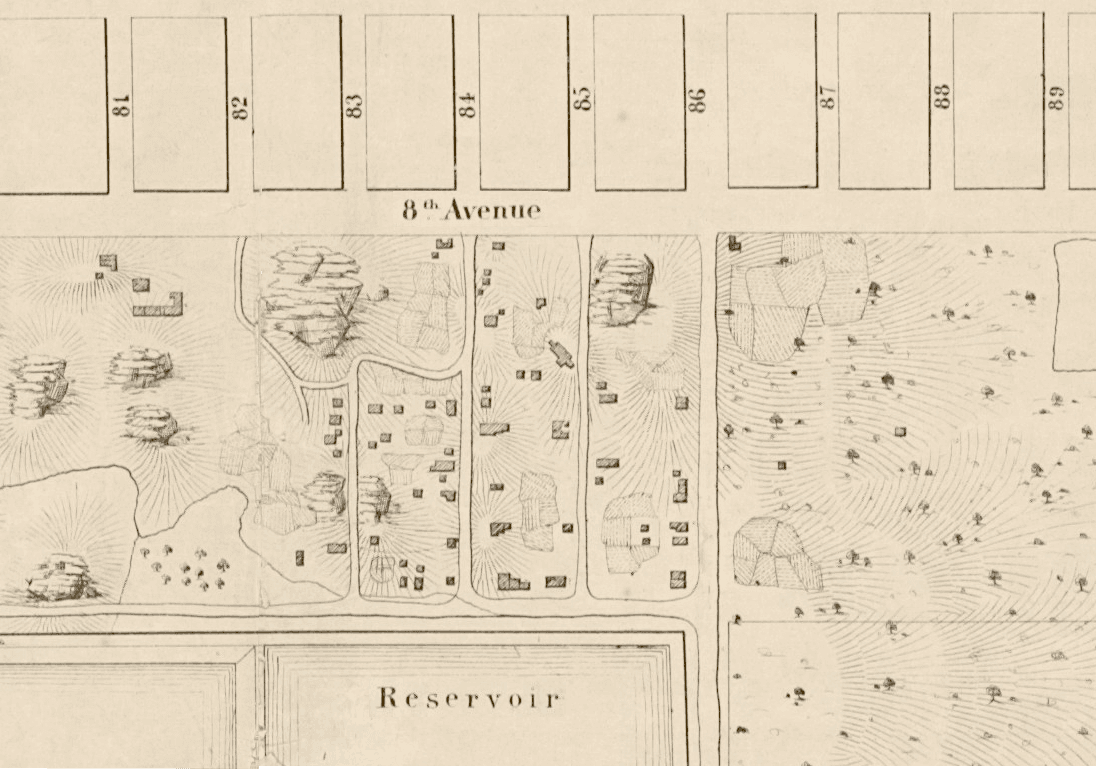
The village began with a land deal nobody planned as history. In 1824, a white farmer named John Whitehead bought farmland in upper Manhattan, then a remote stretch far above the city's core, which ended below 23rd Street. A year later he and his wife Elizabeth began selling it off in small parcels — and unlike most white landowners of the era, they sold to Black buyers. On September 27, 1825, a twenty-five-year-old Black bootblack named Andrew Williams bought three lots for $125. The same day, Epiphany Hall — a feed-store clerk and a trustee of the African Methodist Episcopal Zion Church — bought twelve lots for $578. Within the week, AME Zion itself bought six more. Williams and Hall belonged to the New York African Society for Mutual Relief, founded in 1808 to help Black families support one another and buy property. Over the next seven years the Whiteheads sold some fifty parcels, at least twenty-four of them to Black families, and by 1829 at least nine houses stood on the land. A second pocket of Black settlement grew nearby on York Hill, where a young Black man named William Matthews bought five acres in the late 1830s. There was a practical reason to buy: New York's 1821 constitution required Black men to own $250 of property to vote, while white men faced no such bar. In 1845, one hundred Black men in the entire state were eligible to vote — and ten of them lived in Seneca Village. The village's main street appears as Spring Street on an 1838 map, and the spring that likely gave it its name — Tanner's Spring — still flows in the park today.
Three churches, two schools, three cemeteries
By 1855 the village held about 230 people in fifty-two buildings, most of them two-story wood-frame houses with sheds and barns, and it ran on its institutions. The AME Zion congregation — the city's first Black church, organized downtown in 1796 — had owned burial land in the village since 1827; by 1853 it had built a church there, known from 1848 as the AME Zion Branch Militant. A hundred yards away stood the African Union Church, a Methodist congregation that bought its lots in 1837 and counted fifty members. The third church, All Angels', was a mission of St. Michael's Episcopal: it opened a Sunday school in 1846, then built a wooden church on West 84th Street that opened in 1849, ministering to a congregation that was two-thirds Black — Irish and German settlers worshiped alongside. The sexton, Ishmael Allen, lived next door and named his first son for the church's rector. Schooling ran through the churches too. A branch of the African Free School opened beside the African Union Church in the mid-1840s and became Colored School No. 3 in the public system, serving seventy-five students under teacher Caroline W. Simpson; AME Zion ran a school in its own basement. Roughly two-thirds of the village's residents were regular churchgoers. Beyond the institutions, people kept gardens, raised livestock, and fished the Hudson — a self-sufficient community far from the crowded wards downtown.
What the ground gave back
Seneca Village survived in the archives long before it survived in the ground. In 1992, historians Roy Rosenzweig and Elizabeth Blackmar gave the village a full chapter in their history of Central Park, The Park and the People, drawing on records at the New-York Historical Society — which mounted an exhibition, "Before Central Park: The Life and Death of Seneca Village," in 1997. Then, in 2004, anthropologists Diana Wall of City College, Nan Rothschild of Columbia, and Cynthia Copeland of NYU began to dig. Their eight-week excavation in the summer of 2011 was the breakthrough. Ground-penetrating radar had flagged anomalies across the site, and two proved to be the real thing. One was the foundation walls of the home of William Godfrey Wilson — a porter and a sexton of one of the village churches — his wife Charlotte, and their eight children, with deposits full of architectural and domestic material. The finds were intimate: a child's shoe, a roasting pan, a tea kettle, the bone handle of a toothbrush. The other was a buried backyard surface from another part of the village, preserved well enough to reconstruct how that corner of the settlement looked and lived. More than 250 bags of artifacts came out of the ground that summer — physical proof, a foot beneath the park's surface, of the community the city had paved over.
Paid — but not what it was worth
The taking began on paper. In July 1853 the state legislature passed the Central Park Act, authorizing the park, and in 1855 the city drew up a condemnation map — every resident, every lot, every house, shed, and barn catalogued so the city would know whom to pay and how much. Owners were paid what the city deemed fair value, calibrated by lot position and the size and quality of the structures. Renters got nothing. Many owners thought the valuations were low, and they said so in writing: letters and filings in the state supreme court contesting the offers survive in the archives. Andrew Williams himself challenged the valuation placed on his land. By the end of 1857 the village was gone — roughly 1,600 people were displaced from across the future park, and the buildings came down. The churches scattered: All Angels' dismantled its wooden building and rebuilt it on Eleventh Avenue between 80th and 81st Streets. Graves were dug up and moved to a cemetery in Queens. Where the residents went is one of the lingering mysteries — some, like Williams, reinvested in homes in Queens; the sexton William Wilson moved his family to the Upper West Side, near All Angels' new home. Tellingly, the name "Seneca Village" doesn't appear in the surviving record until 1873, sixteen years after the demolition — there is no evidence the residents ever called it that themselves. No known photographs of the community have ever been found; the village survives in maps, census pages, and court filings — and now, in the artifacts a foot beneath the grass. Today the Conservancy's signs mark home and church sites in what it calls one of Manhattan's least-altered landscapes; Summit Rock, the old Goat Hill, still rises above the site, and Tanner's Spring still runs at its base.
Key Facts
- Seneca Village was founded in 1825 when free Black New Yorkers began buying land in upper Manhattan.
- At its height the village had about 300 residents, three churches, and a school.
- Because Black men in New York could vote only if they owned property, Seneca Village's landowners were among the few enfranchised Black voters of the era.
- The village was condemned in 1857 for Central Park; residents were evicted and their homes demolished.
- A 2011 archaeological excavation recovered home foundations and everyday objects from the village.
Hero photo: Egbert Ludovicus Viele, Public domain, via Wikimedia Commons.
Location Photography


Gallery photos: Allison Meier (CC BY-SA 2.0), Unknown author (Public domain), Unknown author (Public domain) via Wikimedia Commons.