The guns that never fired
In 1917, as America entered World War I, the Army built Fort Tilden on the Rockaway peninsula to guard the entrance to New York Harbor — massive concrete batteries aimed at an enemy fleet that never came. Through World War II the guns stood ready; after the war, the threat changed, and so did the fort.
Missiles in the dunes
In the 1950s, Fort Tilden became a Nike anti-aircraft missile site, with missiles hidden in the dunes to defend against Soviet bombers. The missiles left in the 1970s, the Army decommissioned the fort in 1974, and the whole site passed to the National Park Service as part of the Gateway National Recreation Area.
Ruins by the beach
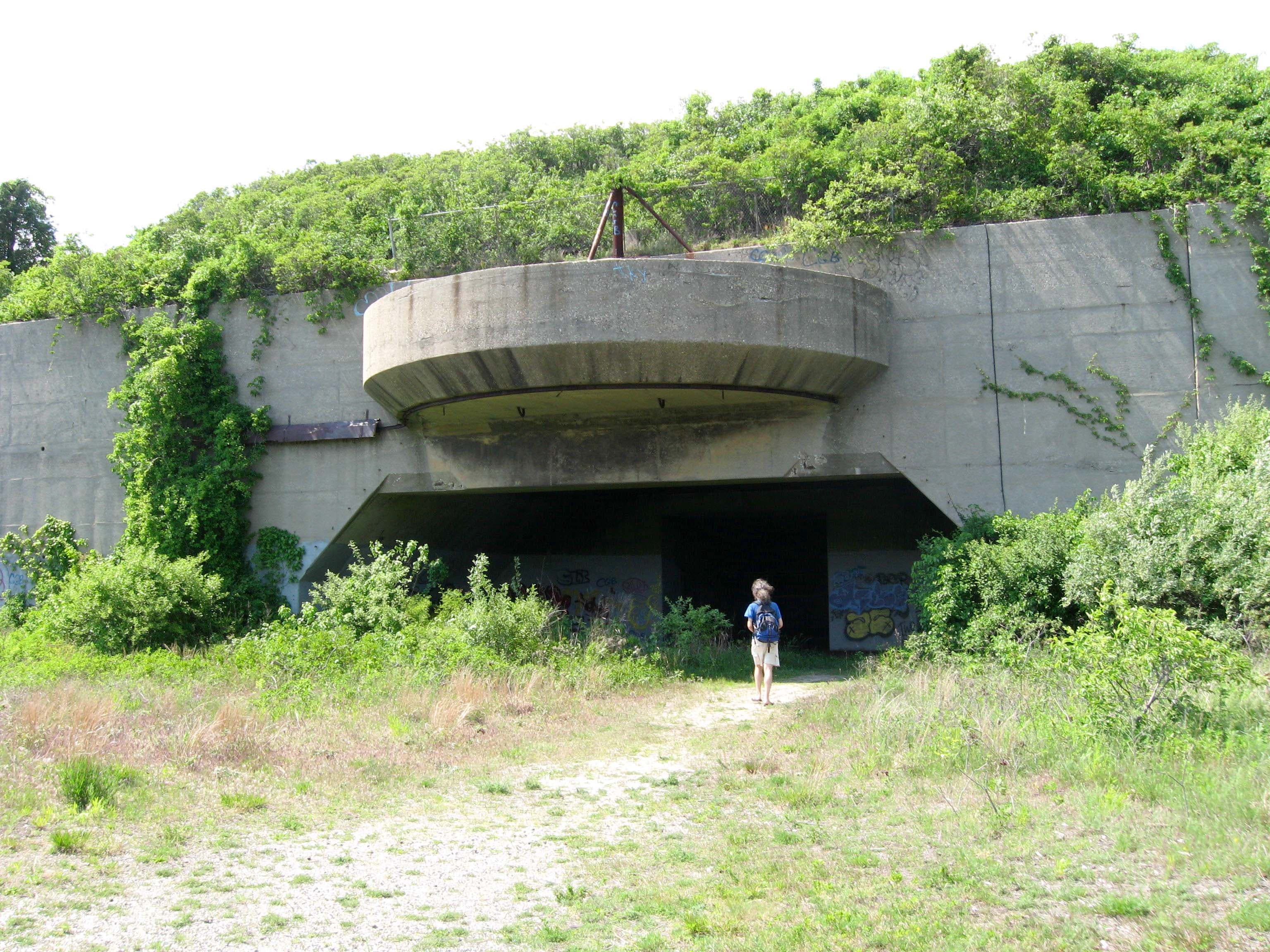
Today the batteries stand empty and spectacular: concrete casemates covered in murals, observation towers rusting in the salt air, trails threading through beach grass to some of the city's wildest shoreline. The former military buildings now house artists' studios, and the beach at the fort's edge is a local secret.
The Sixteen-Inch Giants of Battery Harris
The fort began as Camp Rockaway Beach, thrown up in the spring of 1917 after the United States entered World War I, and renamed later that year for Samuel J. Tilden, the one-term New York governor defeated in the disputed 1876 election. Its first weapons were stopgaps: four twelve-inch mortars and two batteries of six-inch M1900 guns, Battery Kessler and Battery East, borrowed from Fort Hamilton and Fort Slocum. The mortars sat too close to the Naval Air Station to fire safely and were gone by 1920. The real armament arrived in March 1921, when construction began on Battery Harris: two sixteen-inch M1919 guns, the most powerful weapons in the American arsenal, mounted in the open on the dunes, fed by a narrow railway that carried ammunition to the pits. Accepted for service in December 1924 and named for the late Army officer Henry Leavenworth Harris, the battery was entombed in 1943: the Army poured ten-foot concrete casemates over both gun pits and heaped twenty feet of earth on top against aerial bombing. Inside, overhead trolley hoists moved one-ton shells from deep magazines to the gun ports, and concrete aprons ringed the firing platforms so the blast would not tear up the sand. The guns were scrapped in 1948, never having fired at an enemy.
Nike Country: Missiles in the Dunes
When the coastal guns were scrapped, the threat had already moved overhead. In 1950 the Army deployed sixteen 90mm anti-aircraft guns at Fort Tilden, designated Site NY-43, and added 120mm batteries two years later. In 1955 the guns were replaced by a Nike-Ajax missile site called NY-49, with two launch areas of six rails each set among the dunes. Three years later the Ajax gave way to the nuclear-capable Nike-Hercules, with a range of about seventy-five miles, and its launchers went into an underground silo in the western part of the property. That ground is still sealed behind an eight-foot fence and thick vegetation. Between the two eras came an unexpected civilian chapter: in 1946 the state converted forty-six barracks into three hundred and fifty apartments for war veterans and their families. By 1951, two hundred and eighty-one families lived there, but that year they were evacuated as the Cold War escalated, many of the men shipping off to Korea. The Hercules missiles were deactivated nationwide in 1972, and the Army closed the fort two years later. It lingered as an Army Reserve post into the 1990s, home to the 411th Engineer Brigade headquarters and, until 1995, a towed howitzer battalion of the 187th Infantry Brigade.
After the Army: Art, Storms, and the Golden Venture
The strangest night in the fort's history came after it had closed. Around 2 a.m. on June 6, 1993, the Golden Venture, a 147-foot cargo ship carrying 286 undocumented immigrants from China, ran aground on the fort's beach after a four-month voyage from Bangkok via Kenya and the Cape of Good Hope. Ten people drowned trying to swim ashore; the survivors were detained, and the last fifty-two were not freed until February 1997. Two decades later the art world arrived: after Superstorm Sandy, MoMA PS1 staged "Rockaway!" in the fort's damaged chapel in 2014 with work by Patti Smith, Adrian Villar Rojas, and Janet Cardiff, and in 2016 Katharina Grosse covered an abandoned building near the beach in swirling spray-painted color before it was razed. The northeastern corner, where the troop housing stood, is far better kept than the western battery fields: it holds the Rockaway Artists Alliance and the Rockaway Theatre Company, sports fields, and a community garden. The wooden stairs at Battery Harris East lead to a viewing platform with a 360-degree panorama over the city, the harbor, and the Atlantic, while the wilder dunes draw bird-watchers and fishermen past signs warning of piping plover nests.
Key Facts
- Fort Tilden was established in 1917 as a coastal artillery fort defending New York Harbor.
- In the 1950s it became a Nike anti-aircraft missile site aimed at Soviet bombers.
- The Army decommissioned the fort in 1974; it is now part of the Gateway National Recreation Area.
- Its abandoned batteries, covered in murals, are among the city's most striking ruins.
Hero photo: Jim Henderson, Public domain, via Wikimedia Commons.