The crown jewel of the first subway
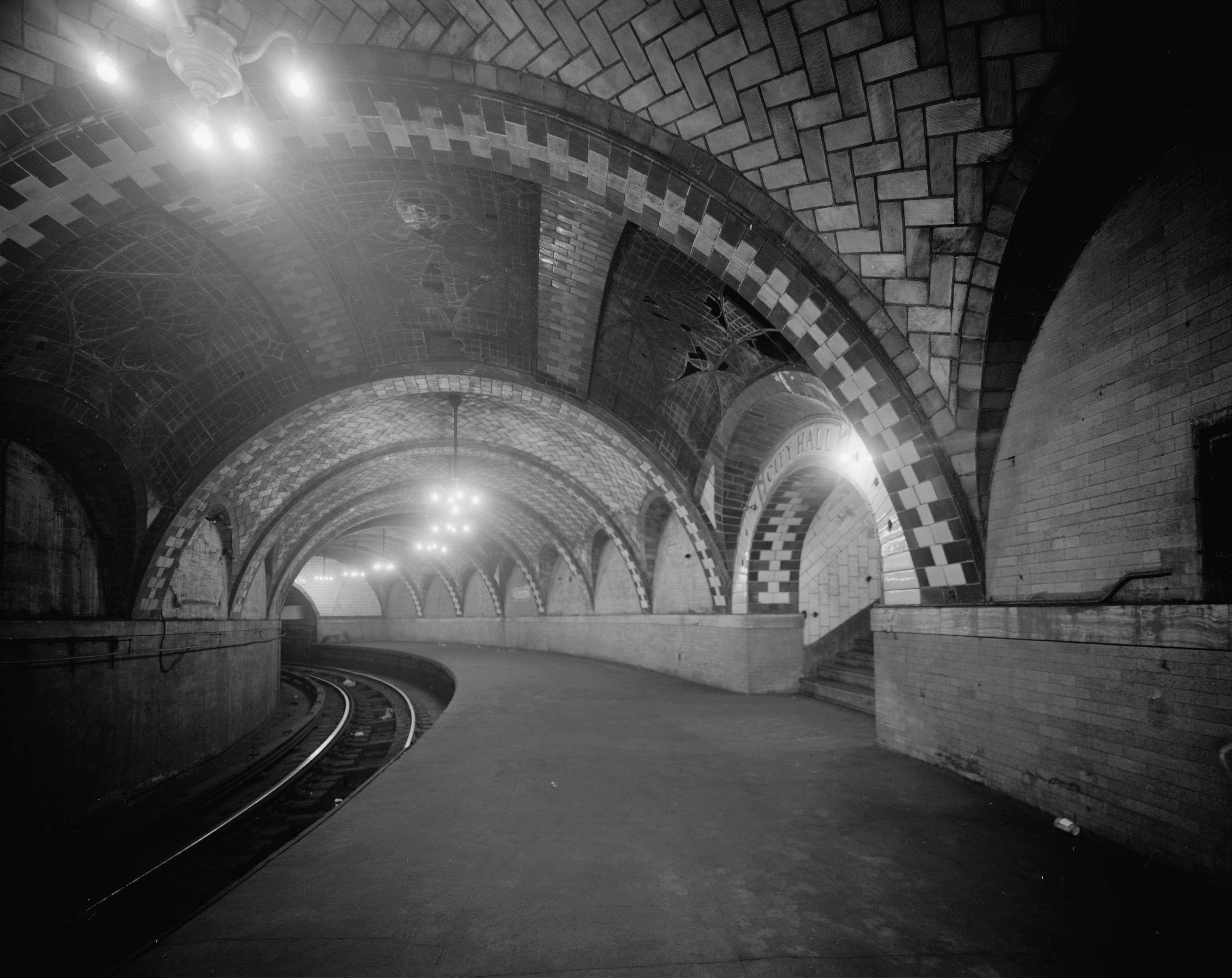
On October 27, 1904, New York's first subway line opened, and its southern terminus was a showpiece: City Hall station, designed by Heins & LaFarge with sweeping tile vaults by Rafael Guastavino. Brass chandeliers, skylights, oak ticket booths, and a curved platform made it feel more like a ballroom than a station — the city wanted the subway's front door to be unforgettable.
Why it closed
The station's beauty was also its doom. The sharply curved platform could never be lengthened for ten-car trains, ridership stayed low beside the Brooklyn Bridge express stop, and on December 31, 1945, the last passengers boarded. It has sat silent ever since — though every downtown 6 train still loops through it to turn around, giving riders a slow glimpse through the windows.
How to see it
The Transit Museum runs members-only tours that sell out within hours of release. The reliable free method: stay on a downtown 6 past Brooklyn Bridge–City Hall and ride the loop — watch for the skylights and the vaulted tile ceiling as the train curves through the old station.
The day the Mayor-Motorman took the controls
On October 27, 1904, the showpiece was finally ready for its audience. At 2:35 that afternoon, the first IRT train pulled out of City Hall station with Mayor George B. McClellan Jr. at the controls. The mayor had been given the honorary duty of starting the train, with the understanding that he would hand the controls to an IRT motorman once the ceremony ended. He refused. According to the New York Times, when someone asked, "Don't you want the motorman to take hold?" McClellan answered, "No sir! I'm running this train!" — and stayed at the controls all the way to 103rd Street, earning the nickname "Mayor-Motorman" in the next day's paper. The station had been decked out for the occasion. Commemorative plaques honoring the men who designed, built, and financed the system were mounted in City Hall itself, the chosen spot because no other station on the new line approached its grandeur. At 7 p.m. that evening the subway opened to the public, and more than 100,000 New Yorkers paid a nickel each for their first ride beneath the streets. The line ran 9.1 miles through 28 stations — from City Hall up to Grand Central, west along 42nd Street to Times Square, then north to 145th Street in Harlem — advertised with the slogan "City Hall to Harlem in 15 minutes." The crowds at City Hall that day were enormous: nearly 7,000 people pressed around the station, and 200 policemen were stationed to manage them. The day's events had been choreographed for months, and every detail — from the brass fittings to the tiled vaults — was meant to tell New Yorkers that the age of the elevated railway was over. It was the proudest day in the history of the city's transit ambitions — and, although nobody knew it, the station's finest hour.
A showpiece with nowhere to grow
The problems were architectural, and they were permanent. The station's curved platform had been drawn to fit a turning loop, not a growing system: it could handle the original five-car trains, but when the IRT lengthened its fleet to ten cars in the 1940s, City Hall could not be lengthened to match. Lengthening a straight platform was routine work on other stations; on a tight curve it meant rebuilding the station itself. On the curve, the gap between the platform edge and the newer cars yawned wide enough to be dangerous, and rebuilding the station to fix it would have cost more than the traffic justified. The traffic was thin. The station sat about 600 feet from the Brooklyn Bridge stop, which was easier to reach and could handle the longer trains, so commuters overwhelmingly chose the express. By the war years the loop station was handling only about 800 fares a day, and it stood closed at night and on Sundays. Even the glass had gone dark: during World War II the skylights were tarred over as a blackout measure against air raids, and scraps of that black paint still cling to the remaining panes. The last day came on December 31, 1945. The station closed to passengers that evening at 9 p.m., and the city moved quickly to erase it: the wooden ticket booths and benches were taken out, the bronze plaques and cast-iron entrance kiosks were removed, and the street entrances were boarded and locked. Up above, two kiosks in City Hall Park came down as well, opening up the park the way the subway's builders had never intended. The loop itself could not be demolished — downtown 6 trains needed it to turn around — so the station entered a strange suspended state: buried, locked, and permanently trapped inside working infrastructure.
What survives in the dark
Almost everything that made the station famous is still there, because the things worth saving turned out to be hard to remove. The tile vaults by Rafael Guastavino remain — lightweight, fireproof, and load-bearing, spanning the platform in sweeping arches that needed no steel skeleton. The brass chandeliers still hang. The skylights are broken in places, some still carrying their wartime tar, but the cut amethyst glass throws a faint colored light down when the park above is bright. The sculptor Gutzon Borglum — later of Mount Rushmore — made the bronze plaque commemorating the first ride, and though it was taken from the station, it was the detail that told riders this place was meant to be remembered. The station has never been forgotten, only inaccessible. As early as 1965, Transit Authority commissioner Joseph O'Grady proposed converting it into a museum, arguing that a station this singular belonged in "the tradition of preserving the historic landmarks of our city." The idea stalled — the authority chose the Court Street station in Brooklyn for its transit museum instead, partly because the City Hall loop was still needed to turn 6 trains around — but it never died. In 1987, readers of the Times wrote in urging the city to reopen it as a museum, calling it "the showcase station" that "deserves a broader patronage." Protection eventually arrived in other forms. The Landmarks Preservation Commission designated the station's interior in 1979, one of twelve original IRT stations protected that year, and it is listed on the National Register of Historic Places. And there is one reliable way to see it today without a museum ticket: stay on a downtown 6 past Brooklyn Bridge–City Hall and ride the loop. The train slows as it curves through the arches, and for a few seconds the windows frame Guastavino's vaults, the skylights, and the empty platform — a ballroom with no more dances.
Key Facts
- City Hall station opened on October 27, 1904, as the original southern terminus of the IRT, New York's first subway line.
- The station's tile arches were built with Rafael Guastavino's patented vaulting system, the same technique behind the Oyster Bar ceiling at Grand Central.
- It was designated an interior New York City landmark in 1979, protecting it even in abandonment.
- Downtown 6 trains still pass through the station daily on the City Hall loop, though they no longer stop.
Hero photo: David Sagarin, Public domain, via Wikimedia Commons.
Location Photography


Gallery photos: Rhododendrites (CC BY-SA 4.0), Rhododendrites (CC BY-SA 4.0), Rhododendrites (CC BY-SA 4.0), Rhododendrites (CC BY-SA 4.0), Rhododendrites (CC BY-SA 4.0) via Wikimedia Commons.