The tunnel Moses buried
In the 1930s, the West Side Improvement buried the freight tracks in a concrete tunnel beneath the new Riverside Park — a mile-long cavern running roughly from 72nd to 122nd Street. When freight traffic faded, the tunnel sat mostly empty: dark, vast, and temptingly close to the surface.
Freedom's cathedral
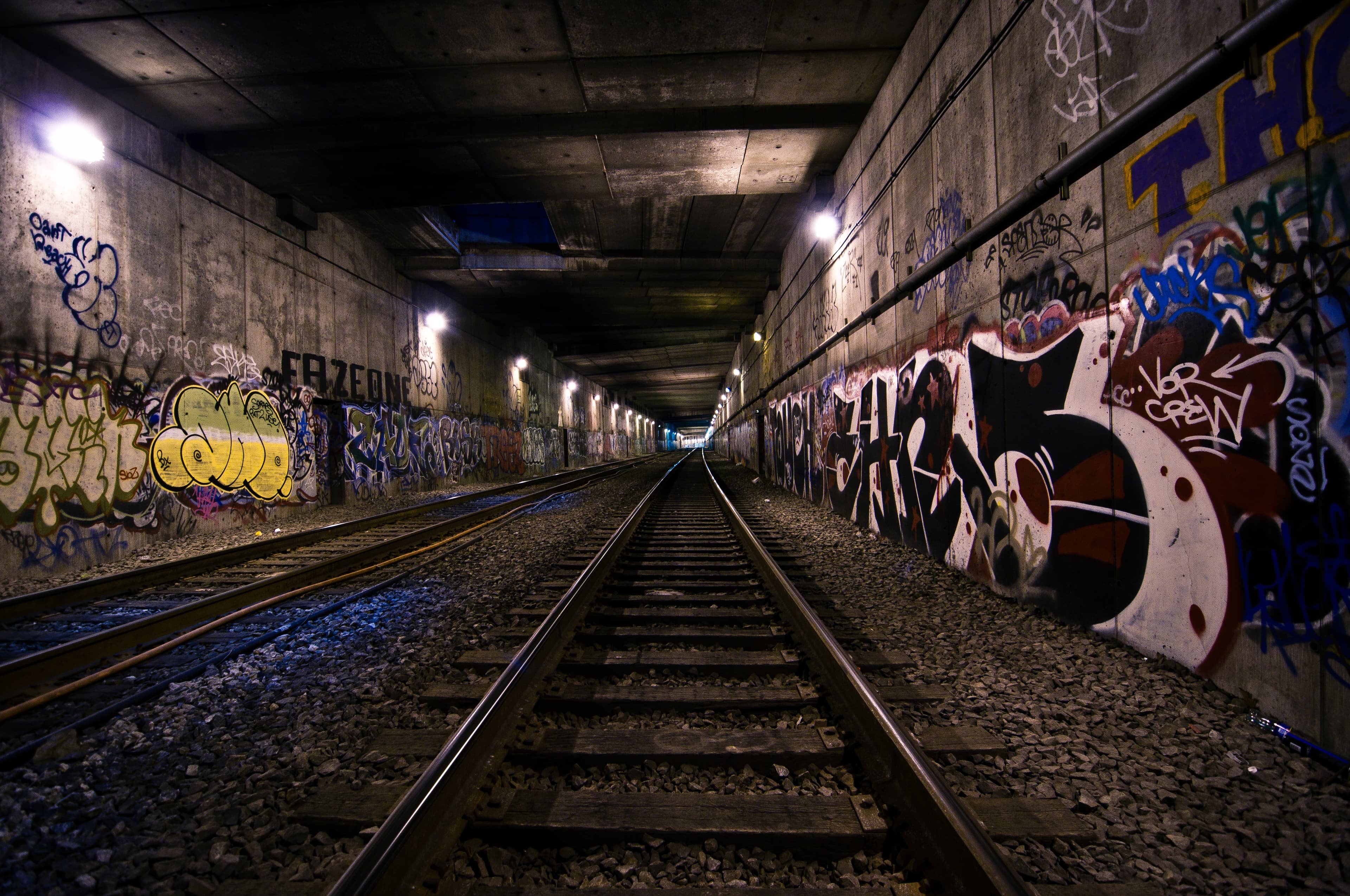
In the 1980s, graffiti artists claimed it. Chris "Freedom" Pape — who gave the tunnel its name — painted enormous murals in the gloom, including his famous self-portrait series. Below the art, a full underground community grew: the "mole people," hundreds of homeless New Yorkers living in shanties along the tracks through the 80s and early 90s, until Amtrak cleared the encampments.
Don't go down there
The tunnel is an active Amtrak corridor again and entirely off-limits — entering is trespassing, and trains run with little warning in the dark. Its legend survives in photographs, in the murals, and in the books and films it inspired.
A park poured over a railroad
The tunnel is not as old as the neighborhood's mythmaking suggests, and its birth was bureaucratic. It came from Robert Moses's West Side Improvement of the 1930s, which moved the New York Central's freight tracks off the surface and under a new Riverside Park. The covered stretch runs about 2.6 miles, roughly from 72nd Street to 124th Street — a concrete cavern built to hide the railroad while the park played overhead. Freight trains used it until 1980, when regular operations ended. The railroad preferred its yards in the Bronx and New Jersey, and trucks were eating the freight business anyway. Then the tunnel sat. Its south portal had opened into the 60th Street rail yard, but when that yard was redeveloped into the Riverside South apartment complex in the late 1990s and 2000s, the tracks south of the tunnel were covered too, sealing the corridor's past even tighter. The tunnel came back to life on April 4, 1991, as the Amtrak Empire Connection. Long-distance and regional services — the Adirondack, the Empire Service, the Maple Leaf, the Lake Shore Limited — shifted from Grand Central Terminal to Penn Station, and passenger trains began running through the cavern again. The old portals and grates that once let in light and the noise of playgrounds were suddenly part of a working railroad. The name the tunnel had earned in the dark years stuck. Today the trains pass over the same ballast where shanties once stood.
Freedom's gallery
Chris Pape started tagging subway tunnels and cars in 1974, when he was a teenager, under the name "Gen II." He later shortened it to "Freedom," and the tunnel under Riverside Park became his studio. He worked in the dark on a scale few graffiti artists attempted: full-scale recreations of classical paintings in black and silver, rendered on walls lit only by shafts falling through the ventilation grates. His self-portrait, painted in 1984, shows a male torso with a spray-can head — the artist as his own tool. Around it he built a body of work that mixed art history with protest: a reinterpretation of the Venus de Milo, a full-car recreation of the reaching hands from Michelangelo's Sistine Chapel, a version of Goya's The Third of May. His most pointed piece was "There's No Way Like the American Way," also known as the Coca-Cola Mural — a parody of Coke advertising and a tribute to the homeless people being cleared from the tunnel, pairing the weathered face of a homeless man with a cartoon of a 1950s American family in a shiny automobile. Four years after the 1991 evictions, Pape painted his final tunnel work: "Buy American," a comic-book-style mural commemorating the homeless and their fraught relationship with the city and its police. In 2009, Amtrak painted over it and many other murals, after a senior official was reportedly horrified by the amount of graffiti visible during a ride through. Pape was philosophical about the erasure — street art, he said, is ephemeral — and about five of his paintings are believed to remain in the dark.
The people underground
Below the art, and for a time more permanent than it, was a neighborhood. At its height in 1994, nearly a hundred people were living in the tunnel, in shanties built along the tracks out of scrap wood and salvaged material. They were part of a larger underground homeless population scattered through the city's rail infrastructure — the "mole people," named in Jennifer Toth's 1993 book, which remains the defining account of the life down there. The encampments were orderly in their way. Residents tapped power lines for electricity, built walls and doors, kept pets, and looked out for one another. They lived beyond the reach of shelters and their rules, and the tunnel's darkness offered a privacy the surface did not. It ended on a single day. When Amtrak reopened the corridor for the Empire Connection on April 4, 1991, a mass eviction followed: the shantytowns were bulldozed and the tunnel was chained off. Some residents slipped back in afterward — the last unofficial tenants did not leave until 1994 — but the community was gone. The legend that remained was shaped by two works. Toth's book carried the residents' stories into print, and in 2000 the filmmaker Marc Singer released "Dark Days," a documentary made with the tunnel's residents, with a soundtrack by DJ Shadow. Margaret Morton's book "The Tunnel" added the photographers' record. Between them, the evicted kept their names.
What the tunnel became
The tunnel today is a contradiction: a working railroad that people still cannot resist. Amtrak trains run through it on schedules, fast and loud in the dark, and the corridor is chained off and posted. Trespassers are caught — around 2014 and 2015, Amtrak police sporadically escorted out graffiti artists and urban explorers — but the walls keep being repainted. After the 2009 whitewash, a new generation of writers began laying work over Amtrak's coat of gray, drawn by the same things that drew Pape: the scale, the light shafts, the feeling of a gallery nobody owns. The tunnel has also been rebuilt in fiction. The 2020 film "Topside," about a mother and her five-year-old daughter living underground, recreated the world of the mole people with painstaking care — Chris Pape himself repainted his murals for it in an abandoned tunnel in Rochester, New York. The film won top awards at the Venice Film Festival and SXSW. What survives down there now is layered: freight-era concrete, the scars of the shantytowns, Pape's remaining murals, and the fresh tags over the gray. None of it is visible from the surface. The park above Riverside Drive is calm and manicured; thirty feet below, the light still falls through the grates the way it did when the tunnel belonged to no one.
Key Facts
- The Freedom Tunnel was built in the 1930s to bury freight tracks beneath Riverside Park.
- Graffiti artist Chris "Freedom" Pape named the tunnel and painted its most famous murals there in the 1980s and 90s.
- Hundreds of homeless New Yorkers lived in the tunnel's encampments until Amtrak cleared them in the 1990s.
- The tunnel is an active rail corridor today — entering it is illegal and dangerous.
Freedom Tunnel Photography


Hero photo: Stuart McAlpine, CC BY 2.0, via Wikimedia Commons.
Gallery photos: Antigng (CC BY-SA 4.0), Susan Murray (CC BY-SA 3.0), Susan Murray (CC BY-SA 3.0), Susan Murray (CC BY-SA 2.5) via Wikimedia Commons.