A Cathedral Before the Cathedral
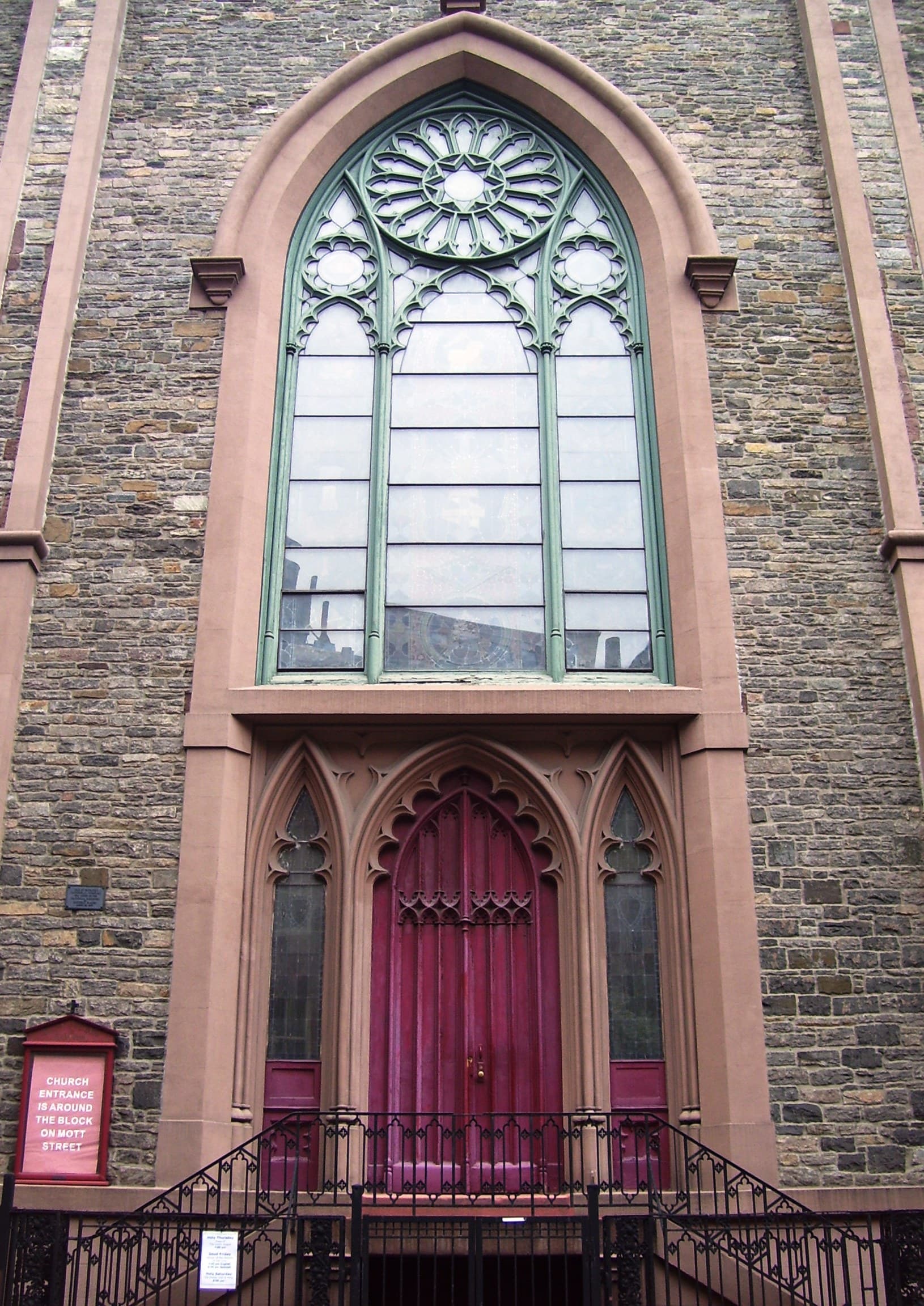
Most New Yorkers who hear “St. Patrick’s Cathedral” picture the white-marble giant on Fifth Avenue. But for its first 64 years, the seat of the Archdiocese of New York stood two miles downtown, on a Mulberry Street block between Prince and Houston. The cornerstone of Old St. Patrick’s was laid on June 8, 1809, and the church was dedicated on May 14, 1815 — a Gothic Revival building 120 feet long and 80 feet wide, its inner vault rising 85 feet, designed by Joseph-François Mangin, the French architect who had co-designed City Hall with John McComb Jr.
This was the city’s first cathedral, and it served as such until the new St. Patrick’s opened uptown in 1879. In 2010, Pope Benedict XVI named it a minor basilica — the designation came on March 17, St. Patrick’s Day — so its full name today is the Basilica of St. Patrick’s Old Cathedral. From above ground, it reads as a handsome old church with a walled churchyard. The real story is underneath it.
The Ground Was a Cemetery First
The land was a burial ground before it was ever a church. In 1801, St. Peter’s Church — the city’s first Catholic parish, down on Barclay Street — bought the property as a Catholic cemetery. The cathedral rose around and above the dead, and the churchyard that survives today, split into walled north and south cemeteries, remains Manhattan’s only Catholic cemetery.
That fact alone makes the site unusual, but the subterranean part is rarer still. Beneath the basilica floor lies a network of burial vaults the parish calls the catacombs: 35 family crypts and 5 clerical vaults, brick and stone chambers that were sealed, forgotten by the public, and then — after more than a century — reopened both to new interments and to visitors. When the parish began offering tours in 2017, it was the first time the general public had been admitted to the crypts since the late 1800s.
Thirty-Five Vaults of New York History
The people in the vaults read like an index of 19th-century Catholic New York. Bishop John Connolly, the first resident Bishop of New York, who died in 1825, rests here. So does General Thomas Eckert, the Civil War officer who served as an adviser to President Lincoln — his crypt is still lit by its original Edison bulbs, a detail the guides love, since the bulbs date to the earliest days of electric light.
The Delmonico family occupies vault space here — twenty members of the clan behind Delmonico’s, the restaurant credited with inventing eggs Benedict, the wedge salad, Delmonico potatoes, chicken à la king, and baked Alaska. Nearby lies Countess Annie Leary, who died in 1919 and remains the only Catholic ever admitted to Mrs. Astor’s “400,” the official roster of Gilded Age society; her title came from Pope Leo XIII. There’s Congressman John Kelly of Tammany Hall — “Honest John” — and Charles O’Connor, who ran for president in 1872. Wine merchant Dominick Lynch and Mary Agnes O’Connor, the first mother superior of the Sisters of Mercy in New York, are here too.
Two of the most famous names associated with the catacombs aren’t there anymore. Pierre Toussaint, the formerly enslaved Haitian hairdresser turned philanthropist declared Venerable by Pope John Paul II in 1996, was originally interred here; his remains were later moved to the new cathedral on Fifth Avenue, as were Father Isaac Hecker’s, founder of the Paulist Fathers. The old cathedral kept losing its treasures to the new one — up to and including its most venerated dead.
Fire, Riot, and Survival
The building above the vaults has nearly been destroyed twice. In 1836, during a wave of nativist agitation, a mob threatened the cathedral; the parishioners cut loopholes in the churchyard walls — built just two years earlier — and stood watch with muskets. The attack never came, but the walls still carry that history.
Thirty years later, fire did what the mob couldn’t. On October 7, 1866, the cathedral burned. It was rebuilt under architect Henry Engelbert, with the first Mass celebrated in the restored church on April 1, 1867, and a full reopening in 1868. The 1868 Henry Erben pipe organ, with roughly 2,500 pipes, is still played; the Organ Historical Society has cited it for exceptional historical merit, and a preservation group — honorary chair Martin Scorsese — has been raising funds for its restoration.
The church kept collecting history even as the neighborhood changed around it. Lorenzo da Ponte — Mozart’s librettist, who ended his days as a Columbia professor and the man who brought Italian opera to New York — was buried from here in 1838. St. John Neumann was ordained at Old St. Patrick’s in 1836. The 69th Regiment’s colors were blessed here in April 1861 as the Irish Brigade headed to war. And in a detail that sounds invented but isn’t, the parish once kept sheep in the cemetery to keep the grass down.
The Godfather's Baptism
If the interior looks familiar, there’s a reason. The baptism scene in The Godfather — the intercut sequence where Michael Corleone renounces Satan while his men carry out hits across the city — was filmed inside Old St. Patrick’s. The baby being baptized was Sofia Coppola, the director’s infant daughter. (The church’s exterior in the film is a different building: the Church of St. Joachim and St. Anne on Staten Island.) The production returned for The Godfather Part III, for the scene in which Michael receives a church honor. Scorsese himself used the graveyard in Mean Streets. The basilica’s movie career is a minor footnote to its history, but it’s the reason a certain kind of visitor shows up already knowing the floor plan.
Going Underground
The only way into the catacombs is on a guided tour. “Catacombs by Candlelight” — the name is slightly theatrical; the candles are battery-operated LEDs — is run by Tommy’s New York, the tour company of Thomas Wilkinson, which has operated as the basilica’s exclusive tour partner since the tours began in 2017. The walks run about 80 minutes and cover the church, both walled cemeteries, and the crypt level, in groups that can run as large as 40 people.
Tours meet at 266 Mulberry Street, the former chancery building next door, with check-in 15 minutes before the start. The guides lean into the storytelling — the Edison bulbs, the Delmonicos, Toussaint’s empty vault — but the tone stays respectful; this is an active burial place that has simply agreed to admit the curious. Prices and schedules shift often, so check the official site before visiting.
Key Facts
- Old St. Patrick's (dedicated 1815) was New York's first cathedral, serving as the archdiocesan seat until 1879; it became a minor basilica in 2010.
- The catacombs hold 35 family crypts and 5 clerical vaults, reopened to the public via guided tours in 2017 after more than a century closed.
- Notable interments include Bishop John Connolly, Civil War Gen. Thomas Eckert, the Delmonico family, and Countess Annie Leary; Pierre Toussaint's remains were later moved to the Fifth Avenue cathedral.
- The Godfather's baptism scene was filmed inside; the church survived an 1836 nativist attack threat and an 1866 fire.
Location Photography