The Race Into the Sky
The Empire State Building began as a bet between millionaires. In 1929, John J. Raskob — a General Motors and DuPont financier — joined with former New York governor Al Smith to build the world's tallest office tower on the Fifth Avenue site of the original Waldorf-Astoria Hotel. Two rivals were already climbing. The Bank of Manhattan Building at 40 Wall Street had revised its plans upward to 925 feet, and Walter Chrysler's tower on Lexington Avenue was rising toward a stubby dome. Then, in October 1929, Chrysler sprang his trap: workers hoisted a 185-foot steel spire that had been secretly assembled inside the building's crown, and the Chrysler Building shot to 1,046 feet — the tallest structure ever built. Raskob was reportedly haunted by the thought that Chrysler might "hide a rod in the spire and stick it up at the last minute," so in December 1929 his architects, Shreve, Lamb & Harmon, revised the Empire State design one final time: five more floors, a sixteen-story metal crown, and a 222-foot mooring mast for airships. The roof would reach 1,250 feet — nearly two hundred feet clear of Chrysler. The race was over before the first column was set.
Thirteen Months of Steel and Stone
Construction began on March 17, 1930, weeks after the stock market crash, and proceeded at a pace that still reads like a misprint. As many as 3,400 workers — many of them recent immigrants, including Mohawk ironworkers famous for their head for heights — swarmed the frame, and at the peak the steel rose four and a half stories a week. Some 57,000 tons of structural steel, much of it fabricated in Pittsburgh and still warm from riveting when it was bolted into place, went up alongside 200,000 cubic feet of Indiana limestone, ten million bricks, and 6,514 windows. The steel frame topped out in September 1930, the mast followed in November, and the building was completed on April 11, 1931 — one year and forty-five days after work began, and under its $50 million budget at roughly $41 million all in. On May 1, 1931, President Herbert Hoover pressed a button in Washington to switch on the lights, and the world's tallest building opened its doors. The timing was wretched: the Depression had gutted demand for office space, wags renamed it the "Empty State Building," and the owners did not turn a profit until the early 1950s — kept afloat in the lean years, in part, by the observatory's ticket sales.
The Airship Dock That Never Was
The needle on top was not decoration. The mooring mast was designed as a working airship dock: dirigibles sailing from Europe would nose into the mast, passengers would step off at the 102nd floor, clear customs, and ride express elevators down to Fifth Avenue — three hours from the Atlantic crossing to Midtown. It was a glorious idea with one fatal flaw, the wind. At 1,250 feet, the updrafts and crosswinds whipping around the tower made it impossible for a huge, light, hydrogen-filled ship to hold station safely while passengers crossed an open gangway. In September 1931 a small private blimp did briefly grapple with the mast to deliver a bundle of newspapers — a publicity stunt that proved the concept unworkable rather than practical. No airship ever docked commercially, and the mast settled into its second career as an observation level and, later, a broadcast antenna farm. The docking floor survives as the 102nd-floor observatory: the world's most spectacular waiting room for passengers who never came.
An Art Deco Giant in Indiana Limestone
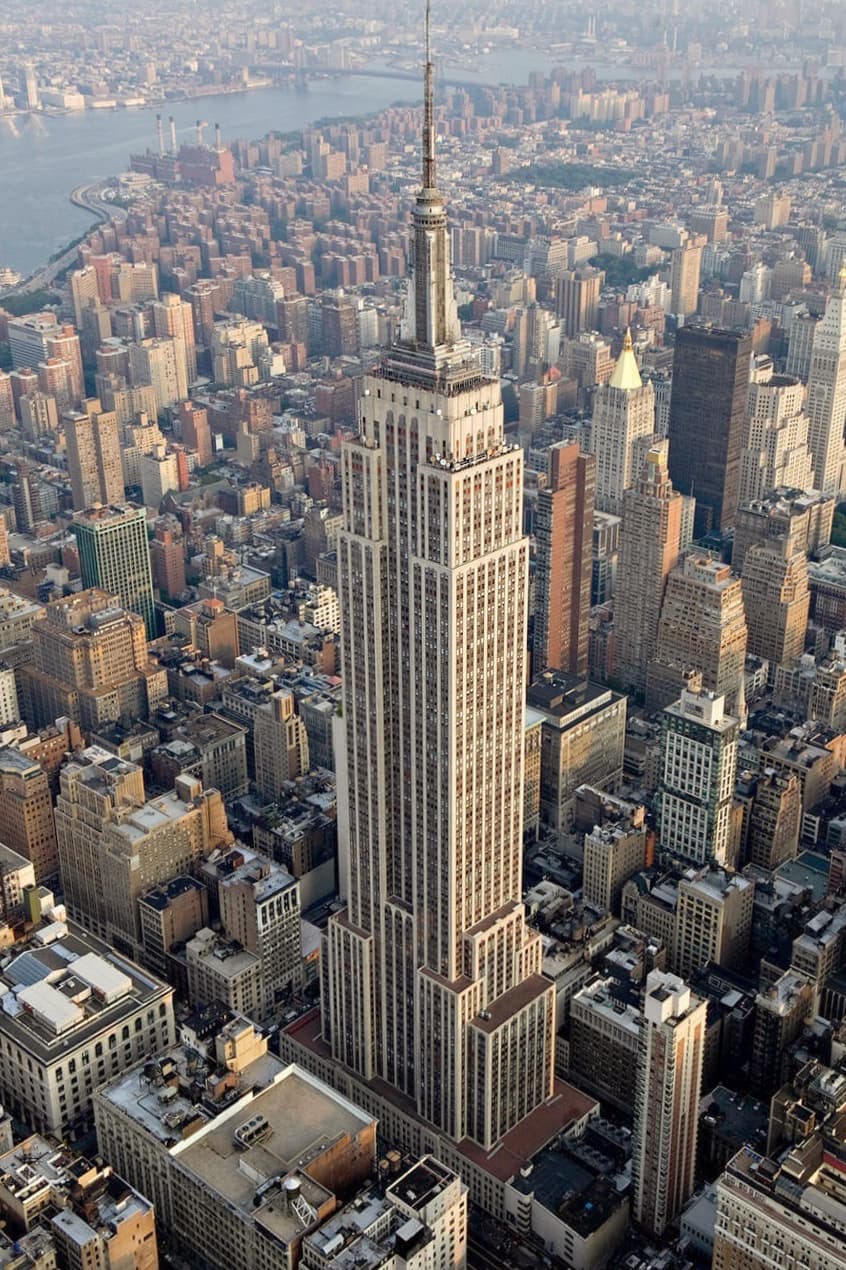
For all its height, the building's manners are restrained. Architect William F. Lamb, working at frantic speed — the final design was reportedly sketched in two weeks from the firm's earlier Reynolds Building in North Carolina — wrapped the frame in pale Indiana limestone and granite, which gives the tower its signature warm blonde color. The 1916 Zoning Resolution dictated the silhouette: a five-story base filling the lot, then a long, nearly unbroken shaft stepping back at the 21st, 25th, 30th, 72nd, 81st, and 85th floors, so the mass tapers like a pencil — Lamb's team called the design process "from the top down." Inside, the three-story Fifth Avenue lobby is a monument in itself, lined with marble and aluminum reliefs of the machine age, its ceiling mural depicting the building radiating golden light. The tower lights became a feature in their own right: colored floodlights were installed for the Bicentennial in 1976, replaced in 2012 by an LED system capable of millions of colors, and today the crown changes hue for holidays, championships, and causes — a signal lamp for the whole city. The American Society of Civil Engineers named the building one of the Seven Wonders of the Modern World, and in 2007 it topped the American Institute of Architects' list of America's Favorite Architecture.
King Kong, a Bomber, and Immortality
Two years after opening, the building became a movie star. In King Kong (1933), the giant ape climbs the tower and swats at biplanes from the mooring mast before falling to Fifth Avenue — a sequence that fixed the building's silhouette in the imagination of people who had never seen New York. It has since appeared in more than 250 films and television shows, from An Affair to Remember to Sleepless in Seattle. Its darkest day came on July 28, 1945, when a B-25 Mitchell bomber, lost in thick fog on a routine flight, slammed into the 78th and 79th floors, killing fourteen people; remarkably, the building reopened within days, and an elevator operator, Betty Lou Oliver, survived a 75-story fall inside a plunging cab — still a world record. The tower held the title of world's tallest building for nearly forty years, until the World Trade Center's North Tower passed it in 1970; after the attacks of September 11, 2001, it was briefly New York's tallest again, until One World Trade Center surpassed it in 2012. It was designated a New York City landmark in 1981 and a National Historic Landmark in 1986.
The View From 86 and 102
About four million people a year ride the elevators — 73 of them, in the largest elevator order of its day — to the observatories. The 86th-floor deck, at 1,050 feet, is the famous one: an open-air promenade wrapping the base of the mast, with coin-operated viewers, the harbor to the south, Central Park to the north, and on a clear day a horizon that takes in five states. The smaller, enclosed 102nd-floor observatory sits at 1,224 feet in what was meant to be the airship terminal. An indoor observatory on the 80th floor, added in 2019 as part of a top-to-bottom reinvention of the visitor experience, frames the view with exhibits on the building's construction before you step outside. Go at dusk if you can: the limestone shaft glows gold below you, the tower lights come on overhead, and the city switches over from the view to the thing viewed. That double role — lookout and landmark, the place you see New York from and the thing you look for — is the Empire State Building's real record, and no taller tower has taken it.
Key Facts
- Built by Empire State Inc. (John J. Raskob and Al Smith) to designs by Shreve, Lamb & Harmon; construction began March 17, 1930, and the building opened May 1, 1931 — a build of thirteen and a half months.
- The design was revised fifteen times in a race with the Chrysler Building and 40 Wall Street; after Chrysler secretly raised a 185-foot spire to reach 1,046 feet, Raskob answered with a crown and mooring mast that took the Empire State to a 1,250-foot roof (1,454 feet to the antenna tip), 102 stories.
- The mooring mast was intended as a dock for transatlantic dirigibles; dangerous winds at that height ended the plan after a single stunt mooring in 1931, and the docking level became the 102nd-floor observatory.
- The world's tallest building from 1931 until 1970; designated a New York City landmark in 1981 and a National Historic Landmark in 1986; named one of the Seven Wonders of the Modern World by the American Society of Civil Engineers.
- Immortalized by King Kong (1933) and more than 250 film and TV appearances; struck by a B-25 bomber in fog on July 28, 1945, an accident that killed fourteen but failed to close the building for long.
- Its observatories — the open-air 86th floor at 1,050 feet, the 102nd floor at 1,224 feet, plus an indoor 80th-floor gallery added in 2019 — draw roughly four million visitors a year.
Visitor Details
Address: 350 Fifth Avenue, New York, NY 10118 (the building has its own ZIP code); the observatory visitor entrance is at 20 West 34th Street, between Fifth and Sixth Avenues.
Transit: 34th Street–Herald Square (B, D, F, M, N, Q, R, W) is one block west; 33rd Street (6 train) is two blocks east; the 33rd Street PATH station is nearby. Penn Station and Grand Central are both an easy walk.
Hours/Admission: The observatory is open daily year-round, but hours vary by season and date (typically running from morning until midnight or later in peak periods) and admission is by timed ticket, with separate pricing for the 86th floor and for combined 86th + 102nd floor access. Do not rely on third-party listings: check current hours and buy timed tickets in advance on the official site, esbnyc.com, as popular slots sell out. Arrive at the 34th Street entrance with time to clear security.
Best timing: Arrive about an hour before sunset to see the city in daylight, dusk, and full illumination on one ticket — or come after 9 pm or before 10 am for thinner crowds. The clearest long views usually follow a cold front or rain, when the air has been scrubbed.
Location Photography