The doorway to America
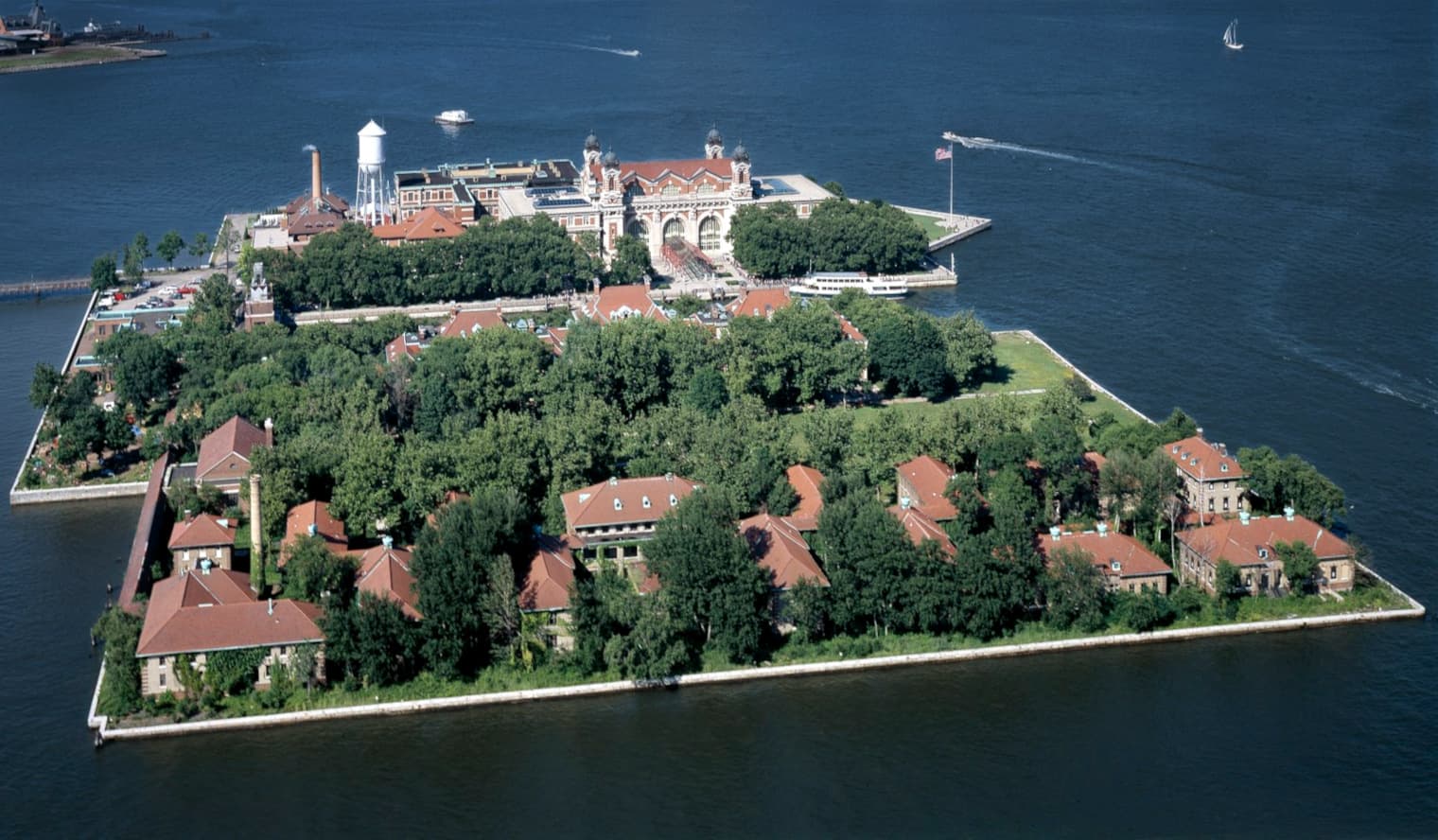
The ferry from Manhattan takes about fifteen minutes to cross Upper New York Bay, and as it approaches the dock, the building comes into view exactly as it was meant to be seen: a long red-brick facade with limestone trim, four corner towers crowned with copper domes, and a great arched entrance facing the water. This is the Main Immigration Building on Ellis Island, opened on December 17, 1900, and for more than half a century it was the busiest immigrant inspection station in the United States. Between January 1, 1892, when the station opened, and November 1954, when it closed, roughly 12 million immigrants were processed here — more than at any other single gateway in American history. The Statue of Liberty-Ellis Island Foundation estimates that over 100 million living Americans, close to 40 percent of the population, can trace their ancestry to a man, woman, or child who passed through this building.
That scale is hard to grasp until you stand in the Registry Room, the vast hall on the building's second floor that immigrants called the Great Hall. It is about 200 feet long, with a soaring Guastavino tile vault overhead, and on the busiest days it held thousands of people at once — families clutching bundles and suitcases, interpreters shouting in a dozen languages, inspectors working down long rows of metal pens. On April 17, 1907, the station's busiest day on record, 11,747 immigrants were processed here. The year 1907 was the peak year overall, with about 1.2 million arrivals. For most of those who came, the stay on Ellis Island lasted only a few hours: a medical inspection on the stairs, a legal inspection at a desk, a stamp, and then the ferry to Manhattan and a new life. For a small minority — about 2 percent were excluded and sent back — the island was where the American dream ended.
Ellis Island is not a monument to an abstraction. It is a working building, preserved almost exactly as it functioned, and that is what makes it one of the most moving museums in America. The benches in the Registry Room are the benches immigrants sat on. The baggage room downstairs still smells faintly of old wood and salt air. The graffiti carved into walls, the inspection desks, the dormitory bunks, the kissing post where detained immigrants were finally reunited with family — all of it is here, in the rooms where it happened. To visit Ellis Island is not to read about immigration history. It is to stand in the room where immigration history was decided, one person at a time.
Before the gateway: a fort, a family name, and Castle Garden
Ellis Island was not always an immigration station, and its earlier lives explain both its name and its location. The island sits in Upper New York Bay, just off the New Jersey shore and about a mile southwest of the Statue of Liberty on Liberty Island. In the colonial era it was a small oyster-fishing island known at various times as Little Oyster Island. In the late eighteenth century it came into the hands of Samuel Ellis, a New York merchant, and it took his name. In 1808 the federal government bought the island from his heirs and fortified it as part of New York Harbor's defenses; the fortification there, later known as Fort Gibson, guarded the harbor through the War of 1812 and beyond. The island's military role lasted for most of the nineteenth century, and its guns were still part of the harbor's defenses when the government chose it for a very different purpose.
That purpose arrived with the federal takeover of immigration. Until 1890, immigration was handled by the states, and in New York that meant Castle Garden — the old fort at the tip of Manhattan, now Castle Clinton in Battery Park — which processed more than eight million immigrants between 1855 and 1890. But Castle Garden was overcrowded, its operators were accused of corruption and of exploiting new arrivals, and Congress wanted a federal station under federal control. The Immigration Act of 1891 gave the federal government that control, and Congress appropriated funds to build America's first federal immigration station on Ellis Island, chosen because it was isolated enough to control access, close enough to Manhattan to be practical, and already owned by the government. The fort was adapted, a new wooden station was built, and on January 1, 1892, Ellis Island opened as the nation's immigration gateway.
The first immigrant processed at the new station has become part of the island's legend. She was Annie Moore, a 15-year-old girl from County Cork, Ireland, who arrived aboard the steamship Nevada with her two younger brothers to join their parents in New York. She was greeted by officials, given a ten-dollar gold piece, and sent on her way — the first of millions. A statue of Annie Moore now stands in the museum, and her story is told to every school group that visits: she was a child, traveling alone with her brothers, and the entire American immigration system, for the first time, was waiting for her on an island in the harbor.
The first station, and the fire
The first Ellis Island station was a large wooden building, three stories tall, built of Georgia pine, with outbuildings for dormitories, a hospital, and administration. It was handsome but it was wood, and it was crowded from the start. In its first five years it processed about 1.5 million immigrants, and the pace only grew as steamship travel brought ever-larger waves from southern and eastern Europe — Italians, Jews from the Russian Empire, Greeks, Poles, Hungarians, Slavs, and many others, joining the Irish and Germans who had dominated earlier decades.
On the night of June 15, 1897, that wooden station burned to the ground. The fire, of unknown origin, destroyed the main building and its records — including the immigration records of the station's first five years, which is why genealogists searching for ancestors who arrived before 1897 often find a gap. No one was killed, but the station was gone, and for the next three years immigration processing moved back to Manhattan, to the Barge Office at the Battery, while the government rebuilt. The Treasury Department set one condition for the replacement: it had to be fireproof.
The result is the building you see today. The New York firm of Boring & Tilton — William Alciphron Boring and Edward Lippincott Tilton — won the commission in an invitational competition, only the second held under the Tarsney Act of 1893, which allowed private architects to compete for federal commissions. They designed a French Renaissance Revival building in red brick with limestone trim, four ornate corner towers topped with copper domes, and huge arched windows meant to be legible from approaching ships. The new Main Immigration Building opened on December 17, 1900, and 2,251 immigrants were received that first day. It was built to impress, and it was built to process people at industrial scale: the Baggage Room on the ground floor, the Registry Room above it, dormitories, dining rooms, a hospital complex on the island's south side, and a ferry slip connecting it all to Manhattan.
Up the stairs: the six-second exam
The immigrant experience at Ellis Island began before anyone set foot on the island. Ocean liners anchored in the harbor, and first- and second-class passengers — the cabin passengers — were inspected aboard ship and usually allowed straight into Manhattan. It was the steerage passengers, the poorest travelers in the crowded lower decks, who were ferried to Ellis Island. That class distinction was the first filter, and it shaped everything that followed: Ellis Island was, from the start, an inspection station for the poor.
Arriving immigrants entered the Main Building through the Baggage Room on the ground floor, where they left their luggage — bundles, trunks, suitcases tied with rope — and then climbed the steep central staircase to the Registry Room. That staircase was itself part of the inspection. Doctors of the U.S. Public Health Service stood at the top and at intervals along the stairs, watching each person climb: watching for a limp, for shortness of breath, for signs of illness, for the hesitation that might suggest a mental condition. The examination that followed, in the Registry Room, was famously brief — often described as a six-second physical — and it was brutally efficient. Doctors checked eyes for trachoma, a contagious eye disease that was a leading cause of exclusion, by flipping the eyelid with a buttonhook or a finger. They checked throats, scalps, and hands. And they marked, in chalk, the clothing of anyone who needed a closer look: an E for eye trouble, an H for heart trouble, an L for lameness, an X for a suspected mental defect, a circled X for a confirmed one. A chalk mark did not mean deportation — most marked immigrants passed a second, more thorough examination and were admitted — but for the person wearing it, the mark was a moment of terror, the possibility that the journey had been for nothing.
The Registry Room itself deserves a long look. When it opened in 1900 it had a plaster vaulted ceiling; that ceiling was damaged by the Black Tom explosion of 1916, a German sabotage attack on a munitions depot across the harbor in Jersey City, and it was rebuilt with the interlocking terracotta tiles of the Guastavino system — the same fireproof tile vaulting used in Grand Central Terminal and the Boston Public Library. The restoration of the 1980s returned the room to its appearance in 1918 to 1924, the peak years, with its long rows of benches, its inspection pens, and its famous American flag hanging at the far end. Stand in the middle of it and imagine it full: thousands of people, the noise, the languages, the smell of disinfectant and steam, the children crying, the officials calling out numbers.
Twenty-nine questions, and the Kissing Post
After the medical inspection came the legal inspection, and it was, in its own way, just as searching. Each immigrant sat before an inspector at a desk in the Registry Room, with an interpreter beside them, and answered 29 questions: name, age, sex, marital status, occupation, ability to read and write, nationality, race, last residence, final destination, whether they had a ticket to that destination, who had paid for their passage, how much money they carried, whether they had ever been in prison or an almhouse or a mental institution, whether they were a polygamist or an anarchist, whether they were coming to join a relative or friend, and that person's name and address. The answers were checked against the ship's manifest, the passenger list compiled at the port of departure, and any discrepancy — a name spelled differently, an amount of money that did not match — could mean detention while the matter was sorted out.
Most immigrants passed. The inspectors were looking, above all, for people likely to become a "public charge" — someone without money, without a job, without a relative to take them in — and for people barred by law: those with certain diseases, criminals, anarchists, and, after later laws, those who failed a literacy test. The process was bureaucratic, impersonal, and, for most, mercifully fast. After the legal inspection came the money-changers' desks, the railroad ticket office (for those heading west or south), and the stairs back down to the ground floor and the ferries.
The most beloved spot in the Registry Room is not an inspection desk at all. It is a column near the stairs, known as the Kissing Post, where immigrants who had been detained — held overnight or for days while their cases were reviewed — were finally reunited with family members waiting on the other side. The name is literal: after days of separation and uncertainty, people embraced and kissed at that post, and the spot became a symbol of the reunions that Ellis Island made possible. The museum preserves the post and tells its story, and it is one of the places in the building where visitors most often stop, quietly, for a long time.
Detention at Ellis Island was real and sometimes harsh. Immigrants who were sick, who were suspected of carrying a contagious disease, who were unaccompanied minors, or whose cases were in dispute were held in dormitories on the upper floors, sometimes for days, sometimes for weeks, sometimes for months. About 2 percent of all arrivals were ultimately excluded and deported, most often for disease or for likelihood of becoming a public charge. The overall exclusion rate was low — the great majority were admitted — but for the roughly 250,000 people who were turned away across the station's history, Ellis Island earned its other name: the Island of Tears, set against its more hopeful title, the Island of Hope. Both names are true, and the museum tells both stories without softening either.
The peak, the decline, and the closing
The years before the First World War were Ellis Island's flood tide. Immigration to the United States reached its historic peak in the early twentieth century, driven by hardship and opportunity in Europe, by cheap steamship fares, and by the promise of work in America's factories, mines, and cities. The station's peak year, 1907, saw about 1.2 million immigrants processed — the largest single-year total in the station's history. The Registry Room was expanded, the dormitories filled, and the island's hospital complex grew to meet the demand. The island itself grew, too: landfill more than doubled its size, from the original 3.3 acres to 27.5 acres, creating the south side where the hospital and contagious-disease wards stood.
The First World War cut immigration sharply, and the laws that followed cut it further. The Immigration Act of 1924 — the Johnson-Reed Act — imposed strict national-origin quotas that drastically reduced immigration from southern and eastern Europe, the very regions that had filled Ellis Island's halls. After 1924, most immigrants were inspected at American consulates abroad before they sailed, and Ellis Island's role shrank: it became primarily a detention and deportation center, holding people awaiting hearings or deportation, rather than the mass-processing gateway it had been. The great hall emptied. The dormitories filled with a different population — detainees, not arrivals.
The island's later chapters are darker and less often told. During the Second World War, Ellis Island held enemy aliens — German, Italian, and Japanese nationals detained by the government — alongside Coast Guard personnel, who used the island as a training station. After the war, the station lingered as a detention center in an era when immigration policy had moved on. On November 12, 1954, Ellis Island closed for good. Its last detainee, a Norwegian merchant seaman named Arne Peterssen who had overstayed his shore leave, was released, and the station that had processed 12 million people fell silent. The buildings were left to decay, and for a decade the island was abandoned — windows broken, roofs leaking, the Great Hall empty and echoing, the hospital complex on the south side slowly returning to ruin.
The hospital side, and the island's second life
Any honest account of Ellis Island must include the south side of the island, and it must be clear about what it is. The Ellis Island Immigrant Hospital, opened in 1902, was one of the most advanced public health facilities of its time: a 22-building complex with a main hospital, contagious-disease wards, a laboratory, a laundry, a mortuary, and staff housing, built on landfill across the ferry slip from the Main Building. Its doctors treated immigrants with measles, scarlet fever, trachoma, and tuberculosis, and its wards saved lives that would otherwise have been lost on the voyage or after arrival. It was also, by the standards of its day, a place of fear: a diagnosis of a contagious disease could mean separation from family, weeks in isolation, or deportation.
The hospital complex is not part of the museum visit, and visitors should understand the distinction. The north side of the island — the Main Building and its museum — is open to every ferry passenger. The south side, including the unrestored hospital buildings, is open only through guided hard-hat tours, run in partnership with the nonprofit Save Ellis Island, which works to preserve the complex. Those tours are a different experience from the museum: they walk through unrestored wards with peeling paint and original equipment, and they tell the hospital's story in the rooms where it happened. If you want to see the hospital, plan for the hard-hat tour specifically — do not expect hospital interiors as part of the regular museum visit, and do not mistake photographs of the hospital's unrestored wards for photographs of the museum.
The island's rescue began in 1965, when President Lyndon B. Johnson proclaimed Ellis Island part of the Statue of Liberty National Monument, ending a decade of abandonment and a series of proposals — a resort, a casino, a college — that would have erased it. In the 1980s, the National Park Service and the Statue of Liberty-Ellis Island Foundation undertook one of the largest historic restorations in American history: a $156 million project, funded largely by private donations, that restored the Main Building to its 1918–1924 appearance, rebuilt the Great Hall, and created the museum. On September 10, 1990, the Ellis Island Immigration Museum opened to the public. On May 20, 2015, it was renamed the Ellis Island National Museum of Immigration, and the new Peopling of America Center opened, extending the museum's story beyond the station years to the full history of migration to America — from the earliest arrivals to the present day.
What to see inside today
A visit to Ellis Island is best taken slowly, room by room, because the building itself is the exhibit. Start on the ground floor in the Baggage Room, where immigrants left their luggage and where the museum now displays trunks, suitcases, and bundles — the material evidence of what people chose to carry across an ocean. Then climb the same staircase the immigrants climbed, past the spot where the doctors stood, and enter the Registry Room. The museum has restored it with its benches, its inspection pens, and its flag, and it is the single most powerful room in the building. Take time here. The audio guide and the exhibits explain the medical and legal inspections, the chalk marks, and the questions, but the room itself — its size, its light, its echoes — does most of the work.
On the upper floors, the museum's galleries trace the story in depth: the Peopling of America galleries, which tell the history of immigration from the colonial era to the present; the exhibits on the peak years, with photographs, oral histories, and personal objects donated by immigrants and their descendants; the dormitory rooms, restored with their triple-decker bunks; and the American Family Immigration History Center, where visitors can search the passenger records database for ancestors who came through Ellis Island — a free resource that has helped millions of families find the record of an arrival. Outside the Main Building, on the grounds facing the harbor, stands the American Immigrant Wall of Honor, a long wall inscribed with the names of immigrants, honored by their descendants through donations to the Foundation. It is a quiet place, and a fitting one: the names on the wall are the reason the building exists.
Outside the museum, the island's grounds are worth a walk. The ferry slip, the courtyards, and the views across the harbor — to the Statue of Liberty on Liberty Island, to the Manhattan skyline, to the New Jersey shore — put the island in its geography: a small place, deliberately set apart, at the entrance to America's greatest port. And one piece of geography is worth knowing, because it surprises many visitors: in 1998, the U.S. Supreme Court ruled in New Jersey v. New York that most of Ellis Island — the landfill portion, including the hospital complex — belongs to New Jersey, while the original 3.3-acre island, including the Main Building, belongs to New York. The museum you visit stands on New York soil; the hospital complex across the slip stands on New Jersey soil. The island is, fittingly, a place shared by two states, just as its history is shared by the whole country.
How to visit, and pairing it with the Statue of Liberty
Ellis Island is accessible only by ferry. The authorized ferry service, Statue City Cruises, departs from Battery Park at the southern tip of Manhattan and from Liberty State Park in Jersey City, New Jersey, and its boats stop at both Liberty Island and Ellis Island — which makes the classic pairing easy: most visitors see the Statue of Liberty and Ellis Island on the same trip, in either order depending on where they board. The ferry ride itself is part of the experience: it crosses the same harbor the immigrant ships crossed, passes the Statue of Liberty, and approaches Ellis Island from the water, as the immigrants did.
No fixed ticket price, ferry fee, or opening hour is stated in this article, since none was verified against an official source in this run. Ferry schedules, ticket prices, and museum hours change seasonally and by demand, and security screening at the ferry terminals can add time to the trip — so check the official Statue City Cruises and National Park Service pages before visiting for current prices, hours, and boarding details, and allow a full day if you want to see both islands properly. The museum itself is free once you are on the island; the cost of the visit is the ferry fare, and the time is the better part of a day.
Pair the visit with the Statue of Liberty, and with the harbor's other immigration landmark: Castle Clinton in Battery Park, the old Castle Garden station that processed immigrants before Ellis Island opened, which now serves as the departure point for the ferries and houses its own small museum. Together, the three sites — Castle Garden, Ellis Island, and the Statue of Liberty — tell the whole arc: the state-run station, the federal station, and the symbol that greeted them all. And if you have family who came through Ellis Island, bring their names: the Family History Center's records, searchable on site and online, can turn a museum visit into a personal discovery — the manifest line, the ship's name, the date of arrival — that makes the Great Hall feel, suddenly and unmistakably, like your own family's front door.
Location Photography


Key Facts
Ellis Island is an island in Upper New York Bay, within New York City, New York, and Jersey City, New Jersey. The original 3.3-acre island belongs to New York; the landfill portion belongs to New Jersey, per the U.S. Supreme Court's 1998 ruling in New Jersey v. New York.
The island is named for Samuel Ellis, a New York merchant who owned it in the late eighteenth century; the federal government bought it in 1808 and fortified it for harbor defense (Fort Gibson).
Before Ellis Island, New York's immigrants were processed at Castle Garden (Castle Clinton) in Battery Park, which handled more than eight million arrivals between 1855 and 1890.
The Immigration Act of 1891 gave the federal government control of immigration, and Ellis Island opened as America's first federal immigration station on January 1, 1892. The first immigrant processed was Annie Moore, 15, from County Cork, Ireland, aboard the Nevada.
The first station, a wooden building of Georgia pine, processed about 1.5 million immigrants before burning down on June 15, 1897. Its records were destroyed in the fire.
The present Main Immigration Building, designed by Boring & Tilton in French Renaissance Revival style with four copper-domed corner towers, opened on December 17, 1900, and received 2,251 immigrants on its first day.
Between 1892 and 1954, about 12 million immigrants were processed at Ellis Island. The peak year was 1907, with about 1.2 million arrivals; the busiest single day was April 17, 1907, with 11,747 processed.
Steerage passengers were ferried to Ellis Island; first- and second-class passengers were generally inspected aboard ship. The medical inspection on the stairs and in the Registry Room was famously brief — often called the six-second exam — and doctors marked clothing in chalk (E for eye trouble, H for heart, L for lameness, X for suspected mental defect, circled X for confirmed).
The legal inspection asked 29 questions, checked against the ship's manifest. About 2 percent of arrivals were excluded and deported, most often for disease or likelihood of becoming a public charge.
The Registry Room (Great Hall) is about 200 feet long; its Guastavino tile vault replaced a plaster ceiling damaged by the Black Tom explosion of 1916. The restoration returned the room to its 1918–1924 appearance.
The Kissing Post in the Registry Room is where detained immigrants were reunited with waiting family members.
The Ellis Island Immigrant Hospital opened in 1902 on the island's south side as a 22-building complex. It is unrestored and is visited only through guided hard-hat tours run with Save Ellis Island — it is not part of the regular museum visit.
The Immigration Act of 1924 imposed national-origin quotas and shifted inspection to consulates abroad; Ellis Island became primarily a detention and deportation center. During World War II it held enemy aliens and served as a Coast Guard training station.
Ellis Island closed on November 12, 1954; its last detainee was Norwegian merchant seaman Arne Peterssen. In 1965 President Lyndon B. Johnson added the island to the Statue of Liberty National Monument.
A $156 million restoration restored the Main Building, and the Ellis Island Immigration Museum opened on September 10, 1990. On May 20, 2015, it was renamed the Ellis Island National Museum of Immigration, with the new Peopling of America Center.
The American Immigrant Wall of Honor outside the Main Building is inscribed with immigrants' names, honored by descendants through donations to the Statue of Liberty-Ellis Island Foundation.
The Statue of Liberty-Ellis Island Foundation estimates that over 100 million living Americans — close to 40 percent of the population — can trace their ancestry to someone who passed through Ellis Island.
Coordinates: 40.6995, -74.0396.