The crown that defines the skyline
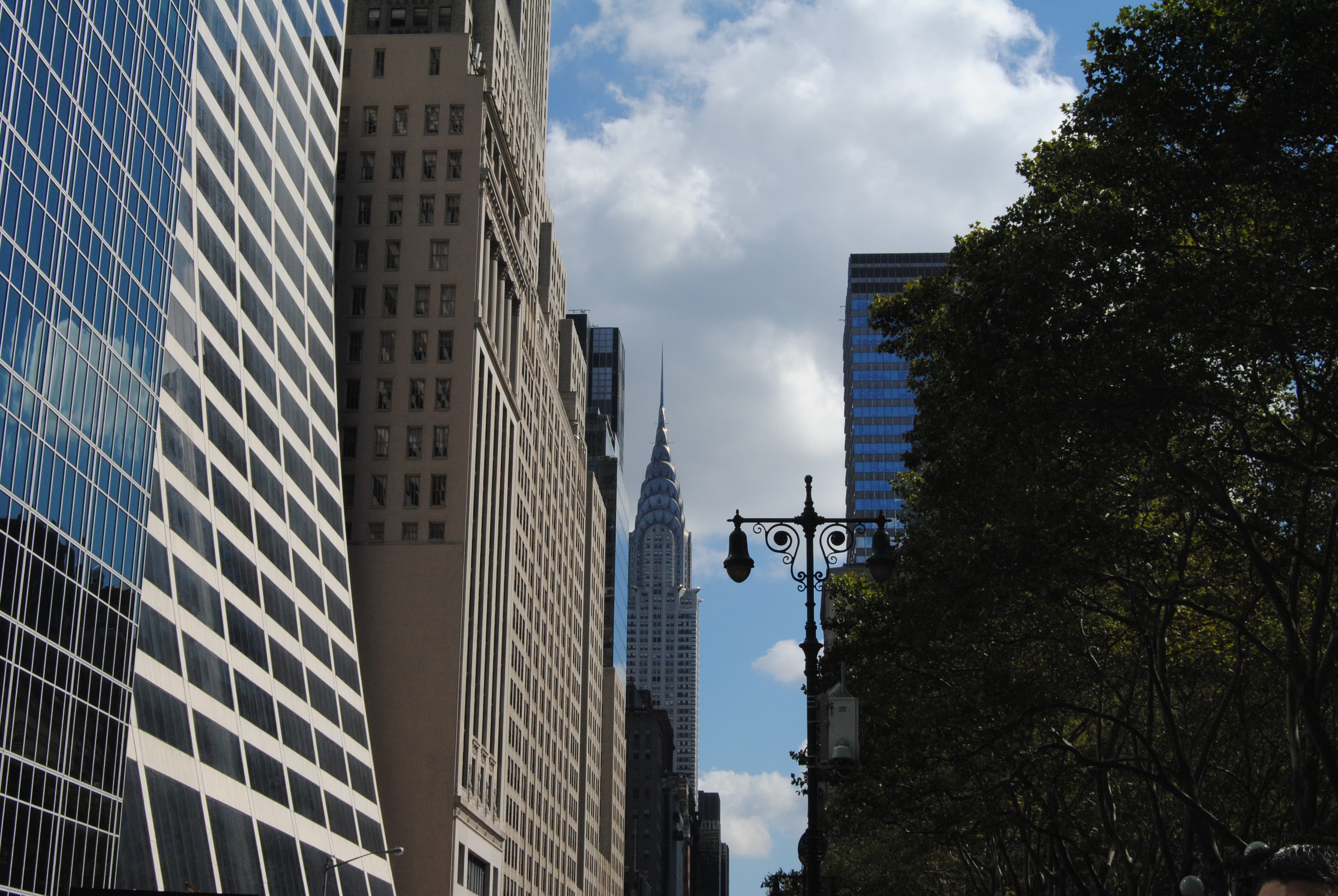
Stand at the corner of 42nd Street and Lexington Avenue and look up, and the first thing you see is not the building. It is the crown. Seven concentric stainless-steel arches rise in steps above the 71st floor, narrowing to a needle-thin spire, their triangular windows catching the sun by day and glowing from within at night. The arches are patterned with a radiating sunburst, and the whole composition looks less like the top of an office building than like a piece of jewelry — which is exactly what it was meant to be. The Chrysler Building was built as an advertisement for the automobile age, and its crown is the most glamorous advertisement ever put on a skyline.
The tower below the crown is 77 stories and 1,046 feet (319 meters) tall, clad in brick with white stone trim, and it is worth looking at the whole shaft, not just the top. The setbacks step back in the classic 1916-zoning-law silhouette, and the 31st-floor frieze is one of the building's great jokes: a band of winged radiator caps, fenders, and hubcaps in stainless steel, the parts of a 1929 Chrysler automobile turned into architectural ornament. Higher up, at the corners of the 61st floor, sit the building's most famous creatures — great stainless-steel eagles, their wings spread, modeled on the hood ornaments of the 1929 Chrysler automobile. They are gargoyles in the medieval sense, perched on a skyscraper to guard it, and they are also a corporate logo blown up to the scale of mythology.
The crown is made of Nirosta stainless steel, a German alloy chosen because it would never need painting and would never rust — and it has kept that promise. Where other towers of the era have been reclad or dulled, the Chrysler's crown still shines exactly as it did in 1930. At night, when the triangular windows are lit, the crown looks like a beacon, and it is the detail that lets you pick the Chrysler Building out of the Midtown skyline from almost anywhere in the city, even among towers that are now far taller.
The race for the sky
The Chrysler Building exists because of a race, and the race is the best story in New York architecture. In the late 1920s, two projects were competing to become the tallest building in the world: Walter P. Chrysler's tower at 42nd Street and Lexington Avenue, designed by William Van Alen, and the Bank of Manhattan Building at 40 Wall Street downtown, designed by H. Craig Severance — who happened to be Van Alen's former business partner. The rivalry was personal as well as commercial, and it played out in public, with each side announcing new heights as construction climbed.
By the autumn of 1929, the contest looked settled. The Bank of Manhattan Building had topped out at 927 feet, taller than anything Van Alen had announced, and its developers were celebrating. What they did not know was that Van Alen had been building a secret weapon inside his own tower. For months, workers had been assembling a 185-foot stainless-steel spire in sections inside the Chrysler Building's upper floors, hidden from the street and from the newspapers. On October 23, 1929, the spire was jacked out through the roof in sections and bolted into place in about ninety minutes. The Chrysler Building was suddenly 1,046 feet tall — the tallest building in the world, and the first structure in history to pass 1,000 feet.
The triumph was brief. The Empire State Building, completed in May 1931, took the title at 1,250 feet and has kept the fame ever since. But the Chrysler Building's eleven months at the top were enough to make it immortal, and the spire trick remains the most famous maneuver in the history of skyscraper building. It was also, in a sense, the point of the whole project: Walter Chrysler had paid for the building himself, as the headquarters of his automobile company and as a monument to himself, and he wanted it to be the tallest thing in the world. For a little under a year, it was.
William Van Alen and the Art Deco moment
The Chrysler Building is the purest expression of Art Deco in New York, and its architect, William Van Alen, is the reason why. Van Alen had trained in Paris and came back to America fluent in the geometric, machine-age style that was sweeping the 1925 Paris Exposition. He designed the Chrysler Building as a total work of that style: not just a tower with decoration applied to it, but a building whose structure, ornament, and materials all spoke the same language of speed, shine, and modernity.
The details repay close attention. The entrance on Lexington Avenue is a great stainless-steel portal, a kind of proscenium arch for the automobile age, with the building's name worked into the metal. The lobby, when you can see it, is one of the great interiors of New York: African marble walls, chrome, and a ceiling mural by Edward Trumbull called "Transport and Human Endeavor," which shows workers, airplanes, trains, and automobiles in a swirling celebration of the machine age. The elevator doors are inlaid with wood marquetry in Art Deco patterns. Even the directory boards and the mailboxes are designed in the same spirit. Nothing in the building is accidental; Van Alen treated a corporate headquarters as if it were a cathedral, and the result is the most complete Art Deco interior in the city.
Van Alen's relationship with Chrysler ended badly — the two fell out over fees, and Van Alen was never fully paid for his most famous building — but the building outlasted the quarrel. It is now a New York City landmark, designated in 1978, and it is routinely voted the most beautiful skyscraper in the city by architects and New Yorkers alike. The Empire State Building may be more famous, and One World Trade Center is taller, but ask a New Yorker which tower they love most and the answer is very often the Chrysler.
A building built as a monument
It is worth remembering what the Chrysler Building was for. Walter P. Chrysler did not build it as a speculative office tower. He built it as the headquarters of the Chrysler Corporation, which he had founded in 1925, and he financed it personally, so that it would carry his name and his company's identity. The automobile ornament — the radiator caps, the hubcaps, the eagle hood ornaments — was not decoration chosen at random. It was the company's product line turned into architecture, a headquarters that was itself an advertisement for what the company made.
That is why the building feels different from a generic office tower, even today. It was designed to be looked at, to be photographed, to be recognized from a distance — and it still works that way. The Chrysler Corporation moved out decades ago, and the building has passed through many owners since, but the identity stuck. No one calls it anything but the Chrysler Building, and the crown remains one of the most reproduced images of New York in the world, on posters, in films, and in the opening credits of a hundred movies.
The building also marks a turning point in the city's history. It opened on May 27, 1930, in the first full year of the Great Depression, and it was one of the last great towers of the 1920s boom. The optimism of its crown — the sunburst, the shining steel, the eagles — belongs to the decade that built it, and it has become, in retrospect, a kind of monument to that decade's ambition. The Depression ended the race for the sky for a generation; the Chrysler Building is the race's most beautiful survivor.
Seeing the Chrysler Building today
Here is the honest part, and it matters for planning a visit: the Chrysler Building is an office building, not a museum, and it does not offer the kind of public access its more famous rival does. There is no public observation deck — the building's old observation level closed long ago, and the Cloud Club, the private lunch club that once occupied the 66th to 68th floors, closed in 1979. The lobby, one of the great Art Deco interiors in New York, is not reliably open to casual visitors; access has been limited and varies with the building's security policies, so a lobby visit cannot be counted on. Do not plan a trip around going inside.
That is not a reason to skip it. The Chrysler Building is best appreciated from the street, and the street views are free and spectacular. The classic vantage point is from 42nd Street and Lexington Avenue itself, looking straight up at the crown — the foreshortening makes the tower seem impossibly tall, and the eagles are visible on the 61st floor if you look carefully. Walk a block east to Third Avenue for a cleaner full-height view, or cross to the north side of 42nd Street for the best angle on the Lexington Avenue entrance. At dusk, when the crown's triangular windows light up, the building is at its most beautiful, and the contrast with the glass towers around it — the Chrysler is brick and steel, warm where they are cold — is at its sharpest.
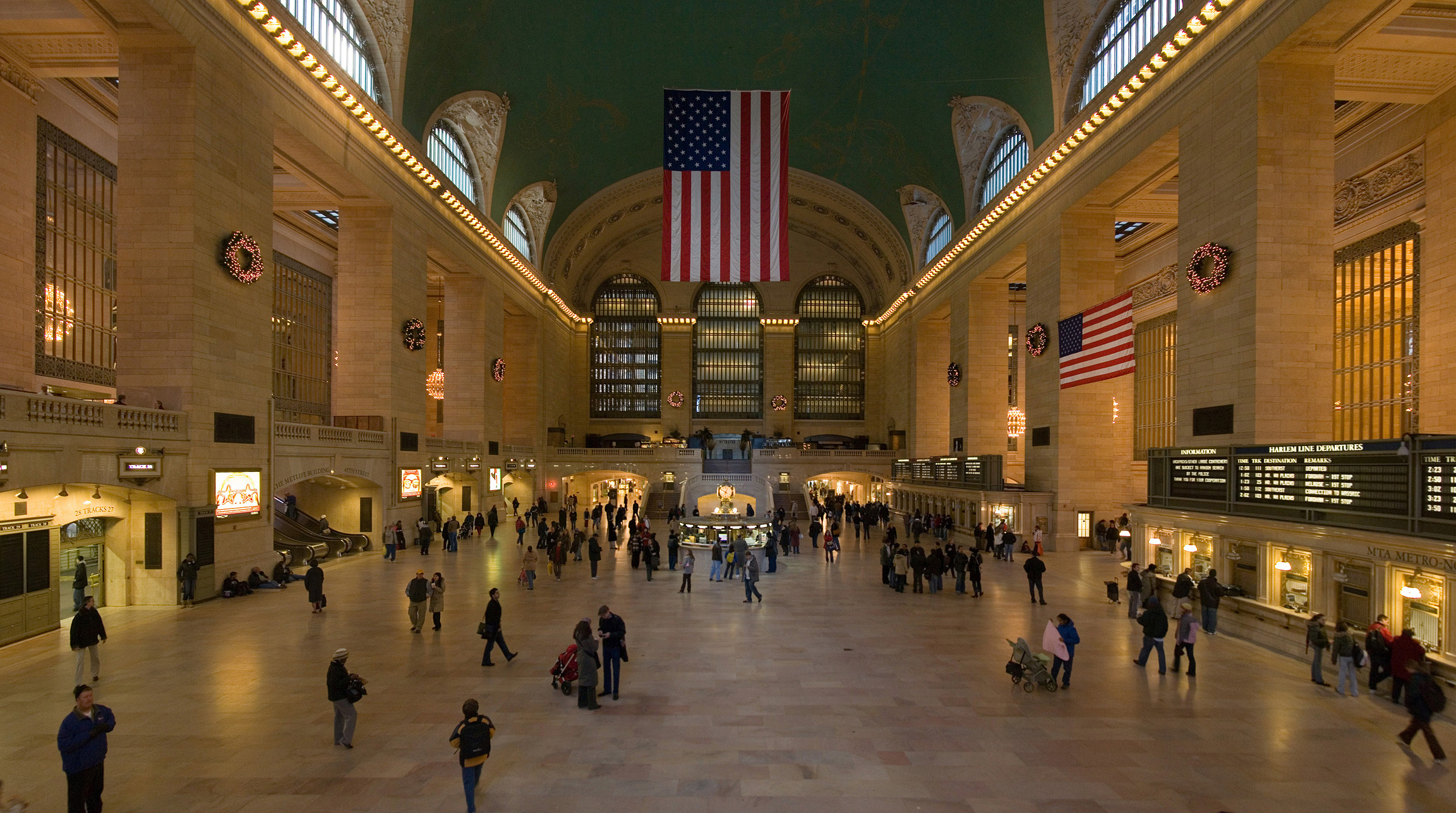
The neighborhood rewards a longer look. The Chrysler Building sits one block east of Grand Central Terminal, and the two buildings belong together: Grand Central is the great Beaux-Arts gateway of the railroad age, and the Chrysler is the Art Deco tower of the automobile age, built a generation later on the same Midtown grid. Walk between them, and you walk through the two eras that made modern New York. The New York Public Library's main branch at Fifth Avenue and 42nd Street is a short walk west, and the whole stretch of 42nd Street between the library and the Chrysler is one of the best short walks in Manhattan.
The best views of the crown
If you want to photograph the Chrysler Building, the best views are not from its own doorstep. The crown is designed to be seen from a distance, and it rewards anyone who steps back. From the south, the view down Lexington Avenue frames the tower between the buildings on either side, and the crown rises above the street wall like a lighthouse. From the east, along Third Avenue or from the Queensboro Bridge approach, the full silhouette reads against the sky. From the west, the top of the Empire State Building's observation deck — and, on a clear day, Top of the Rock at Rockefeller Center — gives you the classic postcard pairing: the Empire State Building in the foreground, the Chrysler's crown gleaming a few blocks east.
For the most dramatic view of all, go to the east side of Manhattan at night. The crown's lit triangles are visible from across the East River, from Long Island City in Queens, and the building's silhouette is the one that tells you you are looking at New York. Photographers have been chasing that view for ninety years, and it has not gotten old. The Chrysler Building is not the tallest tower in the skyline anymore, and it has not been for nearly a century. It is still the one you notice first.
Why the Chrysler Building endures
Skyscrapers are usually remembered for being the tallest, and the Chrysler Building held that title for less than a year. It is remembered instead for being the most beautiful — and that is a rarer achievement. The crown, the eagles, the radiator-cap frieze, the lobby mural: these are not the ornaments of a building trying to be tall. They are the ornaments of a building trying to be loved. Van Alen designed a tower that would make people look up and smile, and it still does.
For a first-time visitor, the Chrysler Building is also the easiest great sight in New York to see well. It costs nothing, it takes ten minutes, and it sits at one of the great crossroads of the city, next to Grand Central and a short walk from the library, Times Square, and Bryant Park. Stand on 42nd Street at dusk, look up at the crown, and remember the spire that was assembled in secret inside the tower and raised in ninety minutes to win a race for the sky. The building has been outgrown by its neighbors, but it has never been outshone. That is why, nearly a century after it opened, it is still the tower New Yorkers point to when they want to show a visitor what their city can do.
Key Facts
- The Chrysler Building, at 405 Lexington Avenue (at 42nd Street) in Midtown Manhattan, was built between 1928 and 1930 and opened on May 27, 1930.
- Architect: William Van Alen, for Walter P. Chrysler, who financed the building personally as the headquarters of the Chrysler Corporation.
- The building is 77 stories and 1,046 feet (319 meters) tall, including its spire.
- The Chrysler Building was the tallest building in the world from its completion in 1930 until the Empire State Building was completed in May 1931 — the first structure in history to exceed 1,000 feet.
- Its 185-foot stainless-steel spire was assembled in secret inside the tower and jacked out through the roof on October 23, 1929, in about ninety minutes, overtaking the Bank of Manhattan Building at 40 Wall Street (927 feet) in the race for the world's tallest building.
- The Art Deco crown consists of seven concentric stainless-steel arches with triangular windows in a radiating sunburst pattern, made of Nirosta stainless steel, which has never needed painting and has never rusted.
- The 31st-floor frieze features winged radiator caps, fenders, and hubcaps in stainless steel; the 61st-floor corners carry stainless-steel eagle gargoyles modeled on the hood ornaments of the 1929 Chrysler automobile.
- The lobby features African marble walls, chrome detailing, wood-marquetry elevator doors, and a ceiling mural by Edward Trumbull titled "Transport and Human Endeavor" (1930).
- The Cloud Club, a private lunch club on the 66th to 68th floors, closed in 1979; the building's observation level closed long ago, and there is no public observation deck today.
- The Chrysler Building was designated a New York City landmark in 1978.
- The building sits one block east of Grand Central Terminal, at the intersection of 42nd Street and Lexington Avenue in Midtown Manhattan.
Visitor Details
Address: The Chrysler Building, 405 Lexington Avenue, New York, NY 10174 (at East 42nd Street, Midtown Manhattan, one block east of Grand Central Terminal)
Transit: Grand Central–42nd Street station (4, 5, 6, 7, and S trains) is one block west; the Lexington Avenue/42nd Street area is also served by numerous bus routes along Lexington Avenue and 42nd Street.
Access: The Chrysler Building is a private office building, not a public attraction. There is no public observation deck, and lobby access is limited and not guaranteed for casual visitors — do not plan a visit around going inside. The building is best appreciated from the street, free of charge, at any hour.
Best timing: Go at dusk, when the crown's triangular windows are lit and the stainless-steel arches glow against the darkening sky; the classic street-level view is from 42nd Street and Lexington Avenue, looking up. Allow ten to thirty minutes for the building itself, and pair it with Grand Central Terminal (one block west), the New York Public Library main branch at Fifth Avenue and 42nd Street, and Bryant Park, all within a short walk. For a distant view of the crown, try the east side of Manhattan at night, or the observation decks at the Empire State Building and Top of the Rock.
Location Photography