Four City Blocks of Architectural Evolution
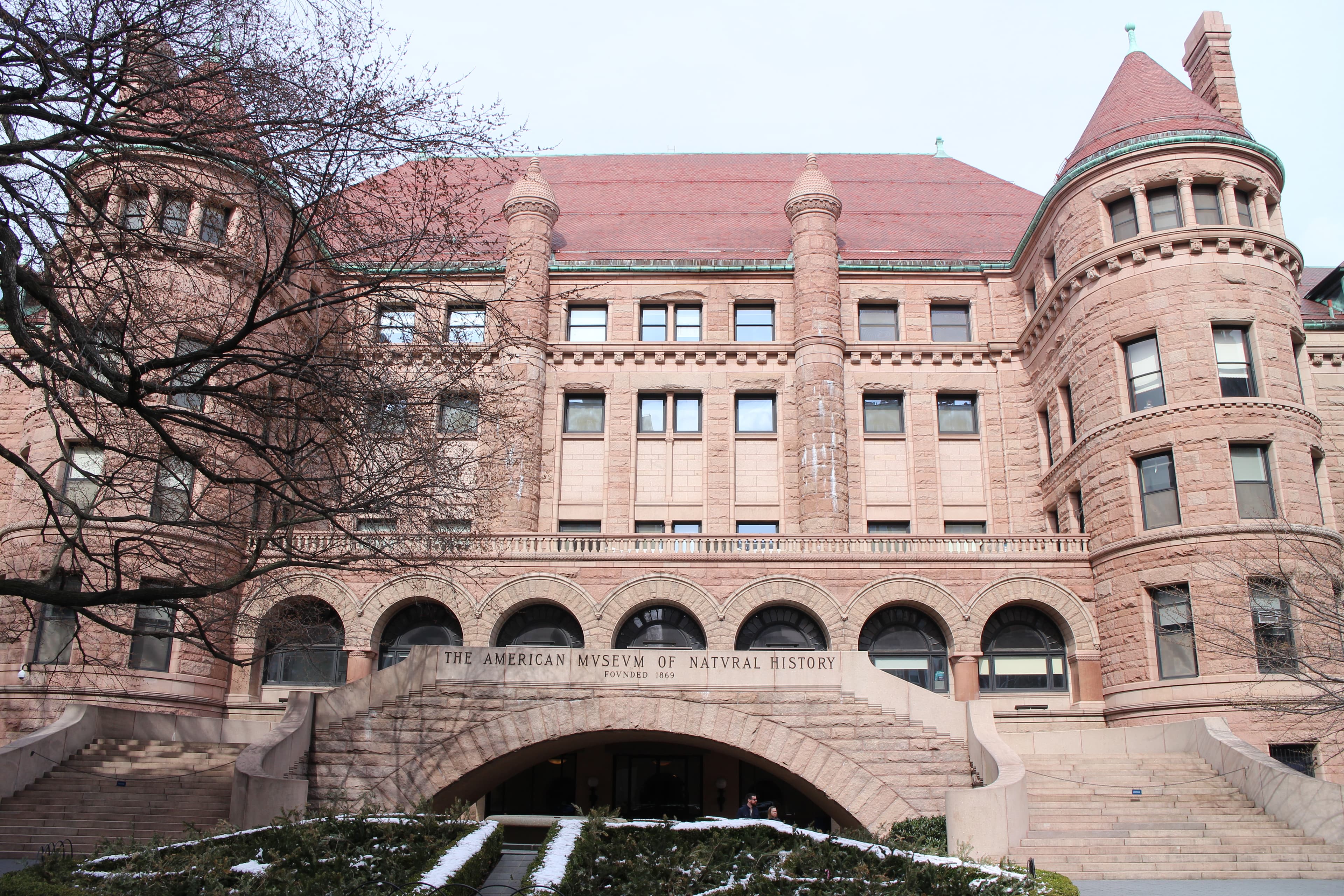
Founded in 1869, the American Museum of Natural History encompasses more than 40 exhibition halls across 2 million square feet. Rather than a single continuous building, it is an interconnected complex representing Victorian Gothic, Romanesque Revival, and Beaux-Arts architectural traditions, with contemporary shotcrete construction.
The Gilder Center Addition
Opened in 2023, the Richard Gilder Center for Science, Education, and Innovation designed by Studio Gang introduced an organic, canyon-inspired atrium built using structural sprayed concrete, creating a continuous flow connecting previously dead-ended wings.
A museum born in an arsenal
The museum began as a pitch. In 1869, the naturalist Albert Smith Bickmore — a former student of Harvard zoologist Louis Agassiz — persuaded a group of wealthy New Yorkers, including Theodore Roosevelt Sr. and J. P. Morgan, to back a natural history museum for the city. Governor John Thompson Hoffman signed the act of incorporation on April 6, 1869, and John David Wolfe became its first president. The new institution had no building. It opened to the public on May 22, 1871, on the top two floors of the Central Park Arsenal, with insects below and stones, fossils, mammals, birds, fish, and reptiles above. It was an immediate hit: in the first nine months of 1876 alone, the Arsenal location drew 856,773 visitors — more than the British Museum recorded for all of 1874. Calls for a natural history museum had been growing since P. T. Barnum's American Museum burned down in 1868, and Bickmore's pitch landed at exactly the right moment. The Arsenal was too small, so the museum secured Manhattan Square, a block across from Central Park between 77th and 81st Streets. The cornerstone of the first purpose-built building was laid on June 2, 1874, by President Ulysses S. Grant, with three cabinet members, the governor, and the mayor in attendance. Three years later the building opened, and President Rutherford B. Hayes presided over the ceremony. The museum had gone from a borrowed arsenal to its own address in eight years.
Reading the building like a timeline
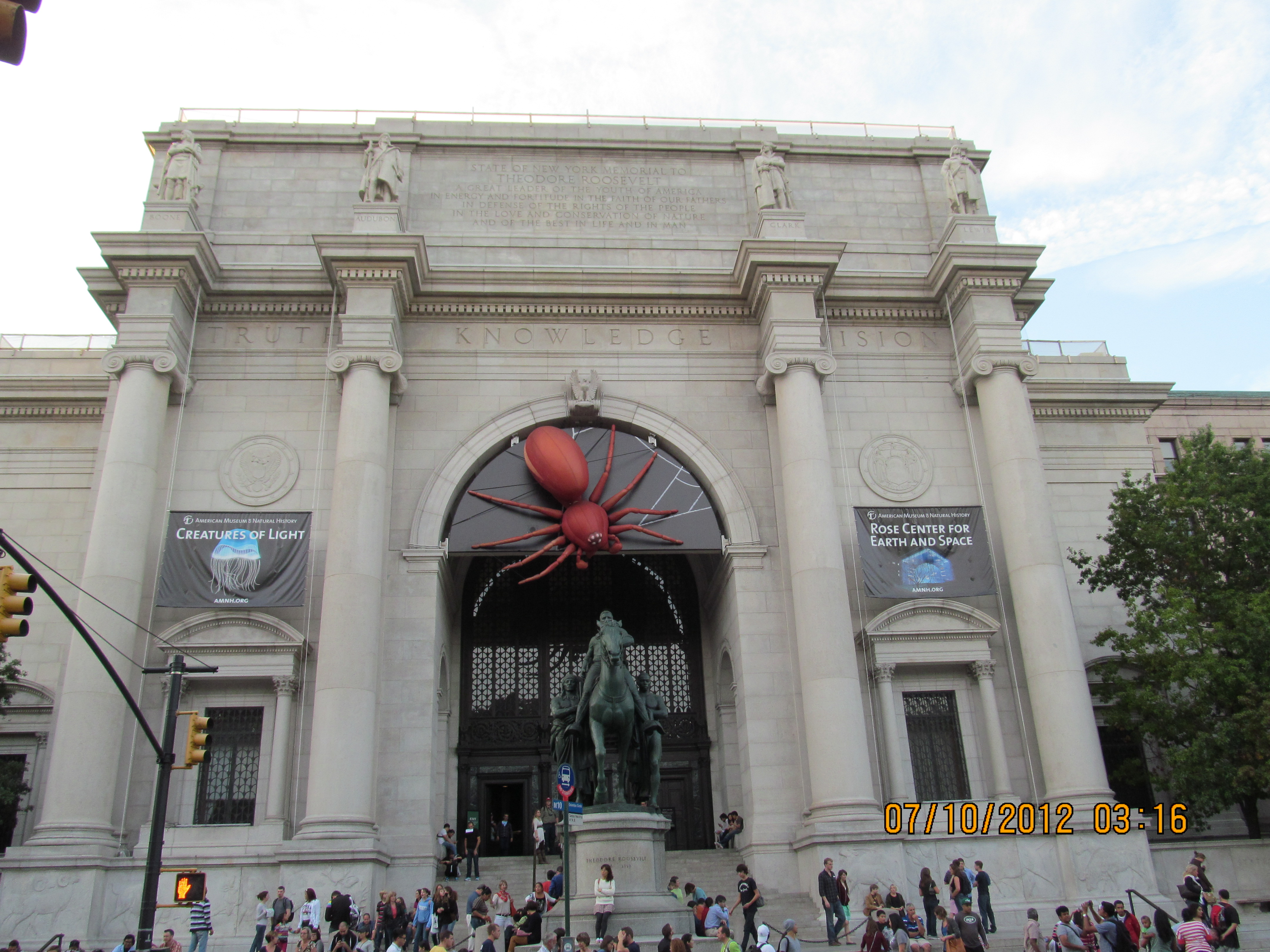
No single architect designed the museum, which is why the building reads like a timeline of American taste. The first structure, by Calvert Vaux and Jacob Wrey Mould — the Central Park architects — was a five-story Victorian Gothic block completed in 1877. You can still find it: it survives, largely intact, buried behind the center of the long 77th Street pavilion, wrapped by everything that came after. In 1891 the museum hired Josiah Cleaveland Cady, designer of the original Metropolitan Opera House, and taste had moved on. Cady's addition was Richardsonian Romanesque — rusticated brownstone, heavy arches — and it completely enveloped Vaux and Mould's Gothic original. The Landmarks Preservation Commission calls the result the most impressive example of Romanesque Revival architecture in New York City. The firm Cady, Berg & See extended the composition with east and west wings in the 1890s, completing the principal 77th Street elevation from Columbus Avenue to Central Park West. The grandest face came last. In 1936, John Russell Pope completed the Beaux-Arts entrance on Central Park West: a triumphal arch dedicated as the Theodore Roosevelt Memorial, leading into a Roman basilica of a rotunda. There stands the museum's most dramatic greeting — a rearing Barosaurus defending her young from an Allosaurus. Four architectural eras, eighteen interconnected buildings, and close to twenty architects: the museum is a palimpsest you can walk through. Theodore Roosevelt's father had been one of the museum's founders, which made the memorial a family homecoming of sorts.
Akeley's elephants
The Akeley Hall of African Mammals began as one man's obsession. In 1909, the explorer and taxidermist Carl Akeley conceived a hall that would show Africa's large mammals the way they actually lived. Akeley had revolutionized his craft — replacing crude straw-stuffed mounts with light, strong manikins modeled from exact clay casts, methods he shared freely with other museums — and he wanted a stage worthy of it. He died of dysentery in Africa in 1926, on his final expedition, a decade before the hall opened. The hall that opened on May 19, 1936, is built around a freestanding group of eight elephants at its center, surrounded by 28 habitat dioramas spread over two floors. Each diorama recreates a scene that scientists observed in the field — photographed and sketched by accompanying artists during expeditions through Africa in the 1920s and 1930s — and each depicts a particular place at a particular time of day. The work was collaborative on an industrial scale. Akeley and James L. Clark served as chief taxidermists, and the background panoramas were painted by artists including Francis Lee Jacques and William R. Leigh, working from field studies; Martin and Osa Johnson contributed photographic research. Between 1926 and the opening, the project usually employed about 45 men at a time in the museum's preparation studios. It took a decade of expeditions and thousands of hours of preparation to assemble — and it remains one of the most celebrated museum displays in the world.
The whale and the canyon
The Hall of Ocean Life began in 1933, but its centerpiece arrived in the Space Age. When the redesigned Hall of Ocean Life and Biology of Fishes opened on February 26, 1969, visitors found a 94-foot, 21,000-pound blue whale suspended overhead — the largest model of the largest creature ever to have lived. It had been lifted to the ceiling three months earlier in two halves, a 66-foot front section and a 28-foot tail, and the Sunday after opening drew more than 35,000 people, a museum attendance record. The whale was built from guesswork. Ocean science was young, and no one had seen a blue whale alive underwater; the model was based on photographs of a dead female found in 1925 off the southern tip of South America. It replaced a 76-foot plaster whale from 1907 — when the old model was auctioned off in 1974, one bidder paid $530 for a single glass eye, saying, "Once you look in the eye of a whale, you never forget it." In 2003 the whale was renovated and recolored with 25 gallons of cobalt and cerulean blue paint, its bulging eyes flattened, its anatomy corrected. The hall was renamed for the Milstein family. The museum's newest chapter opened on May 4, 2023: the Richard Gilder Center for Science, Education, and Innovation. Announced in 2014, the $465 million, 230,000-square-foot addition was designed by Jeanne Gang's Studio Gang as a canyon-like atrium of curving, cave-mouthed walls — built with shotcrete, the sprayed-concrete technique invented by none other than Carl Akeley. The center creates 33 connections among 10 museum buildings, erasing decades of dead ends, and adds a new entrance on Columbus Avenue at 79th Street, a butterfly conservatory with 1,000 free-flying butterflies, and an insectarium. Akeley's technique, invented for taxidermy, now holds up a building.
Notable Exhibits
- The 94-foot-long blue whale model hangs suspended above visitors in the Milstein Family Hall of Ocean Life.
- The world-famous Fourth Floor Fossil Halls house a Tyrannosaurus rex and towering Titanosaur casts.
- The historic Akeley Hall of African Mammals is renowned for its masterfully painted habitat dioramas.
Hero photo: Suicasmo, CC BY-SA 4.0, via Wikimedia Commons.
Location Photography


Gallery photos: Ferfive (CC BY 4.0), Ferfive (CC BY 4.0), Jakub Hałun (CC BY 4.0), Saptarshi Pal (CC BY-SA 4.0) via Wikimedia Commons.