
A museum on Collins Avenue
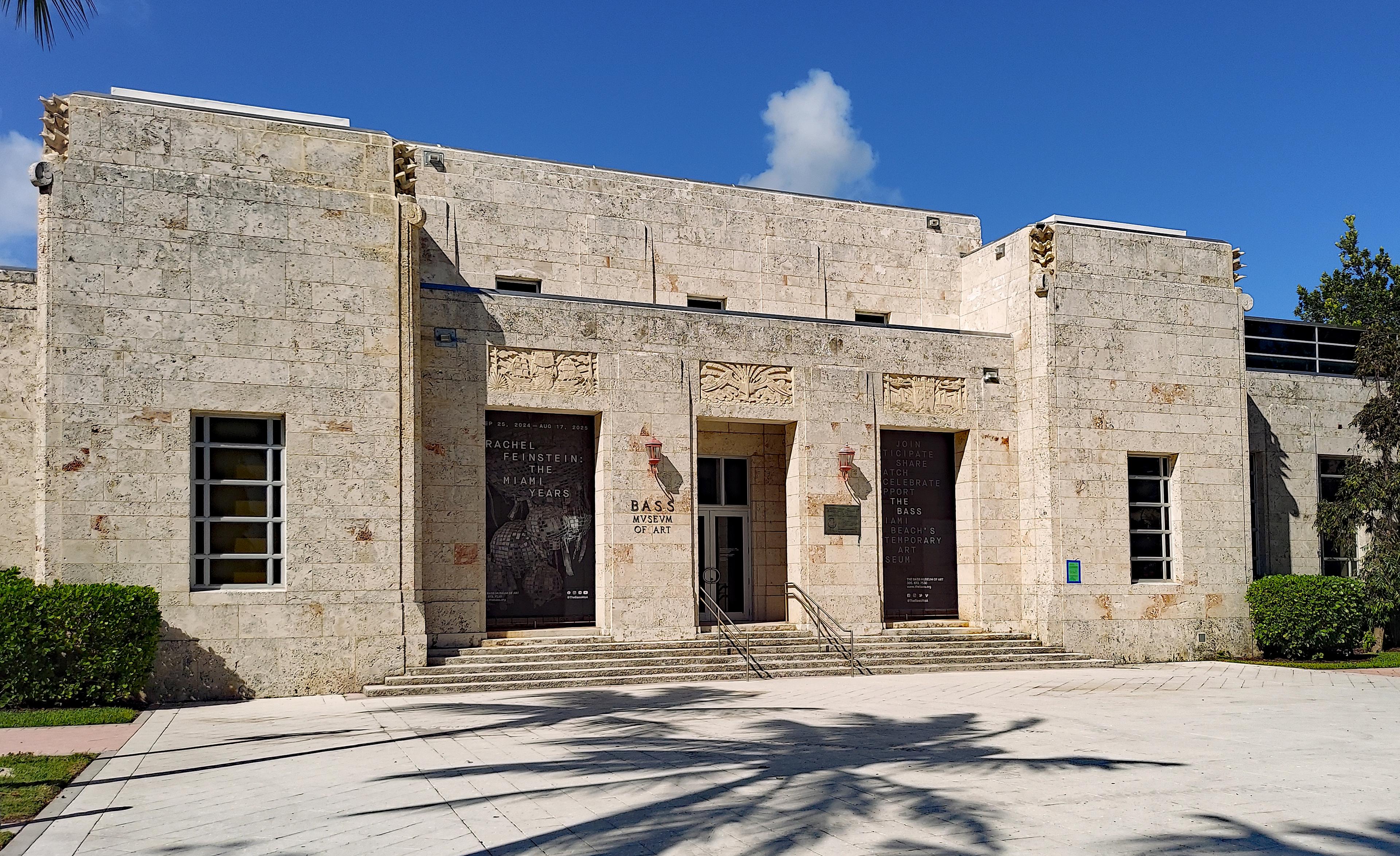
The Bass Museum of Art stands at 2100 Collins Avenue in Miami Beach, on the edge of Collins Park, a block from the beach. The building is a low, symmetrical, pale-stone Art Deco structure with a flat roofline, set behind a paved plaza — and it is easy to walk past it on the way to the sand without realizing that it is one of the most consequential small museums in the United States. Inside are a mummy in its sarcophagus, Flemish tapestries from the sixteenth century, Old Master paintings by Rubens and Dürer, and, upstairs, some of the most ambitious contemporary art being shown anywhere in Florida.
The museum's story is really three stories braided together: the story of John and Johanna Bass, Viennese Jewish immigrants who spent a lifetime collecting and then gave it all away; the story of a 1930s Art Deco building that began life as a public library; and the story of a museum that, in the last fifteen years, has transformed itself from a quiet municipal collection of European art into a contemporary art institution at the center of Art Basel Miami Beach week. None of those stories makes sense without the other two.
The Bass — the name the museum has used since a 2017 rebranding dropped "Museum of Art" from its public identity — is Miami Beach's contemporary art museum. It was founded in 1963 and opened on April 7, 1964, and at the time it was the only municipally operated art gallery in South Florida. It has been open to the public ever since, with one long interruption in the 1970s, under the terms of the bequest that created it: the Basses gave their collection to the City of Miami Beach on the condition that a museum remain open to the public in perpetuity.
John and Johanna Bass: a Viennese collection in Miami Beach
John Bass was born in Vienna in 1891. He wanted to study art; his father sent him to business school instead. He moved to New York in 1914, spent time as an unsuccessful pianist, took a job as an errand boy at a Wall Street firm, and eventually became president of the Fajardo Sugar Company of Puerto Rico. He was, by every account, a man of wide and restless interests: an amateur journalist, a painter and etcher, and a composer of published music. He also collected — fine art, cultural artifacts, and a sizeable manuscript collection that now lives in the Carnegie Hall Archives.
Johanna Redlich married John Bass on February 21, 1921. The couple were Jewish immigrants from Vienna who settled in Miami Beach, and over the decades they built a private collection of more than 500 works: Old Master paintings, textiles, tapestries, and sculptures, mostly European works from the fifteenth to the early twentieth century. In 1963, they bequeathed the whole collection to the City of Miami Beach, along with funds, under the agreement that a Bass Museum of Art would remain open to the public in perpetuity.
The city spent $160,000 renovating a building for the new museum — the former Miami Beach Public Library and Art Center, a 1930s Art Deco building designed by Russell Pancoast — and the Bass Museum of Art opened its doors on April 7, 1964. John Bass directed the museum from its founding until his death in 1978. The collection he and Johanna assembled remains the foundation of the institution: some 200 of the original paintings, textiles, and sculptures form what has been described as one of the most comprehensive collections of European art in the southeastern United States.
The Art Deco building: a library becomes a museum
The building is as much a part of the story as the collection. It was designed in 1930 by Russell Pancoast, the grandson of John Collins — the developer after whom Collins Avenue is named, and on whose former land the museum stands. Pancoast was one of the architects who shaped Miami Beach's built character, and the library building is a restrained example of the Art Deco style that defines the city: symmetrical, pale, and monumental without being ornate.
The building had already lived one life before the museum arrived. It was Miami Beach's first public library and art center, and its conversion into a museum in 1963–64 was a piece of civic recycling that the city has repeated ever since: the same walls that held the library's books now hold the Basses' paintings. In 1978, the building was placed on the National Register of Historic Places, which is why every expansion since has had to work within — or carefully around — its historic shell.
That constraint has shaped the museum's architecture ever since. The building grew from about 15,000 square feet to more than 35,000 square feet over the course of two expansions, but its footprint on Collins Park barely changed. The architects who managed that trick were among the most distinguished working anywhere: Arata Isozaki, the Japanese architect who would later win the Pritzker Prize, designed the first expansion, and his protégé David Gauld led the second.
The collection: Old Masters, tapestries, and a mummy
Walk into The Bass today and the founding collection is still there, now concentrated in a long first-floor gallery and in the museum's "Open Storage" gallery, where works from the permanent collection are shown in dialogue with rotating contemporary artist projects. The permanent collection spans European painting and sculpture from the fifteenth century to the present; textiles, tapestries, and ecclesiastical vestments from the seventh to the twentieth centuries; twentieth- and twenty-first-century North American, Latin American, Asian, and Caribbean art; photographs, prints, and drawings; and modern and contemporary architecture and design, with an emphasis on the pre- and postwar design history of Miami Beach itself.
Two parts of the founding collection have become the museum's signature. The first is the Old Master paintings: works attributed to the studio of Domenico Ghirlandaio, a Holy Family with St. Anne by Peter Paul Rubens, paintings by Albrecht Dürer, and works by artists including Gerard Seghers, Ferdinand Bol, and Cornelis Cornelisz van Haarlem. In 2015–16, a selection of the Northern European works traveled to the Lowe Art Museum at the University of Miami for the exhibition Dürer to Rubens: Northern European Art from the Bass Museum, a measure of how seriously the collection is regarded outside Miami Beach.
The second is the textiles. The Basses collected tapestries and ecclesiastical vestments with the same seriousness they brought to painting, and the museum's holdings of sixteenth-century Flemish tapestries are among its most distinctive assets. The collection also includes the museum's most unexpected object: an Egyptian sarcophagus and mummy. John Bass acquired the sarcophagus and mummy in 1971 from Galerie Fischer in Lucerne, Switzerland, and in 2010 the museum opened its Egyptian Gallery — the only Egyptian gallery in Florida — showcasing fourteen objects of Egyptian antiquity, including the mummy, with loans from the Brooklyn Museum, the Lowe Art Museum, and private collections, and with Dr. Edward Bleiberg of the Brooklyn Museum as consulting curator.
The troubled years: authenticity, closure, and revival
The Bass's early decades were not smooth. In 1969, published reports cast doubt on the authenticity of many of the paintings in the collection, and a group of citizens asked the Art Dealers Association for an independent appraisal. In 1973, the Miami Beach City Council temporarily closed the museum. It did not reopen until January 1980.
The reopening came with new leadership. In 1980, the art historian Diane Camber was hired as executive director, and for the next thirty years she rebuilt the institution: obtaining accreditation from the American Alliance of Museums, producing scholarly exhibitions, and running the capital campaign for a building expansion. The renovations of 2001 and the 16,000-square-foot expansion designed by Arata Isozaki, inaugurated in 2002 with the exhibition Globe Miami Island, more than doubled the museum's size, from 15,000 to 35,000 square feet. Camber's tenure turned a small, troubled municipal museum into a significant cultural institution — and it set the stage for the transformation that followed.
The contemporary turn: Silvia Karman Cubiñá
In 2009, George Lindemann Jr. became president of the board, and Silvia Karman Cubiñá — once a local independent curator — was appointed executive director and chief curator. Under Cubiñá, the museum's focus shifted decisively toward contemporary art. The exhibition program she built reads like a survey of international contemporary practice: Where Do We Go From Here? Selections from la Colección Jumex (2009), Isaac Julien's Creative Caribbean Network (2010), Erwin Wurm's Beauty Business (2011), The Endless Renaissance (2012), From Picasso to Koons: The Artist as Jeweler (2013), Piotr Uklański's ESL (2013), Vanitas: Fashion and Art (2014), Gravity and Grace: Monumental Works by El Anatsui (2014), GOLD (2014), and One Way: Peter Marino (2015). In 2003, before Cubiñá's arrival, the museum had presented the traveling exhibition US DESIGN, 1975–2000, a critical assessment of three generations of American designers — an early sign of the design interests that remain part of the collection today.
The shift was not only curatorial. In 2013, the Bass announced a $7.5 million grant from the City of Miami Beach to begin a second phase of transformation. The museum closed for construction in May 2015 and, after delays that pushed the reopening from a planned December 2016 debut during Art Basel Miami Beach week into the following year, it opened on October 29, 2017 — two years and a $12 million overhaul later, weeks after Hurricane Irma had passed over the city and spared the building. David Gauld was the principal architect, with Isozaki as design consultant, and the project increased the museum's programmable space by almost 50 percent without altering the building's footprint: four new galleries adding 4,100 square feet, a museum store, a café, and the Creativity Center, which opened as the largest art museum education facility in Miami-Dade County, with three classrooms and a courtyard for multigenerational programs. As part of the same transformation, the museum rebranded itself simply as "The Bass."
The reopening exhibitions announced the new identity. On the second floor, Ugo Rondinone's good evening beautiful blue filled the galleries with life-size clown sculptures, slumped and sitting on the floor. Downstairs, Pascale Marthine Tayou's Beautiful set a wall of LED screens saying "welcome" in more than seventy languages against towers of ceramic pottery in the Open Storage gallery — the first contemporary artist project staged in dialogue with the historic collection. Mika Rottenberg's exhibition opened that December, timed to Art Basel Miami Beach. The museum had stopped trying to be an encyclopedic institution and become, in Cubiñá's phrase, a place of dynamic experience rather than a quiet churchlike space.
Miami Mountain and Collins Park
The most visible sign of the museum's new direction stands outside it, in Collins Park. In 2016, The Bass launched a ten-year initiative to grow its holdings of international contemporary art, and its first acquisition was Miami Mountain (2016) by Ugo Rondinone: a 42-foot-tall column of five boulders painted in fluorescent colors, permanently installed in Collins Park at the corner of 21st Street and Collins Avenue. It was the first of Rondinone's mountain sculptures to be acquired by a museum, and it followed his Seven Magic Mountains — seven towers of thirty-five boulders in the desert outside Las Vegas — by a few months. The boulders came from a quarry in Nevada and crossed the country on flatbed trucks to the beachfront park. Two more acquisitions followed in the initiative's first year: Sylvie Fleury's Eternity Now (2015) and Allora & Calzadilla's Petrified Petrol Pump (Pemex II) (2011).
Miami Mountain has become the museum's outdoor signature — a totem in the park that is visible from Collins Avenue and from the beach, and a natural meeting point before a visit. The Bass's outdoor program in Collins Park has grown around it: works on view have included pieces by Zanele Muholi and a text-based work by Lawrence Weiner that reads, in part, "SHELLS USED TO BUILD ROADS POURED UPON SHELLS USED TO PAY THE WAY, AT THE LEVEL OF THE SEA" — a direct address to the museum's oceanfront context and to rising sea levels.
Art Basel week and the museum today
The Bass's rise is inseparable from Art Basel Miami Beach. The fair's arrival in 2002 transformed Miami Beach into a global art destination every December, and the museum's attendance rose with it; the 2017 reopening was deliberately timed for the fair, and the museum's December exhibitions — Rottenberg in 2017, and in recent years the major survey Nam June Paik: The Miami Years (October 2023 – August 2024) — are built for the art world's annual descent on the city. During Art Basel week, the museum is one of the fair's essential stops: the place where the city's own art history, from the Basses' Old Masters to Rondinone's boulders, meets the contemporary art the fair brings to town. The museum converted to a 501(c)(3) nonprofit corporation as the fair and the city's development accelerated, with support from the John S. and James L. Knight Foundation among others, and it operates on an annual budget of around $4.5 million.
The institution keeps growing. In December 2017, Riccardo and Tatyana Silva donated $500,000 to the museum's endowment, and a first-floor gallery was named for them. In 2022, the Bass received $20.1 million in city-issued funds as part of a municipal general obligation bond approved by voters, to add a new wing for additional exhibition space. Six decades after two Viennese immigrants gave their collection to the city on the condition that it stay open to the public forever, the museum they founded is larger, busier, and more ambitious than it has ever been — and still in the same Art Deco library on Collins Avenue.
How to visit
The Bass Museum of Art is at 2100 Collins Avenue, Miami Beach, FL 33139, facing Collins Park at 21st Street — reach it by Metrobus (routes 14, 36, 79, 100, 150 stop on Collins Avenue at 22nd Street) or the Miami Beach Trolley. Before you go in, walk around Collins Park to see Ugo Rondinone's Miami Mountain, the 42-foot stack of fluorescent boulders at 21st Street and Collins Avenue — it is free, outdoors, and visible at any hour. Inside, start with the Open Storage gallery and the Egyptian Gallery on the ground floor, where the founding collection lives, then go upstairs for the contemporary exhibitions. Allow at least an hour, longer if a major temporary exhibition is on. No fixed admission price or opening hours are stated in this article, since none was verified against the museum's official site in this run: check thebass.org before visiting for current admission and hours.
The Bass Museum of Art in photographs


Key Facts
- The Bass Museum of Art is a contemporary art museum at 2100 Collins Avenue, Miami Beach, FL 33139, facing Collins Park. Coordinates: 25.7964, -80.1299.
- Founded in 1963 and opened April 7, 1964, when the City of Miami Beach accepted the bequest of more than 500 works — Old Master paintings, textiles, tapestries, and sculptures — from John and Johanna Bass, Jewish immigrants from Vienna, on the condition that a museum remain open to the public in perpetuity. At its opening it was the only municipally operated art gallery in South Florida.
- John Bass (1891–1978) was president of the Fajardo Sugar Company of Puerto Rico and an amateur journalist, painter, etcher, and composer of published music; his manuscript collection now lives in the Carnegie Hall Archives. He directed the museum from its founding until his death in 1978. He married Johanna Redlich on February 21, 1921.
- The museum occupies the former Miami Beach Public Library and Art Center, a 1930s Art Deco building designed in 1930 by Russell Pancoast, grandson of John Collins, on land that once belonged to Collins. The city spent $160,000 renovating it before the 1964 opening. The building was placed on the National Register of Historic Places in 1978.
- The founding collection includes European painting and sculpture from the fifteenth century to the present; textiles, tapestries, and ecclesiastical vestments from the seventh to the twentieth centuries; and works including a Holy Family with St. Anne by Peter Paul Rubens and paintings attributed to the studio of Domenico Ghirlandaio. About 200 of the original works form one of the most comprehensive collections of European art in the southeastern United States.
- The museum's Egyptian Gallery, opened in 2010, is the only Egyptian gallery in Florida; it shows fourteen objects of Egyptian antiquity, including a sarcophagus and mummy acquired by John Bass in 1971 from Galerie Fischer in Lucerne, Switzerland, with loans from the Brooklyn Museum and the Lowe Art Museum and Dr. Edward Bleiberg of the Brooklyn Museum as consulting curator.
- In 1969, published reports cast doubt on the authenticity of many paintings in the collection; in 1973 the Miami Beach City Council temporarily closed the museum, and it reopened in January 1980. Art historian Diane Camber was hired as executive director in 1980 and led the museum for thirty years, obtaining American Alliance of Museums accreditation and running the capital campaign for expansion.
- Renovations took place in 2001 and a 16,000-square-foot expansion designed by Arata Isozaki was inaugurated in 2002 with the exhibition Globe Miami Island, more than doubling the museum from 15,000 to 35,000 square feet.
- Silvia Karman Cubiñá became executive director and chief curator in 2009; under her leadership the museum shifted decisively to contemporary art, with exhibitions including Where Do We Go From Here? Selections from la Colección Jumex (2009), Erwin Wurm: Beauty Business (2011), From Picasso to Koons: The Artist as Jeweler (2013), Gravity and Grace: Monumental Works by El Anatsui (2014), and One Way: Peter Marino (2015).
- The museum closed for construction in May 2015 and reopened October 29, 2017 after a $12 million renovation led by David Gauld as principal architect with Arata Isozaki as design consultant, adding four new galleries (4,100 square feet) and increasing programmable space by almost 50 percent without altering the building's footprint. The Creativity Center opened as the largest art museum education facility in Miami-Dade County. The museum rebranded as "The Bass."
- Reopening exhibitions in 2017–18 included Ugo Rondinone's good evening beautiful blue, Pascale Marthine Tayou's Beautiful (the first artist project in dialogue with the historic collection in the Open Storage gallery), Mika Rottenberg, Laure Prouvost's They Are Waiting for You, and the DESTE Fashion Collection's 1 to 8. Nam June Paik: The Miami Years ran October 4, 2023 – August 11, 2024.
- In 2016 the museum launched a ten-year initiative to grow its contemporary holdings; its first acquisition was Ugo Rondinone's Miami Mountain (2016), a 42-foot-tall stack of five fluorescent boulders permanently installed in Collins Park at 21st Street and Collins Avenue, followed by Sylvie Fleury's Eternity Now (2015) and Allora & Calzadilla's Petrified Petrol Pump (Pemex II) (2011).
- In December 2017, Riccardo and Tatyana Silva donated $500,000 to the museum's endowment, and a first-floor gallery was named for them. In 2022, the Bass received $20.1 million in city-issued bond funds approved by voters to add a new wing for additional exhibition space. The museum's annual operating budget is around $4.5 million.
Visitor Details
Address: The Bass Museum of Art, 2100 Collins Avenue, Miami Beach, FL 33139 (facing Collins Park at 21st Street).
Transit: Metrobus routes 14, 36, 79, 100, and 150 stop on Collins Avenue at 22nd Street; Miami Beach Trolley (Middle Beach Loop, Collins Express, South Beach Loop) serves the area.
Hours/Admission: No fixed admission price or opening hours are stated in this article, since none was verified against the museum's official site in this run. Check thebass.org before visiting for current admission and hours.
Best timing: Allow at least an hour, longer for a major temporary exhibition. Visit Collins Park first to see Ugo Rondinone's Miami Mountain outdoors, then the Open Storage gallery and Egyptian Gallery on the ground floor, then the contemporary exhibitions upstairs. December (Art Basel Miami Beach week) is the museum's busiest and most programmed time of year.