
The oldest natural science institution in the Americas
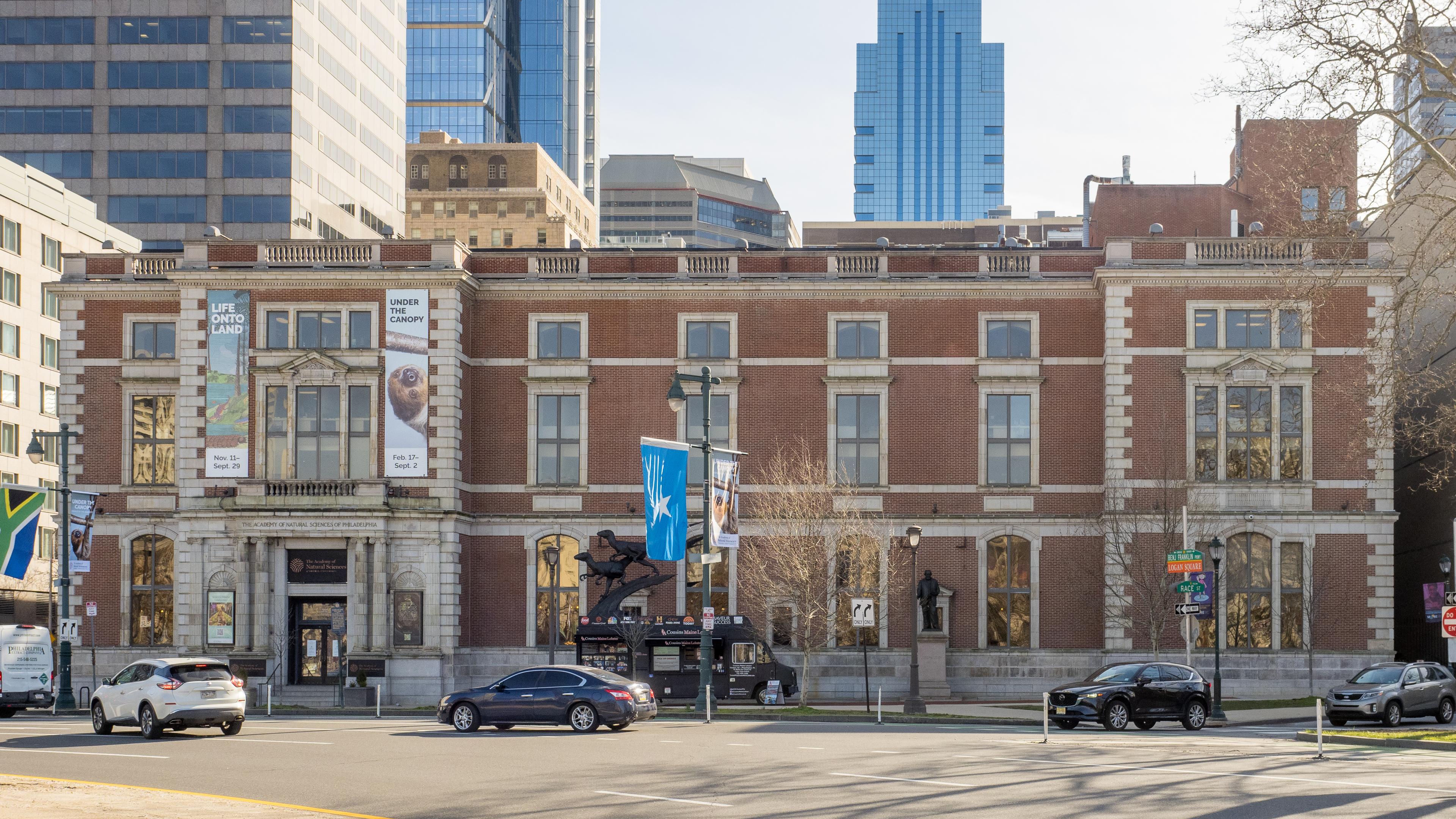
The Academy of Natural Sciences of Drexel University stands at 1900 Benjamin Franklin Parkway, on Logan Square, in the heart of Philadelphia's museum district — a red-brick building with white stone trim, directly across the Parkway from the Franklin Institute and a short walk from Logan Circle. For nearly two centuries it was Philadelphia's natural history museum, and it remains the oldest natural science research institution and museum in the Americas: founded in the winter of 1812, when the United States was barely a generation old and Philadelphia was still the young republic's cultural capital.
That claim is not a slogan. The Academy was founded by leading naturalists of the young American republic with the stated mission of "the encouragement and cultivation of the sciences," and it has been in continuous operation ever since. It opened its collections to the public in 1828, making it one of the earliest public natural history museums in the country. In 1868 it displayed the world's first mounted dinosaur skeleton. Its collections now hold more than 19 million biological specimens, fossils, and archival treasures — among the most significant natural history collections in the world by geographic, biological, and historical depth. Its library and archives hold hundreds of thousands of volumes, journals, illustrations, photographs, and archival items, including rare books dating to the sixteenth century.
This article is written at an unusual moment in the Academy's history. On September 1, 2026, Drexel University announced that the Academy's public museum would close at the end of the month. The last day open to the public under regular hours was Sunday, September 27, 2026, and the museum closed on September 30, 2026. The scientific institution did not close: research, education, and the care of the collections continue from the same building on the Parkway, and Drexel has said it is committed to securing a future for the Academy that may include relocating its public exhibitions to a modern facility in Philadelphia. But as of this writing, there is no general admission on sale and no reopening date. The building, the bronze Deinonychus statue outside it, and the history inside it are still there to be seen from the Parkway — and the story of what happened inside those walls for 214 years is one of the great stories in American science.
A winter of 1812: the founding
Philadelphia in 1812 was the most intellectually ambitious city in America. The Library Company and the American Philosophical Society were centers of enlightened thought, and the city's naturalists were acutely aware that the American wilderness — the vast continent west of the Appalachians, barely explored by science — was full of species no European had ever described. The increasing sophistication of the earth and life sciences, combined with that awareness, led a small group of naturalists to establish the Academy of Natural Sciences in the winter of 1812: an institution meant to foster a gathering of fellow naturalists and to nurture the growth and credibility of American science.
The Academy's first home was a building near the intersection of 3rd and Market Streets. On April 25, 1817, it was incorporated by the Pennsylvania legislature under the title of the Academy of Natural Sciences of Philadelphia. By January 1, 1818, eight members had published scientific work under its name. Within a decade it had become, in the words of its own historians, the undisputed center of natural sciences in the United States. Its members were frequently enlisted to participate in national surveys of the western territories and other major expeditions, and its corresponding members — naturalists who lived far from Philadelphia — included Thomas Jefferson, Georges Cuvier of France, Alexander von Humboldt of Prussia, and, later, Charles Darwin and his supporters Asa Gray and Thomas Henry Huxley.
A Pennsylvania historical marker now stands at 302 Market Street, near the Academy's founding site. Its text reads: "Founded nearby in 1812, it is the oldest natural science institution in the Americas and a leading resource for the study of life on Earth, with outstanding exhibits and scientific collections. It relocated to Logan Square in 1876, and has been part of Drexel University since 2011." The marker was designated on May 15, 2013.
The naturalists: Say, Bonaparte, Audubon, and Lewis and Clark
The Academy's early decades read like a roll call of the founders of American natural science. Thomas Say, a Philadelphia pharmacist who joined the Academy soon after its founding, became the father of American entomology and of American conchology — the study of shells — and described hundreds of new species of insects and mollusks. His colleague Isaac Lea was another pioneering malacologist. Titian Peale, a leading natural history illustrator, served as chief naturalist on the United States Exploring Expedition of 1838–1842, and his moth and butterfly collection remains the oldest entomology collection in the United States.
Charles Lucien Bonaparte — Napoleon's nephew, exiled in America — was one of the Academy's most active early ornithologists, and the Academy's bird collections became one of the largest and most taxonomically complete in the world, with nearly 200,000 specimens representing more than 9,000 species. John James Audubon was a member and a frequent presence; the Academy's collections include specimens and material connected to his work, and its library holds Audubon treasures that were once opened to the public in page-turning events. George Ord, Thomas Nuttall, Richard Harlan, and Alexander Wilson — the father of American ornithology — were all among the Academy's earliest members. Later in the nineteenth century came Joseph Leidy, the father of American vertebrate paleontology; Edward Drinker Cope, of the infamous Bone Wars with Othniel Charles Marsh; and John Cassin, one of America's great ornithologists.
The Academy's connection to the exploration of the continent predates even its founding. In May 1803, Meriwether Lewis met with scientists in Philadelphia and purchased supplies for the Lewis and Clark Expedition before departing west. A historical marker outside the Academy's Parkway building commemorates that meeting. The plants Lewis collected on the expedition — pressed, dried, and carried back across the continent — are preserved in the Academy's herbarium to this day, alongside plants collected by Johann and Georg Forster during Captain James Cook's voyages. The Philadelphia Herbarium, the oldest institutional herbarium in the New World, holds approximately 1.5 million specimens of vascular plants, fungi, lichens, algae, and fossil plants, some 40,000 of them type specimens — the reference specimens on which species descriptions rest.
Three moves and a home on the Parkway
The Academy outgrew its first home quickly, and then its second. It moved in the mid-nineteenth century to a dedicated building at the corner of Broad and Sansom Streets, but the collections kept expanding — specimens arrived from Academy-sponsored expeditions around the world, from the donations and purchases of existing collections, and from the fieldwork of individual scientists — and it outgrew that building too.
The move that stuck came in 1876, the year of the Centennial Exhibition in Philadelphia. The Academy relocated to its present building at 19th Street and the Benjamin Franklin Parkway, on Logan Square. The building was designed by James H. Windrim in the Victorian Gothic style, and it was remodeled so extensively — a 1909 redesign by Wilson, Harris & Richards — that its original Gothic appearance is barely recognizable today. The present facade is the red-brick, white-trimmed building that generations of Philadelphians and visitors know: arched windows, a formal entrance on the Parkway, and, outside the front doors, a bronze statue of two Deinonychus dinosaurs in mid-leap, sculpted by Kent Ullberg in 1987, that became the museum's unofficial mascot and the first thing children ran to.
The crowds that forced the move were no accident. They were the direct result of the Academy's most famous exhibit — and the event that made the Academy famous around the world.
Haddy: the dinosaur that changed everything
In the summer of 1858, William Parker Foulke, an amateur scientist from Haddonfield, New Jersey — a town just across the Delaware River from Philadelphia — was told of large bones being dug from a marl pit. He notified his friend Joseph Leidy, the Academy's great anatomist. Leidy and the natural history artist Benjamin Waterhouse Hawkins excavated the site and recovered the remains of a nearly complete dinosaur: a plant-eating hadrosaur that had lived roughly 81 to 79 million years ago, in the Late Cretaceous, in forested coastal regions that are now New Jersey, its remains washed out to sea after its death.
Leidy described the animal as Hadrosaurus foulkii, named for Foulke. It was the first dinosaur discovered in North America and, at the time, the most complete dinosaur ever found anywhere. And then Leidy and Hawkins did something no one had ever done: using their knowledge of comparative anatomy, they reassembled the skeleton — sculpting models to fill in the missing pieces, including a skull modeled on that of an iguana — and in 1868 the Academy put it on display. It was the world's first mounted dinosaur skeleton, the first time anyone, anywhere, could stand in the presence of a dinosaur.
By modern standards the 1868 mount was not especially accurate — the sculpted shoulder blades and vertebrae resembled those of a mammal rather than a reptile, the iguana-based skull turned out to be completely off the mark, and the fully upright, kangaroo-like posture is now known to be anatomically implausible. But none of that mattered to the crowds. The Hadrosaurus display caused public visitation to skyrocket, and it was the size of those crowds that prompted the Academy to relocate to its larger Parkway building in 1876. The dinosaur, affectionately called "Haddy," became the Academy's emblem. A display of casts of the 35 original bones was long shown in the museum, and the mount itself returned to Dinosaur Hall in the summer of 2025, taking up permanent residence there — just over a year before the museum closed.
The Hadrosaurus story also made Philadelphia the birthplace of American vertebrate paleontology. Leidy, who described Hadrosaurus and alerted the scientific world to the paleontological treasures of the American West, is considered the father of the field. The Academy's vertebrate paleontology collection now holds more than 22,000 specimens, including the Thomas Jefferson Fossil Collection, transferred from the American Philosophical Society by the end of the nineteenth century. And the tradition continued into the twenty-first century: Academy curator Edward B. Daeschler is a co-discoverer of Tiktaalik roseae, the transitional "fishapod" from the Canadian Arctic that illuminates the move from water to land, and the discoverer of two early tetrapods from Pennsylvania's Catskill Formation.
Dinosaur Hall and the fossil galleries
The current Dinosaur Hall, which opened in 1998, was the centerpiece of the public museum. It presented more than 30 species of dinosaurs and other Mesozoic creatures, roughly half of them as complete skeletal mounts, arranged around a 42-foot-long cast of a Tyrannosaurus rex that greeted visitors as they entered. A skeletal mount of the crested hadrosaur Corythosaurus served as another centerpiece, and a 43-foot complete fossil specimen of the mosasaur Tylosaurus proriger — a giant marine reptile, shown with a human figure for scale — hung among the dinosaurs. The hall also held Chasmosaurus, ichthyosaurs, and a Stegosaurus brain endocast, among other specimens, with murals and models reconstructing the animals as they may have looked in life.
Beyond the dinosaurs, the museum's fossil galleries told the longer story of life on Earth, and the Academy's research collections behind them were — and remain — working scientific infrastructure, not just display material. The Academy preserves more than 73,000 type specimens, the reference material on which the scientific names of species rest. Its malacology collection — the study of mollusks — is the oldest such collection in the United States and the third largest in the world, with more than 10 million specimens. Its entomology collection holds more than 3.5 million specimens. Its ichthyology collection holds nearly 1.2 million fish specimens and nearly 3,000 types. Its diatom herbarium, some 220,000 slides of microscopic algae, is the largest in the Americas and the second largest in the world. The Academy's scientists have used these collections for more than two centuries to describe new species, reconstruct evolutionary relationships, and track the health of freshwater ecosystems through the Patrick Center for Environmental Research.
The dioramas: virtual reality of the 1930s
If Dinosaur Hall was the Academy's spectacle, the dioramas were its soul. The museum held 37 hand-crafted habitat dioramas, most installed in the 1930s and 1940s, showing mounted animals from Africa, Asia, and North America in carefully built reconstructions of their natural habitats — bears, lions, tigers, a moose, caribou, plains zebra, desert bighorn, kiang, Kodiak bear, and a giant panda among them. The first, created by Harold T. Green in 1929, featured Rocky Mountain goats. Some of the animals on display are familiar and relatively common; others, such as the passenger pigeon and the great auk, are extinct, and their dioramas are the closest thing to seeing them alive.
The dioramas were the virtual reality of their time, and the museum knew it: one exhibit explained how the dioramas themselves were made. They have held up surprisingly well to modern eyes — the painted backdrops, the modeled foregrounds, the taxidermy posed mid-stride — and for generations of Philadelphia schoolchildren, they were the first encounter with animals from continents they might never visit. They were also, quietly, a record of a changing planet: dioramas of species that have since declined or vanished now read as memorials as much as exhibits.
Butterflies, live animals, and Outside In
Not everything at the Academy was dead. The second floor held "Butterflies!", a live butterfly garden — an indoor, year-round tropical garden kept hot and humid, where dozens of live butterflies from around the world fluttered among lush plants, some as large as a small bird, with chrysalises visible as caterpillars transformed. New butterflies were sent to the Academy from around the world every week, so the species on display were constantly changing.
On the top floor, "Outside In" was an interactive, hands-on space designed for children — and quietly beloved by adults — where visitors could meet live animals up close: turtles, spiders, snakes, and other small creatures, sometimes taken out of their enclosures for closer examination. The animals lived in the Live Animal Center in the museum's basement, where the Academy sheltered more than one hundred animals. Temporary exhibition galleries hosted traveling shows, and the museum ran hands-on science workshops, lectures, family weekend and evening events, and school programs throughout the year.
The library and the collections behind the glass
Behind the public galleries sat the part of the Academy that mattered most to science. The Academy Library and Archives, established in 1812, is internationally recognized for its collections documenting the historical development of the natural and environmental sciences: more than 75,000 titles, including rare volumes dating back to 1529, and hundreds of thousands of volumes, journals, illustrations, photographs, and archival items. The library's Audubon materials, its early expedition journals, and its historic scientific illustrations are among the most important of their kind anywhere.
The collections as a whole — more than 19 million specimens by the Academy's current count — are used by researchers around the world to solve real-world problems: describing species new to science, tracking biodiversity loss, studying climate change, and informing conservation decisions. They include specimens that predate the Academy's founding and reflect the work of famous naturalists and scientists, including Thomas Jefferson, John James Audubon, Meriwether Lewis, and William Clark. Many of the specimens were gathered by Academy-sponsored expeditions across the world, and the Academy's tradition of public exhibits and educational programs for schools and the general public ran alongside that research for nearly two centuries.
The Drexel years and the bicentennial
In 2011, the Academy formed a ground-breaking affiliation with nearby Drexel University, and changed its name to the Academy of Natural Sciences of Drexel University. The affiliation, announced by Academy CEO George W. Gephart Jr. and Drexel president John A. Fry, was meant to create a scientific powerhouse — pairing the Academy's collections and research with a major urban university. In 2012 the Academy celebrated its bicentennial with a yearlong exhibit showcasing highlights from its world-renowned collection.
The affiliation also tied the Academy to Drexel's campus just west of the Schuylkill, and the Academy's scientists continued to publish, to lead field expeditions, and to run the Patrick Center's freshwater research. But the public museum, like many museums, never fully recovered its pre-pandemic attendance. By the time of the closure announcement, attendance remained at about 70 percent of pre-pandemic levels, and the costs of operating the museum — while also addressing mounting capital costs for the aging Parkway building — had become, in Drexel's words, financially prohibitive. A study commissioned by the Academy's leadership explicitly recommended closing the public museum.
The closing of the museum
The announcement came on September 1, 2026. Drexel University said the Academy's public museum would close at the end of the month, citing lasting changes in visitor patterns and rising operating costs. The last day open to the public under regular hours was Sunday, September 27, 2026. Museum operations ended officially on September 30, 2026. Twenty-seven of the Academy's eighty employees were affected, and president and CEO Scott Cooper stepped down immediately after nearly nine years in the job.
The public reaction was swift. The William Penn Foundation offered to cover the museum's operating costs for at least a year; Drexel did not accept the offer. Philadelphia City Council members introduced a resolution to examine the closure and the financial and governance decisions behind it, and the Council's Committee on Legislative Oversight held hearings — the first on October 7, 2026, with further testimony on October 26 — to investigate the closure, its consequences for the city, and options to preserve public access and the Academy's scientific and educational missions. City leaders and residents called for the decision to be slowed down, and the future of the 19-million-specimen collection — where it will end up, and in what building — remains undecided. Leadership has discussed selling the Parkway building and moving the collections, but no new location has been chosen.
Drexel's testimony to City Council stressed that the September 30 closure of the public museum "does not mark the end of the Academy or its commitment to public engagement and exhibitions," and that the institution is committed to securing a vibrant future for the Academy "which may mean relocating its public exhibitions to a modern and better equipped facility in Philadelphia — as the Academy did several times during the first half-century of its existence." The Academy's own website, ansp.org, now presents the institution through its collections, environmental research, and library and archives, with workshops, lectures, and family events continuing as public engagement in new forms.
The Academy has moved before — from 3rd and Market, to Broad and Sansom, to Logan Square — and each move was forced by growth. This time the move, if it comes, will be forced by something else. But the institution has survived 214 years, a civil war, two world wars, a depression, and a pandemic. The dinosaur that made it famous is still in the building. The specimens are still in the building. And the question Philadelphia is asking now — what a city owes the oldest natural science institution in the Americas — is the same question the Academy's founders asked in the winter of 1812, when they set out to prove that American science could stand beside Europe's.
How to visit
IMPORTANT — READ BEFORE VISITING: the Academy's public museum closed on September 30, 2026 (last day open to the public under regular hours: Sunday, September 27, 2026). As of this writing there is no general admission on sale, no regular public opening schedule, and no announced reopening date. Do not travel to the Academy expecting to enter the museum galleries. Check ansp.org before any visit for the current status, announcements, and details of any public events or exhibitions.
What you can still do: the building itself is worth seeing from the outside. Walk the Benjamin Franklin Parkway to 1900 Benjamin Franklin Parkway, at 19th Street on Logan Square, and look at the red-brick facade, the arched windows, and the bronze Deinonychus statue by Kent Ullberg outside the front doors. The Pennsylvania historical marker about Meriwether Lewis stands outside the building. The Academy sits in the middle of the Parkway's museum district, directly across from the Franklin Institute and steps from Logan Circle, the Free Library of Philadelphia, and the Barnes Foundation — all of which remain open — so the walk is well worth making even while the Academy's galleries are closed. For researchers and educators, the collections, library, and archives remain available for research and educational use; contact the Academy through ansp.org.
No admission price, fee, or opening hours are stated in this article, since none is currently applicable and none was verified against an official source in this run. Check ansp.org before visiting for current information.
Location Photography