
The donut on the Mall
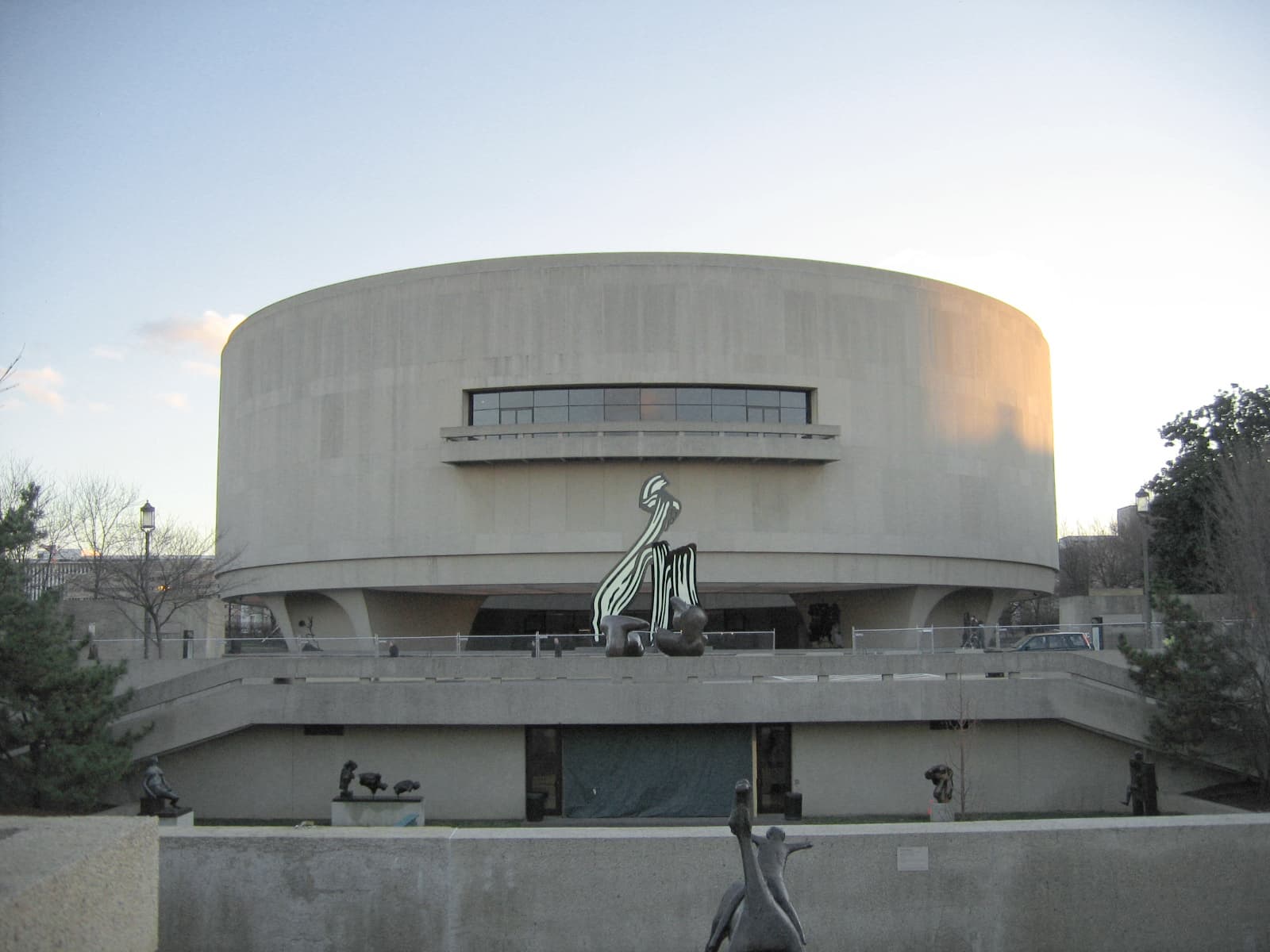
You can spot the Hirshhorn from the steps of the Capitol, and there is nothing else on the National Mall that looks anything like it. Where its neighbors are limestone and marble in the classical mode, the Hirshhorn is a perfect cylinder — 231 feet across, four stories high — with a hollow center open to the sky. It stands at Independence Avenue and 7th Street SW, on the south side of the Mall, between the National Air and Space Museum and the National Gallery of Art, and it is elevated on four massive piers so that visitors walk underneath the ring and into a sheltered plaza at its base. Washingtonians have called it the donut since the day it opened, and the nickname has stuck with a kind of affection: the building is strange, but it is unmistakably itself, and after fifty years it is hard to imagine the Mall without it.
The architect was Gordon Bunshaft, of the firm Skidmore, Owings & Merrill, who had already reshaped the American corporate skyline with Lever House in New York. For the Hirshhorn he produced something almost perverse in its simplicity: a single geometric form, repeated with total discipline. The galleries are arranged in a ring around a central courtyard, so a visit to the museum is a walk in a circle — out along the outer wall, looking in through windows to the courtyard, and back around again. The exterior walls are windowless at ground level, which gives the building its fortress-like, bunker-like quality and has always been the chief complaint of its critics. Bunshaft answered, in effect, that the building is a container for art, not a view of the city — and that the courtyard, with its fountain and its open sky, supplies all the light and air the galleries need.
The concrete itself is worth a closer look. It is aggregate concrete flecked with pink granite, giving the ring a warm, faintly rosy tone that changes with the light — gray in the morning, almost salmon at sunset. It is a building that rewards slow looking, which is fitting, because so does everything inside it. Bunshaft won the Pritzker Architecture Prize in 1988, the highest honor in architecture, and the Hirshhorn is the building most often cited as his masterpiece in the public realm.
A collector's gift
The museum exists because of one man, Joseph Hirshhorn, and one extraordinary act of generosity. Hirshhorn was born in 1899 in Mitava, in what is now Latvia, and emigrated to the United States as a child. He made his fortune in mining — uranium in Canada, where he was known as the Uranium King — and he spent that fortune on modern art, buying with a speed and an appetite that startled even the art world. Beginning in the 1930s, guided by his adviser Abram Lerner, he bought works by the artists who were inventing modernism: Picasso, Matisse, de Kooning, Giacometti, Moore, Calder. He bought in depth, acquiring dozens of works by a single artist when he believed in them, and by the 1960s his collection numbered in the thousands.
In 1966 Hirshhorn gave it away: some 6,000 paintings and sculptures, together with a two-million-dollar endowment, to the Smithsonian Institution, to found a museum of modern art on the National Mall. It was one of the largest gifts of art ever made to an American institution, and it was conditional on the museum being built — the Smithsonian had to raise the funds and find the site. Congress approved the project, the site was chosen on the south side of the Mall, Bunshaft was commissioned, and the museum opened on October 4, 1974. Hirshhorn lived to see it open, and he kept collecting until his death in 1981, leaving further works to the museum. The collection he founded has since grown to more than 12,000 works, but its core is still his eye: a collector who bought what he loved, in depth, and who believed that modern art belonged to the public, for free, on the nation's front lawn.
The sculpture garden
Cross Jefferson Drive, on the north side of the building, and you reach the other half of the museum: the Sculpture Garden, a sunken garden of hedges, gravel paths, and a long reflecting pool, set below the level of the Mall. It was designed by landscape architect Lester Collins and opened with the museum in 1974, and it remains one of the most peaceful places in central Washington — a green room, a few steps from the crowds on the Mall, where the sculptures have room to breathe.
The garden is where the museum's sculpture collection lives outdoors, and it is a survey of modern sculpture in its own right. The centerpiece is Auguste Rodin's The Burghers of Calais, the great bronze group of six citizens of Calais who offered their lives to save their city in 1347 — one of the most famous sculptures in the world, standing here in the open air. Around it are works by Henry Moore, whose reclining figures seem to have grown out of the landscape, and by Alexander Calder, whose mobiles and stabiles bring a note of play and movement to the garden's calm. The garden was reworked in 1981 and has been rethought several times since; a long-planned redesign by the artist Hiroshi Sugimoto is underway, so the garden's exact layout may be changing — check the museum's site before visiting for current access. But the idea has never changed: sculpture that belongs outside, in a garden designed for looking slowly.
Inside the ring: the collection
Step inside the building and the ring begins to make sense. The galleries wrap around the courtyard in a continuous loop, and the art is hung in a way that makes the walk itself part of the experience: you circle the building, and the story of modern art unfolds around you. The second floor is the museum's permanent collection, and it is arranged to show how the twentieth century's art moved — from the early modernists to the postwar abstractionists to the pop artists and the minimalists — with the courtyard windows offering a view of the sky and the fountain at every turn.
Start with the artists Hirshhorn loved best. The museum holds one of the largest collections of Alexander Calder's work anywhere, and Calder is everywhere in the building: mobiles turning slowly overhead, stabiles standing like friendly giants, and the bright primary colors that make his work the museum's most joyful presence. Henry Moore's sculptures, heavy and organic, anchor the galleries as they do the garden. Willem de Kooning's fierce, slashing paintings, Mark Rothko's floating fields of color, and Jackson Pollock's poured paintings give the postwar galleries their force. Pablo Picasso and Henri Matisse, the two giants of early modernism, are represented in depth from Hirshhorn's original gift, and the collection continues through the pop art of Andy Warhol and Roy Lichtenstein and into the present day.
Two recent works define the museum's current identity. Yayoi Kusama's Infinity Mirror Rooms — mirrored chambers filled with lights that stretch to infinity — drew record crowds when the museum showed six of them together in 2017, in the most popular exhibition in Hirshhorn history, and the museum has since made Kusama a permanent part of its program. And Mark Bradford's Pickett's Charge, a monumental 400-foot-long painting about the Civil War's most famous assault, wraps around the second-floor galleries in a single unbroken sweep — a work that could only exist in a round building, and a reminder that the Hirshhorn's architecture is not just a quirk but a frame for art that no other museum in America could hang.
Modern art's home on the Mall
The Hirshhorn is the only Smithsonian museum devoted entirely to modern and contemporary art, and that gives it a different role from its neighbors. The National Gallery shows the history of art; the Hirshhorn shows the art of now, and of the living artists and recent movements that the other museums have not yet caught up with. Its exhibition program is the most adventurous on the Mall: blockbuster surveys of artists like Kusama, Ai Weiwei, and Barbara Kruger sit alongside experimental shows by younger artists, and the museum's plaza and courtyard have become a stage for performance, sound, and large-scale installation.
That role has made the Hirshhorn the Mall's liveliest museum — and sometimes its most controversial. The building itself was denounced when it opened as a bunker and a donut, and the museum has never been afraid of a fight: it shows art that challenges, confuses, and occasionally offends, which is, after all, what modern art is for. But it is also, quietly, one of the Mall's most welcoming museums. Admission is free, as at all Smithsonian museums. The galleries are small enough to see in an hour and rich enough to spend a day in, the courtyard is a place to sit and think, and the garden is a place to escape the crowds. It is the museum on the Mall where Washington comes to be surprised.
How to visit
The Hirshhorn Museum and Sculpture Garden is at Independence Avenue SW and 7th Street SW, on the south side of the National Mall, between the National Air and Space Museum and the National Gallery of Art. It is reachable by Metro — the L'Enfant Plaza station (Blue, Orange, Silver, Green, and Yellow lines) and the Archives station (Green and Yellow lines) are both a short walk away — and by bus along the Mall, and there is no admission charge: like all Smithsonian museums, the Hirshhorn is free. No fixed opening hour is stated in this article, since none was verified against an official source in this run: Smithsonian hours can change with the season and with special events, and the museum occasionally closes galleries or the sculpture garden for installation work, so check the official Hirshhorn site before visiting for current hours and any timed-entry requirements for special exhibitions.
Allow two to three hours: an hour for the second-floor collection, time for whatever special exhibition is on, and a slow walk through the sculpture garden. Start at the top and work your way around the ring, and save the courtyard and the garden for the end — the building makes more sense once you have walked it. Pair the visit with the National Gallery of Art across the Mall, or with the National Air and Space Museum next door, for a full day on the Mall that runs from the history of art to the history of flight, with the Hirshhorn's donut standing between them as a reminder that the newest ideas are often the strangest-looking ones.
Photo Gallery


Key Facts
- The Hirshhorn Museum and Sculpture Garden opened on October 4, 1974, on the south side of the National Mall in Washington, DC.
- It is the Smithsonian Institution's museum of modern and contemporary art — the only Smithsonian museum devoted entirely to modern art.
- The museum was founded on Joseph Hirshhorn's 1966 gift of some 6,000 paintings and sculptures, together with a two-million-dollar endowment, to the Smithsonian.
- Joseph Hirshhorn (1899–1981) was a Latvian-born American financier who made his fortune in Canadian uranium mining and began collecting modern art in the 1930s.
- The building was designed by Gordon Bunshaft of Skidmore, Owings & Merrill: a hollow cylinder 231 feet across, elevated on four massive piers, with galleries arranged in a ring around a central courtyard.
- The building's concrete is aggregate concrete flecked with pink granite. Bunshaft won the Pritzker Architecture Prize in 1988.
- The sunken Sculpture Garden, across Jefferson Drive from the museum, was designed by landscape architect Lester Collins and opened with the museum in 1974; it is being reimagined under a redesign by artist Hiroshi Sugimoto.
- The garden's centerpiece is Auguste Rodin's The Burghers of Calais, alongside works by Henry Moore and Alexander Calder.
- The collection has grown from Hirshhorn's original gift to more than 12,000 works, including one of the largest holdings of Alexander Calder's work anywhere.
- Collection highlights include works by Picasso, Matisse, de Kooning, Rothko, Pollock, Warhol, and Lichtenstein; Yayoi Kusama's Infinity Mirror Rooms; and Mark Bradford's Pickett's Charge, a 400-foot-long painting wrapping the second-floor galleries.
- Abram Lerner, Hirshhorn's longtime adviser, became the museum's first director.
- The museum's address is Independence Avenue SW at 7th Street SW, Washington, DC 20013.
- Coordinates: 38.8881, -77.0230.
Visitor Details
Address: Independence Avenue SW at 7th Street SW, Washington, DC 20013.
Transit: Metro L'Enfant Plaza (Blue, Orange, Silver, Green, Yellow lines) or Archives (Green, Yellow lines), both a short walk; buses run along the Mall.
Hours/Admission: Admission is free, as at all Smithsonian museums. No fixed opening hour is stated in this article, since none was verified against an official source in this run. Check the official Hirshhorn site before visiting for current hours, timed-entry rules for special exhibitions, and sculpture garden access during its redesign.
Best timing: Allow two to three hours — an hour for the second-floor collection, time for the special exhibition, and a slow walk through the sculpture garden. Start at the top and circle the ring; save the courtyard and garden for the end. Pair with the National Gallery of Art across the Mall or the National Air and Space Museum next door.