
A museum older than the building it stands in
The Museum of Science is one of the oldest science institutions in the United States, and its age is the first thing to understand about it. It began in 1830 as the Boston Society of Natural History, founded by a group of Bostonians who wanted a place to collect, study, and display scientific specimens and share their enthusiasm with the city. For its first decades the society moved between temporary quarters in Boston's Financial District, but in 1864 it settled into a handsome building of its own at 234 Berkeley Street in the Back Bay, next door to the original home of the Massachusetts Institute of Technology. That building — designed by William Gibbons Preston in the Romanesque Revival style — still stands today, repurposed as a home-furnishings showcase, a quiet survivor of the museum's first century.
The society's collection grew, its mission widened from natural history to all of science, and after World War II it made the move that defines it today. Under the leadership of Bradford Washburn — mountaineer, explorer, and the museum's director — the society negotiated a 99-year lease with the Metropolitan District Commission for land on the Charles River Dam Bridge, a plot now known as Science Park. Construction began in 1948, and the museum opened in its new home in 1951, renamed the Boston Museum of Science. The claim made for it then — that it was arguably the first museum to bring all the sciences together under one roof — still describes the experience of walking through it: physics, biology, astronomy, engineering, and natural history are not separate departments here but neighboring rooms, and the visitor drifts between them the way a curious mind does.
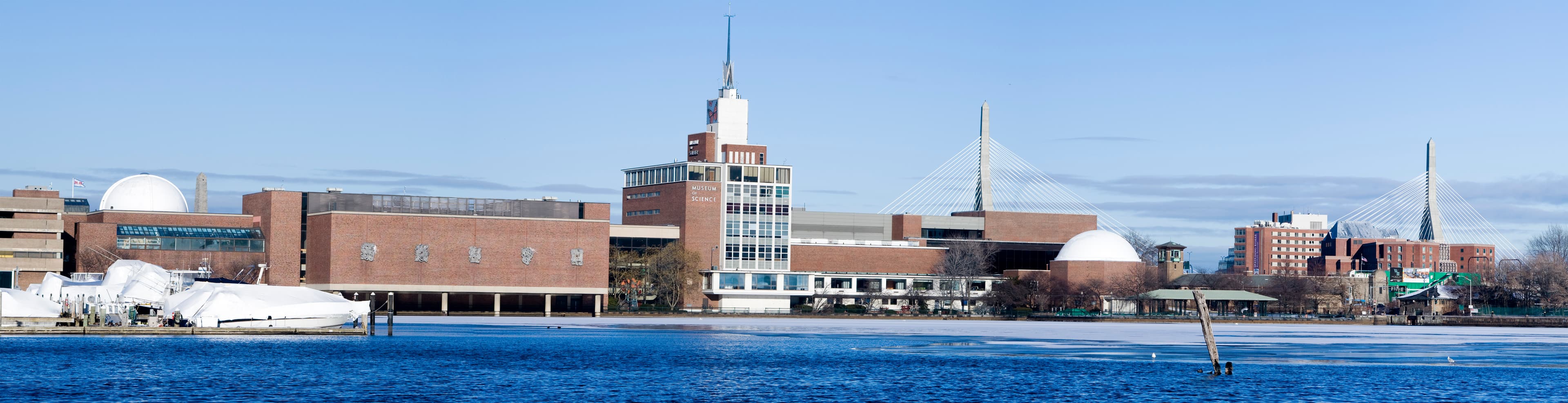
The building itself is part of the exhibit. The Museum of Science spans the length of the Charles River Dam, and its main entrance famously straddles the border between Boston and Cambridge, with the city line marked in the floor inside. Stand in the lobby and you are, in a small but literal way, in two cities at once. The museum has grown in stages ever since — a new wing in 1968, the Theater of Electricity in 1980, the Charles Hayden Planetarium as a permanent building in 1958, and a major renovation campaign that began in the 2010s and added the Hall of Human Life and the Yawkey Gallery on the Charles River. The five decorative aluminum panels that once faced the river basin, sculpted by Theodore Barbarossa, were removed during recent work on a new glass-enclosed Public Science Common, a reminder that this is a museum still being rebuilt around its visitors.
Lightning indoors
If the museum has a single signature experience, it is the Theater of Electricity. The theater's centerpiece is the world's largest air-insulated Van de Graaff generator, a machine with a history as dramatic as its demonstrations. It was built in the early 1930s at MIT's Round Hill facility by physicist Robert J. Van de Graaff and his team, originally designed as a particle accelerator — an atom smasher — and when MIT no longer needed it, the generator was transferred to the museum in the mid-1950s, where it became the heart of the Elihu Thomson Theater of Electricity.
In the Lightning! presentation, educators use the generator and a pair of Tesla coils to throw real indoor lightning bolts across the theater, explaining as they go what lightning is, why thunder follows it, how to stay safe in a storm, and how electricity and magnetism are related. The generator routinely builds up charges of a million volts or more, and the finale — an educator standing inside a metal cage while bolts strike it — is the kind of demonstration that makes abstract physics unforgettable. It is also a piece of living history: a 1930s research machine, still working, still teaching, in front of audiences who were not born when it was built.
The theater sits in the Blue Wing, the museum's main hall, and it sets the tone for everything around it. This is a museum built for doing rather than reading. The Blue Wing also holds Seeing is Deceiving, a collection of optical illusions including motorized ones; Mathematica, the classic Charles and Ray Eames exhibition on the world of numbers; Natural Mysteries, an investigative exhibit built around classification and curious specimens; and the Butterfly Garden, a walk-through greenhouse of tropical plants and free-flying butterflies. Nearby, Science in the Park turns playground equipment into physics lessons, and the Discovery Center invites younger visitors — and their parents — to try experiments and talk with scientists.
Dinosaurs, humans, and the living world
Downstairs and across the wings, the museum's natural-history roots are still visible. The dinosaur exhibits pair a life-sized Tyrannosaurus model with real fossil material, including the museum's celebrated Triceratops, Cliff — a real Triceratops skeleton from the Hell Creek Formation, described as one of the most complete Triceratops specimens ever found. The pairing is deliberate: the model shows what these animals may have looked like in life, the fossil shows what actually survived 66 million years, and the exhibits explain how scientists move between the two. Children run to the dinosaurs first; adults tend to linger over the labels.
The Hall of Human Life, opened in November 2013 on the expanded second level of the Green Wing, takes the same hands-on approach to the visitor's own body. It explores human biology — how we grow, move, sense, and age — with interactive stations and live presentations, and it anchors the Green Wing alongside the New England Habitats dioramas, which recreate the region's rocky shores, salt marshes, and forests with the animals that live in them, and A Bird's World, which displays specimens of the bird species found in New England. The museum is also an accredited zoo, home to more than 100 animals, many of them rescued and rehabilitated, in its Live Animal Care Center — a reminder of the institution's origins as a natural-history collection, now expressed as living conservation.
The Yawkey Gallery on the Charles River, opened in 2016 in the lower lobby, brings the museum back to its setting. It is an exhibit about the river itself — its ecology, its engineering, and its place in the city's life — and it created a new entrance with broad views over the Charles River basin toward the Boston and Cambridge skylines. Step out of the gallery's orbit and the view continues: the Riverview Café looks over the same water, and the museum's Science in the Park exhibits sit just outside, on the river's edge.
Two domes: the planetarium and the Omni Theater
The Red Wing holds the museum's two great domed theaters, and they are worth planning a visit around. The Charles Hayden Planetarium, opened as a permanent building in 1958, presents astronomy shows built with the museum's Center for Space Sciences, from tours of the night sky to journeys through the solar system and beyond, along with evening music shows under the dome. The Mugar Omni Theater, New England's only domed IMAX theater, projects films onto a five-story dome, wrapping the audience in image and sound in a way a flat screen cannot match. Between them, the two theaters cover the two scales the museum loves best: the cosmos overhead and the natural world at human scale.
The planetarium's history runs deeper than its 1958 building. In 1948 the museum built one of the first traveling planetariums, taking the stars to schools across Greater Boston, and a version of that traveling show still visits elementary schools today. That outreach instinct — the museum going to its audience, rather than waiting for the audience to come to it — is one of the institution's oldest habits, and it explains why the Museum of Science has remained New England's most attended cultural institution: it has always treated science as something to carry into the community, not just to display behind glass.
It also explains why the building rewards repeat visits. Temporary exhibitions rotate through the museum's special-exhibition spaces, school groups fill the halls on weekday mornings, and evening programs draw an adult crowd back under the planetarium dome — the same building, several different museums depending on the hour. First-time visitors should not try to see everything; they should pick a wing, follow their curiosity, and let the river views and the lightning show set the pace.
How to visit
The Museum of Science is at 1 Science Park, Boston, MA 02114, on the Charles River Dam between Boston's West End and East Cambridge. It is served by the MBTA Green Line's Science Park station, opened as an infill station in the mid-1950s to serve the museum, and it sits within walking distance of the West End, North Station, and the Charles River Esplanade paths. No fixed ticket price or opening hour is stated in this article, since none was verified against an official source in this run: admission varies by ticket type and by whether planetarium or Omni Theater shows are included, and hours change through the year, so check the official Museum of Science site (mos.org) before visiting for current prices, hours, and any timed-entry requirements.
Allow a full day if you can, and plan a route rather than wandering: the museum's three wings and 700-plus exhibits reward a plan. Start with the Theater of Electricity's Lightning! show, which runs on a daily schedule and draws crowds; take in the dinosaurs and the Hall of Human Life in the late morning; save the planetarium or an Omni film for the afternoon; and finish with the Yawkey Gallery and the river views as the light changes over the Charles. Families with young children should build in the Discovery Center and the Butterfly Garden, and everyone should budget time simply to stand in the lobby and look out at the river — the museum's oldest exhibit, in a sense, and the reason it is where it is.
Pair the visit with a walk along the Charles River Esplanade or a stop in the West End, and it becomes a full day in one of Boston's great public landscapes: a dam, a river, two cities, and a museum that has spent nearly two centuries trying to explain the world to anyone willing to look.
Key Facts
- Began 1830 as Boston Society of Natural History
- First permanent home: 234 Berkeley Street, Back Bay (1864, William Gibbons Preston), still stands repurposed
- Moved to Charles River Dam Bridge (Science Park) in 1951 under Bradford Washburn, 99-year lease, construction begun 1948
- Main entrance straddles the Boston–Cambridge border
- More than 700 interactive exhibits
- Theater of Electricity houses the world's largest air-insulated Van de Graaff generator, built early 1930s by Robert J. Van de Graaff's MIT team, transferred mid-1950s
- Charles Hayden Planetarium permanent building 1958, traveling planetarium 1948
- Mugar Omni Theater, New England's only domed IMAX theater
- Hall of Human Life, November 2013
- Yawkey Gallery, 2016
- Accredited zoo, more than 100 animals, many rescued
- Address: 1 Science Park, Boston, MA 02114
- Nearest MBTA stop: Science Park station, Green Line
- Coordinates: 42.3678, -71.0712
Location Photography


Visitor Details
Address: 1 Science Park, Boston, MA 02114.
Transit: MBTA Green Line to Science Park station; walking distance from North Station and the West End.
Hours/Admission: No fixed price or hour stated — check the official Museum of Science site (mos.org).
Best timing: Allow a full day; Lightning! show on daily schedule, dinosaurs and Hall of Human Life in the morning, planetarium or Omni film in the afternoon.
Pair with a Charles River Esplanade walk.