

A carrier that refused to sink
The USS Intrepid was launched at Newport News, Virginia, on April 26, 1943, and commissioned into the United States Navy on August 16 of that year — the third Essex-class aircraft carrier to join the fleet in the middle of the Second World War. She was 872 feet long, carried more than 100 aircraft, and shipped out to the Pacific in early 1944 with a crew of about 3,000. Over the next eighteen months she would earn a reputation that followed her for the rest of her life: the ship the enemy kept claiming to have sunk, and that kept coming back.
Intrepid's war was fought in the heart of the Pacific campaign. She took part in the strikes on Truk and the Marshall Islands, the invasion of the Marianas, and the Battle of Leyte Gulf in October 1944 — the largest naval battle in history, fought off the Philippines. It was during that battle, on October 29, 1944, that a kamikaze struck her for the first time. The worst came a month later: on November 25, 1944, two kamikaze aircraft hit the ship within five minutes of each other, killing 69 of her crew and wounding many more. The fires were fought, the dead were buried at sea, and Intrepid sailed home for repairs — only to return to the fight and be hit again, by another kamikaze, on April 16, 1945, off Okinawa.
Japanese propaganda radio announced her sinking so often that her crew began calling her the "Ghost Ship" — the carrier that would not stay sunk. She finished the war with five battle stars, and with a combat record that made her one of the most decorated carriers of the Essex class. Walking her decks today, you can still find the places where the war left its mark: the hangar deck where aircraft were armed and repaired under fire, the ready rooms where pilots waited for the call to launch, and the island — the tower on the starboard side — where the ship was conned through battle.
Cold War, Vietnam, and the space race
Intrepid's war did not end in 1945. She was decommissioned in 1947, then brought back into service in 1954 after a two-year modernization that gave her a reinforced, angled flight deck, steam catapults, and a new island — the rebuild that let an Essex-class carrier operate the jet age. Through the late 1950s she served in the Atlantic and the Mediterranean, and in 1962 she was converted into an antisubmarine carrier, redesignated CVS-11.
It was in this second life that Intrepid became part of the space race. On May 24, 1962, she served as the recovery ship for Mercury-Atlas 7, fishing astronaut Scott Carpenter and his Aurora 7 capsule out of the Atlantic after Carpenter's three-orbit flight. Three years later, on March 23, 1965, she recovered Gemini 3 — astronauts Gus Grissom and John Young, on the first crewed flight of the Gemini program.
Vietnam followed. Intrepid made three combat deployments to Southeast Asia, in 1966, 1967, and 1968–69, launching strikes from Yankee Station in the South China Sea. Her aircraft flew thousands of sorties, and her crew earned more battle stars. When she was decommissioned for the final time, on March 15, 1974, she had served for more than three decades across three wars and the opening of the space age — a service record few American warships can match.
How a carrier became a museum
Intrepid's afterlife was almost a scrapyard. After decommissioning she was mothballed, and by the late 1970s she was slated to be sold for scrap. She was saved by the real-estate developer and philanthropist Zachary Fisher and his wife Elizabeth, who led a campaign to bring the carrier to New York as a museum and educational center. In 1982 the ship was towed to Manhattan, and on August 4, 1982 — the same year she was struck from the Naval Vessel Register — the Intrepid Sea, Air & Space Museum opened at Pier 86, at West 46th Street and 12th Avenue on the Hudson River.
The museum was designated a National Historic Landmark in 1986, and it has grown steadily since. The ship itself is the core exhibit, and a visit is as much a tour of a working warship as it is a museum: the hangar deck holds galleries on the ship's history and on naval aviation, the mess decks and berthing compartments show how 3,000 sailors lived at sea, and the island's bridge and flag bridge are open, with the Hudson and the Manhattan skyline spread out below. In 2006–2008 the ship went through a major restoration — towed to Bayonne, New Jersey, for hull work and a rebuilt pier — and returned to Pier 86 in October 2008.
The flight deck
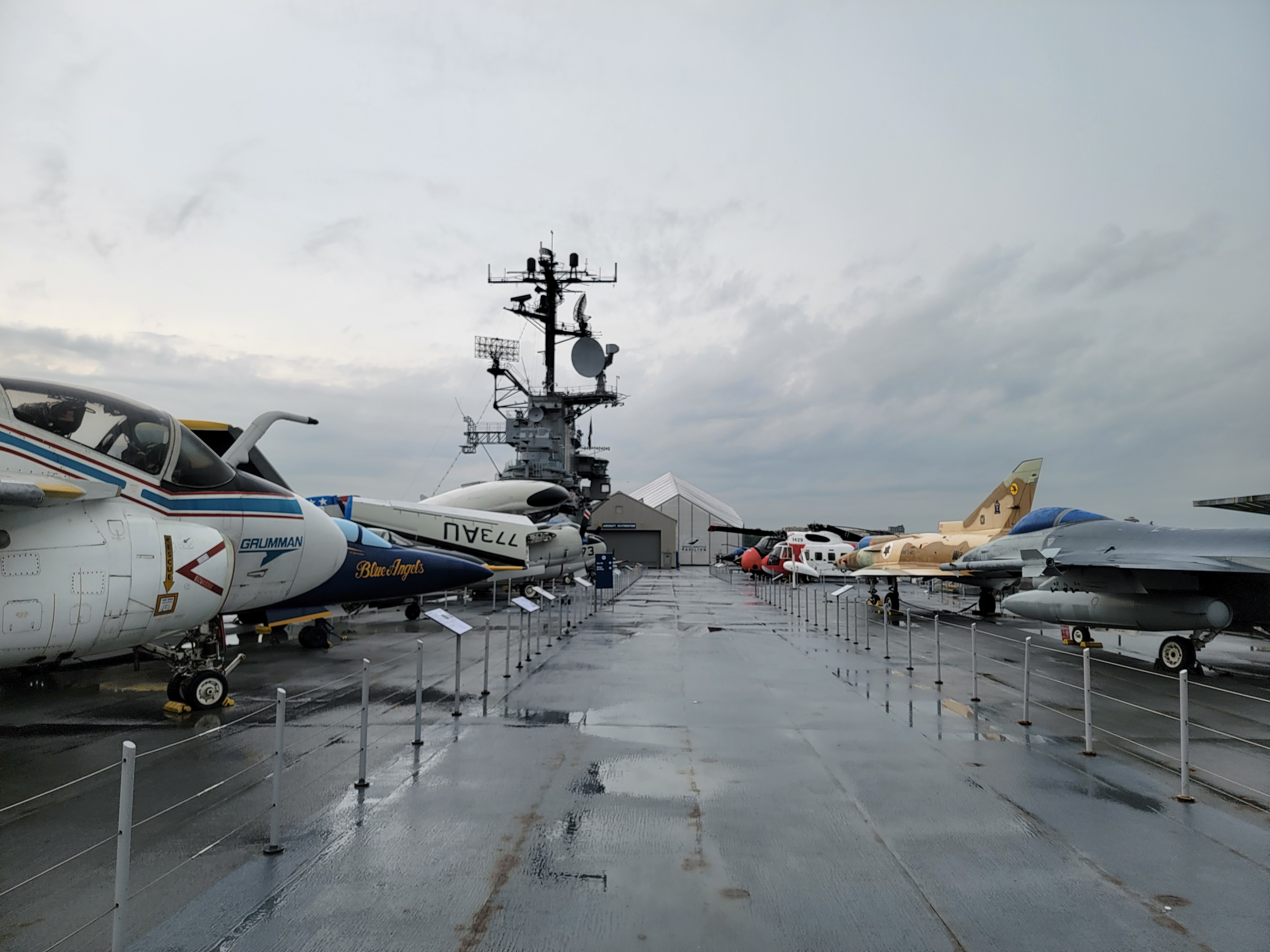
The flight deck is the museum's great open-air gallery, and it is the first thing most visitors see. Some two dozen aircraft stand in the open, parked where they would have been spotted for launch, with the Hudson on one side and the Midtown skyline on the other. The collection spans the jet age: a Grumman F-14 Tomcat, the swing-wing fighter made famous by naval aviation; a McDonnell Douglas F-4 Phantom II; an F-8 Crusader; an A-4 Skyhawk; a British-built AV-8A Harrier, the jump jet; a Soviet-built MiG-17 and a MiG-21, the adversaries American pilots trained against; and an AH-1 Cobra attack helicopter.
The most striking aircraft on the deck is also the most secretive: a Lockheed A-12, the CIA's high-altitude reconnaissance aircraft and the direct predecessor of the SR-71 Blackbird. The A-12 on Intrepid's deck is one of only a handful on public display anywhere. The deck also carries the museum's interactive exhibits and, in warm weather, the flight simulators and the views that make it one of the best vantage points on the Hudson: the river, the New Jersey shore, and the skyline in a single sweep.
The Space Shuttle Enterprise
The newest chapter of the museum sits at the aft end of the flight deck, in the Space Shuttle Pavilion: the orbiter Enterprise, OV-101, the first space shuttle ever built. Enterprise never flew in space. She was built in 1976 as a test vehicle, to prove that a winged orbiter could glide home from orbit and land like an airplane — and in 1977 she did exactly that, in a series of approach and landing tests carried by a modified 747. Her name came from a write-in campaign by fans of the television series Star Trek, and the cast of the show attended her rollout.
After the shuttle fleet retired, Enterprise was transferred to the Intrepid Museum: flown to New York atop a 747 in April 2012, barged up the Hudson that June, and lifted by crane onto the flight deck. She went on public display on July 19, 2012. Months later, Hurricane Sandy flooded the pier and damaged the original inflatable pavilion; the shuttle herself survived, and a new, permanent pavilion opened in July 2013. Today you can walk around the orbiter and stand beneath it, close enough to see the heat-shield tiles, the delta wings, and the cockpit windows — and to feel the scale of a machine that was built to leave the planet and come home again. The pavilion also holds space artifacts, including a Soyuz capsule, and exhibits on the shuttle program and the science of spaceflight.
The submarine USS Growler
Moored alongside Intrepid, and easy to miss if you are looking up at the carrier, is the museum's other vessel: the USS Growler (SSG-577), a diesel-electric submarine that carried nuclear-armed Regulus cruise missiles in the late 1950s and early 1960s. Growler was commissioned in 1958, one of only two submarines built to launch the Regulus I missile, and she served as part of America's nuclear deterrent — a submarine that could surface, erect its missiles, and launch them at targets more than 500 miles away.
Growler was decommissioned in 1964, and she opened to visitors at the Intrepid Museum in 1989. A tour takes you through the boat from bow to stern: the torpedo room, the control room, the crew's cramped berthing spaces, the missile hangar, and the galley where the crew of about 90 ate in shifts. It is a study in confinement — the submarine is 317 feet long and barely 27 feet across at its widest, and everything aboard was built to fit men and machinery into a steel tube that spent weeks underwater.
How to visit
The museum stands at Pier 86, West 46th Street and 12th Avenue, on the Hudson River in Hell's Kitchen — a short walk west from Times Square and the Theater District, and reachable by subway (the A, C, and E trains to 42nd Street–Port Authority, or the 7 train to Hudson Yards) and by crosstown bus. No fixed ticket price or opening hour is stated in this article, since none was verified against an official source in this run: admission varies by ticket type and by day, and hours change through the year, so check the official Intrepid Museum site before visiting for current prices, hours, and any timed-entry requirements. Some experiences — including the Growler tour, the flight simulators, and the Concorde — have their own schedules and may carry separate arrangements.
Also on the pier is the Concorde G-BOAD, the British Airways supersonic airliner that holds the record for the fastest transatlantic crossing by a commercial aircraft. Allow at least three to four hours, and plan a route: start on the flight deck while the light is good, go inside for the hangar deck and the island, take the Growler tour when the line is short, and save the Space Shuttle Pavilion for the end — Enterprise is the sight to linger over, and the pavilion is the quietest place to do it.
Key Facts
- The USS Intrepid (CV-11) is an Essex-class aircraft carrier, launched April 26, 1943, at Newport News, Virginia, and commissioned August 16, 1943.
- She served in the Pacific in World War II, including the Battle of Leyte Gulf, and was hit by kamikaze aircraft on October 29, 1944, November 25, 1944 (two hits in five minutes, 69 killed), and April 16, 1945, off Okinawa. She finished the war with five battle stars and the nickname "the Ghost Ship."
- Modernized in 1952–1954 with an angled flight deck, steam catapults, and a new island, she served in the Atlantic and Mediterranean, and was converted to an antisubmarine carrier (CVS-11) in 1962.
- As a NASA recovery ship, Intrepid recovered Mercury-Atlas 7 (Scott Carpenter, Aurora 7) on May 24, 1962, and Gemini 3 (Gus Grissom and John Young) on March 23, 1965.
- She made three combat deployments to Vietnam, in 1966, 1967, and 1968–69, launching strikes from Yankee Station, and was decommissioned for the final time on March 15, 1974.
- Saved from scrapping by Zachary and Elizabeth Fisher, she opened as the Intrepid Sea, Air & Space Museum at Pier 86 on August 4, 1982, and was designated a National Historic Landmark in 1986.
- The flight deck holds about two dozen aircraft, including an F-14 Tomcat, an F-4 Phantom II, a MiG-21, an AV-8A Harrier, and a Lockheed A-12, predecessor of the SR-71 Blackbird.
- The Space Shuttle Pavilion houses Enterprise (OV-101), the first space shuttle, built as a test orbiter in 1976; she arrived at the museum in June 2012 and went on display on July 19, 2012, in a new permanent pavilion opened in July 2013 after Hurricane Sandy damaged the original.
- The USS Growler (SSG-577), a Regulus-missile submarine commissioned in 1958 and decommissioned in 1964, opened to visitors at the museum in 1989.
- The Concorde G-BOAD on Pier 86 holds the record for the fastest transatlantic crossing by a commercial aircraft.
- The museum is at Pier 86, West 46th Street and 12th Avenue, Hudson River, New York.
- Coordinates: 40.7645, -73.9996.
Visitor Details
Address: Pier 86, West 46th Street and 12th Avenue, New York, NY 10036.
Transit: Subway A/C/E to 42nd Street–Port Authority or 7 to Hudson Yards, then walk west to the Hudson; crosstown buses serve 42nd and 49th Streets. The museum is a short walk west from Times Square.
Hours/Admission: No fixed ticket price or opening hour is stated in this article, since none was verified against an official source in this run. Check the official Intrepid Museum site before visiting for current prices, hours, timed-entry rules, and schedules for the Growler tour, flight simulators, and Concorde.
Best timing: Allow three to four hours. Start on the flight deck, tour the hangar deck and the island, take the Growler tour when the line is short, and save the Space Shuttle Pavilion for the end.
Location Photography