
A Greek temple at 8th and F
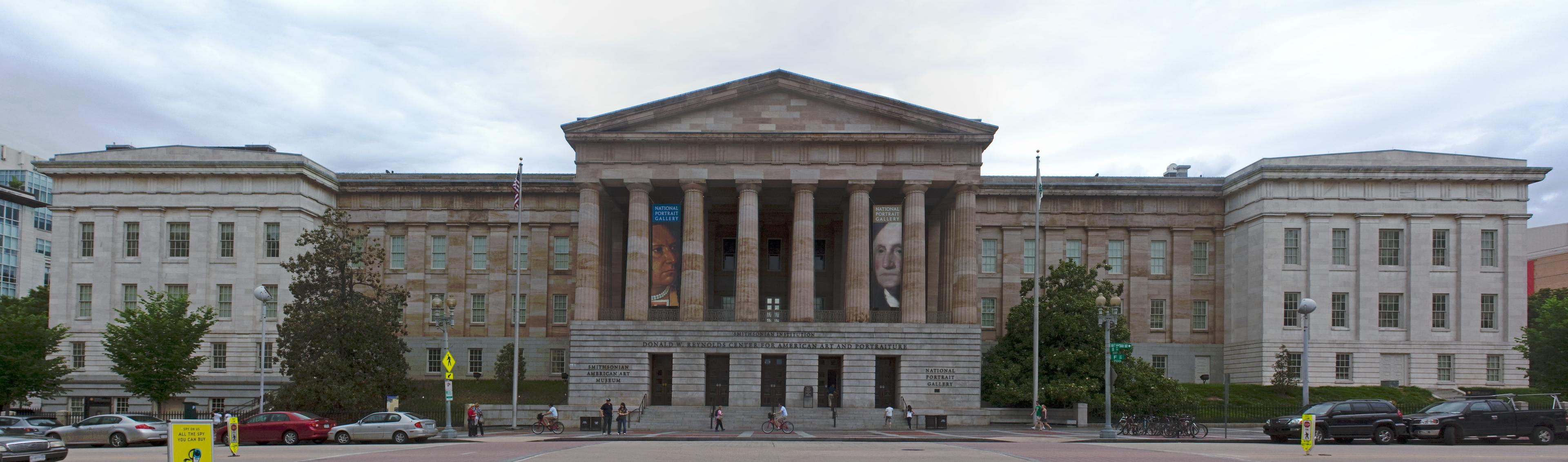
The National Portrait Gallery sits in the middle of downtown Washington, a full city block between 7th and 9th Streets and F and G Streets NW, in the Penn Quarter section of Chinatown. The building is impossible to miss: a great sandstone and marble temple in the Greek Revival style, its porticos modeled after the Parthenon in Athens, its long vaulted galleries lit by skylights as long as a city block. It is one of the finest examples of Greek Revival architecture in the United States, and the Smithsonian's own fact sheet calls it the third-oldest federal building in Washington.
The building was not built as a museum. It was built as the United States Patent Office. President Andrew Jackson laid the cornerstone in 1836, and construction continued for more than three decades — the south wing was occupied by the Patent Office in 1840 and completed in 1842, the east wing was finished in 1855, and the north wing was completed in 1868, bringing the whole structure to completion after 31 to 32 years of work. The architect was Robert Mills, who also designed the Washington Monument, working with Alexander Jackson Davis, Thomas U. Walter, and William Parker Elliot. The government conceived the building as a place to issue patents and to store and display the scale models that inventors submitted with their applications — thousands of miniature machines, devices, and contraptions, filed in glass cases in the great model rooms on the upper floors.
But the building was always more than an office. In its early decades it functioned as the first federally supported museum in the country: in addition to the patent models, the government housed its historical, scientific, and art collections on the third floor, including the Declaration of Independence — which was displayed here for 35 years — and George Washington's Revolutionary War camp tent. The building's great hall, built to display the inventors' models, was once the largest room in America. Walt Whitman, who knew the building well, called it the "noblest of Washington buildings," and the praise has stuck to it ever since.
The war years: hospital, barracks, and ball
The Patent Office Building's most dramatic chapter came during the Civil War. In the early months of the war, the building served as a barracks for Union soldiers — members of the First Rhode Island Infantry Regiment were billeted in the west wing in 1861 — and then, from 1861 to 1863, it became a military hospital and a morgue. Wounded soldiers lay on cots in the second-floor galleries, among the glass cases crowded with miniature models of every invention the country had patented. The contrast was almost unbearable, and it was not lost on the people who worked there.
Among the volunteers who nursed the wounded was the poet Walt Whitman, who frequented what he called "that noblest of Washington buildings," reading aloud to the young men, playing games with them, and writing letters home for them. Clara Barton, the founder of the American Red Cross, was also there — she had been one of the first women employed at the Patent Office, hired as a clerk in 1854, and she volunteered as a nurse in the hospital wards. Whitman later went to work in the building as a clerk for the Bureau of Indian Affairs, part of the Department of the Interior, which moved into the second floor in 1865; he was fired after six months when a heavily revised copy of his collection of poems, Leaves of Grass, was found on his desk.
Then, in March 1865, the building changed character in a single night. The Model Hall — the same great room that had so recently been a ward of suffering and death — was transformed into the festive venue for Abraham Lincoln's second inaugural ball. Thousands of guests filled the hall, decorated for the occasion, in what one account called a celebration of the Union's survival. It was one of the great parties of 19th-century Washington, held in a room that had, weeks earlier, held the wounded of the war. Lincoln himself had a personal connection to the building: in March 1849, fresh from his term as a congressman from Illinois, he had applied for a patent here, for a device for "buoying vessels over shoals" — and he remains the only American president to hold a patent.
Saved from the wrecking ball
After the war, the building kept working. The Patent Office remained until 1932, when it moved out after 92 years; the Department of the Interior and the Bureau of Indian Affairs had offices here, and from 1932 to 1953 the building housed the Civil Service Commission. A fire in 1877 had badly damaged the upper floors of the north and west wings, which were rebuilt in the Victorian "modern Renaissance" style by the architect Adolf Cluss. By the mid-20th century, the old building was in trouble: it was nearly demolished to make way for a parking facility, and only a public outcry saved it. In March 1958, Congress authorized the transfer of the building to the Smithsonian Institution, and it was designated a National Historic Landmark in 1965.
The idea of a national portrait gallery had been in search of a building for a long time. In 1962, Congress authorized the National Portrait Gallery by act, with the mission to exhibit and promote the study of "portraiture and statuary depicting men and women who have made significant contributions to the history, development, and culture of the people of the United States." The Civil Service Commission moved out in November 1963, renovation began in 1964, and on October 7, 1968 — after a gala opening on October 5 attended by Mayor Walter Washington, Smithsonian Secretary S. Dillon Ripley, and Chief Justice Earl Warren — the museum opened its doors in the Old Patent Office Building, sharing the space with the National Collection of Fine Arts, since renamed the Smithsonian American Art Museum. Its first director was Charles Nagel, and its opening exhibition, "This New Man: A Discourse in Portraits," hung 168 paintings, sculptures, and photographs in deliberately provocative juxtapositions.
America's Presidents
The heart of the National Portrait Gallery is the "America's Presidents" exhibition, on the museum's second floor. It holds the only complete collection of presidential portraits outside the White House — more than 1,730 portraits of U.S. presidents in the collection as a whole, spanning paintings, sculpture, photographs, and works on paper. The gallery is arranged so that you can walk the whole history of the presidency face by face, from Washington to the present, and the effect is unlike any other room in Washington: the presidency as a portrait gallery, with all of its grandeur, its awkwardness, and its surprises intact.
The grand introductory image of the exhibition is the most famous portrait in American art: Gilbert Stuart's "Lansdowne" portrait of George Washington, painted in 1796. The eight-by-five-foot canvas was commissioned by Senator William Bingham of Pennsylvania, one of the wealthiest men in America, as a gift to the British prime minister, the Marquess of Lansdowne. It shows Washington standing in a black velvet suit, one hand on his sword, the other gesturing toward the table where the documents of the new republic lie — the very image of the republic as Stuart and his generation imagined it. The painting was displayed only three times in the United States before it came to the National Portrait Gallery on loan for the museum's opening in 1968; it stayed on indefinite loan until 2000, when its owner decided to sell it, and a gift from the Donald W. Reynolds Foundation allowed the Gallery to buy it as a gift to the nation in 2001. It was restored and re-presented in September 2017.
The gallery's other portraits are full of stories of their own. There is Alexander Gardner's "cracked-plate" photograph of Abraham Lincoln from 1865, the last portrait taken of him before his assassination — the glass plate cracked during the sitting, and the flaw runs across the image like a wound. There is a daguerreotype of John Quincy Adams from 1843, the earliest known photographic likeness of a U.S. president. There is Elaine de Kooning's John F. Kennedy from 1963, Norman Rockwell's Richard Nixon from 1968, and Everett Raymond Kinstler's Ronald Reagan from 1991. And there is the portrait that Lyndon Johnson called "the ugliest thing he had ever seen" — Peter Hurd's painting of him, which was not on view at the opening in 1968, with the alcove meant for the incumbent president filled instead by his predecessor, Kennedy.
The Obama portraits
On February 12, 2018, the National Portrait Gallery held the most-watched unveiling in its history. In the Robert and Arlene Kogod Courtyard, before a crowd of distinguished guests and reporters, the museum revealed its commissioned portraits of former President Barack Obama and former First Lady Michelle Obama — and the room went quiet, then erupted. The portraits were unveiled as part of the Gallery's 50th-anniversary celebrations, and they were a first in more than one way: Kehinde Wiley and Amy Sherald were the first African American artists ever commissioned to paint the official portraits of a president and first lady for the National Portrait Gallery.
Wiley's portrait of Barack Obama shows the president seated in a polished wood chair, serious and still, against a lush wall of green vines and blossoming flowers that seem to threaten to consume him — the leaves winding up his legs and poking around the edges of the chair. Sherald's portrait of Michelle Obama is startling in its boldness: the former first lady, cool and confident in a flowing Milly dress, gazes resolutely outward, her skin rendered in Sherald's signature gray tones. The two paintings could hardly be more different in style, and that was the point: the Obamas chose their own artists before leaving the White House, after reviewing dozens of portfolios, and the result was a pair of portraits that look like nothing else in the presidential collection.
Wiley's painting of President Obama is permanently installed in the "America's Presidents" exhibition, where it hangs in the company of Stuart's Washington and Gardner's Lincoln. Sherald's portrait of Mrs. Obama went on view in the museum's "Recent Acquisitions" corridor, and the pair later toured the country on a five-city tour beginning in June 2021. They remain the most visited, most photographed, and most argued-about portraits in the museum — and the single best reason, for many visitors, to come to the Gallery at all.
The Kogod Courtyard and the Great Hall
The building's most surprising space is not a gallery at all. The Robert and Arlene Kogod Courtyard, at the center of the Old Patent Office Building, is a 28,000-square-foot enclosed public gathering space under an undulating glass-and-steel canopy designed by the London firm Foster + Partners, with interior landscape design by Kathryn Gustafson. The wavy roof — 864 double-glazed glass panes set in a grid, supported by eight anodized aluminum-clad columns around the perimeter so that its weight never touches the historic walls — appears to float over the courtyard, letting in natural light while protecting visitors from the weather. It opened to the public on November 18, 2007, after the building's six-year renovation, and it has become the museum's living room: a café, free public Wi-Fi, tables and chairs, and one of the calmest rooms in downtown Washington. The Obama portraits were unveiled here for a reason — it is the room where the museum gathers.
The renovation that produced the courtyard was itself a major event. The building closed in 2000 for repairs and underwent a $283 million restoration by Hartman-Cox Architects, reopening on July 1, 2006, as the Donald W. Reynolds Center for American Art and Portraiture. The work restored the porticos modeled on the Parthenon, the curving double staircase, the vaulted galleries, and the skylights as long as a city block, and replaced more than 550 windows with laminated glass that protects the artworks while letting natural light in.
Upstairs, the Great Hall — the room that was once the Patent Office's model room, then a Civil War hospital ward, then the site of Lincoln's inaugural ball — survives as one of the museum's great spaces, its long vaulted ceiling and tall windows intact. Parts of the original Old Patent Office interior are still visible on the third floor, where the Great Hall stands. It is the room to linger in: stand in the middle of it and you are standing where inventors' models were displayed, where wounded soldiers lay, and where Lincoln danced.
Beyond the presidents
The presidents are the draw, but they are only part of the museum. The National Portrait Gallery's collection holds more than 26,000 works, and its permanent exhibitions range far beyond the White House. "Out of Many: Portraits from 1600 to 1900" traces portraiture from the colonial era through the 19th century; "Twentieth-Century Americans" covers the figures who shaped the modern United States; and "The Struggle for Justice" honors the people and communities who fought for a more inclusive and fair country. The museum was authorized in 2001 to begin collecting portraits of living sitters beyond the presidents, and in 1976 Congress amended its charter to allow it to collect portraiture "by any means or process, whether invented or developed" — which is why the collection now includes photographs, time-based media, and works that the founders of 1962 could not have imagined.
Outside the building, on its south side, stands one more work worth finding: Roy Lichtenstein's "Modern Head," a 31-foot-tall brushed stainless steel sculpture, installed on August 27, 2008, after being donated to the Smithsonian by Jeffrey H. Loria. It is a piece of Pop Art at the door of a Greek temple, and the contrast is deliberate — the building has been reinventing itself for nearly two centuries, and the sculpture is the latest chapter.
The National Portrait Gallery shares its building with the Smithsonian American Art Museum and the Archives of American Art, and the two museums share a main entrance on F Street, an auditorium, a conservation center, and the Kogod Courtyard. The arrangement is part of the charm: you can walk from a gallery of presidential portraits into a gallery of American landscape painting without leaving the building, and the whole block becomes a single museum of American art and American identity. It is also, fittingly, the building that gives its name to the Gallery Place–Chinatown Metro station at the corner of F and 7th Streets.
How to visit
The National Portrait Gallery is at 8th and F Streets NW, Washington, DC 20004, above the Gallery Place–Chinatown Metrorail station (Red, Yellow, and Green lines). The main entrance is on F Street, on the south side of the building; the G Street entrance on the north side serves tour groups and the museum store. Admission is free, as at all Smithsonian museums. The museum's official site (npg.si.edu) lists hours of 11:30 a.m. to 7:00 p.m. daily, closed December 25 — that schedule was verified against the museum's official site in this run, but hours can change, so check npg.si.edu before visiting.
Allow at least two hours: one for "America's Presidents" and the Lansdowne Washington, and one for the rest — the Great Hall, the Kogod Courtyard, and whichever special exhibition is on. Come late in the day if you can: the museum stays open until 7 p.m., later than most Washington museums, and the Kogod Courtyard in the late afternoon, with the light coming through the glass canopy, is one of the quietest and most beautiful rooms in the city. And when you leave, look back at the building from the corner of 7th and F — the temple that held the Declaration of Independence, nursed the wounded of the Civil War, and hosted Lincoln's ball, still standing, still open, and still free.
Location Photography


Key Facts
- The National Portrait Gallery is housed in the Old Patent Office Building, at 8th and F Streets NW in Washington, DC — a full city block between 7th and 9th Streets and F and G Streets NW, in the Penn Quarter section of Chinatown. Coordinates: 38.8978, -77.0230.
- The Old Patent Office Building was built in the Greek Revival style between 1836 and 1867, with the final north wing completed in 1868; President Andrew Jackson laid the cornerstone in 1836. The architect was Robert Mills, with Alexander Jackson Davis, Thomas U. Walter, and William Parker Elliot. The Smithsonian calls it the third-oldest federal building in Washington.
- The building was built to house the U.S. Patent Office and the scale models inventors submitted with patent applications; its Great Hall was once the largest room in America. It also functioned as the first federally supported museum, displaying the Declaration of Independence for 35 years and George Washington's Revolutionary War camp tent.
- During the Civil War the building served as a barracks, a military hospital, and a morgue (1861–1863). Walt Whitman and Clara Barton volunteered as nurses there; Whitman later worked in the building as a clerk for the Bureau of Indian Affairs and was fired after six months when a copy of Leaves of Grass was found on his desk.
- In March 1865, the building's Model Hall hosted Abraham Lincoln's second inaugural ball. Lincoln is the only U.S. president to hold a patent — he applied for one here in March 1849, for a device for "buoying vessels over shoals."
- The building was nearly demolished in the mid-20th century to make way for a parking facility; Congress transferred it to the Smithsonian in March 1958, and it was designated a National Historic Landmark in 1965.
- The National Portrait Gallery was authorized by an act of Congress in 1962 and opened to the public on October 7, 1968 (gala opening October 5, 1968), sharing the building with the National Collection of Fine Arts, now the Smithsonian American Art Museum. Its first director was Charles Nagel.
- The "America's Presidents" exhibition holds the only complete collection of presidential portraits outside the White House; the collection holds more than 1,730 portraits of U.S. presidents and more than 26,000 works in total.
- Gilbert Stuart's "Lansdowne" portrait of George Washington (1796), commissioned by Senator William Bingham as a gift to the Marquess of Lansdowne, was bought by the Gallery in 2001 with a gift from the Donald W. Reynolds Foundation and was restored and re-presented in September 2017.
- The official portraits of Barack Obama (by Kehinde Wiley) and Michelle Obama (by Amy Sherald) were unveiled in the Kogod Courtyard on February 12, 2018, as part of the Gallery's 50th-anniversary celebrations; Wiley and Sherald were the first African American artists commissioned for official presidential portraits.
- The Robert and Arlene Kogod Courtyard, designed by Foster + Partners, opened November 18, 2007: a 28,000-square-foot enclosed space under a wavy glass canopy of 864 panes supported by eight perimeter columns.
- The building closed in 2000 and reopened July 1, 2006, after a $283 million renovation, as the Donald W. Reynolds Center for American Art and Portraiture.
- Roy Lichtenstein's 31-foot steel sculpture "Modern Head" stands on the south side of the building; installed August 27, 2008, after being donated to the Smithsonian by Jeffrey H. Loria.
- Coordinates: 38.8978, -77.0230 (8th and F Streets NW).
Visitor Details
Address: 8th and F Streets NW, Washington, DC 20004 (Penn Quarter / Chinatown; the building fills the block between 7th and 9th Streets and F and G Streets NW). Main entrance on F Street; G Street entrance serves tour groups and the museum store.
Transit: Gallery Place–Chinatown Metrorail station (Red, Yellow, and Green lines) at the corner of F and 7th Streets NW, directly below the museum.
Hours/Admission: Admission is FREE, as at all Smithsonian museums. Hours were verified against the museum's official site (npg.si.edu) in this run: 11:30 a.m.–7:00 p.m. daily, closed December 25. Hours can change, so check npg.si.edu before visiting.
Best timing: Allow at least two hours — one for "America's Presidents" and the Lansdowne Washington, one for the Great Hall, the Kogod Courtyard, and the special exhibitions. Late afternoon is best for the light in the Kogod Courtyard, and the 7 p.m. close is later than most Washington museums.