A Miami original, on an island in the bay
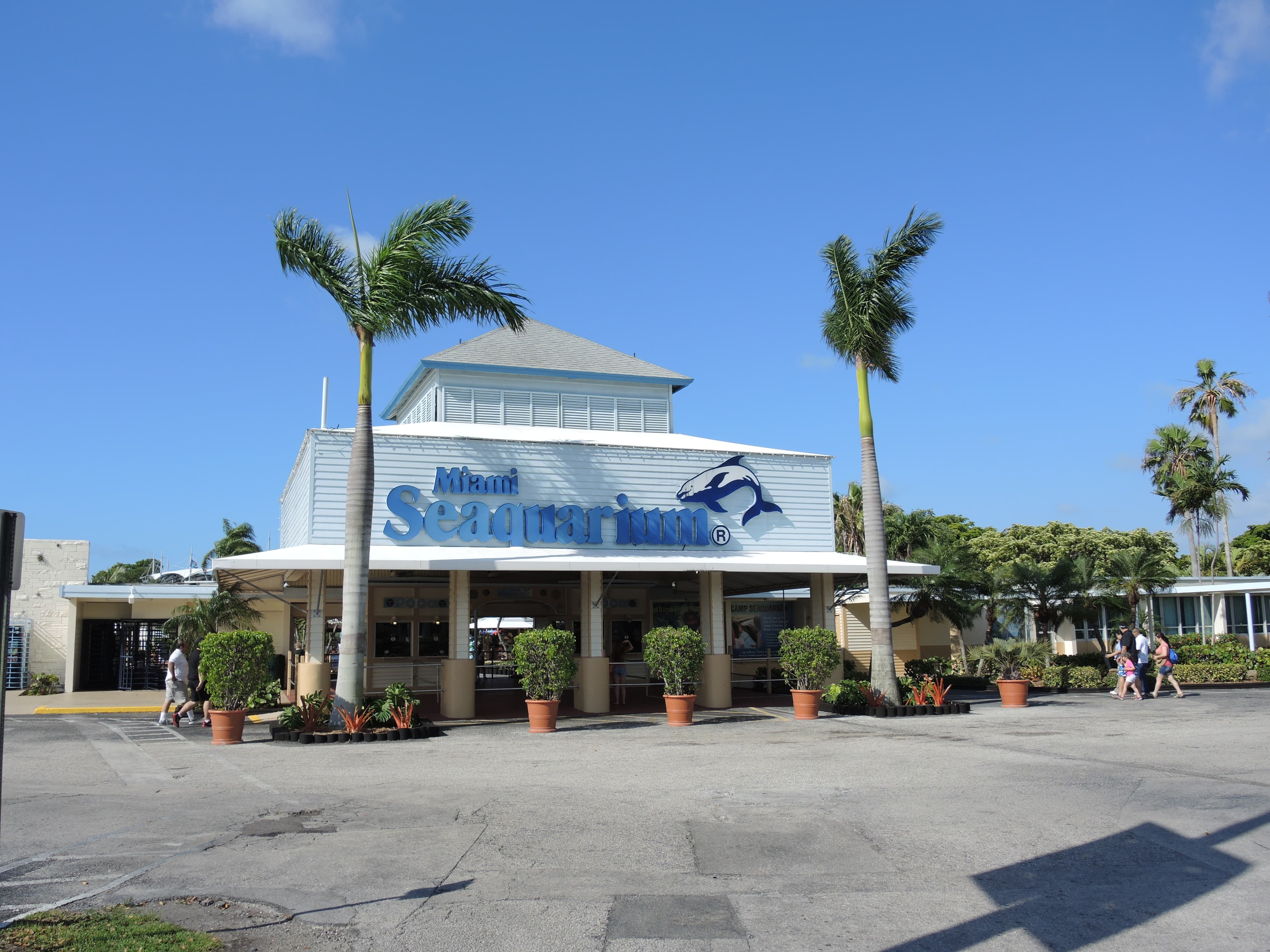
The Miami Seaquarium sat on Virginia Key, the barrier island in Biscayne Bay between downtown Miami and Key Biscayne, at 4400 Rickenbacker Causeway — the road that carries causeway traffic out of the city and across the bay. It was not a downtown attraction you stumbled upon; it was a destination you drove to, past the downtown skyline shrinking behind you and the open water of the bay on both sides, and that journey was part of the experience. The park occupied 38 acres of county-owned land, leased from Miami-Dade County, with the bay on one side and the causeway on the other.
It opened on September 24, 1955, founded by Fred D. Coppock and Captain W.B. Gray, and it was the second marine-life attraction in Florida. When it opened, it was billed as the largest marine-life attraction in the world, and it became one of the oldest continuously operating oceanariums in the United States. At its peak it drew more than 500,000 visitors a year, employed around 225 people, and its lease payments and taxes made it the third-largest single contributor to Miami-Dade County's revenue. For generations of South Florida families, it was simply where you went: school trips, birthday parties, and summer afternoons spent watching dolphins leap against a backdrop of Biscayne Bay.
The park that opened in 1955 had just three major exhibit elements: the Top Deck Dolphin pool, the Reef Tank facility, and the Shark Channel. Over the decades it grew into a full marine park of shows and exhibits — dolphins, sea lions, manatees, sharks, sea turtles, tropical reef fish, penguins, and birds — arranged across lushly landscaped grounds with the downtown Miami skyline visible across the water. Its shows became the park's signature: the Top Deck Dolphin Show, the Flipper Dolphin Show, the Golden Dome Sea Lion Show, and, for decades, the Killer Whale and Dolphin Show.
Flipper's lagoon
The Seaquarium's first claim on American popular culture came in the 1960s, when it became the filming home of Flipper. From 1963 through 1967, eighty-eight episodes of the television series Flipper — the story of a bottlenose dolphin and the family who looked after him — were filmed at the Miami Seaquarium, along with two feature films starring Flipper. Five dolphins were trained to play the role over the years, and the park's lagoon became one of the most recognizable bodies of water on American television.
Flipper mattered beyond ratings. The show, filmed in the bright light of Biscayne Bay, fixed an image of Miami in the national imagination: palm trees, turquoise water, and a dolphin leaping in slow motion. It made the Seaquarium a pilgrimage site for children who had grown up watching the show, and it made the park's dolphins — Flipper above all — into celebrities. The Flipper Dolphin Show, performed in the lagoon that served as the show's set, remained one of the park's most popular attractions for the rest of its life. If you ask a Miamian of a certain age about the Seaquarium, the first word out of their mouth is usually Flipper.
The park had another early distinction that has largely been forgotten: from 1963 to 1991 it operated the Miami Seaquarium Spacerail, the first hanging monorail in the United States, carrying visitors above the grounds on a suspended rail. It was a piece of mid-century optimism — the future, gliding over a marine park — and it fit the park's self-image as a modern, forward-looking attraction.
The Golden Dome
The Seaquarium's most recognizable structure was the Golden Dome, completed in 1960 and designed by the architect Buckminster Fuller. The geodesic dome sheltered the sea lion stadium, and its golden curve became visible from the Rickenbacker Causeway, a landmark for drivers heading to Key Biscayne. Inside, the Golden Dome Sea Lion Show — starring, in later years, Salty the Sea Lion and his Reef Rangers — mixed comedy, athleticism, and a conservation message about litter and the reef.
The dome mattered architecturally as well as theatrically. Fuller, the inventor of the geodesic dome, was one of the twentieth century's most famous designers, and the Seaquarium's dome was an early, working example of his ideas in a public entertainment building. It is the structure the park's redevelopers have promised to preserve: under the Terra Group plan announced in September 2025, the Golden Dome would be converted into an event venue rather than demolished. For now, it stands as the park's most visible surviving signature — the golden curve over the causeway, even with the gates closed.
Lolita, the orca in the Whale Bowl
No story about the Seaquarium is complete without Lolita, and no story about Lolita is simple. She was a female southern resident orca, captured on August 8, 1970, during the Penn Cove capture in Puget Sound, Washington, when she was an estimated three to six years old. She arrived at the Miami Seaquarium on September 24, 1970, and joined the park's first orca, Hugo, who had been captured in Vaughn Bay in February 1968. Hugo died on March 4, 1980, of a brain aneurysm after a history of repeatedly injuring himself against the walls of the tank. After Hugo's death, Lolita lived without another orca for company for more than forty years.
Lolita — also known by her original name, Tokitae, or Toki, and by the Lummi Nation of Washington State as Sk'aliCh'elh-tenaut — performed in the park's Whale Bowl, also called the Killer Whale and Dolphin Stadium, for decades. She was, at the time of her death, the second-oldest orca in captivity after Corky at SeaWorld San Diego. Activists argued for years that her tank, roughly 80 feet across, did not meet federal minimum size requirements under the Animal Welfare Act, and in 2017 the U.S. Department of Agriculture made statements supporting that argument. The Lummi Nation, who regard her as a relative — "our relative under the water" — gathered at the Seaquarium repeatedly to ask that she be returned to the Salish Sea.
In March 2022, after The Dolphin Company acquired the park, Lolita was taken off display and her performances ended under the terms of the new USDA license. On March 30, 2023, the Seaquarium announced a plan to return her to her natal waters in a semi-wild sea pen in the Salish Sea, alongside her companion Pacific white-sided dolphins. She died on August 18, 2023, of what was believed to be a renal condition, before the move could happen. She had spent 53 of her roughly 57 years at the Seaquarium. Her companions were relocated in the months that followed: her Pacific white-sided dolphin companions went to Shedd Aquarium in Chicago and SeaWorld San Antonio.
This is the part of the Seaquarium's story that divides people, and a fair account should say so plainly. To its defenders, the park was a beloved family institution that educated millions of children about marine life and ran rescue and rehabilitation programs for manatees and sea turtles. To its critics, it was a symbol of an older model of animal entertainment that the public had outgrown, and Lolita's half-century in a small tank was its central indictment. Both views are part of the record, and both explain why the park's final years were fought over as fiercely as they were.
The final years
The Seaquarium's last decade was a long decline, documented in federal inspection reports and county proceedings. A 2023 USDA inspection report found several violations of the Animal Welfare Act, citing inadequate veterinary care, animal handling, facilities, staffing, and separation of animals. The park lost its accreditation from American Humane, a violation of its lease terms, and fell behind on rent. In March 2024, Miami-Dade County sent a lease termination notice to The Dolphin Company, citing what Mayor Daniella Levine Cava called a "long and troubling history of violations," and ordered the company to vacate by April 21. The company fought the eviction in court.
On March 31, 2025, The Dolphin Company filed for Chapter 11 bankruptcy protection. In September 2025, a 26-year-old dolphin named Bimini died of what the company described as chronic illness. Then, on September 26, 2025, Miami-Dade County and The Dolphin Company announced an agreement leasing the site to the South Florida development firm Terra Group, which outlined plans to close the facility permanently in favor of a marina and a new aquarium without marine mammals, with modern zoological accreditation. The park closed its doors over the weekend of October 11, 2025 — its final day of operation was October 12, 2025, seventy years and eighteen days after it opened.
What happens to the site now
The Seaquarium's site is not standing empty by accident; it is the subject of an active redevelopment plan. Terra Group, led by CEO David Martin, took over the lease through its affiliate Resilient Aquarium LLC, approved by a bankruptcy judge. The announced plans center on a new aquarium with no marine mammals, alongside a marina, shops, restaurants, and a public baywalk, with the Golden Dome preserved as an event venue. Reported figures have put the investment at $75 million to $100 million, with a possible opening around 2030, but those plans still require county approvals and are not yet built — check Miami-Dade County announcements and local news before planning any trip around a reopening.
The remaining animals were relocated after the closure under the supervision of the bankruptcy trustee and county authorities; a federal inspection in the summer of 2025 counted roughly 90 animals on site, including at least 17 dolphins, 10 sea lions, nine penguins, and eight seals. Their destinations were not all publicly named at the time of closure.
Visiting Virginia Key today
Here is the honest visitor guidance: the Miami Seaquarium itself is closed, and you cannot tour it. Do not plan a trip expecting to walk through the gates. What you can still do is visit Virginia Key itself, which remains one of Miami's most rewarding half-days, and see the Seaquarium's setting — the causeway, the bay, the skyline view — from the outside.
Virginia Key Beach Park, at the island's northern end, is a historic public beach with picnic areas, trails, and views back toward downtown. The Miami Marine Stadium, the great concrete grandstand on the island's western shore, is visible from the causeway and from the water — a landmark of 1960s Miami modernism, long closed to events but still striking from the outside. The island also holds the University of Miami's Rosenstiel School campus and the entrance to Key Biscayne beyond it: Crandon Park and its marine education center, and Bill Baggs Cape Florida State Park with its lighthouse at the island's southern tip.
For the marine-life experience the Seaquarium once provided, the closest in-Miami alternative is the Phillip and Patricia Frost Museum of Science in downtown Museum Park, whose three-level aquarium includes sharks, rays, and a 500,000-gallon Gulf Stream tank. Wild dolphins, meanwhile, are commonly seen in Biscayne Bay itself — dolphin-watching tours run from Bayside Marketplace and Miami Beach marinas — and sea turtle rescue work continues at centers in the Florida Keys, including The Turtle Hospital in Marathon.
The Seaquarium closed, but its place in Miami's story has not. It was there at the beginning of modern Miami tourism — 1955, the same decade the city began selling itself to the world — and it was still there, on the causeway, when the city changed its mind about what a marine park should be. Drive out the Rickenbacker on a clear morning, look across the bay at the skyline, and you are looking at the view the Seaquarium sold for seventy years. The park is gone. The island, the bay, and the view are still there.
Historic photographs of the Miami Seaquarium


Key Facts
- The Miami Seaquarium was a 38-acre oceanarium at 4400 Rickenbacker Causeway, on Virginia Key in Biscayne Bay, Miami-Dade County, Florida, near downtown Miami.
- It opened on September 24, 1955, founded by Fred D. Coppock and Captain W.B. Gray; it was the second marine-life attraction in Florida and, when it opened, was billed as the largest marine-life attraction in the world.
- At its peak it drew more than 500,000 visitors a year, employed around 225 people, and its lease payments and taxes made it the third-largest single contributor to Miami-Dade County's revenue.
- From 1963 through 1967, eighty-eight episodes of the television series Flipper and two Flipper films were filmed at the Seaquarium; the Flipper Dolphin Show remained a signature attraction for the rest of the park's life.
- From 1963 to 1991 the park operated the Miami Seaquarium Spacerail, the first hanging monorail in the United States.
- The Golden Dome, completed in 1960 and designed by Buckminster Fuller, sheltered the sea lion stadium and became a landmark visible from the Rickenbacker Causeway; redevelopment plans preserve it as an event venue.
- The park's first orca was Hugo, captured in February 1968 in Vaughn Bay; he died on March 4, 1980, of a brain aneurysm after repeatedly injuring himself against the tank walls.
- Lolita (also Tokitae, or Toki; called Sk'aliCh'elh-tenaut by the Lummi Nation) was captured August 8, 1970, in the Penn Cove capture in Puget Sound and arrived at the Seaquarium on September 24, 1970; she lived without another orca for company after Hugo's death in 1980, was taken off display in 2022, and died August 18, 2023, of a believed renal condition, before a planned move to a Salish Sea sea pen could happen.
- A 2023 USDA inspection report found several Animal Welfare Act violations; the park lost its American Humane accreditation; in March 2024 Miami-Dade County sent a lease termination notice citing a "long and troubling history of violations"; The Dolphin Company filed for Chapter 11 bankruptcy on March 31, 2025.
- The park closed permanently on October 12, 2025, after 70 years of operation; on September 26, 2025, Miami-Dade County and The Dolphin Company announced an agreement leasing the site to Terra Group (Resilient Aquarium LLC) for redevelopment as a marina and a new aquarium without marine mammals, with the Golden Dome preserved.
- In addition to marine mammals, the park housed fish, sharks, sea turtles, birds, and reptiles, and ran rescue and rehabilitation programs for manatees and sea turtles.
Visitor Details
Address: Miami Seaquarium (closed), 4400 Rickenbacker Causeway, Miami, FL 33149, on Virginia Key.
Status: CLOSED — the park closed permanently on October 12, 2025, and is not open to visitors. No ticket price, fee, or hours are stated in this article, since the park is closed and no current admission information exists to verify.
Getting there: From downtown Miami, take the Rickenbacker Causeway (SR 913) east toward Key Biscayne; the former Seaquarium site is on Virginia Key, just past the toll plaza on the right. Miami-Dade Transit bus route 102 (the Brickell–Key Biscayne route) historically served the site; check current Miami-Dade Transit schedules before relying on it.
What to do instead: Virginia Key Beach Park (historic public beach, picnic areas, trails) and the exterior of Miami Marine Stadium are on the same island; continue over the Bear Cut Bridge to Key Biscayne for Crandon Park and Bill Baggs Cape Florida State Park. For a marine-life experience, the Phillip and Patricia Frost Museum of Science aquarium in downtown Museum Park is the closest in-Miami alternative; wild dolphin-watching tours run from Bayside Marketplace and Miami Beach marinas.
Best timing: Virginia Key is best visited in the morning, before the causeway traffic builds, and the island's bay-facing viewpoints are best at sunrise or late afternoon. Check Miami-Dade County announcements and local news for any updates on the Seaquarium site's redevelopment before planning a trip around it.